
ICCK

Hashim Hashim

Department of mathematics and statistics, university of Haripur, Haripur, Pakistan

Section 01

Academic Profile

No academic profile information available at the moment.

Section 02

Editorial Roles

This user currently does not serve as an editor for any ICCK journals.

Section 03

ICCK Publications

Open Access | Research Article | 28 March 2026 | Cited: Crossref logo  3 , Scopus 1
Heat Transportation During Slip Flow of Non-Newtonian Rheology with Thermal Stratification past a Stretched Surface
International Journal of Thermo-Fluid Systems and Sustainable Energy | Volume 2, Issue 1: 18-29, 2026 | DOI: 10.62762/IJTSSE.2025.505390
Abstract
This study investigates heat transportation in slip flow of a non-Newtonian fluid with thermal stratification over a stretched surface, a configuration that closely represents many industrial and engineering processes. The inclusion of slip effects and non-Newtonian rheology provides a more realistic description of flows encountered in polymer extrusion, coating technologies, micro- and nano-scale devices, and biomedical systems. Thermal stratification is incorporated to model non-uniform temperature environments commonly observed in heat exchangers, cooling of electronic components, and energy systems. The governing partial differential equations for momentum, energy, and nanoparticle conce... More >

Graphical Abstract
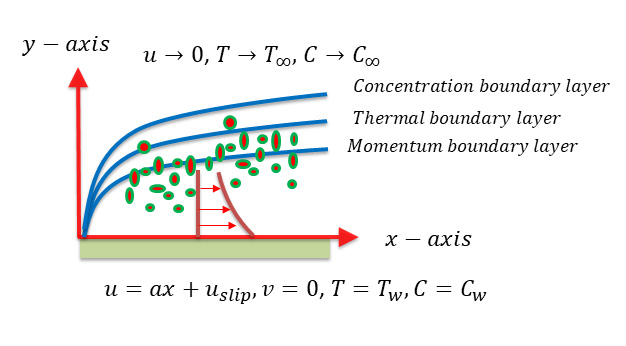
Heat Transportation During Slip Flow of Non-Newtonian Rheology with Thermal Stratification past a Stretched Surface
Open Access | Research Article | 25 November 2025
Multiple Slip Mechanism for Converging/Diverging Flow of Second Grade Nanofluids with Thermal Performance
International Journal of Thermo-Fluid Systems and Sustainable Energy | Volume 1, Issue 2: 64-74, 2025 | DOI: 10.62762/IJTSSE.2025.412468
Abstract
This study presents a comprehensive numerical investigation of the flow and heat transfer characteristics of a second-grade nanofluid in a converging/diverging channel, incorporating the significant effects of multiple slip mechanisms. The analysis considers velocity, thermal, and solutal slip conditions at the channel walls, providing a more realistic model of nanofluid behavior in micro-environments or with specific surface interactions. The governing equations, derived from the principles of conservation of mass, momentum, and energy, are formulated using a non-Newtonian second-grade fluid model to account for viscoelastic effects, combined with the Buongiorno model to capture the Brownia... More >

Graphical Abstract
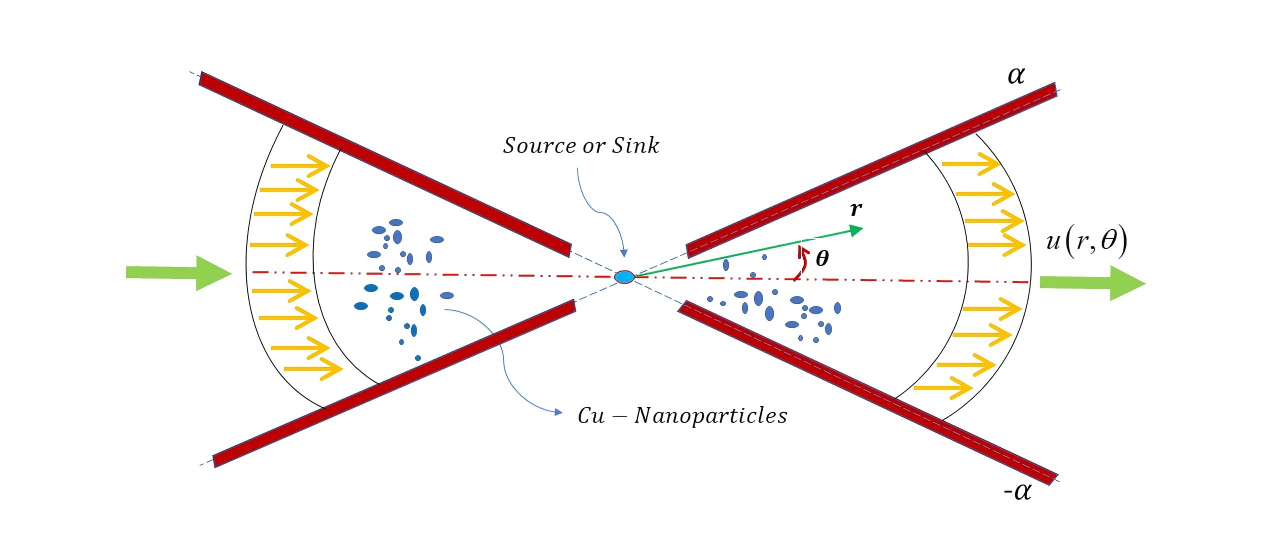
Multiple Slip Mechanism for Converging/Diverging Flow of Second Grade Nanofluids with Thermal Performance