
Volume 1, Issue 2, International Journal of Thermo-Fluid Systems and Sustainable Energy
Volume 1, Issue 2, 2025
Submit Manuscript Edit a Special Issue
Article QR Code
Article QR Code
Scan the QR code for reading
Popular articles
International Journal of Thermo-Fluid Systems and Sustainable Energy, Volume 1, Issue 2, 2025: 64-74

Open Access | Research Article | 25 November 2025
Multiple Slip Mechanism for Converging/Diverging Flow of Second Grade Nanofluids with Thermal Performance
1 Department of Mathematics and Statistics, University of Haripur, Haripur 22620, Pakistan
* Corresponding Author: Hashim, [email protected]
ARK: ark:/57805/ijtsse.2025.412468
Received: 01 September 2025, Accepted: 02 October 2025, Published: 25 November 2025  
Abstract
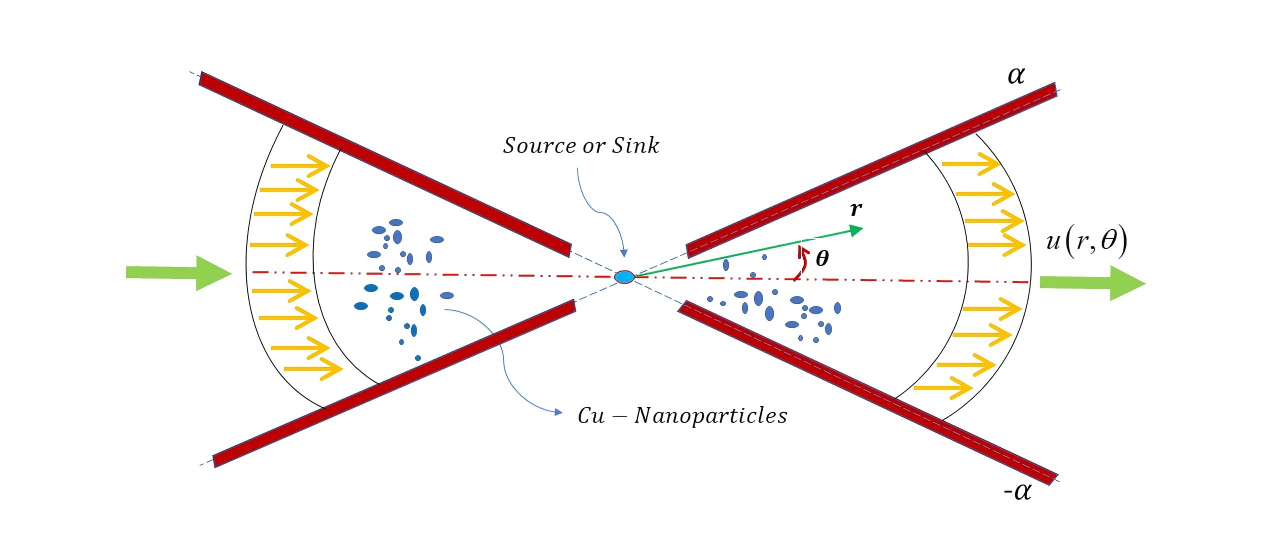
This study presents a comprehensive numerical investigation of the flow and heat transfer characteristics of a second-grade nanofluid in a converging/diverging channel, incorporating the significant effects of multiple slip mechanisms. The analysis considers velocity, thermal, and solutal slip conditions at the channel walls, providing a more realistic model of nanofluid behavior in micro-environments or with specific surface interactions. The governing equations, derived from the principles of conservation of mass, momentum, and energy, are formulated using a non-Newtonian second-grade fluid model to account for viscoelastic effects, combined with the Buongiorno model to capture the Brownian motion and thermophoresis mechanisms of nanoparticles. The resulting system of highly non-linear, coupled partial differential equations is transformed into a set of ordinary differential equations using a similarity transformation approach. The ensuing boundary value problem is solved computationally using the robust MATLAB bvp4c solver. The results are meticulously analyzed to elucidate the intertwined influence of the second-grade fluid parameter (viscoelasticity), the nanoparticle volume fraction, the slip parameters, and the channel geometry (converging/diverging angle) on the velocity profile, temperature distribution, and thermal performance. Key findings indicate that velocity slip and thermal slip parameters substantially reduce skin friction and enhance the local Nusselt number, respectively, thereby critically optimizing the thermal performance of the system. Furthermore, the converging channel geometry is shown to synergize with the viscoelastic nature of the second-grade fluid to significantly augment heat transfer rates compared to the diverging case.

Graphical Abstract
Multiple Slip Mechanism for Converging/Diverging Flow of Second Grade Nanofluids with Thermal Performance

Keywords
second grade nanofluid
converging/diverging channel
multiple slip
heat transfer enhancement
viscoelastic fluid
numerical solution

Data Availability Statement
Data will be made available on request.

Funding
This work was supported without any funding.

Conflicts of Interest
The authors declare no conflicts of interest.

Ethical Approval and Consent to Participate
Not applicable.

References
  1. Choi, S. U. (1995, November). Enhancing thermal conductivity of fluids with nanoparticles. In ASME international mechanical engineering congress and exposition (Vol. 17421, pp. 99-105). American Society of Mechanical Engineers.
    [CrossRef]   [Google Scholar]
  2. Buongiorno, J. (2006). Convective transport in nanofluids. ASME Journal of Heat Transfer, 128(3), 240–250.
    [CrossRef]   [Google Scholar]
  3. Khan, W. A., & Pop, I. (2010). Boundary-layer flow of a nanofluid past a stretching sheet. International Journal of Heat and Mass Transfer, 53(11–12), 2477–2483.
    [CrossRef]   [Google Scholar]
  4. Makinde, O. D., & Aziz, A. (2011). Boundary layer flow of a nanofluid past a stretching sheet with a convective boundary condition. International Journal of Thermal Sciences, 50(7), 1326–1332.
    [CrossRef]   [Google Scholar]
  5. Rahman, M. M., Roşca, A. V., & Pop, I. (2014). Boundary layer flow of a nanofluid past a permeable exponentially shrinking/stretching surface with second order slip using Buongiorno's model. International Journal of Heat and Mass Transfer, 77, 1133–1143.
    [CrossRef]   [Google Scholar]
  6. Hashim, & Khan, M. (2016). A revised model to analyze the heat and mass transfer mechanisms in the flow of Carreau nanofluids. International Journal of Heat and Mass Transfer, 103, 291-297.
    [CrossRef]   [Google Scholar]
  7. Dogonchi, A. S., & Ganji, D. D. (2017). Analytical solution and heat transfer of two-phase nanofluid flow between non-parallel walls considering Joule heating effect. Powder Technology, 318, 390–400.
    [CrossRef]   [Google Scholar]
  8. Turkyilmazoglu, M. (2018). Buongiorno model in a nanofluid filled asymmetric channel fulfilling zero net particle flux at the walls. International Journal of Heat and Mass Transfer, 126, 974–979.
    [CrossRef]   [Google Scholar]
  9. Hayat, T., Muhammad, K., Khan, M. I., & Alsaedi, A. (2019). Theoretical investigation of chemically reactive flow of water-based carbon nanotubes (single-walled and multiple walled) with melting heat transfer. Pramana, 92(4), 57.
    [CrossRef]   [Google Scholar]
  10. Hashim, Hafeez, M., & Chu, Y. M. (2021). Numerical simulation for heat and mass transport analysis for magnetic-nanofluids flow through stretchable convergent/divergent channels. International Journal of Modern Physics B, 35(19), 2150198.
    [CrossRef]   [Google Scholar]
  11. O'Neill, M. E., Ranger, K. B., & Brenner, H. (1986). Slip at the surface of a translating-rotating sphere bisected by a free surface bounding a semi-infinite viscous fluid: Removal of the contact-line singularity. Physics of Fluids, 29(4), 913–924.
    [CrossRef]   [Google Scholar]
  12. Nadeem, S., Hayat, T., Abbasbandy, S., & Ali, M. (2010). Effects of partial slip on a fourth-grade fluid with variable viscosity: An analytic solution. Nonlinear Analysis: Real World Applications, 11(2), 856–868.
    [CrossRef]   [Google Scholar]
  13. Ashmawy, E. A. (2012). Unsteady Couette flow of a micropolar fluid with slip. Meccanica, 47(1), 85–94.
    [CrossRef]   [Google Scholar]
  14. Devakar, M., Sreenivasu, D., & Shankar, B. (2014). Analytical solutions of couple stress fluid flows with slip boundary conditions. Alexandria Engineering Journal, 53(3), 723–730.
    [CrossRef]   [Google Scholar]
  15. Hayat, T., Shafique, M., Tanveer, A., & Alsaedi, A. (2016). Magnetohydrodynamic effects on peristaltic flow of hyperbolic tangent nanofluid with slip conditions and Joule heating in an inclined channel. International Journal of Heat and Mass Transfer, 102, 54–63.
    [CrossRef]   [Google Scholar]
  16. Khan, M., Hashim, & Hafeez, A. (2017). A review on slip-flow and heat transfer performance of nanofluids from a permeable shrinking surface with thermal radiation: Dual solutions. Chemical Engineering Science, 173, 1–11.
    [CrossRef]   [Google Scholar]
  17. Xu, H., & Cui, J. (2018). Mixed convection flow in a channel with slip in a porous medium saturated with a nanofluid containing both nanoparticles and microorganisms. International Journal of Heat and Mass Transfer, 128, 1043–1053.
    [CrossRef]   [Google Scholar]
  18. Turkyilmazoglu, M. (2019). Fully developed slip flow in a concentric annuli via single and dual phase nanofluids models. Computer Methods and Programs in Biomedicine, 179, 104997.
    [CrossRef]   [Google Scholar]
  19. Bilal, M. (2020). Micropolar flow of EMHD nanofluid with nonlinear thermal radiation and slip effects. Alexandria Engineering Journal, 59(2), 965–976.
    [CrossRef]   [Google Scholar]
  20. Bég, O. A., Bég, T., Khan, W. A., & Uddin, M. J. (2021). Multiple slip effects on nanofluid dissipative flow in a converging/diverging channel: A numerical study. Heat Transfer, 51(1), 1040–1061.
    [CrossRef]   [Google Scholar]
  21. Motsa, S. S., Sibanda, P., Awad, F. G., & Shateyi, S. (2010). A new spectral-homotopy analysis method for the MHD Jeffery–Hamel problem. Computers & Fluids, 39(7), 1219–1225.
    [CrossRef]   [Google Scholar]
  22. Hayat, T., Nawaz, M., & Sajid, M. (2010). Effect of heat transfer on the flow of a second-grade fluid in divergent/convergent channel. International Journal for Numerical Methods for Fluids, 64(7), 761–776.
    [CrossRef]   [Google Scholar]

Cite This Article
APA Style
Hashim, & Iftikhar, A. L. (2025). Multiple Slip Mechanism for Converging/Diverging Flow of Second Grade Nanofluids with Thermal Performance. International Journal of Thermo-Fluid Systems and Sustainable Energy, 1(2), 64–74. https://doi.org/10.62762/IJTSSE.2025.412468
Export Citation
RIS Format
Compatible with EndNote, Zotero, Mendeley, and other reference managers
RIS format data for reference managers
TY  - JOUR
AU  - Hashim
AU  - Iftikhar, Akhunzadi Laiba
PY  - 2025
DA  - 2025/11/25
TI  - Multiple Slip Mechanism for Converging/Diverging Flow of Second Grade Nanofluids with Thermal Performance
JO  - International Journal of Thermo-Fluid Systems and Sustainable Energy
T2  - International Journal of Thermo-Fluid Systems and Sustainable Energy
JF  - International Journal of Thermo-Fluid Systems and Sustainable Energy
VL  - 1
IS  - 2
SP  - 64
EP  - 74
DO  - 10.62762/IJTSSE.2025.412468
UR  - https://www.icck.org/article/abs/IJTSSE.2025.412468
KW  - second grade nanofluid
KW  - converging/diverging channel
KW  - multiple slip
KW  - heat transfer enhancement
KW  - viscoelastic fluid
KW  - numerical solution
AB  - This study presents a comprehensive numerical investigation of the flow and heat transfer characteristics of a second-grade nanofluid in a converging/diverging channel, incorporating the significant effects of multiple slip mechanisms. The analysis considers velocity, thermal, and solutal slip conditions at the channel walls, providing a more realistic model of nanofluid behavior in micro-environments or with specific surface interactions. The governing equations, derived from the principles of conservation of mass, momentum, and energy, are formulated using a non-Newtonian second-grade fluid model to account for viscoelastic effects, combined with the Buongiorno model to capture the Brownian motion and thermophoresis mechanisms of nanoparticles. The resulting system of highly non-linear, coupled partial differential equations is transformed into a set of ordinary differential equations using a similarity transformation approach. The ensuing boundary value problem is solved computationally using the robust MATLAB bvp4c solver. The results are meticulously analyzed to elucidate the intertwined influence of the second-grade fluid parameter (viscoelasticity), the nanoparticle volume fraction, the slip parameters, and the channel geometry (converging/diverging angle) on the velocity profile, temperature distribution, and thermal performance. Key findings indicate that velocity slip and thermal slip parameters substantially reduce skin friction and enhance the local Nusselt number, respectively, thereby critically optimizing the thermal performance of the system. Furthermore, the converging channel geometry is shown to synergize with the viscoelastic nature of the second-grade fluid to significantly augment heat transfer rates compared to the diverging case.
SN  - 3069-1877
PB  - Institute of Central Computation and Knowledge
LA  - English
ER  - 
BibTeX Format
Compatible with LaTeX, BibTeX, and other reference managers
BibTeX format data for LaTeX and reference managers
@article{Hashim2025Multiple,
  author = {Hashim and Akhunzadi Laiba Iftikhar},
  title = {Multiple Slip Mechanism for Converging/Diverging Flow of Second Grade Nanofluids with Thermal Performance},
  journal = {International Journal of Thermo-Fluid Systems and Sustainable Energy},
  year = {2025},
  volume = {1},
  number = {2},
  pages = {64-74},
  doi = {10.62762/IJTSSE.2025.412468},
  url = {https://www.icck.org/article/abs/IJTSSE.2025.412468},
  abstract = {This study presents a comprehensive numerical investigation of the flow and heat transfer characteristics of a second-grade nanofluid in a converging/diverging channel, incorporating the significant effects of multiple slip mechanisms. The analysis considers velocity, thermal, and solutal slip conditions at the channel walls, providing a more realistic model of nanofluid behavior in micro-environments or with specific surface interactions. The governing equations, derived from the principles of conservation of mass, momentum, and energy, are formulated using a non-Newtonian second-grade fluid model to account for viscoelastic effects, combined with the Buongiorno model to capture the Brownian motion and thermophoresis mechanisms of nanoparticles. The resulting system of highly non-linear, coupled partial differential equations is transformed into a set of ordinary differential equations using a similarity transformation approach. The ensuing boundary value problem is solved computationally using the robust MATLAB bvp4c solver. The results are meticulously analyzed to elucidate the intertwined influence of the second-grade fluid parameter (viscoelasticity), the nanoparticle volume fraction, the slip parameters, and the channel geometry (converging/diverging angle) on the velocity profile, temperature distribution, and thermal performance. Key findings indicate that velocity slip and thermal slip parameters substantially reduce skin friction and enhance the local Nusselt number, respectively, thereby critically optimizing the thermal performance of the system. Furthermore, the converging channel geometry is shown to synergize with the viscoelastic nature of the second-grade fluid to significantly augment heat transfer rates compared to the diverging case.},
  keywords = {second grade nanofluid, converging/diverging channel, multiple slip, heat transfer enhancement, viscoelastic fluid, numerical solution},
  issn = {3069-1877},
  publisher = {Institute of Central Computation and Knowledge}
}

Article Metrics
Citations:

Crossref

0

Scopus

0

Web of Science

0
Article Access Statistics:
Views: 227
PDF Downloads: 103

Publisher's Note
ICCK stays neutral with regard to jurisdictional claims in published maps and institutional affiliations.

Rights and Permissions
CC BY Copyright © 2025 by the Author(s). Published by Institute of Central Computation and Knowledge. This article is an open access article distributed under the terms and conditions of the Creative Commons Attribution (CC BY) license (https://creativecommons.org/licenses/by/4.0/), which permits use, sharing, adaptation, distribution and reproduction in any medium or format, as long as you give appropriate credit to the original author(s) and the source, provide a link to the Creative Commons licence, and indicate if changes were made.
International Journal of Thermo-Fluid Systems and Sustainable Energy

International Journal of Thermo-Fluid Systems and Sustainable Energy

ISSN: 3069-1877 (Online)

Email: [email protected]

Portico

Portico

All published articles are preserved here permanently:
https://www.portico.org/publishers/icck/