
ICCK

Yanyou Wu

Research Center for Environmental Bio-Science and Technology, Institute of Geochemistry, Chinese Academy of Sciences, China/College of Agricultural Engineering, Jiangsu University,China

Section 01

Academic Profile

Yanyou Wu holds a Ph.D. in Botany, an M.S. in Plant Physiology and Biochemistry, and a B.S. in Biology. His research focuses on plant biophysics, electrobiology, and environmental adaptation. He has dedicated himself to explaining the fertility of certain intergeneric hybrids through "cell fusion - chromosome set segregation" and the extended genetic laws in his early years. He proposed a new mechanism of photosynthetic oxygen release: half of the oxygen originates from the photolysis of bicarbonate, and the other half from the photolysis of water. The release of oxygen through electrochemical energy is fundamental. He has also innovated plant electrobiological information detection technology and invented a plant life information instrument. Additionally, he created a technical method for characterizing physical information of life (including humans) based on the energy storage and conversion of cellular electrical components. He serves as the Editor-in-Chief of the Journal of Plant Electrobiology. (Email: [email protected])

Section 02

Editorial Roles

This user currently does not serve as an editor for any ICCK journals.

Section 03

ICCK Publications

Free Access | Perspective | 13 May 2026
Rethinking Photosynthesis: Intracellular Water Dynamics, Bicarbonate Photolysis, and Electrophysiological Coupling in Inorganic Carbon Assimilation
Journal of Plant Electrobiology | Volume 1, Issue 2: 82-93, 2026 | DOI: 10.62762/JPE.2026.900219
Abstract
Photosynthesis is the fundamental biochemical process driving Earth's biogeochemical cycles. The traditional theory holds that water is the sole source of photosynthetic oxygen and atmospheric CO$_2$ the only inorganic carbon substrate. However, electrophysiological, isotopic, and physiological evidence from our systematic research prompts a re-examination of this paradigm, revealing an unrecognized coupling between plant inorganic carbon assimilation and intracellular water utilization. Our key findings are: (i) Intracellular water utilization rate is decoupled from atmospheric CO$_2$ assimilation, suggesting that terrestrial plants assimilate inorganic carbon from atmospheric CO$_2$, soil... More >

Graphical Abstract
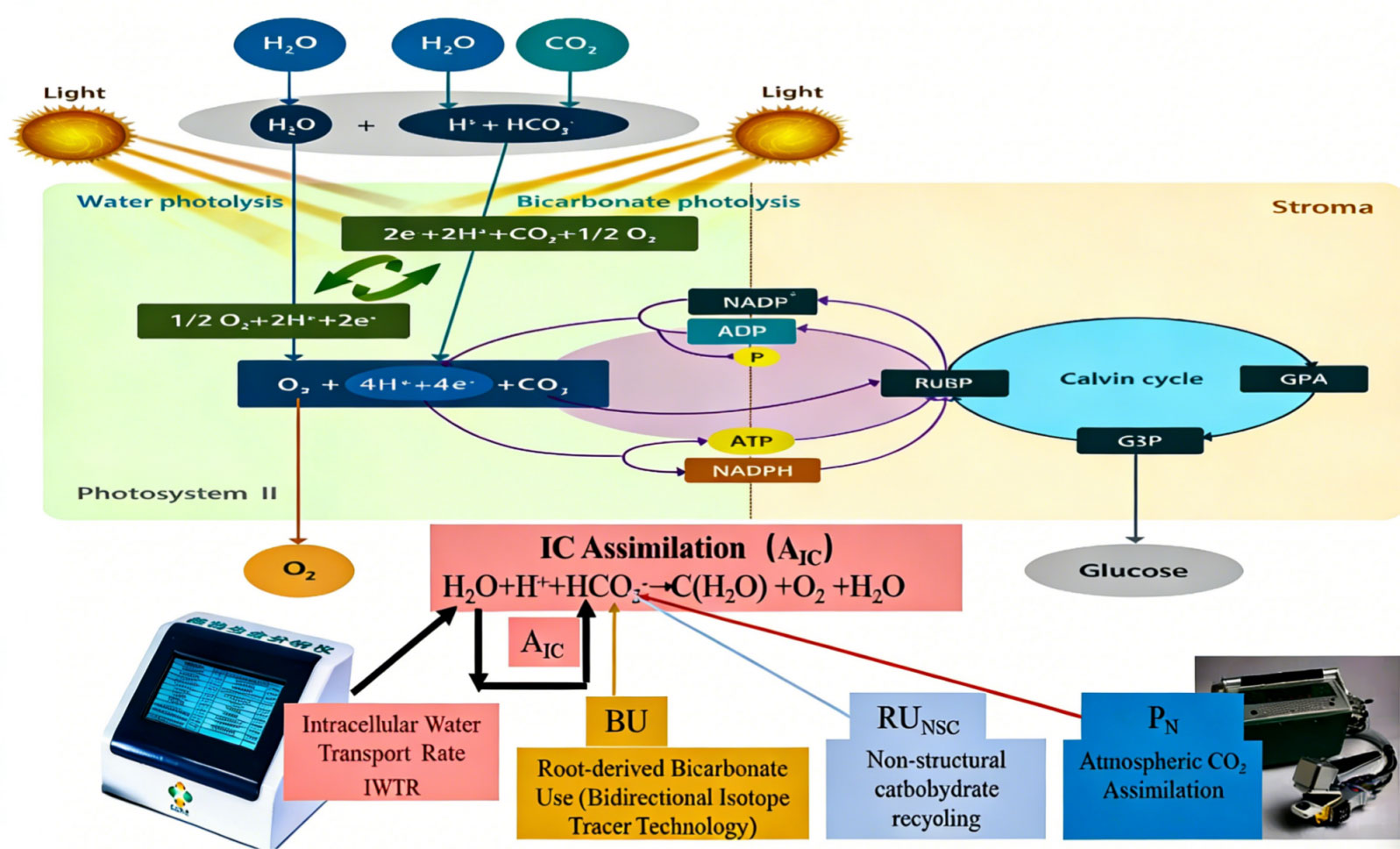
Rethinking Photosynthesis: Intracellular Water Dynamics, Bicarbonate Photolysis, and Electrophysiological Coupling in Inorganic Carbon Assimilation
Free Access | Research Article | 12 February 2026
Salt Adaptation in Aegiceras Corniculatum: Electrophysiology, Gene Expression, and Energy Trade-Offs
Journal of Plant Electrobiology | Volume 1, Issue 1: 7-31, 2026 | DOI: 10.62762/JPE.2025.184208
Abstract
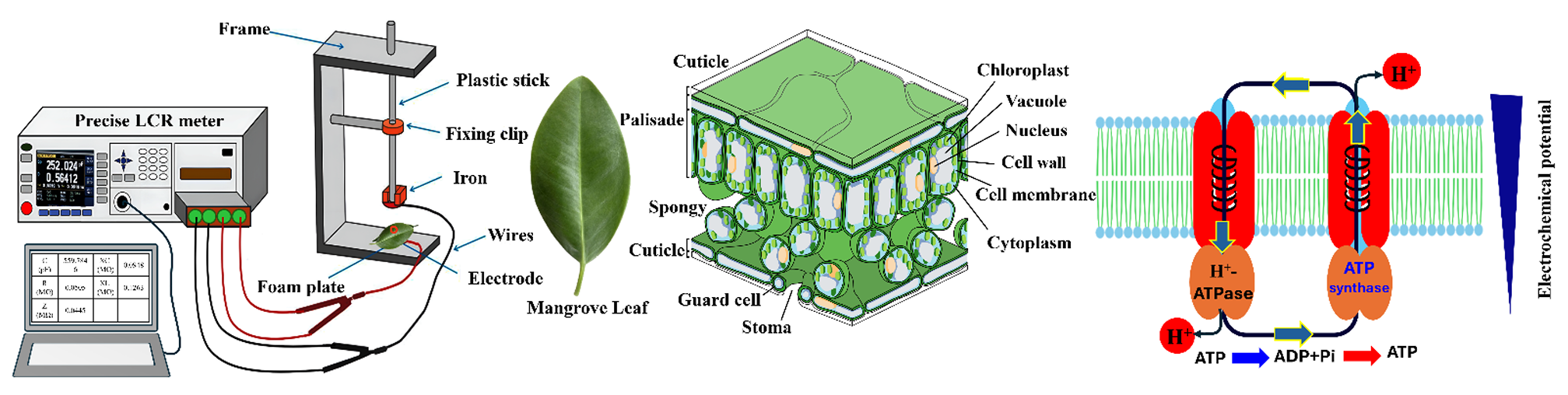
The integration of physical and chemical processes underpins life. Plant cells function as bioelectrical units, storing and converting energy through capacitive, inductive, and resistive properties. This study elucidates the electrophysiological and molecular mechanisms governing salt transport and energy allocation in Aegiceras corniculatum leaves under combined salinity-waterlogging stress (T1: 0.1 M NaCl + 2 h; T2: 0.2 M NaCl + 4 h; T3: 0.4 M NaCl + 6 h). Results demonstrate that leaf intracellular water-salt transport dynamics, coupled with salt-transport gene expression, coordinately regulate active/passive transport, vacuolar compartmentalization, cytoplasmic Na+ levels, and excretion.... More >

Graphical Abstract
Salt Adaptation in Aegiceras Corniculatum: Electrophysiology, Gene Expression, and Energy Trade-Offs
Open Access | Editorial | 21 September 2025 | Cited: Scopus 1
Inaugural Editorial for the Journal of Plant Electrobiology
Journal of Plant Electrobiology | Volume 1, Issue 1: 1-6, 2025 | DOI: 10.62762/JPE.2025.322792
Abstract
This editorial defines the core mission, academic orientation, and six interrelated thematic pillars of Journal of Plant Electrobiology (JPE), which is a peer-reviewed international journal dedicated to advancing the interdisciplinary fusion of electronics, bioenergetics, biophysics, and plant science. JPE aims to showcase innovative researches that leverage electronic principles and technologies to address fundamental and applied questions in plant biology, foster cross-disciplinary collaboration, and accelerate the translation of plant electrobiology breakthroughs into solutions for sustainable agriculture, plant stress resilience, and environmental stewardship. Against the backdrop of rap... More >