

Summary

Andre Leon S. Gradvohl holds a bachelor’s degree in Computer Science from the Federal University of Ceará -- Brazil (1997), a Masters of Science in Electrical Engineering and Computer Science from the Technological Institute of Aeronautics -- Brazil (2000), and a Ph.D. in Electrical and Computer Engineering from the University of Campinas (2005) -- Brazil. He also holds a Specialist degree in Science Journalism from the Advanced Studies in Journalism Laboratory at the University of Campinas (2010). In 2014, he did a Postdoctoral stage at the Laboratoire d’Informatique de l’Université Pierre et Marie Curie in Paris, France. Since 1999, he has taught at undergraduate and graduate levels in Brazilian universities. Dr. Gradvohl was user support analyst at the National Center for High-Performance Computing (2003–2010) and former head of Computer Science and Computer Engineering undergraduate courses at the University São Francisco (2002–2010) and head of the Information Systems and Technology in Systems Analysis and Development undergraduate courses at the School of Technology at the University of Campinas (2013). He was also an ad-hoc consultant in the Brazil Ministry of Education and in São Paulo State Council of Education. Currently, he is a professor at the School of Technology at the University of Campinas. He has research experience in Computer Science, with an emphasis on Astroinformatics; High-Performance Computing, and Solar Flares Forecasting.

Edited Journals

ICCK Contributions


Free Access | Review Article | 13 December 2025
Solar Flare Forecasting: From Data-driven Towards Physics-informed Machine Learning Models
ICCK Transactions on Artificial Intelligence in Space | Volume 1, Issue 1: 3-24, 2025 | DOI: 10.62762/TAIS.2025.793969
Abstract
Solar flares are phenomena characterized by the sudden release of accumulated magnetic energy in active regions of the solar magnetosphere. Such liberation occurs through electromagnetic radiation and high-energy particles. Flares appear as intense glows across a broad spectrum, ranging from radio waves to X- or $\gamma$-rays, and last from a few minutes to a few hours. When electromagnetic radiation reaches Earth, it can damage orbiting technologies, disrupting activities that depend on these technologies. This scoping review examines the scientific approaches to solar flare forecasting, covering methods based on physical principles, data-driven approaches using Machine Learning, and their... More >

Graphical Abstract
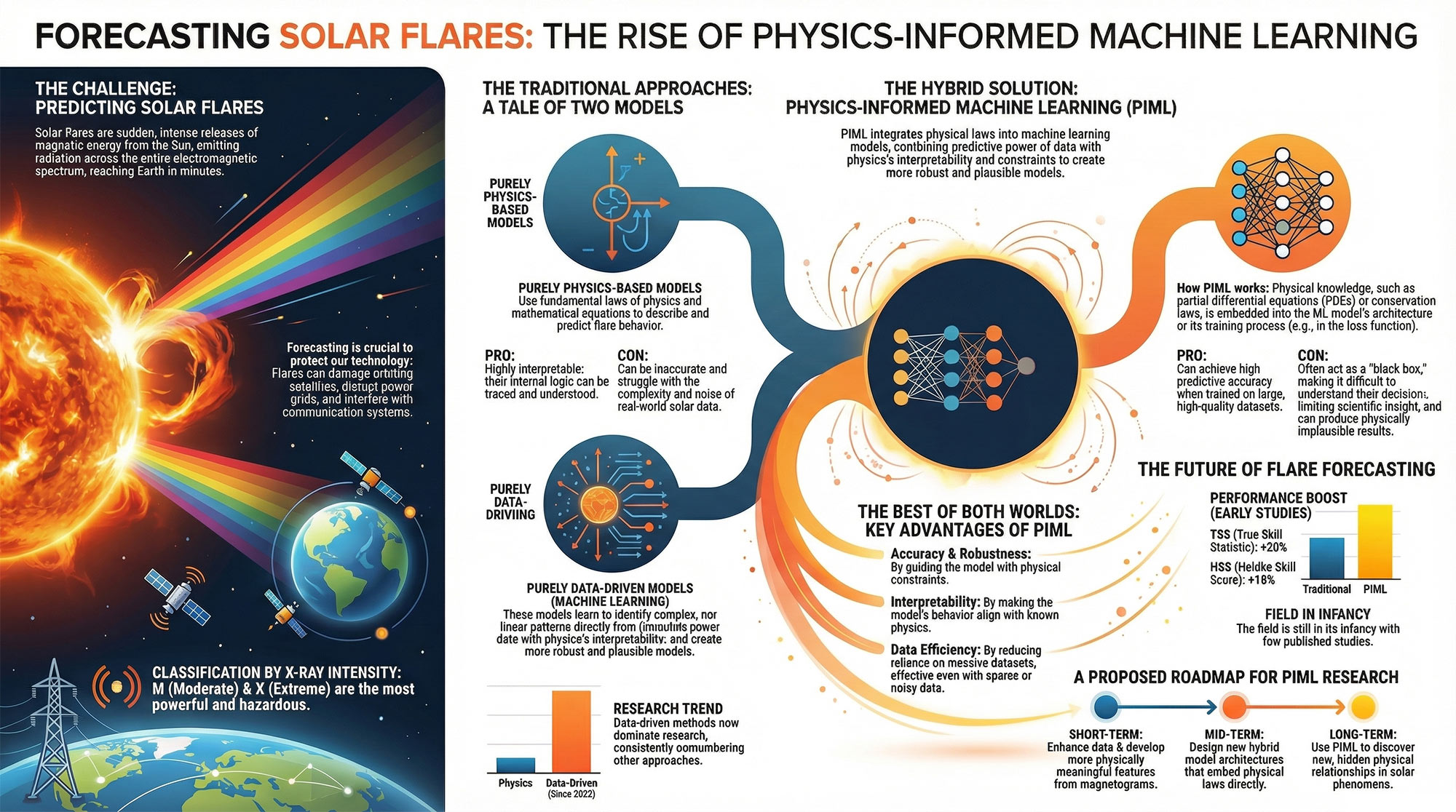
Solar Flare Forecasting: From Data-driven Towards Physics-informed Machine Learning Models