

Dr. Ramesh Kumar Bhukya received the B.Tech. degree in Electronics and Communication Engineering from Mahatma Gandhi Institute of Technology (MGIT) Gandipet, Hyderabad, Telangana, India, in 2008, the M.Tech. degree in Electronics and Communication Engineering from Motilal Nehru National Institute of Technology (MNNIT) Allahabad, Prayagraj, Uttar Pradesh, India in 2011, and the Ph.D. degree in Electronics and Electrical Engineering from Indian Institute of Technology Guwahati (IITG), Guwahati, Assam, India in 2019. His Ph.D. work focuses on Approaches for robust text-dependent speaker verification under degraded conditions using speech-specific knowledge from the perspective of practical application-oriented systems. After completing doctoral studies, he joined as an Assistant Professor in Electronics and Communication Engineering from the National Institute of Technology (NIT), Hamirpur, Himachal Pradesh, India, in 2019-2020. In 2020, he joined in the Department of Electronics and Communication Engineering at National Institute of Technology Andhra Pradesh (NIT-AP), Tadepalligudem, Andhra Pradesh, India. He is currently working as an Assistant Professor in the Department of Electronics and Communication Engineering from the Indian Institute of Information Technology Allahabad (IIIT-A), Prayagraj, Uttar Pradesh, India. His research interests are speech signal processing, speaker verification, biomedical signal processing, machine learning and pattern recognition.
Editorial Roles
No Editorial Roles
This user currently does not serve as an editor for any ICCK journals.
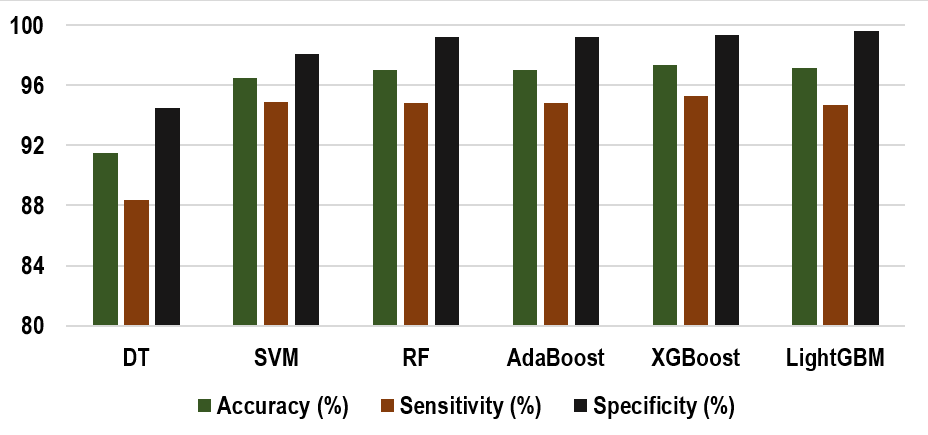
Maize productivity in India, a major global producer, is severely threatened by leaf diseases. Accurate identification of Common Rust (CR), Northern Corn Leaf Blight (NCLB), and Gray Leaf Spot (GLS) remains challenging with traditional methods. This study evaluated traditional and ensemble-based classifiers for classifying these diseases alongside healthy (HL) leaves. Using accuracy, precision, recall, and F1-score, we assessed k-NN, DT, RF, ETs, AdaBoost, SGD, GB, XGBoost, LightGBM, and a Stacking model on a four-class dataset. Ensemble methods demonstrated clear superiority. The Stacking model achieved the highest accuracy (98.50%), followed by LightGBM (98.46%) and XGBoost (98.01%). Among... More >
Graphical Abstract
We use cookies to improve your experience. By continuing to browse, you agree to our use of essential cookies.
Learn more