ICCK

Mirlan Chynybaev

Razzakov Kyrgyz State Technical University, Bishkek 720044, Kyrgyzstan

Section 01

Academic Profile

No academic profile information available at the moment.

Section 02

Editorial Roles

This user currently does not serve as an editor for any ICCK journals.

Section 03

ICCK Publications

Free Access | Research Article | 08 July 2026
Coordinated Electricity Tariff and Import Planning for Kyrgyzstan Using Rolling MILP Optimization Under Seasonal Hydropower Constraints
ICCK Transactions on Systems Safety and Reliability | Volume 2, Issue 3: 176-191, 2026 | DOI: 10.62762/TSSR.2026.468829
Abstract
Kyrgyzstan relies heavily on hydropower generation, which results in a pronounced seasonal mismatch between electricity supply and demand, posing significant challenges to power system reliability and supply security. During winter, reduced hydropower availability and increased electricity consumption often lead to power shortages and a growing dependence on electricity imports. To support more effective operational planning, this study proposes a mixed-integer linear programming (MILP) model for the coordinated optimization of electricity tariffs and import procurement under seasonal supply constraints. The proposed model incorporates tariff-responsive demand, domestic generation limits, el... More >

Graphical Abstract
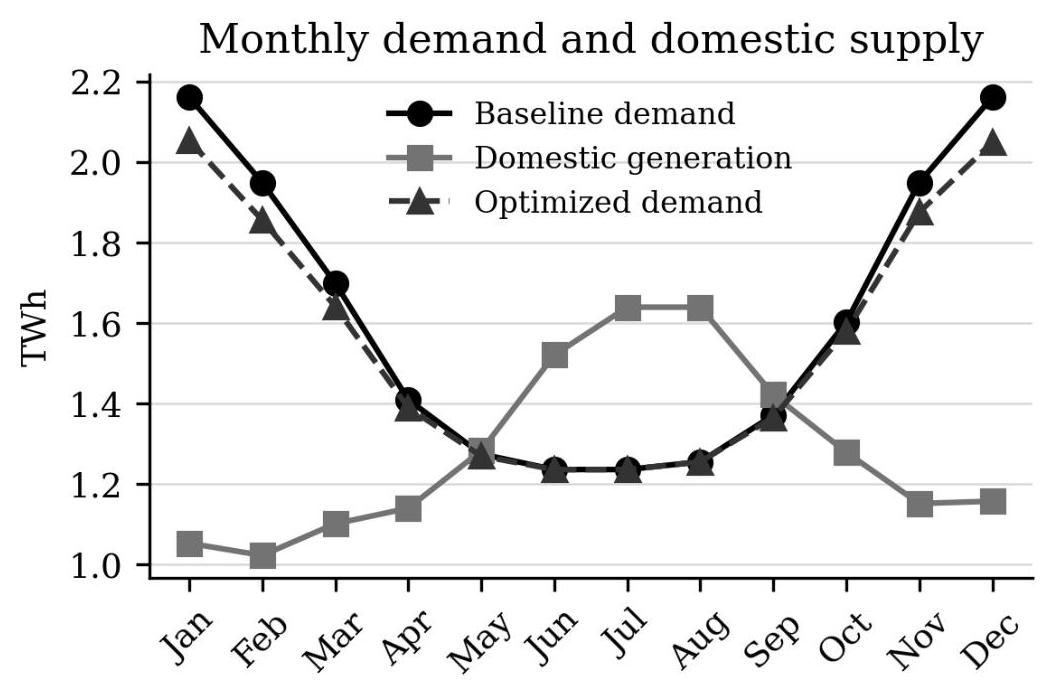
Coordinated Electricity Tariff and Import Planning for Kyrgyzstan Using Rolling MILP Optimization Under Seasonal Hydropower Constraints
Free Access | Research Article | 08 April 2026
Optimal Allocation of Heterogeneous UAV Swarms for Reservoir Inspection with Task Decomposition
ICCK Transactions on Systems Safety and Reliability | Volume 2, Issue 2: 101-111, 2026 | DOI: 10.62762/TSSR.2026.977710
Abstract
To meet the efficiency and economy requirements of unmanned aerial vehicle (UAV) inspection for large watershed, long-distance and multi-measurement-point reservoirs, this paper focuses on the optimal allocation problem of heterogeneous UAV swarms for reservoir inspection with task decomposition. Firstly, the four decomposable dimensions of reservoir inspection tasks (spatial decomposition, time decomposition, measurement point decomposition, and data accuracy decomposition) are clarified, and the performance metrics and constraints of heterogeneous UAV swarms are defined. Secondly, inspection success models and inspection cost models are constructed to form a dual-objective optimization mod... More >
Free Access | Review Article | 02 March 2026 | Cited: Crossref logo  1 , Scopus 1
Reliability Optimization for Large Language Model Training Infrastructure: Challenges, Advances, and Future Directions
ICCK Transactions on Systems Safety and Reliability | Volume 2, Issue 1: 36-53, 2026 | DOI: 10.62762/TSSR.2025.806733
Abstract
The ultra-large scale and prolonged runtime of Large Language Model (LLM) training—often involving thousands of GPUs and spanning weeks—render reliability a pivotal bottleneck. Hardware failures, stragglers, and runtime issues can waste over 30% of GPU resources, delaying model rollout and driving up costs. This survey focuses on reliability optimization for LLM training systems. The discussion centers on three pillars of reliability: fault detection, fault recovery, and straggler mitigation. For each pillar, we dissect innovative mechanisms, which range from communication-aware fault detection to adaptive load balancing, and we assess their impact on critical reliability metrics such as... More >
Free Access | Review Article | 31 October 2025 | Cited: Crossref logo  3 , Scopus 2
Performability Analysis for Large-Scale Multi-State Computing Systems: Methodologies, Advances, and Future Directions
ICCK Transactions on Systems Safety and Reliability | Volume 1, Issue 2: 81-97, 2025 | DOI: 10.62762/TSSR.2025.527003
Abstract
Large-scale computing systems, such as cloud data centers, grid infrastructures, and high-performance computing clusters, are the backbone of modern information technology ecosystems. These systems typically consist of numerous heterogeneous, multi-state computing nodes that exhibit varying performance levels due to component failures, degradation, or dynamic resource allocation. Performability analysis, which integrates both system reliability and performance evaluations to quantify the probability of the system operating at a specified performance level, is critical for ensuring the efficient, reliable, and cost-effective operation of these complex systems. This paper presents a comprehens... More >

Graphical Abstract
Performability Analysis for Large-Scale Multi-State Computing Systems: Methodologies, Advances, and Future Directions