

Coordinated Electricity Tariff and Import Planning for Kyrgyzstan Using Rolling MILP Optimization Under Seasonal Hydropower Constraints


Article Information
Abstract
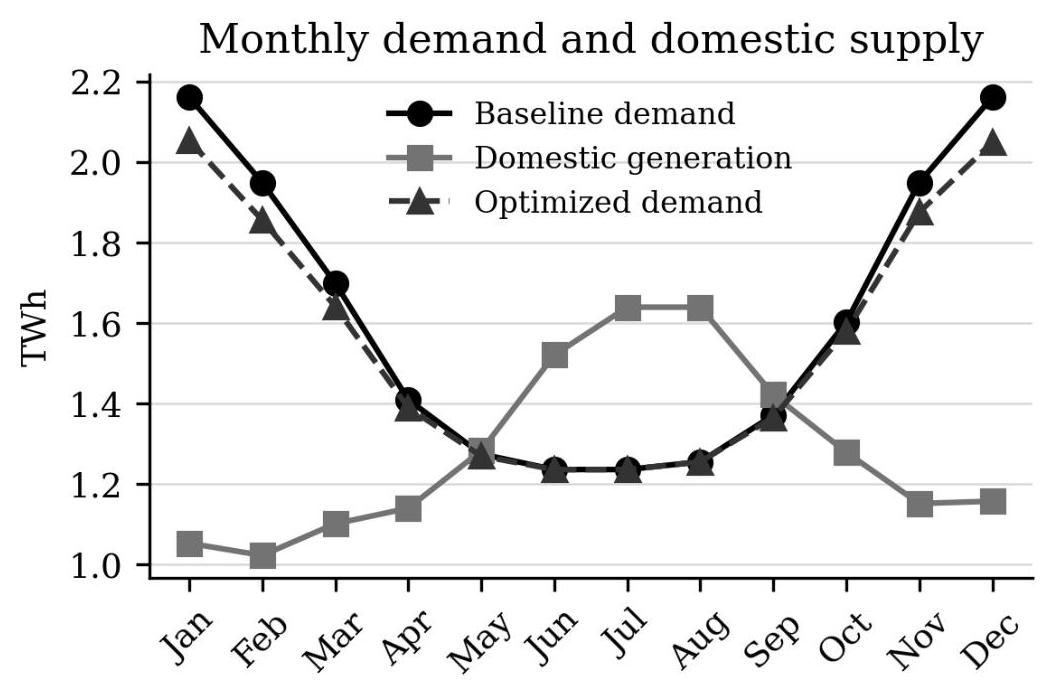
Kyrgyzstan relies heavily on hydropower generation, which results in a pronounced seasonal mismatch between electricity supply and demand, posing significant challenges to power system reliability and supply security. During winter, reduced hydropower availability and increased electricity consumption often lead to power shortages and a growing dependence on electricity imports. To support more effective operational planning, this study proposes a mixed-integer linear programming (MILP) model for the coordinated optimization of electricity tariffs and import procurement under seasonal supply constraints. The proposed model incorporates tariff-responsive demand, domestic generation limits, electricity imports from neighboring countries, affordability requirements, and revenue adequacy constraints. A rolling optimization framework is developed to support annual, quarterly, and monthly planning updates. The model is applied to a case study of the Kyrgyz power system using publicly available electricity statistics for 2025 and seasonally adjusted monthly scenarios. Results indicate that coordinated tariff and import planning can alleviate winter supply pressure and improve system reliability, as measured by the Energy Not Supplied (ENS) indicator, compared with a benchmark planning approach. Under the studied scenarios, the optimized strategy reduces annual import requirements and lowers import expenditures while maintaining affordability and revenue-related constraints. The rolling optimization framework also provides greater flexibility for adapting to changing hydrological conditions and import market uncertainties. The proposed approach offers a practical decision-support tool for hydropower-dominated power systems facing seasonal electricity shortages and increasing import dependence.
Graphical Abstract
Keywords
Data Availability Statement
Funding
Conflicts of Interest
AI Use Statement
Ethical Approval and Consent to Participate
References
- International Energy Agency. (2022). Strengthening power system security in Kyrgyzstan: A roadmap (No. 2b21a7d5-en). OECD Publishing.
[CrossRef] [Google Scholar] - International Energy Agency. (2020). Kyrgyzstan energy profile. IEA. Retrieved from https://www.iea.org/reports/kyrgyzstan-energy-profile
[Google Scholar] - Orlonskaya, I. (2026, January 14). Electricity consumption in Kyrgyzstan has increased to 19.3 billion kWh — A meeting on energy took place in the Cabinet of Ministers. Gazeta.kg. Retrieved from https://gazeta.kg/en/exclusive/158610-potreblenie-jelektrojenergii-v-kyrgyzstane-vyroslo-do-193-mlrd-kvtch-v-kabmine-proshlo-soveschanie-po-jenergetike.html
[Google Scholar] - Sultanov, A. (2026, January 23). Annual electricity deficit in Kyrgyzstan reaches 3.9 billion kWh. 24.kg. Retrieved from https://24.kg/english/359082__Annual_electricity_deficit_in_Kyrgyzstan_reaches_39_billion_kWh/
[Google Scholar] - Kutueva, A. (2026, February 24). Kyrgyzstan imported 3,886 billion kWh of electricity in 2025. 24.kg. Retrieved from https://24.kg/english/363352_Kyrgyzstan_imported_3886_billion_kWh_of_electricity_in_2025/
[Google Scholar] - Bengard, A. (2025, April 28). Electricity tariffs will be adjusted every year — Ministry of Energy. 24.kg. Retrieved from https://24.kg/english/327652_Electricity_tariffs_will_be_adjusted_every_year__Ministry_of_Energy/
[Google Scholar] - Vasilkova, A. (2025, April 18). From subsidies to modernization: What the new tariff policy will bring to Kyrgyzstan's economy. Akchabar. Retrieved from https://www.akchabar.kg/en/article/otrasli-rtyxderlqtlyjimo/ot-dotatsij-k-modernizatsii-chto-novaya-tarifnaya-politika-dast-ekonomike-kr-freytdshajilhtae
[Google Scholar] - Muktarbek kyzy, A., & Alfnes, F. (2025). Household energy responses to the introduction of increasing block tariffs on residential electricity in Kyrgyzstan. Energy Policy, 203, 114629.
[CrossRef] [Google Scholar] - Borenstein, S. (2005). The long-run efficiency of real-time electricity pricing. The Energy Journal, 26(3), 93-116.
[CrossRef] [Google Scholar] - Joskow, P. L., & Wolfram, C. D. (2012). Dynamic pricing of electricity. American Economic Review, 102(3), 381-385.
[CrossRef] [Google Scholar] - Faruqui, A., & Sergici, S. (2010). Household response to dynamic pricing of electricity: a survey of 15 experiments. Journal of regulatory Economics, 38(2), 193-225.
[CrossRef] [Google Scholar] - Albadi, M. H., & El-Saadany, E. F. (2008). A summary of demand response in electricity markets. Electric power systems research, 78(11), 1989-1996.
[CrossRef] [Google Scholar] - World Bank. (2024). Kambarata-1 hydropower plant project (HPP). World Bank. Retrieved from https://www.worldbank.org/en/programs/kambarata-1-hpp
[Google Scholar] - World Bank. (2024, July 11). World Bank provides additional technical support for clean, hydropower energy generation in the Kyrgyz Republic [Press release]. Retrieved from https://www.worldbank.org/en/news/press-release/2024/07/11/world-bank-provides-additional-technical-support-for-clean-hydropower-energy-generation-in-the-kyrgyz-republic
[Google Scholar] - Hobbs, B. F. (1995). Optimization methods for electric utility resource planning. European Journal of Operational Research, 83(1), 1-20.
[CrossRef] [Google Scholar] - Carrión, M., & Arroyo, J. M. (2006). A computationally efficient mixed-integer linear formulation for the thermal unit commitment problem. IEEE Transactions on power systems, 21(3), 1371-1378.
[CrossRef] [Google Scholar] - Morales-España, G., Latorre, J. M., & Ramos, A. (2013). Tight and compact MILP formulation for the thermal unit commitment problem. IEEE Transactions on Power Systems, 28(4), 4897-4908.
[CrossRef] [Google Scholar] - Koltsaklis, N. E., & Nazos, K. (2017). A stochastic MILP energy planning model incorporating power market dynamics. Applied Energy, 205, 1364-1383.
[CrossRef] [Google Scholar] - Hart, W. E., Laird, C. D., Watson, J. P., Woodruff, D. L., Hackebeil, G. A., Nicholson, B. L., & Siirola, J. D. (2017). Pyomo-optimization modeling in python (Vol. 67, p. 277). Berlin: Springer.
[CrossRef] [Google Scholar]
Cite This Article
TY  - JOUR
AU  - Mo, Yuchang
AU  - Chynybaev, Mirlan
AU  - Chymyrov, Akylbek
AU  - Wu, Wen
AU  - Li, Yunfei
AU  - He, Xi
AU  - Ma, Shuaisen
PY  - 2026
DA  - 2026/07/08
TI  - Coordinated Electricity Tariff and Import Planning for Kyrgyzstan Using Rolling MILP Optimization Under Seasonal Hydropower Constraints
JO  - ICCK Transactions on Systems Safety and Reliability
T2  - ICCK Transactions on Systems Safety and Reliability
JF  - ICCK Transactions on Systems Safety and Reliability
VL  - 2
IS  - 3
SP  - 176
EP  - 191
DO  - 10.62762/TSSR.2026.468829
UR  - https://www.icck.org/article/abs/TSSR.2026.468829
KW  - Kyrgyzstan power system
KW  - electricity tariff
KW  - electricity import planning
KW  - mixed-integer linear programming
KW  - hydropower
KW  - rolling optimization
KW  - supply reliability
AB  - Kyrgyzstan relies heavily on hydropower generation, which results in a pronounced seasonal mismatch between electricity supply and demand, posing significant challenges to power system reliability and supply security. During winter, reduced hydropower availability and increased electricity consumption often lead to power shortages and a growing dependence on electricity imports. To support more effective operational planning, this study proposes a mixed-integer linear programming (MILP) model for the coordinated optimization of electricity tariffs and import procurement under seasonal supply constraints. The proposed model incorporates tariff-responsive demand, domestic generation limits, electricity imports from neighboring countries, affordability requirements, and revenue adequacy constraints. A rolling optimization framework is developed to support annual, quarterly, and monthly planning updates. The model is applied to a case study of the Kyrgyz power system using publicly available electricity statistics for 2025 and seasonally adjusted monthly scenarios. Results indicate that coordinated tariff and import planning can alleviate winter supply pressure and improve system reliability, as measured by the Energy Not Supplied (ENS) indicator, compared with a benchmark planning approach. Under the studied scenarios, the optimized strategy reduces annual import requirements and lowers import expenditures while maintaining affordability and revenue-related constraints. The rolling optimization framework also provides greater flexibility for adapting to changing hydrological conditions and import market uncertainties. The proposed approach offers a practical decision-support tool for hydropower-dominated power systems facing seasonal electricity shortages and increasing import dependence.
SN  - 3069-1087
PB  - Institute of Central Computation and Knowledge
LA  - English
ER  -
@article{Mo2026Coordinate,
  author = {Yuchang Mo and Mirlan Chynybaev and Akylbek Chymyrov and Wen Wu and Yunfei Li and Xi He and Shuaisen Ma},
  title = {Coordinated Electricity Tariff and Import Planning for Kyrgyzstan Using Rolling MILP Optimization Under Seasonal Hydropower Constraints},
  journal = {ICCK Transactions on Systems Safety and Reliability},
  year = {2026},
  volume = {2},
  number = {3},
  pages = {176-191},
  doi = {10.62762/TSSR.2026.468829},
  url = {https://www.icck.org/article/abs/TSSR.2026.468829},
  abstract = {Kyrgyzstan relies heavily on hydropower generation, which results in a pronounced seasonal mismatch between electricity supply and demand, posing significant challenges to power system reliability and supply security. During winter, reduced hydropower availability and increased electricity consumption often lead to power shortages and a growing dependence on electricity imports. To support more effective operational planning, this study proposes a mixed-integer linear programming (MILP) model for the coordinated optimization of electricity tariffs and import procurement under seasonal supply constraints. The proposed model incorporates tariff-responsive demand, domestic generation limits, electricity imports from neighboring countries, affordability requirements, and revenue adequacy constraints. A rolling optimization framework is developed to support annual, quarterly, and monthly planning updates. The model is applied to a case study of the Kyrgyz power system using publicly available electricity statistics for 2025 and seasonally adjusted monthly scenarios. Results indicate that coordinated tariff and import planning can alleviate winter supply pressure and improve system reliability, as measured by the Energy Not Supplied (ENS) indicator, compared with a benchmark planning approach. Under the studied scenarios, the optimized strategy reduces annual import requirements and lowers import expenditures while maintaining affordability and revenue-related constraints. The rolling optimization framework also provides greater flexibility for adapting to changing hydrological conditions and import market uncertainties. The proposed approach offers a practical decision-support tool for hydropower-dominated power systems facing seasonal electricity shortages and increasing import dependence.},
  keywords = {Kyrgyzstan power system, electricity tariff, electricity import planning, mixed-integer linear programming, hydropower, rolling optimization, supply reliability},
  issn = {3069-1087},
  publisher = {Institute of Central Computation and Knowledge}
}
Article Metrics
Publisher's Note
ICCK stays neutral with regard to jurisdictional claims in published maps and institutional affiliations.
Rights and Permissions


Portico
