

A Hybrid RUL Prediction Approach for Lithium-ion Batteries Based on CEEMDAN-SSA-SVR-BiGRU


Article Information
Abstract
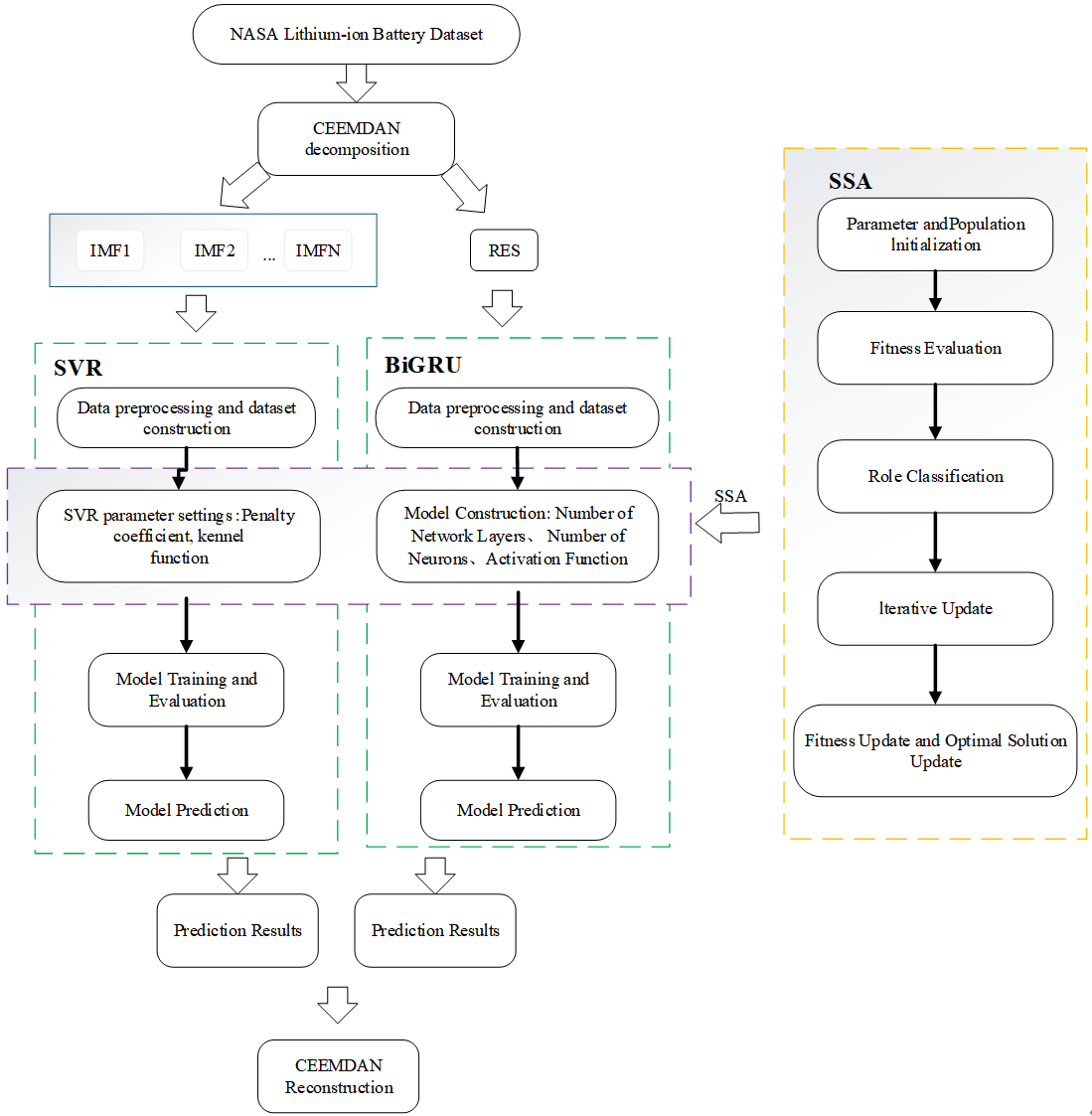
The capacity regeneration phenomenon in lithium-ion batteries is inevitable and leads to non-monotonic fluctuations in capacity degradation trajectories, significantly complicating accurate remaining useful life (RUL) prediction. To address this challenge, this paper proposes a hybrid prediction model based on CEEMDAN-SSA-SVR-BiGRU. The method first employs Complete Ensemble Empirical Mode Decomposition with Adaptive Noise (CEEMDAN) to decompose the original capacity sequence into multiple Intrinsic Mode Functions (IMFs) representing local regeneration fluctuations, and a residual component (RES) referring to the global degradation trend, thereby achieving effective signal decoupling. Subsequently, distinct prediction strategies are applied to different components after decomposition. Support Vector Regression (SVR) is utilized to capture nonlinear local fluctuations, while Bidirectional Gated Recurrent Unit (BiGRU) models long-term dependencies. To further enhance the model performance, the Sparrow Search Algorithm (SSA) is introduced to jointly optimize kernel parameters and penalty factors in SVR, as well as architectural hyperparameters in BiGRU. Experimental results on the NASA lithium battery dataset demonstrate that the proposed model achieves higher accuracy, with Mean Absolute Error (MAE), Mean Absolute Percentage Error (MAPE), and Root Mean Square Error (RMSE) no more than 0.0067, 0.0049, and 0.0094, respectively, significantly outperforming the ablated models and some baseline models. This study validates that the integration of signal decomposition, component-specific modeling, and hyperparameter optimization yields a significant improvement in the accuracy and robustness of the RUL prediction for lithium-ion batteries under capacity regeneration.
Graphical Abstract
Keywords
Data Availability Statement
Funding
Conflicts of Interest
Ethical Approval and Consent to Participate
References
- Jia, Z., Li, Z., Wang, Z., Liu, Z., & Vong, C. M. (2025). Joint prediction of SOH and RUL for lithium batteries considering capacity self recovery and model drift. IEEE Internet of Things Journal.
[CrossRef] [Google Scholar] - Zhang, S., Liu, Z., Xu, Y., & Su, H. (2024). A physics-informed hybrid multitask learning for lithium-ion battery full-life aging estimation at early lifetime. IEEE Transactions on Industrial Informatics.
[CrossRef] [Google Scholar] - Ma, Q., Zheng, Y., Yang, W., Zhang, Y., & Zhang, H. (2021). Remaining useful life prediction of lithium battery based on capacity regeneration point detection. Energy, 234, 121233.
[CrossRef] [Google Scholar] - Zhang, J., Chen, J., Liu, D., He, L., Yang, K., Du, F., ... & Zhang, X. (2025). Multi-state joint prediction algorithm for lithium battery packs based on data-driven and physical models. Energy, 322, 135641.
[CrossRef] [Google Scholar] - Fang, W., Chen, H., & Zhou, F. (2022). Fault diagnosis for cell voltage inconsistency of a battery pack in electric vehicles based on real-world driving data. Computers and Electrical Engineering, 102, 108095.
[CrossRef] [Google Scholar] - Liu, Z., He, H., Xie, J., Wang, K., & Huang, W. (2022). Self-discharge prediction method for lithium-ion batteries based on improved support vector machine. Journal of Energy Storage, 55, 105571.
[CrossRef] [Google Scholar] - Sun, J., Ren, S., Shang, Y., Zhang, X., Liu, Y., & Wang, D. (2023). A novel fault prediction method based on convolutional neural network and long short-term memory with correlation coefficient for lithium-ion battery. Journal of Energy Storage, 62, 106811.
[CrossRef] [Google Scholar] - Tian, Y., Lu, C., Wang, Z., & Tao, L. (2014). Artificial fish swarm algorithm‐based particle filter for Li‐ion battery life prediction. Mathematical Problems in Engineering, 2014(1), 564894.
[CrossRef] [Google Scholar] - Chang, Y., Fang, H., & Zhang, Y. (2017). A new hybrid method for the prediction of the remaining useful life of a lithium-ion battery. Applied energy, 206, 1564-1578.
[CrossRef] [Google Scholar] - Chen, X., Liu, Z., Sheng, H., Wu, K., Mi, J., & Li, Q. (2024). Transfer learning based remaining useful life prediction of lithium-ion battery considering capacity regeneration phenomenon. Journal of Energy Storage, 76, 109798.
[CrossRef] [Google Scholar] - Yang, Z., Wang, Y., & Kong, C. (2021). Remaining useful life prediction of lithium-ion batteries based on a mixture of ensemble empirical mode decomposition and GWO-SVR model. IEEE Transactions on Instrumentation and Measurement, 70, 1-11.
[CrossRef] [Google Scholar] - Yao, F., He, W., Wu, Y., Ding, F., & Meng, D. (2022). Remaining useful life prediction of lithium-ion batteries using a hybrid model. Energy, 248, 123622.
[CrossRef] [Google Scholar] - Xue, J., & Shen, B. (2020). A novel swarm intelligence optimization approach: sparrow search algorithm. Systems science & control engineering, 8(1), 22-34.
[CrossRef] [Google Scholar] - Huang, N. E., Shen, Z., Long, S. R., Wu, M. C., Shih, H. H., Zheng, Q., ... & Liu, H. H. (1998). The empirical mode decomposition and the Hilbert spectrum for nonlinear and non-stationary time series analysis. Proceedings of the Royal Society of London. Series A: mathematical, physical and engineering sciences, 454(1971), 903-995.
[CrossRef] [Google Scholar] - Zhang, C., Wang, S., Yu, C., Wang, Y., & Fernandez, C. (2023). A complete ensemble empirical mode decomposition with adaptive noise deep autoregressive recurrent neural network method for the whole life remaining useful life prediction of lithium-ion batteries. Ionics, 29(10), 4337-4349.
[CrossRef] [Google Scholar] - Liu, Y., Sun, J., Shang, Y., Zhang, X., Ren, S., & Wang, D. (2023). A novel remaining useful life prediction method for lithium-ion battery based on long short-term memory network optimized by improved sparrow search algorithm. Journal of Energy Storage, 61, 106645.
[CrossRef] [Google Scholar] - Balogun, A. L., Rezaie, F., Pham, Q. B., Gigović, L., Drobnjak, S., Aina, Y. A., ... & Lee, S. (2021). Spatial prediction of landslide susceptibility in western Serbia using hybrid support vector regression (SVR) with GWO, BAT and COA algorithms. Geoscience Frontiers, 12(3), 101104.
[CrossRef] [Google Scholar] - Jia, S., Ma, B., Guo, W., & Li, Z. S. (2021). A sample entropy based prognostics method for lithium-ion batteries using relevance vector machine. Journal of Manufacturing Systems, 61, 773-781.
[CrossRef] [Google Scholar] - Zhao, F., Gao, W., Lu, J., Jiang, H., & Shi, J. (2024). Real-time concentration detection of Al dust using GRU-based Kalman filtering approach. Process Safety and Environmental Protection, 189, 154-163.
[CrossRef] [Google Scholar] - Zhang, J., Huang, C., Chow, M. Y., Li, X., Tian, J., Luo, H., & Yin, S. (2023). A data-model interactive remaining useful life prediction approach of lithium-ion batteries based on PF-BiGRU-TSAM. IEEE Transactions on Industrial Informatics, 20(2), 1144-1154.
[CrossRef] [Google Scholar] - Wang, Z., Wang, Q., Liu, Z., & Wu, T. (2024). A deep learning interpretable model for river dissolved oxygen multi-step and interval prediction based on multi-source data fusion. Journal of hydrology, 629, 130637.
[CrossRef] [Google Scholar] - Wen, J., Jia, C., & Xia, G. (2025). State of health prediction of lithium-ion batteries for driving conditions based on full parameter domain sparrow search algorithm and dual-module bidirectional gated recurrent unit. arXiv preprint arXiv:2505.17405.
[Google Scholar] - Fan, T. E., Wang, K., & Qu, B. (2025). Joint estimation of Li-ion battery states based on parallel TCN-Transformer multi-task learning model. Journal of Energy Storage, 134, 118077.
[CrossRef] [Google Scholar] - Gong, Q., Wang, P., Cheng, Z., & Zhang, J. A. (2021). A method for estimating state of charge of lithium-ion batteries based on deep learning. Journal of The Electrochemical Society, 168(11), 110532.
[CrossRef] [Google Scholar] - Jia, C., Tian, Y., Shi, Y., Jia, J., Wen, J., & Zeng, J. (2023). State of health prediction of lithium-ion batteries based on bidirectional gated recurrent unit and transformer. Energy, 285, 129401.
[CrossRef] [Google Scholar] - Wang, T., Ma, Z., & Zou, S. (2023). Remaining useful life prediction of lithium-ion batteries: A temporal and differential guided dual attention neural network. IEEE Transactions on Energy Conversion, 39(1), 757-771.
[CrossRef] [Google Scholar] - Liu, S., Sun, C., Sun, B., Fang, L., & Li, D. (2025). A two-layer full data-driven model for state of health estimation of lithium-ion batteries based on MKRVM-ELM hybrid algorithm with ant-lion optimization. Journal of Energy Storage, 114, 115716.
[CrossRef] [Google Scholar]
Cited By (2)
-
Shuyi Wang, Leyan Zhang, Zichuan Ni, Lei Li. Remaining Useful Life Prediction of Lithium-Ion Batteries Under Capacity Regeneration: An Adaptive Decomposition and Hybrid Deep Learning Framework.
Batteries, 2026 , 12 (6).
[CrossRef] -
Xiangyu Kong, Ruishu Huang, He Li, C. Guedes Soares. SCADA data-driven failure rate and reliability prediction for offshore wind turbines.
Reliability Engineering & System Safety, 2026 , 273 .
[CrossRef]
Cite This Article
TY  - JOUR
AU  - Zhao, Fei
AU  - Dai, Xinyu
PY  - 2025
DA  - 2025/12/30
TI  - A Hybrid RUL Prediction Approach for Lithium-ion Batteries Based on CEEMDAN-SSA-SVR-BiGRU
JO  - ICCK Transactions on Systems Safety and Reliability
T2  - ICCK Transactions on Systems Safety and Reliability
JF  - ICCK Transactions on Systems Safety and Reliability
VL  - 1
IS  - 2
SP  - 136
EP  - 148
DO  - 10.62762/TSSR.2025.657859
UR  - https://www.icck.org/article/abs/TSSR.2025.657859
KW  - remaining useful life
KW  - capacity regeneration
KW  - CEEMDAN
KW  - sparrow search algorithm
KW  - support vector regression
KW  - bidirectional gated recurrent unit
AB  - The capacity regeneration phenomenon in lithium-ion batteries is inevitable and leads to non-monotonic fluctuations in capacity degradation trajectories, significantly complicating accurate remaining useful life (RUL) prediction. To address this challenge, this paper proposes a hybrid prediction model based on CEEMDAN-SSA-SVR-BiGRU. The method first employs Complete Ensemble Empirical Mode Decomposition with Adaptive Noise (CEEMDAN) to decompose the original capacity sequence into multiple Intrinsic Mode Functions (IMFs) representing local regeneration fluctuations, and a residual component (RES) referring to the global degradation trend, thereby achieving effective signal decoupling. Subsequently, distinct prediction strategies are applied to different components after decomposition. Support Vector Regression (SVR) is utilized to capture nonlinear local fluctuations, while Bidirectional Gated Recurrent Unit (BiGRU) models long-term dependencies. To further enhance the model performance, the Sparrow Search Algorithm (SSA) is introduced to jointly optimize kernel parameters and penalty factors in SVR, as well as architectural hyperparameters in BiGRU. Experimental results on the NASA lithium battery dataset demonstrate that the proposed model achieves higher accuracy, with Mean Absolute Error (MAE), Mean Absolute Percentage Error (MAPE), and Root Mean Square Error (RMSE) no more than 0.0067, 0.0049, and 0.0094, respectively, significantly outperforming the ablated models and some baseline models. This study validates that the integration of signal decomposition, component-specific modeling, and hyperparameter optimization yields a significant improvement in the accuracy and robustness of the RUL prediction for lithium-ion batteries under capacity regeneration.
SN  - 3069-1087
PB  - Institute of Central Computation and Knowledge
LA  - English
ER  -
@article{Zhao2025A,
  author = {Fei Zhao and Xinyu Dai},
  title = {A Hybrid RUL Prediction Approach for Lithium-ion Batteries Based on CEEMDAN-SSA-SVR-BiGRU},
  journal = {ICCK Transactions on Systems Safety and Reliability},
  year = {2025},
  volume = {1},
  number = {2},
  pages = {136-148},
  doi = {10.62762/TSSR.2025.657859},
  url = {https://www.icck.org/article/abs/TSSR.2025.657859},
  abstract = {The capacity regeneration phenomenon in lithium-ion batteries is inevitable and leads to non-monotonic fluctuations in capacity degradation trajectories, significantly complicating accurate remaining useful life (RUL) prediction. To address this challenge, this paper proposes a hybrid prediction model based on CEEMDAN-SSA-SVR-BiGRU. The method first employs Complete Ensemble Empirical Mode Decomposition with Adaptive Noise (CEEMDAN) to decompose the original capacity sequence into multiple Intrinsic Mode Functions (IMFs) representing local regeneration fluctuations, and a residual component (RES) referring to the global degradation trend, thereby achieving effective signal decoupling. Subsequently, distinct prediction strategies are applied to different components after decomposition. Support Vector Regression (SVR) is utilized to capture nonlinear local fluctuations, while Bidirectional Gated Recurrent Unit (BiGRU) models long-term dependencies. To further enhance the model performance, the Sparrow Search Algorithm (SSA) is introduced to jointly optimize kernel parameters and penalty factors in SVR, as well as architectural hyperparameters in BiGRU. Experimental results on the NASA lithium battery dataset demonstrate that the proposed model achieves higher accuracy, with Mean Absolute Error (MAE), Mean Absolute Percentage Error (MAPE), and Root Mean Square Error (RMSE) no more than 0.0067, 0.0049, and 0.0094, respectively, significantly outperforming the ablated models and some baseline models. This study validates that the integration of signal decomposition, component-specific modeling, and hyperparameter optimization yields a significant improvement in the accuracy and robustness of the RUL prediction for lithium-ion batteries under capacity regeneration.},
  keywords = {remaining useful life, capacity regeneration, CEEMDAN, sparrow search algorithm, support vector regression, bidirectional gated recurrent unit},
  issn = {3069-1087},
  publisher = {Institute of Central Computation and Knowledge}
}
Publisher's Note
ICCK stays neutral with regard to jurisdictional claims in published maps and institutional affiliations.
Rights and Permissions


Portico
