

Preventive Maintenance and Competitive Strategies in IIoT-enable After-sales Markets: A Degradation Modeling and Game Theoretic Approach



Article Information
Abstract
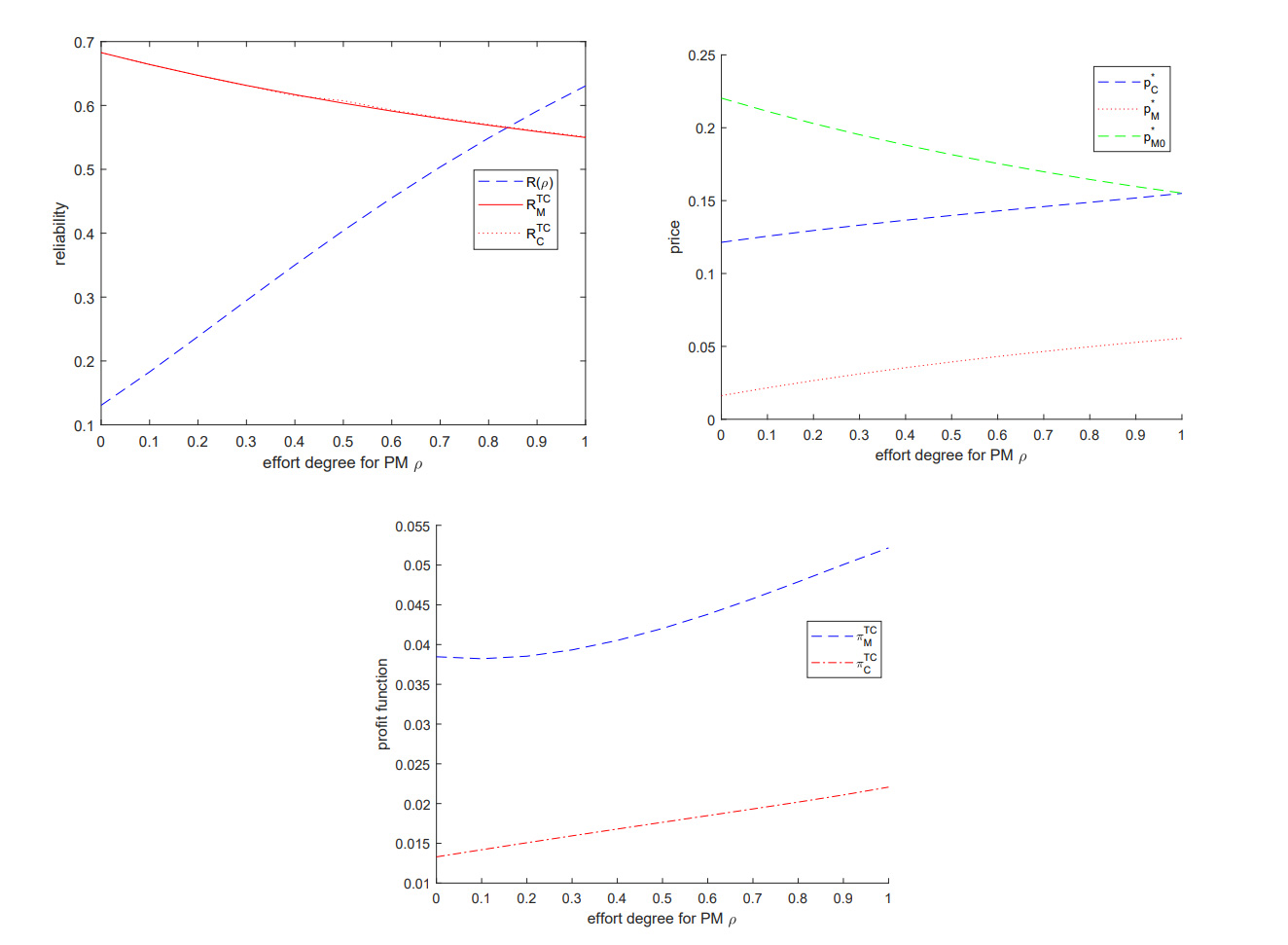
In the after-sales service market, understanding both the internal degradation of products and the external incentives within warranty period is crucial. Efforts into preventive maintenance can slow down the internal degradation, but these efforts are also influenced by external strategic services. Enabling an Industrial Internet of Things (IIoT) platform for preventive maintenance requires carefully considering the benefits instead of merely increasing efforts. This paper addresses these complexities by first proposing an additive degradation model to characterize the internal deterioration of products and the impact of efforts into preventive maintenance. It then introduces a sequential game model based on the IIoT platform, examining interactions between manufacturers and cooperative competitors under three competitive schemes: traditional competition, monopolistic competition, and shared competition. Equilibrium prices for new products and after-sales services are used to analyze external incentives. Utilizing these equilibrium prices, the paper derives profit and reliability functions of manufacturers and cooperative competitors under each competition scheme. Finally, this study combines the efforts into preventive maintenance and the internal degradation mechanism of products through equilibrium reliability functions.
Graphical Abstract
Keywords
Data Availability Statement
Funding
Conflicts of Interest
Ethical Approval and Consent to Participate
References
- Agrawal, V. V., Kavadias, S., & Toktay, L. B. (2016). The limits of planned obsolescence for conspicuous durable goods. Manufacturing & Service Operations Management, 18(2), 216-226.
[CrossRef] [Google Scholar] - August, T., Chen, W., & Zhu, K. (2021). Competition among proprietary and open-source software firms: The role of licensing in strategic contribution. Management Science, 67(5), 3041-3066.
[CrossRef] [Google Scholar] - Berrade, M. D., Calvo, E., & Badía, F. G. (2023). Maintenance of systems with critical components. Prevention of early failures and wear-out. Computers & Industrial Engineering, 181, 109291.
[CrossRef] [Google Scholar] - Bian, Y., Xie, J., Archibald, T. W., & Sun, Y. (2019). Optimal extended warranty strategy: Offering trade-in service or not?. European Journal of Operational Research, 278(1), 240-254.
[CrossRef] [Google Scholar] - Fu, W., Atasu, A., & Tereyağoğlu, N. (2022). Warranty length, product reliability, and secondary markets. Manufacturing & Service Operations Management, 24(4), 2240-2255.
[CrossRef] [Google Scholar] - Automotive aftersales market value in selected countries 2020| Statista. (2021, July 1). Statista. Retrieved from \url{https://www.statista.com/statistics/1267042/automotive-aftersales-market-value-in-selected-countries/.
[Google Scholar] - Hu, S., Zhu, S. X., & Fu, K. (2023). Optimal trade-in and refurbishment strategies for durable goods. European Journal of Operational Research, 309(1), 133-151.
[CrossRef] [Google Scholar] - Hu, S., & Tang, Y. (2024). Impact of product sharing and heterogeneous consumers on manufacturers offering trade-in programs. Omega, 122, 102949.
[CrossRef] [Google Scholar] - Huang, X., Atasu, A., Tereyağoğlu, N., & Toktay, L. B. (2023). Lemons, trade-ins, and certified pre-owned programs. Manufacturing & Service Operations Management, 25(2), 737-755.
[CrossRef] [Google Scholar] - Jiang, B., & Zhang, X. (2011). How does a retailer's service plan affect a manufacturer's warranty? Management Science, 57(4), 727-740.
[CrossRef] [Google Scholar] - Liang, X. J., Cui, L. R., & Wang, R. T. (2024) Non-renewable warranty cost analysis for dependent series configuration with distinct warranty periods. Reliability Engineering and System Safety, 246, 110074.
[CrossRef] [Google Scholar] - Mitra, A. (2021). Warranty parameters for extended two-dimensional warranties incorporating consumer preferences. European Journal of Operational Research, 291, 525-535.
[CrossRef] [Google Scholar] - Olsen, T. L., & Tomlin, B. (2020). Industry 4.0: Opportunities and challenges for operations management. Manufacturing & Service Operations Management, 22(1):113-122.
[CrossRef] [Google Scholar] - Oraiopoulos, N, Ferguson, M. E., & Toktay, L. B. (2012). Relicensing as a secondary market strategy. Management Science, 58(5), 1022-1037.
[CrossRef] [Google Scholar] - Pei, J., Yan, P., & Kumar, S. (2023). No permanent friend or enemy: Impacts of the IIoT-based platform in the maintenance service market. Management Science, 69(11), 6800-6817.
[CrossRef] [Google Scholar] - Peng, S. Z., Jiang, W., Huang, W. P., & Luo, Q. L. (2024). The impact of gamma usage processes on preventive maintenance policies under two-dimensional warranty. Reliability Engineering and System Safety, 242, 109743.
[CrossRef] [Google Scholar] - ReportLinker. (2022, February 9). Medical equipment maintenance global market report 2022. Yahoo Finance. Retrieved from \url{https://finance.yahoo.com/news/medical-equipment-maintenance-global-market-114600182.html.
[Google Scholar] - Ruan, Y., Luo, X., Ding, X., & Dai, A. (2023). Non-periodic preventive maintenance policies for complex multi-component products sold with loss-based two-dimensional warranties. Computers & Industrial Engineering, 185, 109626.
[CrossRef] [Google Scholar] - Sun, M. Y., Ng, C. T., Yang, L., & Zhang, T. H. (2024). Optimal after-sales service offering strategy: Additive manufacturing, traditional manufacturing, or hybrid? International Journal of Production Economics, 268, 109116.
[CrossRef] [Google Scholar] - VMR. (2022). Global aviation MRO market size by organization type, by sevice type, by geographic scope and forecast. Retrieved from, \url{http://www.verifiedmarketresearch.com-/product/aviation-mro-market/.
[Google Scholar] - Waldman, M. (2003). Durable goods theory for real world markets. Journal of Economic Perspectives, 17(1), 131-154.
[CrossRef] [Google Scholar] - Wang, X. L., & Xie, W. (2018). Two-dimensional warranty: A literature review. Proceedings of the Institution of Mechanical Engineers Part O-Journal of Risk and Reliability, 232(2), 284-307.
[CrossRef] [Google Scholar] - Wu, S. M. (2014). Construction of asymmetric copulas and its application in two-dimensional reliability modelling. European Journal of Operational Research, 238, 476-485.
[CrossRef] [Google Scholar] - Wu, S. (2024). A copula-based approach to modelling the failure process of items under two-dimensional warranty and applications. European Journal of Operational Research, 314(3), 854-866.
[CrossRef] [Google Scholar] - Xu, J., Liang, Z. L., Li, Y. F., & Wang, K. B. (2021). Generalized condition-based maintenance optimization for multi-component systems considering dependency and imperfect maintenance. Reliability Engineering & System Safety, 211, 107592.
[CrossRef] [Google Scholar] - Japan: Extended warranty service sales value 2030 | Statista. (2022, September 26). Statista. Retrieved from, \url{https://www.statista.com/statistics/1350433/japan-extended-warranty-service-sales-value/.
[Google Scholar] - Zhang, S., Tong, X., & Jin, X. (2023). Contract design and comparison under the opportunity cost of working capital: Buyback vs. revenue sharing. European Journal of Operational Research, 309(2), 845-856.
[CrossRef] [Google Scholar] - Zhao, X., Liu, B., Xu, J., & Wang, X. L. (2023). Imperfect maintenance policies for warranted products under stochastic performance degradation. European Journal of Operational Research, 308(1), 150-165.
[CrossRef] [Google Scholar]
Cited By (8)
-
Yuxin Xian, Hui Xiao, Kaiye Gao, Rui Peng. A preventive maintenance policy considering energy consumption process and production wait.
Reliability Engineering & System Safety, 2027 , 277 .
[CrossRef] -
Chunyan Ling, Lechang Yang, Jingzhe Lei, Suk Joo Bae. Reliability-Based Preventive Maintenance for a Humanoid Robot System Under Dependent Competing Failure Processes.
IEEE Transactions on Reliability, 2026 , 75 .
[CrossRef] -
Lijun Shang, Liying Wang, Kaiye Gao, Rui Peng. Random customized maintenance design for mission-cycled systems under warranty with cost offsetting and repair enhancement.
Computers & Industrial Engineering, 2026 , 221 .
[CrossRef] -
Lijun Shang, Kaiye Gao, Rui Peng. Random collaborative warranty pricing and out-of-warranty maintenance design for mission-epoch systems.
Reliability Engineering & System Safety, 2026 , 275 .
[CrossRef] -
Shu Fang, Rongquan Yu, Di Wu, Rui Peng. Defending a capacitated series-parallel system with imperfect fault coverage.
International Journal of General Systems, 2026 .
[CrossRef] -
Qingqing Zhai, Ziyan Zhao, Guangze Pan. Optimal maintenance strategies for deteriorating products with heavy-tailed degradation pattern.
Reliability Engineering & System Safety, 2026 , 275 .
[CrossRef] -
Zhuqing Miao, Tianzi Tian, Yige Li, Jun Yang. Generalized Fiducial Inference for Accelerated Life Tests With Failure-Free Life Based on Three-Parameter Weibull Distribution.
IEEE Transactions on Reliability, 2026 , 75 .
[CrossRef] -
Xiaodian Zhuang, Xiuwen Fu, Liudong Xing, Rui Peng. Network recovery for UAV-assisted IoTs after cascading failures with heterogeneous graph neural networks.
Reliability Engineering & System Safety, 2026 , 273 .
[CrossRef]
Cite This Article
TY  - JOUR
AU  - Liang, Xiaojun
AU  - Yang, Li
AU  - Qiu, Qingan
PY  - 2025
DA  - 2025/07/30
TI  - Preventive Maintenance and Competitive Strategies in IIoT-enable After-sales Markets: A Degradation Modeling and Game Theoretic Approach
JO  - ICCK Transactions on Systems Safety and Reliability
T2  - ICCK Transactions on Systems Safety and Reliability
JF  - ICCK Transactions on Systems Safety and Reliability
VL  - 1
IS  - 1
SP  - 21
EP  - 42
DO  - 10.62762/TSSR.2025.782610
UR  - https://www.icck.org/article/abs/TSSR.2025.782610
KW  - product warranty
KW  - after-sales service
KW  - degradation process
KW  - sequential games
KW  - Industrial Internet of Things (IIoT)
AB  - In the after-sales service market, understanding both the internal degradation of products and the external incentives within warranty period is crucial. Efforts into preventive maintenance can slow down the internal degradation, but these efforts are also influenced by external strategic services. Enabling an Industrial Internet of Things (IIoT) platform for preventive maintenance requires carefully considering the benefits instead of merely increasing efforts. This paper addresses these complexities by first proposing an additive degradation model to characterize the internal deterioration of products and the impact of efforts into preventive maintenance. It then introduces a sequential game model based on the IIoT platform, examining interactions between manufacturers and cooperative competitors under three competitive schemes: traditional competition, monopolistic competition, and shared competition. Equilibrium prices for new products and after-sales services are used to analyze external incentives. Utilizing these equilibrium prices, the paper derives profit and reliability functions of manufacturers and cooperative competitors under each competition scheme. Finally, this study combines the efforts into preventive maintenance and the internal degradation mechanism of products through equilibrium reliability functions.
SN  - 3069-1087
PB  - Institute of Central Computation and Knowledge
LA  - English
ER  -
@article{Liang2025Preventive,
  author = {Xiaojun Liang and Li Yang and Qingan Qiu},
  title = {Preventive Maintenance and Competitive Strategies in IIoT-enable After-sales Markets: A Degradation Modeling and Game Theoretic Approach},
  journal = {ICCK Transactions on Systems Safety and Reliability},
  year = {2025},
  volume = {1},
  number = {1},
  pages = {21-42},
  doi = {10.62762/TSSR.2025.782610},
  url = {https://www.icck.org/article/abs/TSSR.2025.782610},
  abstract = {In the after-sales service market, understanding both the internal degradation of products and the external incentives within warranty period is crucial. Efforts into preventive maintenance can slow down the internal degradation, but these efforts are also influenced by external strategic services. Enabling an Industrial Internet of Things (IIoT) platform for preventive maintenance requires carefully considering the benefits instead of merely increasing efforts. This paper addresses these complexities by first proposing an additive degradation model to characterize the internal deterioration of products and the impact of efforts into preventive maintenance. It then introduces a sequential game model based on the IIoT platform, examining interactions between manufacturers and cooperative competitors under three competitive schemes: traditional competition, monopolistic competition, and shared competition. Equilibrium prices for new products and after-sales services are used to analyze external incentives. Utilizing these equilibrium prices, the paper derives profit and reliability functions of manufacturers and cooperative competitors under each competition scheme. Finally, this study combines the efforts into preventive maintenance and the internal degradation mechanism of products through equilibrium reliability functions.},
  keywords = {product warranty, after-sales service, degradation process, sequential games, Industrial Internet of Things (IIoT)},
  issn = {3069-1087},
  publisher = {Institute of Central Computation and Knowledge}
}
Publisher's Note
ICCK stays neutral with regard to jurisdictional claims in published maps and institutional affiliations.
Rights and Permissions


Portico
