

Beyond Firm Boundaries: Orchestrating Ecosystem Sustainability Through Business Model Innovation


Article Information
Abstract
Business model innovation (BMI) constitutes a structural catalyst for competitive advantage within contemporary business ecosystems (BEs), transcending firm-level adaptation to reconfigure multi-stakeholder value generation networks. This research theorizes the reciprocal dynamism between BMI and ecosystem evolution through systematic literature synthesis and longitudinal analysis of a keystone technology enterprise. The study establishes four constitutive dimensions: (1) BMI’s steering effect on BE trajectories and resilience under sustainability pressures; (2) Its mediation of environmental integrity, social equity, and economic viability across ecosystem lifecycles; (3) The generative mechanisms whereby BMI propels sustainable niche market emergence; and (4) BMI-mediated augmentation of ecosystem adaptive capacity confronting systemic sustainability disruptions. Findings demonstrate that strategic BMI fundamentally restructures stakeholder interdependencies, serving as the cornerstone for ecosystem-level sustainability transitions. Empirical evidence reveals that such innovation enables critical adaptation to systemic pressures—including resource constraints, climate disruptions, and ethical consumption shifts—while unlocking novel value architectures integrating planetary stewardship, social impact, and economic returns. This work advances theoretical discourse by conceptualizing the BMI-BE reciprocity as an indispensable framework for achieving Sustainable Development Goals within interconnected commercial networks, providing actionable pathways for scholars and practitioners to reconfigure ecosystem governance toward regenerative futures.
Graphical Abstract
Keywords
Data Availability Statement
Funding
Conflicts of Interest
Ethical Approval and Consent to Participate
References
- Bouncken, R. B., & Fredrich, V. (2016). Business model innovation in alliances: Successful configurations. Journal of Business Research, 69(9), 3584-3590.
[CrossRef] [Google Scholar] - Foss, N. J., & Saebi, T. (2017). Fifteen years of research on business model innovation: How far have we come, and where should we go?. Journal of Management, 43(1), 200-227.
[CrossRef] [Google Scholar] - Bocken, N., & Geradts, T. (2022). Designing your circular business model. Stanford Social Innovation Review, 20(2), 34-39.
[Google Scholar] - Stubbs, W., & Cocklin, C. (2008). Conceptualizing a "sustainability business model". Organization & Environment, 21(2), 103-127.
[CrossRef] [Google Scholar] - Microsoft 2023 annual report. (n.d.). Retrieved from https://www.microsoft.com/investor/reports/ar23/index.html
[Google Scholar] - Adner, R., & Kapoor, R. (2010). Value creation in innovation ecosystems: How the structure of technological interdependence affects firm performance in new technology generations. Strategic management journal, 31(3), 306-333.
[CrossRef] [Google Scholar] - Wong, C. W., Lai, K. H., Shang, K. C., Lu, C. S., & Leung, T. K. P. (2012). Green operations and the moderating role of environmental management capability of suppliers on manufacturing firm performance. International journal of production economics, 140(1), 283-294.
[CrossRef] [Google Scholar] - Amit, R., & Zott, C. (2015). Crafting business architecture: The antecedents of business model design. Strategic Entrepreneurship Journal, 9(4), 331-350.
[CrossRef] [Google Scholar] - Kramer, M. R., & Porter, M. (2011). Creating shared value (Vol. 17). Boston, MA, USA: FSG.
[Google Scholar] - Frishammar, J., & Parida, V. (2019). Circular business model transformation: A roadmap for incumbent firms. California Management Review, 61(2), 5-29.
[CrossRef] [Google Scholar] - Sjödin, D., Parida, V., Jovanovic, M., & Visnjic, I. (2020). Value creation and value capture alignment in business model innovation: A process view on outcome-based business models. Journal of Product Innovation Management, 37(2), 158-183.
[CrossRef] [Google Scholar] - Bocken, N., Boons, F., & Baldassarre, B. (2019). Sustainable business model experimentation by understanding ecologies of business models. Journal of Cleaner Production, 208, 1498-1512.
[CrossRef] [Google Scholar] - Niemimaa, M., Järveläinen, J., Heikkilä, M., & Heikkilä, J. (2019). Business continuity of business models: Evaluating the resilience of business models for contingencies. International Journal of Information Management, 49, 208-216.
[CrossRef] [Google Scholar] - Chesbrough, H. (2007). Business model innovation: it's not just about technology anymore. Strategy & Leadership, 35(6), 12-17.
[CrossRef] [Google Scholar] - Teece, D. J. (2010). Business models, business strategy and innovation. Long Range Planning, 43(2-3), 172-194.
[CrossRef] [Google Scholar] - Chesbrough, H., & Rosenbloom, R. S. (2002). The role of the business model in capturing value from innovation: evidence from Xerox Corporation's technology spin-off companies. Industrial and Corporate Change, 11(3), 529-555.
[CrossRef] [Google Scholar] - Christensen, C. M. (1997). Marketing strategy: learning by doing. Harvard Business Review, 75(6), 141-151.
[Google Scholar] - Teece, D. J. (2018). Business models and dynamic capabilities. Long Range Planning, 51(1), 40-49.
[CrossRef] [Google Scholar] - Zott, C., & Amit, R. (2010). Business model design: An activity system perspective. Long Range Planning, 43(2-3), 216-226.
[CrossRef] [Google Scholar] - Geissdoerfer, M., Savaget, P., & Evans, S. (2017). The Cambridge business model innovation process. Procedia Manufacturing, 8, 262-269.
[CrossRef] [Google Scholar] - Adner, R. (2017). Ecosystem as structure: An actionable construct for strategy. Journal of Management, 43(1), 39-58.
[CrossRef] [Google Scholar] - Mäkinen, S. J., & Dedehayir, O. (2012). Business ecosystem evolution and strategic considerations: A literature review. In 2012 18th International ICE Conference on Engineering, Technology and Innovation (pp. 1-10). IEEE.
[CrossRef] [Google Scholar] - Iansiti, M., & Levien, R. (2004). Strategy as ecology. Harvard Business Review, 82(3), 68-78.
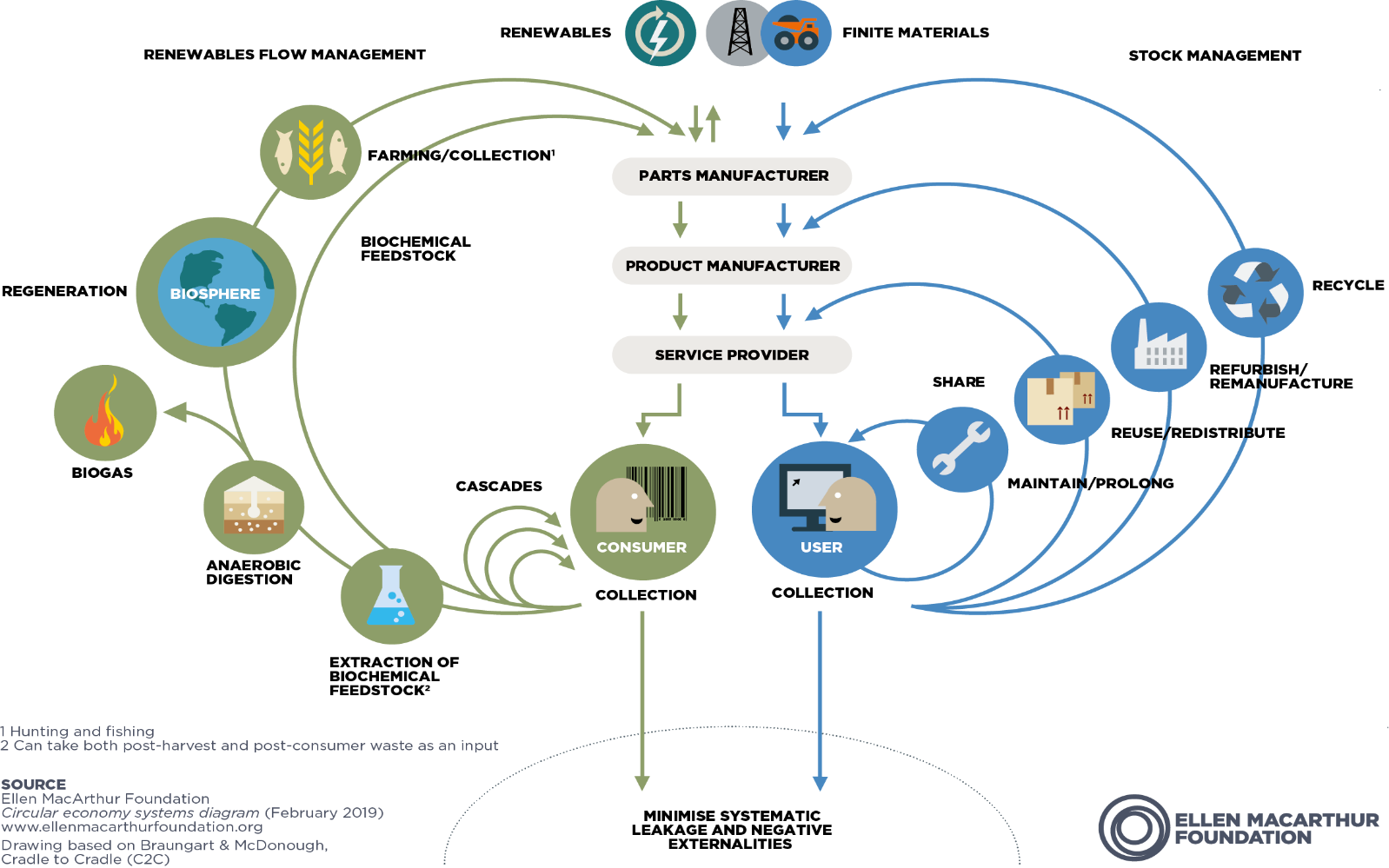
[Google Scholar] - The butterfly diagram: Visualising the circular economy. (n.d.). How to Build a Circular Economy | Ellen MacArthur Foundation. Retrieved from https://www.ellenmacarthurfoundation.org/circular-economy-diagram.
[Google Scholar] - Bocken, N. M., Short, S. W., Rana, P., & Evans, S. (2014). A literature and practice review to develop sustainable business model archetypes. Journal of Cleaner Production, 65, 42-56.
[CrossRef] [Google Scholar] - Geissdoerfer, M., Vladimirova, D., & Evans, S. (2018). Sustainable business model innovation: A review. Journal of Cleaner Production, 198, 401-416.
[CrossRef] [Google Scholar] - Basole, R. C. (2009). Visualization of interfirm relations in a converging mobile ecosystem. Journal of Information Technology, 24(2), 144-159.
[CrossRef] [Google Scholar] - Rayna, T., & Striukova, L. (2016). 360° Business Model Innovation: Toward an Integrated View of Business Model Innovation: An integrated, value-based view of a business model can provide insight into potential areas for business model innovation. Research-Technology Management, 59(3), 21-28.
[CrossRef] [Google Scholar] - Yin, R. K. (2009). How to do better case studies. The SAGE handbook of applied social research methods, 2(254-282).
[Google Scholar] - Siggelkow, N. (2007). Persuasion with case studies. Academy of Management Journal, 50(1), 20-24.
[CrossRef] [Google Scholar] - Microsoft 2022 annual report. (n.d.). Retrieved from https://www.microsoft.com/investor/reports/ar22/index.html
[Google Scholar] - Microsoft 2015 annual report. (n.d.). Retrieved from https://www.microsoft.com/investor/reports/ar15/index.html
[Google Scholar] - Microsoft 2018 annual report. (n.d.). Retrieved from https://www.microsoft.com/investor/reports/ar18/index.html
[Google Scholar]
Cite This Article
TY  - JOUR
AU  - Zhao, Jing
PY  - 2025
DA  - 2025/08/02
TI  - Beyond Firm Boundaries: Orchestrating Ecosystem Sustainability Through Business Model Innovation
JO  - ICCK Transactions on Systems Safety and Reliability
T2  - ICCK Transactions on Systems Safety and Reliability
JF  - ICCK Transactions on Systems Safety and Reliability
VL  - 1
IS  - 1
SP  - 63
EP  - 80
DO  - 10.62762/TSSR.2025.410841
UR  - https://www.icck.org/article/abs/TSSR.2025.410841
KW  - business model innovation
KW  - ecosystem sustainability
KW  - business ecosystem
KW  - niche markets
AB  - Business model innovation (BMI) constitutes a structural catalyst for competitive advantage within contemporary business ecosystems (BEs), transcending firm-level adaptation to reconfigure multi-stakeholder value generation networks. This research theorizes the reciprocal dynamism between BMI and ecosystem evolution through systematic literature synthesis and longitudinal analysis of a keystone technology enterprise. The study establishes four constitutive dimensions: (1) BMI’s steering effect on BE trajectories and resilience under sustainability pressures; (2) Its mediation of environmental integrity, social equity, and economic viability across ecosystem lifecycles; (3) The generative mechanisms whereby BMI propels sustainable niche market emergence; and (4) BMI-mediated augmentation of ecosystem adaptive capacity confronting systemic sustainability disruptions. Findings demonstrate that strategic BMI fundamentally restructures stakeholder interdependencies, serving as the cornerstone for ecosystem-level sustainability transitions. Empirical evidence reveals that such innovation enables critical adaptation to systemic pressures—including resource constraints, climate disruptions, and ethical consumption shifts—while unlocking novel value architectures integrating planetary stewardship, social impact, and economic returns. This work advances theoretical discourse by conceptualizing the BMI-BE reciprocity as an indispensable framework for achieving Sustainable Development Goals within interconnected commercial networks, providing actionable pathways for scholars and practitioners to reconfigure ecosystem governance toward regenerative futures.
SN  - 3069-1087
PB  - Institute of Central Computation and Knowledge
LA  - English
ER  -
@article{Zhao2025Beyond,
  author = {Jing Zhao},
  title = {Beyond Firm Boundaries: Orchestrating Ecosystem Sustainability Through Business Model Innovation},
  journal = {ICCK Transactions on Systems Safety and Reliability},
  year = {2025},
  volume = {1},
  number = {1},
  pages = {63-80},
  doi = {10.62762/TSSR.2025.410841},
  url = {https://www.icck.org/article/abs/TSSR.2025.410841},
  abstract = {Business model innovation (BMI) constitutes a structural catalyst for competitive advantage within contemporary business ecosystems (BEs), transcending firm-level adaptation to reconfigure multi-stakeholder value generation networks. This research theorizes the reciprocal dynamism between BMI and ecosystem evolution through systematic literature synthesis and longitudinal analysis of a keystone technology enterprise. The study establishes four constitutive dimensions: (1) BMI’s steering effect on BE trajectories and resilience under sustainability pressures; (2) Its mediation of environmental integrity, social equity, and economic viability across ecosystem lifecycles; (3) The generative mechanisms whereby BMI propels sustainable niche market emergence; and (4) BMI-mediated augmentation of ecosystem adaptive capacity confronting systemic sustainability disruptions. Findings demonstrate that strategic BMI fundamentally restructures stakeholder interdependencies, serving as the cornerstone for ecosystem-level sustainability transitions. Empirical evidence reveals that such innovation enables critical adaptation to systemic pressures—including resource constraints, climate disruptions, and ethical consumption shifts—while unlocking novel value architectures integrating planetary stewardship, social impact, and economic returns. This work advances theoretical discourse by conceptualizing the BMI-BE reciprocity as an indispensable framework for achieving Sustainable Development Goals within interconnected commercial networks, providing actionable pathways for scholars and practitioners to reconfigure ecosystem governance toward regenerative futures.},
  keywords = {business model innovation, ecosystem sustainability, business ecosystem, niche markets},
  issn = {3069-1087},
  publisher = {Institute of Central Computation and Knowledge}
}
Article Metrics
Publisher's Note
ICCK stays neutral with regard to jurisdictional claims in published maps and institutional affiliations.
Rights and Permissions


Portico
