Academic Profile

Academic Profile

No academic profile information available at the moment.

Editorial Roles

No Editorial Roles

This user currently does not serve as an editor for any ICCK journals.

ICCK Publications

Total Publications: 2
Free Access | Research Article | 04 March 2026
On Mathematical Study of Juvenile Delinquency with Precautionary Measure, Public Education and Intervention Programs as Control Strategies
Journal of Nonlinear Dynamics and Applications | Volume 2, Issue 1: 20-38, 2026 | DOI: 10.62762/JNDA.2025.195550
Abstract
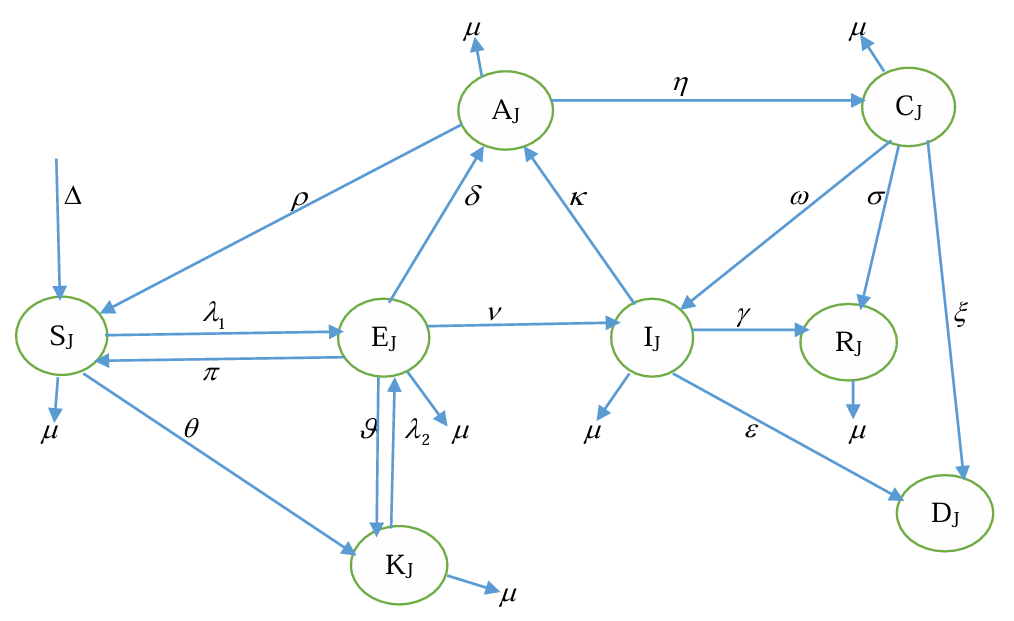
In this paper, we develop a mathematical model for juvenile delinquency transmission dynamics by incorporating key control strategies, namely precautionary measures, public education, and intervention programs. The model aims to identify effective prevention and control measures for curbing the spread of delinquent behavior among youths, with particular emphasis on evaluating the efficacy of public education. Adopting an epidemiological modelling framework, we derive a system of nonlinear differential equations governing the dynamics of juvenile delinquency over time. Stability analysis of the model is conducted, and the basic reproduction number along with the equilibrium points for both de... More >

Graphical Abstract
On Mathematical Study of Juvenile Delinquency with Precautionary Measure, Public Education and Intervention Programs as Control Strategies
Open Access | Research Article | 29 January 2026
On Strategic Planning of a Dynamic Allocation of Vehicles with Stochastic Breakdown to Destinations with Multiple Alternative Routes for Returns Maximization
ICCK Journal of Applied Mathematics | Volume 2, Issue 1: 64-86, 2026 | DOI: 10.62762/JAM.2025.632255
Abstract
This paper proposes a dynamic programming (DP) approach for a stochastic multi-period allocation problem, whereby fleet of vehicles are assigned from stations to destinations with multiple alternative routes in order to maximize returns, while the vehicles are subject to random failure. In the process of managing the business, the company is assumed to incur proportional management costs and pay tax to government. The expected returns is modelled as a function of random failure of vehicles due to bad roads and depreciation. The depreciation rate is assumed to follow a straight-line approach. The breakdown rate is modelled as function of the rate of bad roads on the fleets, depreciation rate... More >