

Journal of Nonlinear Dynamics and Applications
ISSN: 3069-6313 (Online)
Email: [email protected]

 Submit Manuscript
Edit a Special Issue
Submit Manuscript
Edit a Special Issue


TY  - JOUR
AU  - Nkeki, Charles Iwebuke
AU  - Mbarie, Imuwahen Anthonia
PY  - 2026
DA  - 2026/03/04
TI  - On Mathematical Study of Juvenile Delinquency with Precautionary Measure, Public Education and Intervention Programs as Control Strategies
JO  - Journal of Nonlinear Dynamics and Applications
T2  - Journal of Nonlinear Dynamics and Applications
JF  - Journal of Nonlinear Dynamics and Applications
VL  - 2
IS  - 1
SP  - 20
EP  - 38
DO  - 10.62762/JNDA.2025.195550
UR  - https://www.icck.org/article/abs/JNDA.2025.195550
KW  - mathematical model
KW  - juvenile delinquency
KW  - nonlinear dynamics
KW  - basic JD-reproduction number
KW  - JD equilibrium points
KW  - precautionary measure
KW  - public education program
KW  - intervention program
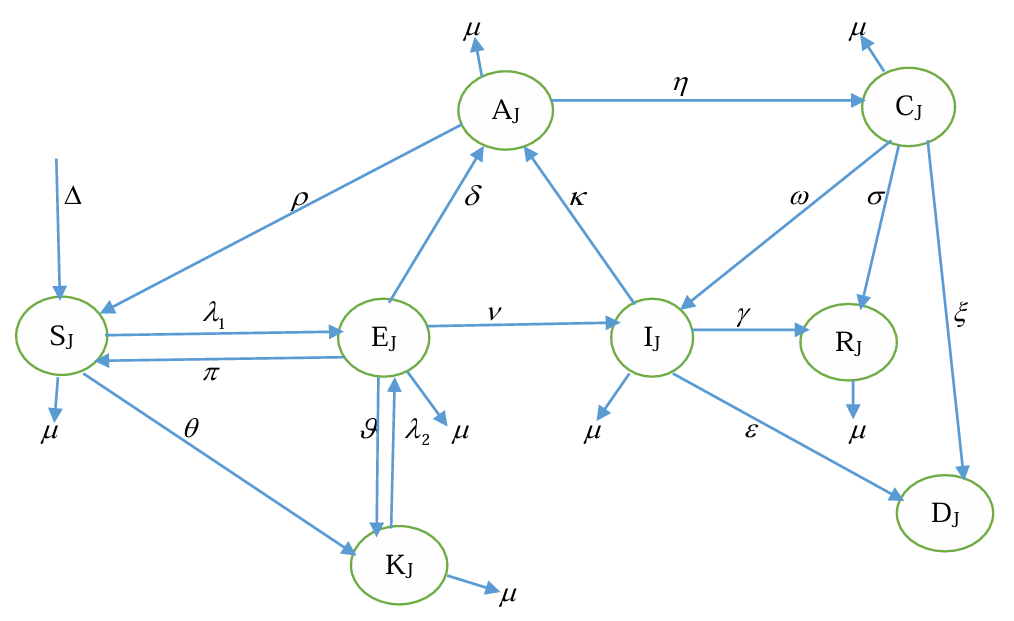
AB  - In this paper, we develop a mathematical model for juvenile delinquency transmission dynamics by incorporating key control strategies, namely precautionary measures, public education, and intervention programs. The model aims to identify effective prevention and control measures for curbing the spread of delinquent behavior among youths, with particular emphasis on evaluating the efficacy of public education. Adopting an epidemiological modelling framework, we derive a system of nonlinear differential equations governing the dynamics of juvenile delinquency over time. Stability analysis of the model is conducted, and the basic reproduction number along with the equilibrium points for both delinquency-free and endemic scenarios are established. Numerical simulations reveal that controlling the entry rate of juveniles into the population, reducing the transition rate from susceptible to delinquent status, and minimizing the rate at which individuals return to delinquency from correctional centers are critical for mitigating the spread of delinquent behavior. Moreover, while public education shows limited impact among susceptible individuals, it proves highly effective among the exposed, delinquent, and those in correctional facilities. Enhanced public education on the consequences of delinquency also contributes to reducing both arrest rates and juvenile homicides. This work offers valuable insights for researchers in applied mathematics, behavioral science, and healthcare management, while providing evidence-based guidance for policymakers seeking to manage and control juvenile delinquency.
SN  - 3069-6313
PB  - Institute of Central Computation and Knowledge
LA  - English
ER  -
@article{Nkeki2026On,
  author = {Charles Iwebuke Nkeki and Imuwahen Anthonia Mbarie},
  title = {On Mathematical Study of Juvenile Delinquency with Precautionary Measure, Public Education and Intervention Programs as Control Strategies},
  journal = {Journal of Nonlinear Dynamics and Applications},
  year = {2026},
  volume = {2},
  number = {1},
  pages = {20-38},
  doi = {10.62762/JNDA.2025.195550},
  url = {https://www.icck.org/article/abs/JNDA.2025.195550},
  abstract = {In this paper, we develop a mathematical model for juvenile delinquency transmission dynamics by incorporating key control strategies, namely precautionary measures, public education, and intervention programs. The model aims to identify effective prevention and control measures for curbing the spread of delinquent behavior among youths, with particular emphasis on evaluating the efficacy of public education. Adopting an epidemiological modelling framework, we derive a system of nonlinear differential equations governing the dynamics of juvenile delinquency over time. Stability analysis of the model is conducted, and the basic reproduction number along with the equilibrium points for both delinquency-free and endemic scenarios are established. Numerical simulations reveal that controlling the entry rate of juveniles into the population, reducing the transition rate from susceptible to delinquent status, and minimizing the rate at which individuals return to delinquency from correctional centers are critical for mitigating the spread of delinquent behavior. Moreover, while public education shows limited impact among susceptible individuals, it proves highly effective among the exposed, delinquent, and those in correctional facilities. Enhanced public education on the consequences of delinquency also contributes to reducing both arrest rates and juvenile homicides. This work offers valuable insights for researchers in applied mathematics, behavioral science, and healthcare management, while providing evidence-based guidance for policymakers seeking to manage and control juvenile delinquency.},
  keywords = {mathematical model, juvenile delinquency, nonlinear dynamics, basic JD-reproduction number, JD equilibrium points, precautionary measure, public education program, intervention program},
  issn = {3069-6313},
  publisher = {Institute of Central Computation and Knowledge}
}


Portico
All published articles are preserved here permanently:
https://www.portico.org/publishers/icck/