


Journal of Nonlinear Dynamics and Applications

Publishing Model:
ISSN:
ISSN: 3069-6313
Journal of Nonlinear Dynamics and Applications (JNDA) is a peer-reviewed, interdisciplinary journal dedicated to advancing research in nonlinear dynamics and its broad applications across science and engineering. The journal provides a platform for original theoretical, computational, and experimental studies that explore the behavior of nonlinear systems, their stability, bifurcations, chaos, and control.
DOI Prefix: 10.62762/JNDA

Journal Metrics

-
Impact Factor
-
CiteScore

Recent Articles

Free Access | Research Article | 21 January 2026
Advances in the Mathematical Theory of WPAA Dynamics for Impulsive High Order Neural Systems in Clifford Algebras
Journal of Nonlinear Dynamics and Applications | Volume 2, Issue 1: 1-12, 2026 | DOI: 10.62762/JNDA.2025.838385
Abstract
The primary objective of this work is to establish the existence, uniqueness, and exponential stability of piecewise weighted pseudo–almost automorphic solutions for impulsive high-order Hopfield neural networks formulated within Clifford algebras. Using the Banach fixed-point principle together with a suitably adapted Gronwall–Bellman inequality, we derive novel and verifiable sufficient conditions that ensure these qualitative properties. The main contributions are as follows: (i) this study is the first to analyze weighted pseudo–almost automorphic (WPAA) dynamics for impulsive high-order Hopfield neural networks directly in the Clifford algebra setting, without reducing the model t... More >

Graphical Abstract
Advances in the Mathematical Theory of WPAA Dynamics for Impulsive High Order Neural Systems in Clifford Algebras
Free Access | Research Article | 24 December 2025
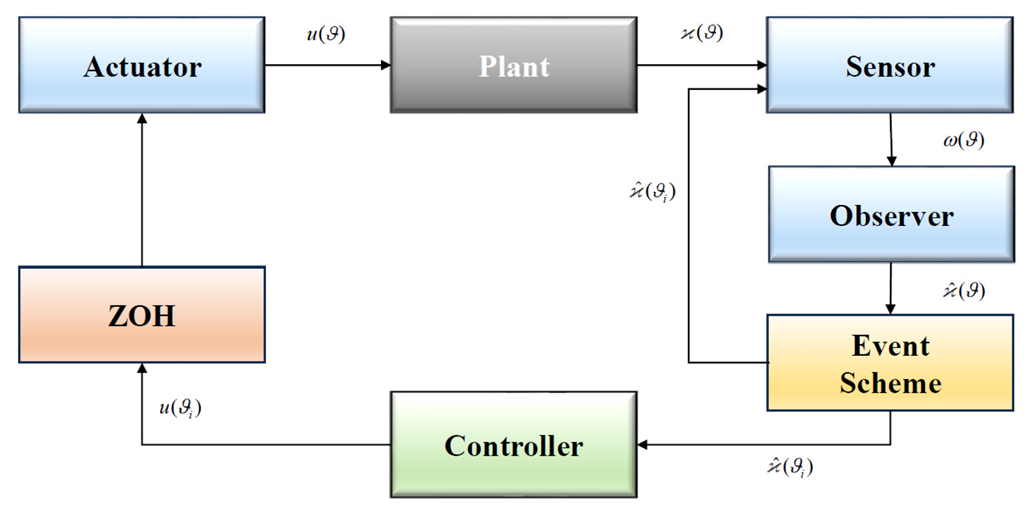
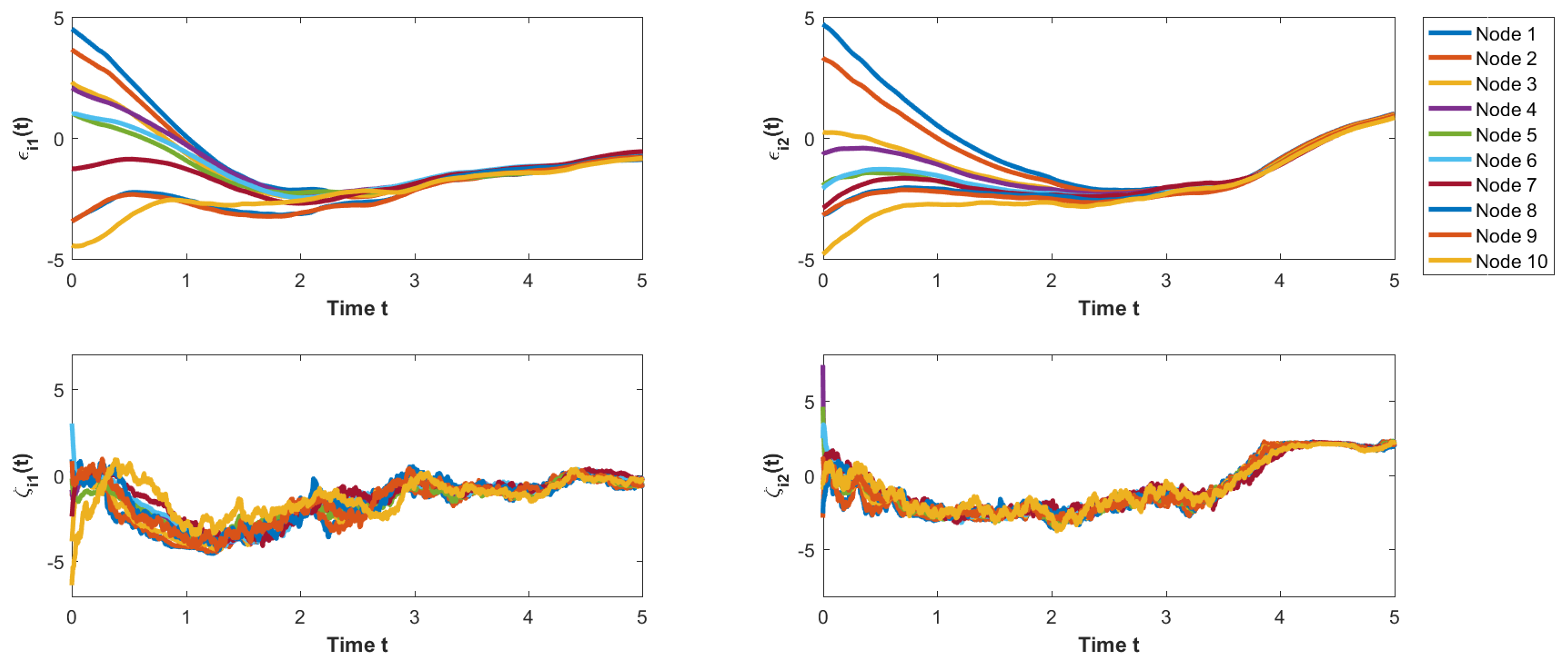
Asynchronous Intermittent Event-Triggered Control for a Class of Coupled Stochastic Strict-Feedback Nonlinear Systems
Journal of Nonlinear Dynamics and Applications | Volume 1, Issue 2: 112-126, 2025 | DOI: 10.62762/JNDA.2025.753314
Abstract
This paper investigates a class of coupled stochastic strict-feedback nonlinear systems under asynchronous intermittent event-triggered control (AIETC). Initially, stochastic analysis technique, Lyapunov method and backstepping design method are employed to design the virtual and actual controllers. AIETC is achieved by an auxiliary timer that grants each subsystem its own control and rest time. In the meantime the control input is applied only at the last node of each subsystem. Then, a global Lyapunov function is constructed. By utilizing graph theory, the global exponential ultimate boundedness in mean square of the systems can be obtained and Zeno behavior is eliminated successfully. Fin... More >

Graphical Abstract
Asynchronous Intermittent Event-Triggered Control for a Class of Coupled Stochastic Strict-Feedback Nonlinear Systems
Free Access | Research Article | 16 December 2025
Predefined-Time Synchronization Control of Fractional Cohen-Grossberg Neural Networks with Non-Identical Fractional Orders under Time-Varying Delays
Journal of Nonlinear Dynamics and Applications | Volume 1, Issue 2: 99-111, 2025 | DOI: 10.62762/JNDA.2025.975574
Abstract
In this paper, we study the problem of predefined-time synchronization for distinct-order fractional delayed Cohen-Grossberg neural networks. Fractional-order models are known for their ability to capture memory effects and complex dynamics more accurately than classical integer-order systems. In particular, allowing distinct-order in the drive and response systems provides additional flexibility in modeling. To achieve synchronization, we propose two control strategies that provide sufficient conditions for predefined-time synchronization of the addressed model. These strategies are based on the construction of an appropriate Lyapunov function and the use of fractional calculus properties.... More >

Graphical Abstract
Predefined-Time Synchronization Control of Fractional Cohen-Grossberg Neural Networks with Non-Identical Fractional Orders under Time-Varying Delays
Free Access | Research Article | 10 December 2025
A Nonlinear Dynamical Model of Divorce Due to Extra-Marital Affairs with Long-Distance and Age-Structured Influences
Journal of Nonlinear Dynamics and Applications | Volume 1, Issue 2: 76-98, 2025 | DOI: 10.62762/JNDA.2025.544526
Abstract
This study introduces an age-structured compartmental model that analyzes transitions among stable marriages, long-distance relationships, extra-marital affairs, and divorce. Key behavioral parameters include $\lambda$ (transition to long-distance), $\delta$ (reunification), $\alpha_1$ and $\alpha_2$ (affair formation), $\beta$ (reconciliation), $\gamma$ (affair-driven divorce), and $\mu$ (non-affair divorce). The unmarried women's pool is structured by age, governed by an engagement function $\theta(a)$ and inflow $\Lambda(a)$. A nonlinear differential equation system captures how behavioral mechanisms collectively drive marital dynamics over time. Numerical simulations show that higher $\b... More >

Graphical Abstract
A Nonlinear Dynamical Model of Divorce Due to Extra-Marital Affairs with Long-Distance and Age-Structured Influences
Free Access | Research Article | 19 November 2025
Further Analysis on Preassigned-time Anti-synchronization of Memristive Inertial BAM Neural Networks
Journal of Nonlinear Dynamics and Applications | Volume 1, Issue 2: 63-75, 2025 | DOI: 10.62762/JNDA.2025.473008
Abstract
This paper studies the preassigned time anti-synchronization control problem of a class of bidirectional associative memory (BAM) neural networks with inertia terms and memristor characteristics. By constructing a novel Lyapunov-Krasovskii function and combining it with the latest fixed-time stability theory, it strictly proves the sufficient conditions for the system to achieve anti-synchronization within the preassigned time. Numerical simulations further verified the effectiveness and superiority of the method, especially demonstrating higher accuracy and flexibility when dealing with high-order dynamics and memristor-based systems. More >

Graphical Abstract
Further Analysis on Preassigned-time Anti-synchronization of Memristive Inertial BAM Neural Networks
Free Access | Research Article | 17 November 2025
Semi-Intermittent Control Based Fixed/Predefined-Time Synchronization of Spatiotemporal Memristive Neural Networks
Journal of Nonlinear Dynamics and Applications | Volume 1, Issue 2: 52-62, 2025 | DOI: 10.62762/JNDA.2025.841722
Abstract
This article addresses the fixed-time (FXT) and predefined-time (PDT) synchronization issues of spatiotemporal memristive neural networks (MNNs). First, an aperiodic semi-intermittent control (ASIC) scheme is introduced to reduce the control costs. Then, some novel FXT/PDT synchronization criteria are obtained by using Guass's divergence theorem and by Lyapunov {functional method}. Finally, the feasibility of the theoretical results is confirmed through numerical simulations. More >

Graphical Abstract
Semi-Intermittent Control Based Fixed/Predefined-Time Synchronization of Spatiotemporal Memristive Neural Networks
Free Access | Research Article | 15 September 2025 | Cited: 2 , Scopus 2
Distributed Practical Prescribed-Time Secondary Control of Microgrid under Event-Triggered Communication
Journal of Nonlinear Dynamics and Applications | Volume 1, Issue 1: 36-51, 2025 | DOI: 10.62762/JNDA.2025.939275
Abstract
With the increasing integration of distributed generation into the grid, the secondary control of microgrids has become a prominent research focus in this field. However, distributed secondary control in microgrids is subject to constraints from external factors, necessitating both rapid response speed and a reliable communication network. This paper proposes a distributed practical prescribed-time secondary control method aimed at achieving microgrid stability. A key feature of this approach is that the convergence time can be predefined and remains independent of both design parameters and initial conditions. Furthermore, an event-triggered communication strategy is adopted to enhance the... More >

Graphical Abstract
Distributed  Practical Prescribed-Time Secondary Control of Microgrid under Event-Triggered Communication
Free Access | Research Article | 29 August 2025 | Cited: 2 , Scopus 2
New Exponential Function Based Fixed/Preassigned-Time Synchronization for A Kind of Neural Networks with Time-Varying Delays
Journal of Nonlinear Dynamics and Applications | Volume 1, Issue 1: 26-35, 2025 | DOI: 10.62762/JNDA.2025.937806
Abstract
This paper investigates a class of neural networks (NNs) with time-varying delays. At first, based on the general exponential function and by using inequality techniques, we establish novel lemmas addressing fixed/preassigned-time synchronization for such NNs. Then, by employing these derived lemmas and designing two effective feedback controllers, we systematically study the fixed-time synchronization (FTS) and preassigned-time synchronization (PRTS) problems of delayed NNs. In addition, the settling-time estimation in our fixed-time stability lemma expresses superior accuracy compared to existing results in previous related works, which can all be viewed as special cases of this paper. Fin... More >

Graphical Abstract
New Exponential Function Based Fixed/Preassigned-Time Synchronization for A Kind of Neural Networks with Time-Varying Delays
Free Access | Research Article | 28 August 2025 | Cited: 1 , Scopus 1
Fixed/Predefined-Time Projective Synchronization of Delayed Discontinuous Fuzzy Neural Networks via Adaptive Aperiodically Switching Strategy
Journal of Nonlinear Dynamics and Applications | Volume 1, Issue 1: 10-25, 2025 | DOI: 10.62762/JNDA.2025.649261
Abstract
In this article, the issues of fixed-time projective synchronization (FTPS) and predefined-time projective synchronization (PTPS) in fuzzy neural networks (FNNs) with discontinuous activations and mixed-time delays are addressed by utilizing an adaptive aperiodically switching strategy. First of all, using the tool of Lyapunov function theory, the fixed-time stabilization (FS) in such FNNs is examined. Next, by developing suitable adaptive aperiodically switching strategy controllers, novel criteria for achieving FTPS and PTPS are established within such FNNs. Unlike recent works, in this paper, aperiodically switching control and adaptive control are employed to synchronize fuzzy neural ne... More >

Graphical Abstract
Fixed/Predefined-Time Projective Synchronization of Delayed Discontinuous Fuzzy Neural Networks via Adaptive Aperiodically Switching Strategy
Free Access | Research Article | 24 August 2025 | Cited: 1 , Scopus 1
State-Dependent Intermittent Synchronization Control for Coupled Switched Neural Networks: A Prescribed-Time Approach
Journal of Nonlinear Dynamics and Applications | Volume 1, Issue 1: 3-9, 2025 | DOI: 10.62762/JNDA.2025.493957
Abstract
This paper addresses the problem of achieving prescribed-time synchronization of coupled switched neural networks (CSNNs) using state-dependent intermittent control. Unlike traditional intermittent control, the intervals for work and rest in this approach are not pre-designed but determined by the relationship between the designed Lyapunov function and the boundary auxiliary functions. The proposed control strategy can effectively mitigate chattering behavior arising from rapid switching in traditional intermittent control. Subsequently, leveraging Lyapunov theory and various inequality techniques, we develop a new set of sufficient conditions, formulated as linear matrix inequalities (LMIs... More >

Graphical Abstract
State-Dependent Intermittent Synchronization Control for Coupled Switched Neural Networks: A Prescribed-Time Approach
Open Access | Editorial | 29 June 2025 | Cited: 1 , Scopus 2
Inaugural Editorial: Journal of Nonlinear Dynamics and Applications
Journal of Nonlinear Dynamics and Applications | Volume 1, Issue 1: 1-2, 2025 | DOI: 10.62762/JNDA.2025.992253
Abstract
It is with great pleasure that we present to you our inaugural issue of Journal of Nonlinear Dynamics and Applications (JNDA). The topics of nonlinear dynamics mainly include stability, bifurcation, chaos and control of nonlinear systems. Before the 1950s, the researches on nonlinear dynamics were in the preliminary stage. In 1963, the formal proposal of chaos theory marked a major breakthrough in nonlinear dynamics. After the 1980s, nonlinear dynamics has been widely applied in physics, chemistry, biology, engineering and other fields. Since the 21st century, complex network dynamics, nonlinear control, intelligent control and other researches have become the hot topics, promoting the cross... More >

Journal Statistics

24
Authors
5
Countries / Regions
11
Articles
6
Citations
2025
Published Since
0
Special Issues
9,700
Article Views
2,577
Article Downloads
Journal of Nonlinear Dynamics and Applications
eISSN: 3069-6313
Crossref
Crossref
Member of Crossref
Visit Crossref →