ICCK

Sarita Pippal

panjab University

Section 01

Academic Profile

No academic profile information available at the moment.

Section 02

Editorial Roles

This user currently does not serve as an editor for any ICCK journals.

Section 03

ICCK Publications

Open Access | Research Article | 28 May 2026
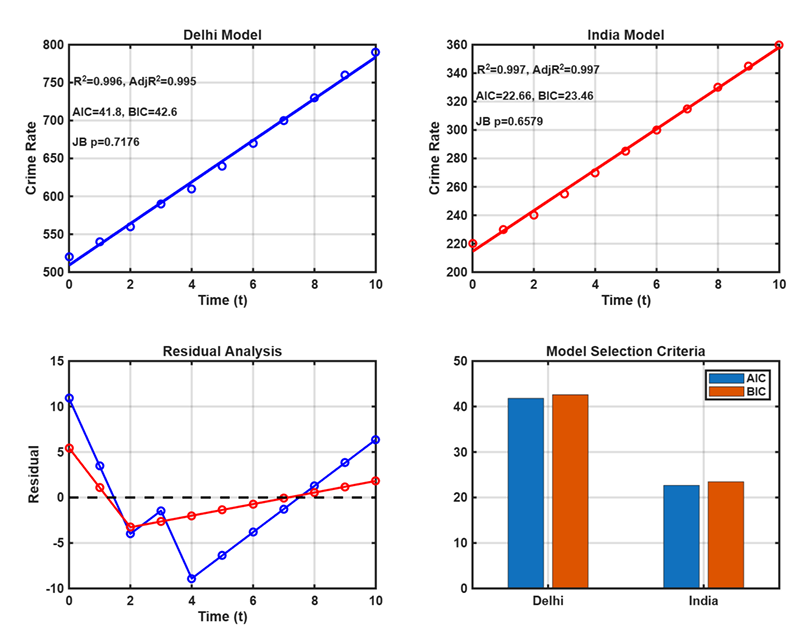
Social Change and Escalation of Crime: A Statistical Study of Delhi $vs$ India (2010-2020)
Journal of Social Systems and Policy Analysis | Volume 3, Issue 3: 109-120, 2026 | DOI: 10.62762/JSSPA.2026.887509
Abstract
Rapid social transformation in metropolitan regions has significantly reshaped crime dynamics, particularly in large urban centers such as Delhi. Understanding whether crime escalation reflects structural social change or random fluctuation is crucial for policy formulation. This study investigates the relationship between social transformation and crime escalation in Delhi within the broader national context of India over the period 2010-2020. The analysis employs a quantitative time-series and econometric framework, including trend analysis, regression modeling, correlation, elasticity estimation, and structural diagnostics. Secondary data are obtained from the National Crime Records Burea... More >

Graphical Abstract
Social Change and Escalation of Crime: A Statistical Study of Delhi $vs$ India (2010-2020)
Open Access | Research Article | 28 May 2026
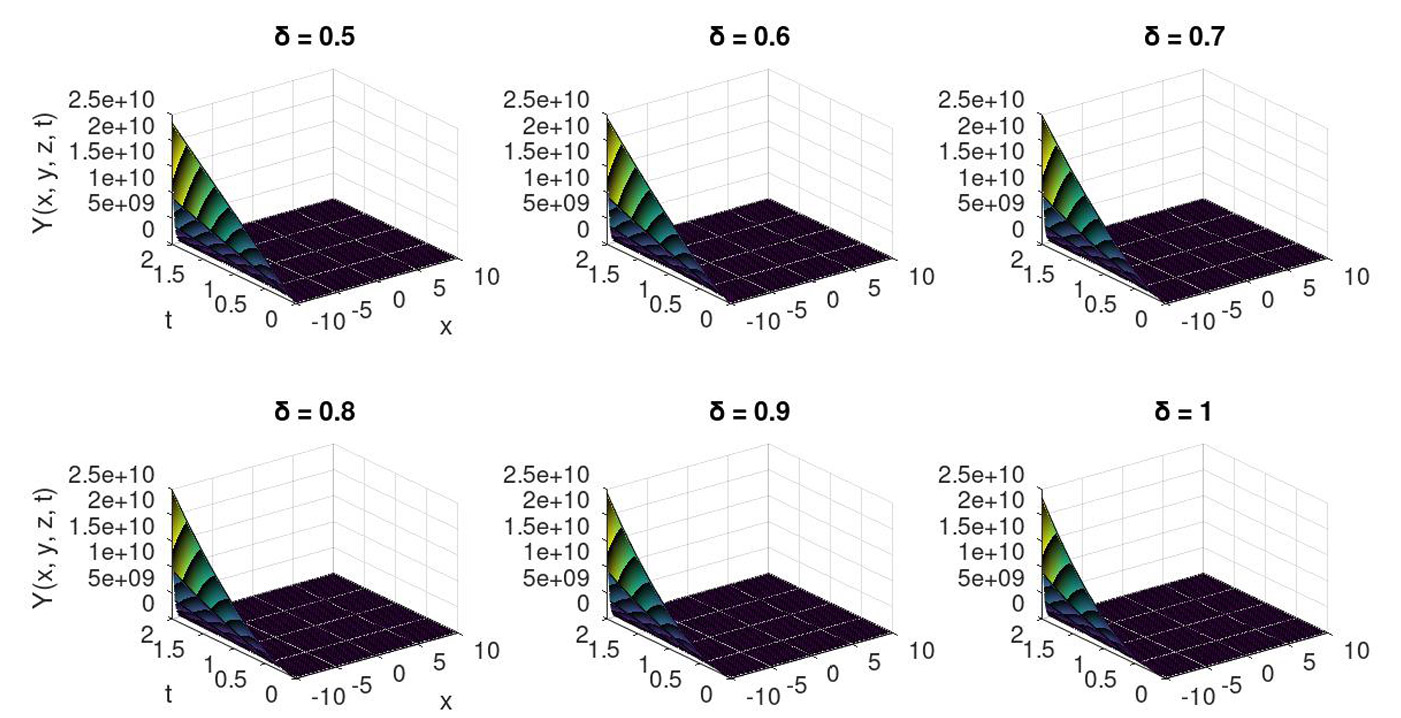
Semi-Analytical Solution of the Fractional Wazwaz-Benjamin-Bona-Mahony (WBBM) System via the Laplace Transform Adomian Decomposition Method
Journal of Numerical Simulations in Physics and Mathematics | Volume 2, Issue 1: 59-68, 2026 | DOI: 10.62762/JNSPM.2026.197265
Abstract
This study explores the application of the Adomian Decomposition Method (ADM), combined with the Laplace transform, to obtain approximate solutions of the time--fractional Wazwaz--Benjamin--Bona--Mahony (WBBM) equations. These equations, which describe wave phenomena in fluid dynamics within a fractional--time framework, present significant analytical challenges. By integrating the Laplace transform with ADM, a modified technique---referred to as the Laplace Transform Adomian Decomposition Method (LTADM)---is introduced. The time--fractional WBBM equations are solved using LTADM, and three--dimensional solution plots are generated for six different values of the fractional order \( \delta \)... More >

Graphical Abstract
Semi-Analytical Solution of the Fractional Wazwaz-Benjamin-Bona-Mahony (WBBM) System via the Laplace Transform Adomian Decomposition Method
Open Access | Research Article | 28 April 2026
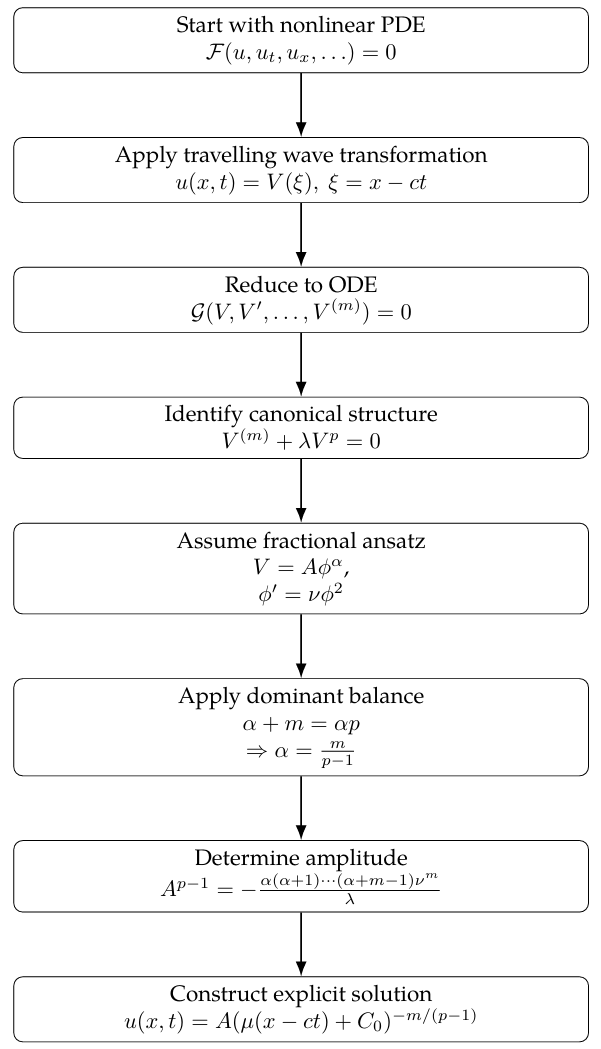
Unified Fractional Balancing Principle for Nonlinear Wave Equations: Exponential versus Algebraic Traveling Waves
ICCK Journal of Applied Mathematics | Volume 2, Issue 2: 166-172, 2026 | DOI: 10.62762/JAM.2026.568364
Abstract
A unified fractional simplest equation framework is developed for nonlinear power-law wave equations whose travelling-wave reductions lead to $U'' + \lambda U^p = 0$, $p>1$. In contrast to classical simplest equation methods restricted to integer polynomial expansions, we introduce a fractional power ansatz $U(\xi)=A\phi^\alpha(\xi)$ derived from a dominant balance principle. A general scaling theorem is established, proving that the admissible travelling-wave exponents are uniquely determined by $\alpha(p-1)=2$, yielding the explicit fractional law $\alpha=\frac{2}{p-1}$. Consequently, the equation admits algebraic travelling waves of the universal form $U(\xi)=A(\mu\xi+C_0)^{-2/(p-1)}$, wi... More >

Graphical Abstract
Unified Fractional Balancing Principle for Nonlinear Wave Equations: Exponential versus Algebraic Traveling Waves
Open Access | Research Article | 15 January 2026
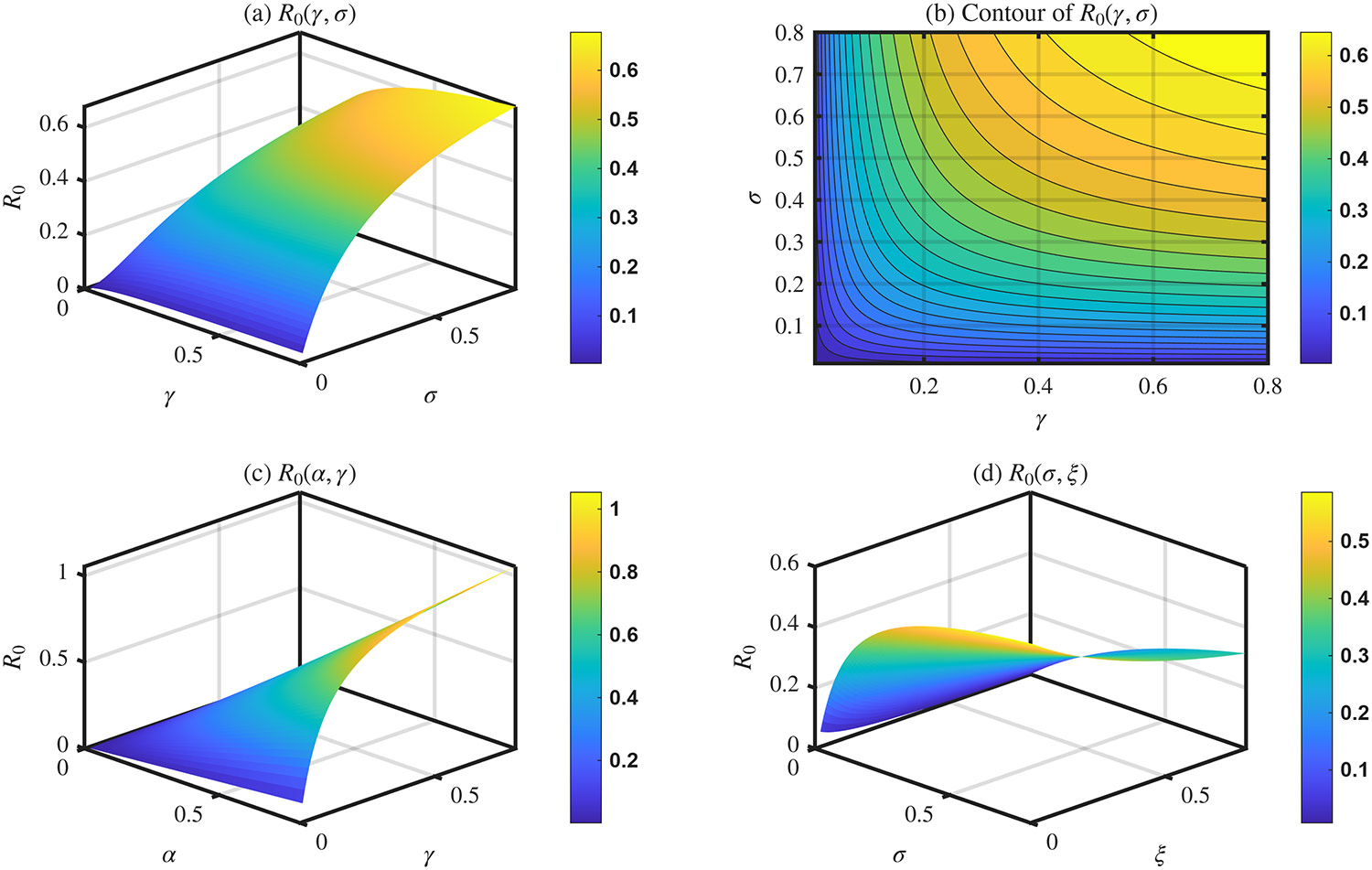
Equilibria and Stability Analysis of a Compartmental Model for Crime Dynamics with Recidivism and Corruption
ICCK Journal of Applied Mathematics | Volume 2, Issue 1: 1-43, 2026 | DOI: 10.62762/JAM.2025.240326
Abstract
A nonlinear compartmental model is developed to analyze crime dynamics in a structured society. The population is stratified into eight compartments: \(S(t)\) (susceptible), \(E(t)\) (exposed), \(C(t)\) (active criminals), \(C_v(t)\) (convicted criminals), \(P_h(t)\) (passive-honest), \(P_c(t)\) (committed-honest), \(J_h(t)\) (honest judges), and \(J_c(t)\) (corrupt judges). The model incorporates nonlinear mechanisms such as institutional corruption (\(\kappa_1\)), judicial correction (\(\kappa_2\)), recidivism feedback (\(\rho_1,\rho_2\)), exposure intensity (\(\eta_1\)), and rehabilitation (\(r_2\)), providing a realistic portrayal of crime--justice interactions. Solutions remain positive... More >

Graphical Abstract
Equilibria and Stability Analysis of a Compartmental Model for Crime Dynamics with Recidivism and Corruption
Free Access | Research Article | 10 December 2025 | Cited: Crossref logo  1 , Scopus 1
A Nonlinear Dynamical Model of Divorce Due to Extra-Marital Affairs with Long-Distance and Age-Structured Influences
Journal of Nonlinear Dynamics and Applications | Volume 1, Issue 2: 76-98, 2025 | DOI: 10.62762/JNDA.2025.544526
Abstract
This study introduces an age-structured compartmental model that analyzes transitions among stable marriages, long-distance relationships, extra-marital affairs, and divorce. Key behavioral parameters include $\lambda$ (transition to long-distance), $\delta$ (reunification), $\alpha_1$ and $\alpha_2$ (affair formation), $\beta$ (reconciliation), $\gamma$ (affair-driven divorce), and $\mu$ (non-affair divorce). The unmarried women's pool is structured by age, governed by an engagement function $\theta(a)$ and inflow $\Lambda(a)$. A nonlinear differential equation system captures how behavioral mechanisms collectively drive marital dynamics over time. Numerical simulations show that higher $\b... More >

Graphical Abstract
A Nonlinear Dynamical Model of Divorce Due to Extra-Marital Affairs with Long-Distance and Age-Structured Influences