ICCK

Ajay Ranga

Y.C.MA. University

Section 01

Academic Profile

No academic profile information available at the moment.

Section 02

Editorial Roles

This user currently does not serve as an editor for any ICCK journals.

Section 03

ICCK Publications

Open Access | Research Article | 28 May 2026
Social Change and Escalation of Crime: A Statistical Study of Delhi $vs$ India (2010-2020)
Journal of Social Systems and Policy Analysis | Volume 3, Issue 3: 109-120, 2026 | DOI: 10.62762/JSSPA.2026.887509
Abstract
Rapid social transformation in metropolitan regions has significantly reshaped crime dynamics, particularly in large urban centers such as Delhi. Understanding whether crime escalation reflects structural social change or random fluctuation is crucial for policy formulation. This study investigates the relationship between social transformation and crime escalation in Delhi within the broader national context of India over the period 2010-2020. The analysis employs a quantitative time-series and econometric framework, including trend analysis, regression modeling, correlation, elasticity estimation, and structural diagnostics. Secondary data are obtained from the National Crime Records Burea... More >

Graphical Abstract
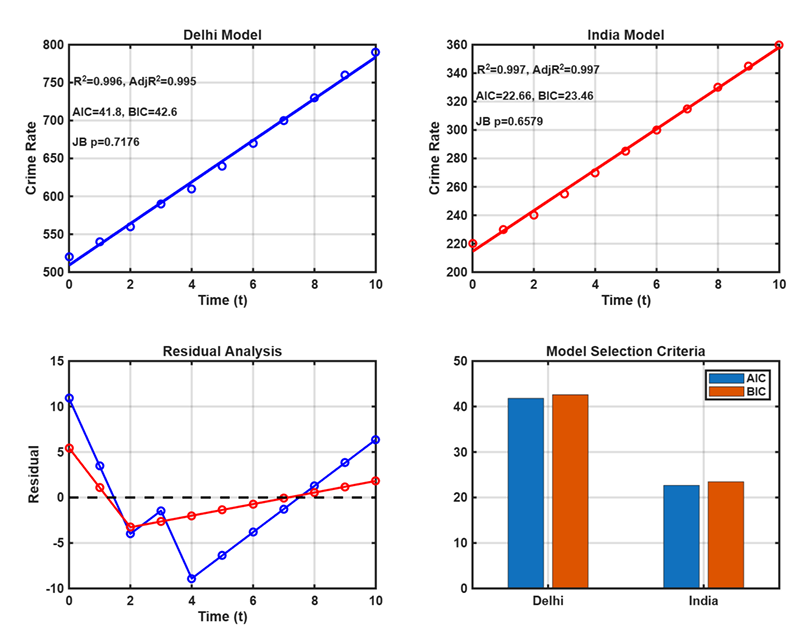
Social Change and Escalation of Crime: A Statistical Study of Delhi $vs$ India (2010-2020)
Open Access | Research Article | 15 January 2026
Equilibria and Stability Analysis of a Compartmental Model for Crime Dynamics with Recidivism and Corruption
ICCK Journal of Applied Mathematics | Volume 2, Issue 1: 1-43, 2026 | DOI: 10.62762/JAM.2025.240326
Abstract
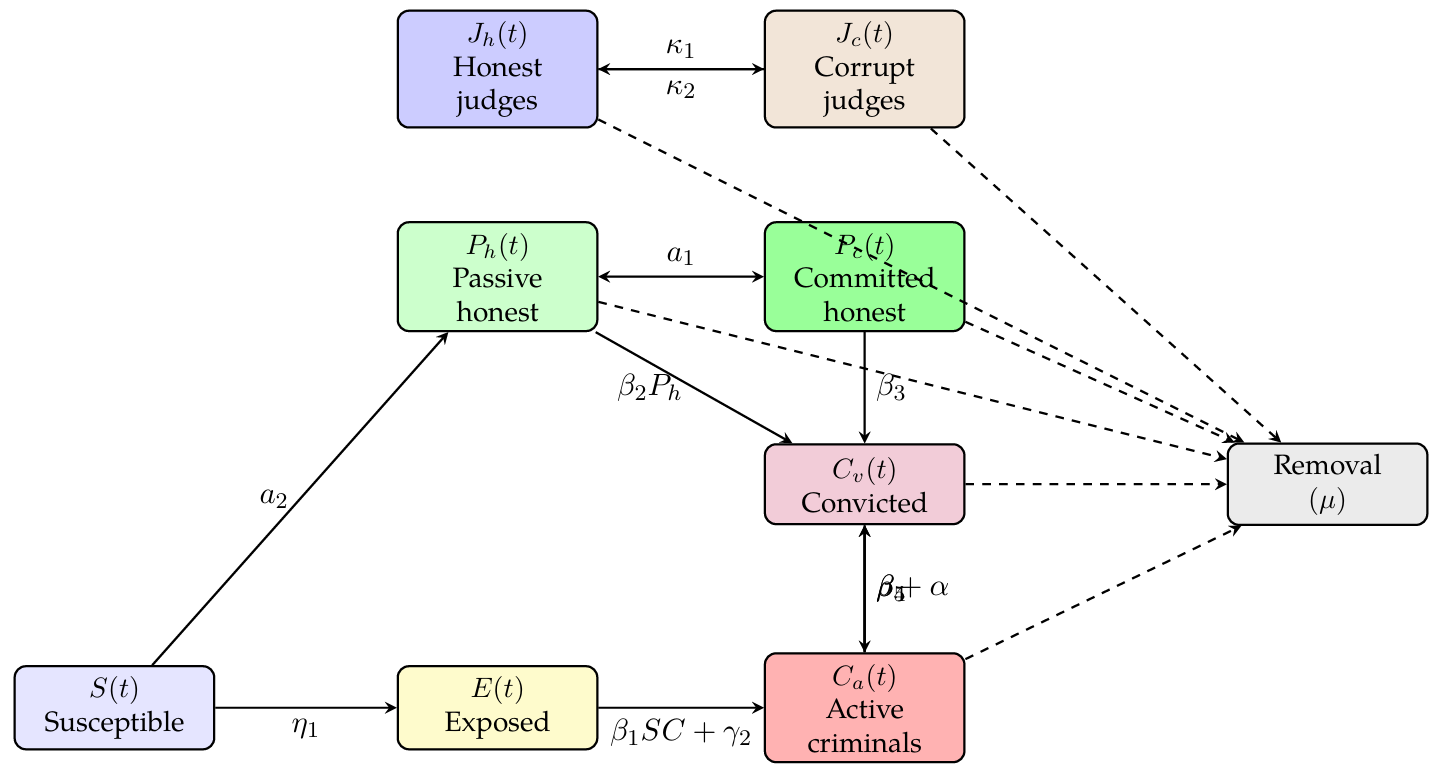
A nonlinear compartmental model is developed to analyze crime dynamics in a structured society. The population is stratified into eight compartments: \(S(t)\) (susceptible), \(E(t)\) (exposed), \(C(t)\) (active criminals), \(C_v(t)\) (convicted criminals), \(P_h(t)\) (passive-honest), \(P_c(t)\) (committed-honest), \(J_h(t)\) (honest judges), and \(J_c(t)\) (corrupt judges). The model incorporates nonlinear mechanisms such as institutional corruption (\(\kappa_1\)), judicial correction (\(\kappa_2\)), recidivism feedback (\(\rho_1,\rho_2\)), exposure intensity (\(\eta_1\)), and rehabilitation (\(r_2\)), providing a realistic portrayal of crime--justice interactions. Solutions remain positive... More >

Graphical Abstract
Equilibria and Stability Analysis of a Compartmental Model for Crime Dynamics with Recidivism and Corruption