

Social Change and Escalation of Crime: A Statistical Study of Delhi $vs$ India (2010-2020)


Article Information
Abstract
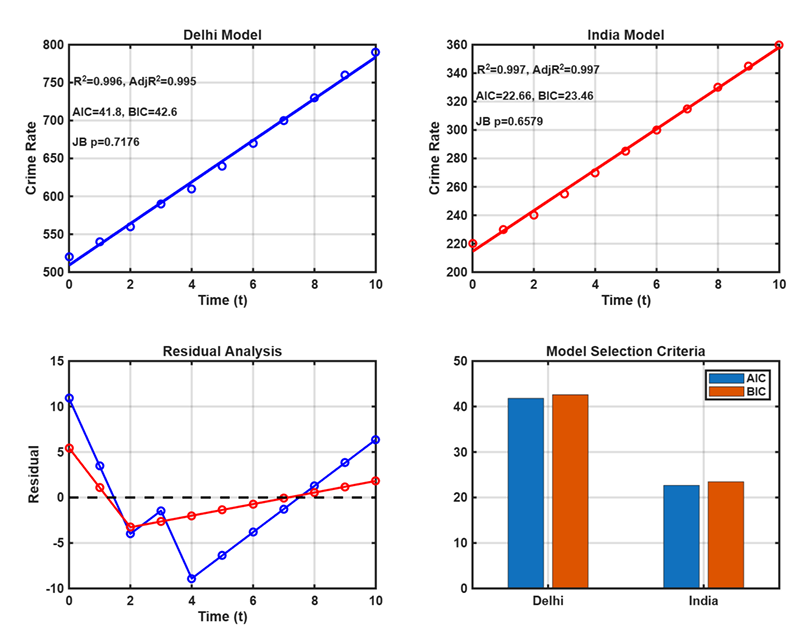
Rapid social transformation in metropolitan regions has significantly reshaped crime dynamics, particularly in large urban centers such as Delhi. Understanding whether crime escalation reflects structural social change or random fluctuation is crucial for policy formulation. This study investigates the relationship between social transformation and crime escalation in Delhi within the broader national context of India over the period 2010-2020. The analysis employs a quantitative time-series and econometric framework, including trend analysis, regression modeling, correlation, elasticity estimation, and structural diagnostics. Secondary data are obtained from the National Crime Records Bureau (NCRB), Delhi Economic Surveys, and related official statistical sources. The findings reveal a strong and statistically significant upward trend in crime, with Delhi exhibiting a higher escalation rate than the national average. High correlation indicates synchronized national and metropolitan crime dynamics, while elasticity estimates greater than unity suggest that Delhi responds more than proportionally to national changes. Robustness diagnostics confirm that this pattern is stable and not driven by nonlinearity, structural breaks, or volatility. The results suggest that crime escalation is a structurally embedded outcome of rapid social transformation, with metropolitan concentration amplifying national trends. These findings highlight the need for integrated socio-economic and urban policy interventions that address both structural drivers and city-specific vulnerabilities.
Graphical Abstract
Keywords
Data Availability Statement
Funding
Conflicts of Interest
AI Use Statement
Ethical Approval and Consent to Participate
References
- Durkheim, E. (1897). Suicide: A study in sociology. Free Press.
[CrossRef] [Google Scholar] - Merton, R. K. (1938). Social Structure and Anomie. American Sociological Review, 3(5), 672.
[CrossRef] [Google Scholar] - Becker, G. S. (1968). Crime and punishment: An economic approach. Journal of political economy, 76(2), 169-217.
[CrossRef] [Google Scholar] - Cohen, L. E., & Felson, M. (1979). Social change and crime rate trends: A routine activity approach. American sociological review, 588-608.
[CrossRef] [Google Scholar] - Shaw, C. R., & McKay, H. D. (1942). Juvenile delinquency and urban areas. University of Chicago Press.
[Google Scholar] - Sampson, R. J., & Groves, W. B. (1989). Community structure and crime: Testing social-disorganization theory. American journal of sociology, 94(4), 774-802.
[CrossRef] [Google Scholar] - Bursik Jr, R. J. (1988). Social disorganization and theories of crime and delinquency: Problems and prospects. criminology, 26(4), 519-552.
[CrossRef] [Google Scholar] - Kaufman, J. M. (2017). Anomie, strain and subcultural theories of crime. Routledge.
[Google Scholar] - Felson, M. (2002). Crime and everyday life. Sage.
[Google Scholar] - Ehrlich, I. (1973). Participation in illegitimate activities: A theoretical and empirical investigation. Journal of Political Economy, 81(3), 521–565.
[CrossRef] [Google Scholar] - National Crime Records Bureau. (2023). Crime in India reports. Ministry of Home Affairs, Government of India. https://data.opencity.in/dataset/crime-in-india-2023
[Google Scholar]
Cite This Article
TY  - JOUR
AU  - Pippal, Sarita
AU  - Ranga, Ajay
PY  - 2026
DA  - 2026/05/28
TI  - Social Change and Escalation of Crime: A Statistical Study of Delhi $vs$ India (2010-2020)
JO  - Journal of Social Systems and Policy Analysis
T2  - Journal of Social Systems and Policy Analysis
JF  - Journal of Social Systems and Policy Analysis
VL  - 3
IS  - 3
SP  - 109
EP  - 120
DO  - 10.62762/JSSPA.2026.887509
UR  - https://www.icck.org/article/abs/JSSPA.2026.887509
KW  - social change
KW  - crime escalation
KW  - Delhi
KW  - inequality
KW  - urbanization
KW  - statistical analysis
AB  - Rapid social transformation in metropolitan regions has significantly reshaped crime dynamics, particularly in large urban centers such as Delhi. Understanding whether crime escalation reflects structural social change or random fluctuation is crucial for policy formulation. This study investigates the relationship between social transformation and crime escalation in Delhi within the broader national context of India over the period 2010-2020. The analysis employs a quantitative time-series and econometric framework, including trend analysis, regression modeling, correlation, elasticity estimation, and structural diagnostics. Secondary data are obtained from the National Crime Records Bureau (NCRB), Delhi Economic Surveys, and related official statistical sources. The findings reveal a strong and statistically significant upward trend in crime, with Delhi exhibiting a higher escalation rate than the national average. High correlation indicates synchronized national and metropolitan crime dynamics, while elasticity estimates greater than unity suggest that Delhi responds more than proportionally to national changes. Robustness diagnostics confirm that this pattern is stable and not driven by nonlinearity, structural breaks, or volatility. The results suggest that crime escalation is a structurally embedded outcome of rapid social transformation, with metropolitan concentration amplifying national trends. These findings highlight the need for integrated socio-economic and urban policy interventions that address both structural drivers and city-specific vulnerabilities.
SN  - 3068-5540
PB  - Institute of Central Computation and Knowledge
LA  - English
ER  -
@article{Pippal2026Social,
  author = {Sarita Pippal and Ajay Ranga},
  title = {Social Change and Escalation of Crime: A Statistical Study of Delhi \$vs\$ India (2010-2020)},
  journal = {Journal of Social Systems and Policy Analysis},
  year = {2026},
  volume = {3},
  number = {3},
  pages = {109-120},
  doi = {10.62762/JSSPA.2026.887509},
  url = {https://www.icck.org/article/abs/JSSPA.2026.887509},
  abstract = {Rapid social transformation in metropolitan regions has significantly reshaped crime dynamics, particularly in large urban centers such as Delhi. Understanding whether crime escalation reflects structural social change or random fluctuation is crucial for policy formulation. This study investigates the relationship between social transformation and crime escalation in Delhi within the broader national context of India over the period 2010-2020. The analysis employs a quantitative time-series and econometric framework, including trend analysis, regression modeling, correlation, elasticity estimation, and structural diagnostics. Secondary data are obtained from the National Crime Records Bureau (NCRB), Delhi Economic Surveys, and related official statistical sources. The findings reveal a strong and statistically significant upward trend in crime, with Delhi exhibiting a higher escalation rate than the national average. High correlation indicates synchronized national and metropolitan crime dynamics, while elasticity estimates greater than unity suggest that Delhi responds more than proportionally to national changes. Robustness diagnostics confirm that this pattern is stable and not driven by nonlinearity, structural breaks, or volatility. The results suggest that crime escalation is a structurally embedded outcome of rapid social transformation, with metropolitan concentration amplifying national trends. These findings highlight the need for integrated socio-economic and urban policy interventions that address both structural drivers and city-specific vulnerabilities.},
  keywords = {social change, crime escalation, Delhi, inequality, urbanization, statistical analysis},
  issn = {3068-5540},
  publisher = {Institute of Central Computation and Knowledge}
}
Article Metrics
Publisher's Note
ICCK stays neutral with regard to jurisdictional claims in published maps and institutional affiliations.
Rights and Permissions
 Copyright © 2026 by the Author(s). Published by Institute of Central Computation and Knowledge. This article is an open access article distributed under the terms and conditions of the Creative Commons Attribution (CC BY) license (https://creativecommons.org/licenses/by/4.0/), which permits use, sharing, adaptation, distribution and reproduction in any medium or format, as long as you give appropriate credit to the original author(s) and the source, provide a link to the Creative Commons licence, and indicate if changes were made.


Portico
