

The Influences of Transformational Leadership on the Organizational Innovation Performance



Article Information
Abstract
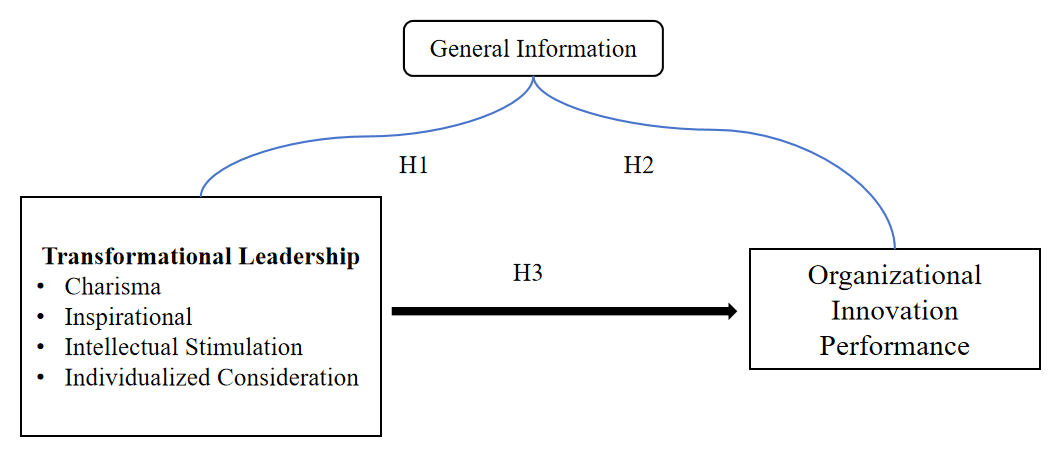
This study aims to explore the enhancement of corporate innovation and performance by analyzing the internal and external corporate environments and their synergistic effects. It emphasizes the importance of human capital, with a spotlight on leaders as the primary shapers of the internal corporate environment. Drawing from existing literature, a theoretical framework is established to investigate the effects of transformational leadership on organizational innovation outcomes. Through the creation of scales and questionnaires, a survey was conducted at Beijing T Company, and the data was empirically analyzed using regression techniques. The findings indicate that transformational leadership plays a significant role in boosting organizational innovation performance, which is partly influenced by education background. The research integrates literature review with statistical analysis to uncover the mechanisms and patterns of influence that transformational leadership has on organizational innovation, providing a theoretical foundation that can be applied to other organizational contexts.
Graphical Abstract
Keywords
Data Availability Statement
Funding
Conflicts of Interest
Ethical Approval and Consent to Participate
References
- Forester, J., & Clegg, S. R. (1991). Burns, JM (1978). Leadership. New York: Harper and Row. Leadership Quarterly, 2(1).
[Google Scholar] - Bass, B. M., & Bass Bernard, M. (1985). Leadership and performance beyond expectations.
[Google Scholar] - Yukl, G. A. (1998). Leadership in organizations. New York: Prentice-Hall.
[Google Scholar] - Yukl, G. (2002). Leadership in organizations (5 ed.). Englewood Cliffs, NJ: Prentice-Hall.
[Google Scholar] - Sergiovanni, T. J. (1990). The principalship: A reflective practice perspective. Toronto: AUyn and Bacon.
[Google Scholar] - Leithwood, K. (1992). Transformational Leadership and School Restructuring.
[Google Scholar] - Gumusluoglu, L., & Ilsev, A. (2009). Transformational leadership, creativity, and organizational innovation. \textit{Journal of business research, 62}(4), 461-473.
[CrossRef] [Google Scholar] - Fields, D. L., & Herold, D. M. (1997). Using the leadership practices inventory to measure transformational and transactional leadership. Educational and Psychological Measurement, 57(4), 569-579.
[CrossRef] [Google Scholar] - Pillai, R., Schriesheim, C. A., & Williams, E. S. (1999). Fairness perceptions and trust as mediators for transformational and transactional leadership: A two-sample study. Journal of management, 25(6), 897-933.
[CrossRef] [Google Scholar] - Wilmore, E., & Thomas, C. (2001). The new century: Is it too late for transformational leadership?. Educational Horizons, 79(3), 115-123.
[Google Scholar] - Ackoff, R. L. (2010). Systems thinking for curious managers. Triarchy Press.
[Google Scholar] - Yammarino, F. J., & Dubinsky, A. J. (1994). Transformational leadership theory: Using levels of analysis to determine boundary conditions. Personnel psychology, 47(4), 787-811.
[CrossRef] [Google Scholar] - Robbins, S. P., & Judge, T. (2009). Organizational behavior. Pearson South Africa.
[Google Scholar] - Jung, D. I., Chow, C., & Wu, A. (2003). The role of transformational leadership in enhancing organizational innovation: Hypotheses and some preliminary findings. The leadership quarterly, 14(4-5), 525-544.
[CrossRef] [Google Scholar] - Xie, X., Zuo, L. L., & Liu, S. Y. (2014). Impact of synergic innovation models of SMEs on synergic innovation effect: Double-moderating effect of synergic mechanism and synergic environment. Science of Science and Management of S. & T, 35(5), 72-81.
[Google Scholar] - Dong, J. (2017). Research on Innovation Ecosystem from a Micro Perspective: Concept and Definition. Science and Technology Progress and Countermeasures, 34(8): 9-14.
[Google Scholar] - Service, R. W., & Boockholdt, J. L. (1998). Factors leading to innovation: a study of managers' perspectives. Creativity Research Journal, 11(4), 295-307.
[CrossRef] [Google Scholar] - Smith, W. K., & Tushman, M. L. (2005). Managing strategic contradictions: A top management model for managing innovation streams. Organization science, 16(5), 522-536.
[CrossRef] [Google Scholar] - Wang, Y., Po Lo, H., Chi, R., & Yang, Y. (2004). An integrated framework for customer value and customer‐relationship‐management performance: a customer‐based perspective from China. Managing service quality: An international journal, 14(2/3), 169-182.
[CrossRef] [Google Scholar] - Yeşil, S., Koska, A., & Büyükbeşe, T. (2013). Knowledge sharing process, innovation capability and innovation performance: An empirical study. Procedia-Social and Behavioral Sciences, 75, 217-225.
[CrossRef] [Google Scholar] - Bass, B. M. (2006). Transformational leadership. Lawrence Elabaum Associating.
[Google Scholar] - Crossan, M. M., & Apaydin, M. (2010). A multi‐dimensional framework of organizational innovation: A systematic review of the literature. Journal of management studies, 47(6), 1154-1191.
[CrossRef] [Google Scholar] - Lovelace, K., Shapiro, D. L., & Weingart, L. R. (2001). Maximizing cross-functional new product teams' innovativeness and constraint adherence: A conflict communications perspective. Academy of management journal, 44(4), 779-793.
[CrossRef] [Google Scholar] - Kouzes, J. M., & Posner, B. Z. (2016). Learning leadership: The five fundamentals of becoming an exemplary leader. John Wiley & Sons.
[Google Scholar] - DeVellis, R. F., & Thorpe, C. T. (2021). Scale development: Theory and applications. Sage publications.
[Google Scholar]
Cite This Article
TY  - JOUR
AU  - Guo, Hangyuan
AU  - Xiong, Jing
AU  - Deng, Zhengfan
PY  - 2024
DA  - 2024/12/30
TI  - The Influences of Transformational Leadership on the Organizational Innovation Performance
JO  - Journal of Social Systems and Policy Analysis
T2  - Journal of Social Systems and Policy Analysis
JF  - Journal of Social Systems and Policy Analysis
VL  - 1
IS  - 4
SP  - 113
EP  - 130
DO  - 10.62762/JSSPA.2024.300794
UR  - https://www.icck.org/article/abs/JSSPA.2024.300794
KW  - transformational leadership
KW  - organizational innovation performance
KW  - social cognitive theory
KW  - resource-based theory
AB  - This study aims to explore the enhancement of corporate innovation and performance by analyzing the internal and external corporate environments and their synergistic effects. It emphasizes the importance of human capital, with a spotlight on leaders as the primary shapers of the internal corporate environment. Drawing from existing literature, a theoretical framework is established to investigate the effects of transformational leadership on organizational innovation outcomes. Through the creation of scales and questionnaires, a survey was conducted at Beijing T Company, and the data was empirically analyzed using regression techniques. The findings indicate that transformational leadership plays a significant role in boosting organizational innovation performance, which is partly influenced by education background. The research integrates literature review with statistical analysis to uncover the mechanisms and patterns of influence that transformational leadership has on organizational innovation, providing a theoretical foundation that can be applied to other organizational contexts.
SN  - 3068-5540
PB  - Institute of Central Computation and Knowledge
LA  - English
ER  -
@article{Guo2024The,
  author = {Hangyuan Guo and Jing Xiong and Zhengfan Deng},
  title = {The Influences of Transformational Leadership on the Organizational Innovation Performance},
  journal = {Journal of Social Systems and Policy Analysis},
  year = {2024},
  volume = {1},
  number = {4},
  pages = {113-130},
  doi = {10.62762/JSSPA.2024.300794},
  url = {https://www.icck.org/article/abs/JSSPA.2024.300794},
  abstract = {This study aims to explore the enhancement of corporate innovation and performance by analyzing the internal and external corporate environments and their synergistic effects. It emphasizes the importance of human capital, with a spotlight on leaders as the primary shapers of the internal corporate environment. Drawing from existing literature, a theoretical framework is established to investigate the effects of transformational leadership on organizational innovation outcomes. Through the creation of scales and questionnaires, a survey was conducted at Beijing T Company, and the data was empirically analyzed using regression techniques. The findings indicate that transformational leadership plays a significant role in boosting organizational innovation performance, which is partly influenced by education background. The research integrates literature review with statistical analysis to uncover the mechanisms and patterns of influence that transformational leadership has on organizational innovation, providing a theoretical foundation that can be applied to other organizational contexts.},
  keywords = {transformational leadership, organizational innovation performance, social cognitive theory, resource-based theory},
  issn = {3068-5540},
  publisher = {Institute of Central Computation and Knowledge}
}
Article Metrics
Publisher's Note
ICCK stays neutral with regard to jurisdictional claims in published maps and institutional affiliations.
Rights and Permissions
 Copyright © 2024 by the Author(s). Published by Institute of Central Computation and Knowledge. This article is an open access article distributed under the terms and conditions of the Creative Commons Attribution (CC BY) license (https://creativecommons.org/licenses/by/4.0/), which permits use, sharing, adaptation, distribution and reproduction in any medium or format, as long as you give appropriate credit to the original author(s) and the source, provide a link to the Creative Commons licence, and indicate if changes were made.


Portico
