

The Development of China-Central Asia Trade Cooperation (2013-2023)



Article Information
Abstract
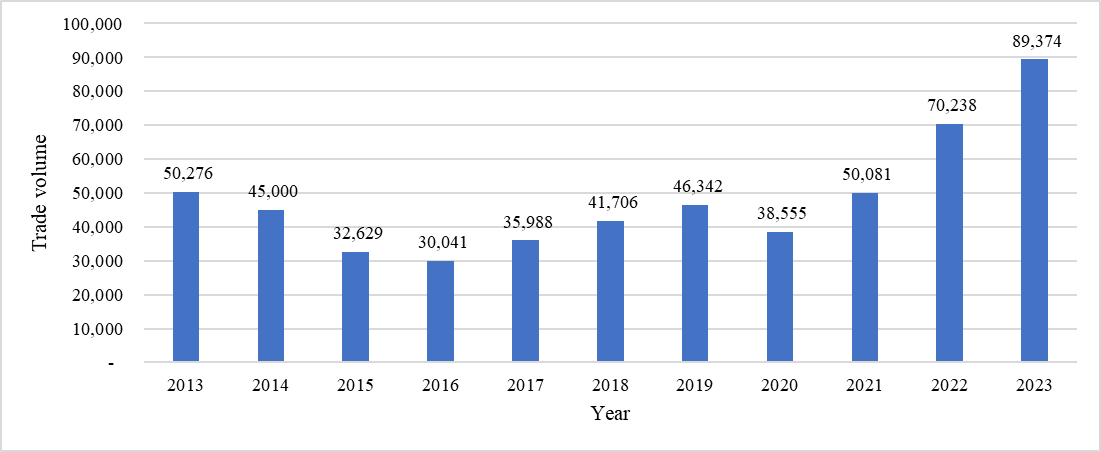
Economic cooperation has been a crucial driving force for promoting China-Central Asia relations. And trade cooperation constitutes a principal component of this driving force. This study presents and assesses the trade relations between China and the five Central Asian countries from 2013 to 2023, aiming to comprehensively depict the evolution of trade ties between the two sides. This study also analyzes the challenges, including trade imbalance, weak trade facilitation and geopolitical risks, may bring to trade cooperation. At the same time, prospects for China-Central Asia trade cooperation, such as enhanced political relations, improved infrastructure connectivity and the potential of e-commerce, are explored in detail.
Graphical Abstract
Keywords
Data Availability Statement
Funding
Conflicts of Interest
Ethical Approval and Consent to Participate
References
- Paramonov, V. (2005). China & Central Asia: present & future of economic relations. Defence Academy of the United Kingdom, Conflict Studies Research Centre.
[Google Scholar] - Li, J. (2022). China-central Asia economic cooperation for 30 years: Policy evolution, progress in key areas and future development paths. Russian Studies, 5, 74-94.
[Google Scholar] - Xi, J. (2013). Promote People-to-People Friendship and Create a Better Future. People’s Daily, 003.
[Google Scholar] - Xi, J. (2022). Joining Hands for a Shared Future - Remarks by Chinese President Xi Jinping at the Virtual Summit to Commemorate the 30th Anniversary of Diplomatic Relations Between China and Central Asian Countries. Gazette of the State Council of the People's Republic of China, 05, 4-6.
[Google Scholar] - Foreign trade turnover of the Republic of Uzbekistan (January-December 2023). (2025, January 20). National Statistics Committee of the Republic of Uzbekistan. Retrieved from https://stat.uz/en/press-center/news-of-committee/49771-foreign-trade-turnover-of-the-rep2213ublic-of-uzbekistan-january-december-202334
[Google Scholar] - Kyrgyzstan's foreign trade up 29.9 pct in 2023. (2023). Xinhua – China, World, Business, Sports, Photos and Video | English.news.cn. Retrieved from https://english.news.cn/20240217/de28e82680604288a4aa5b4c8b36e10d/c.html
[Google Scholar] - Foreign trade turnover of the Republic of Kazakhstan (January-December 2023). (2024, February 15). Bureau of National Statistics. Retrieved from https://stat.gov.kz/en/industries/economy/foreign-market/publications/123067/
[Google Scholar] - Zhang, F., & Wang, Q. R. (2023). Analysis on the New Progress and Development Direction of Cooperation between China and Central Asian Countries under the Background of the Belt and Road Initiative. Ningxia Social Sciences, 04, 65-72.
[Google Scholar] - Wang, H. (2023). Thirty-Year Economic and Trade Cooperation between China and Central Asian Countries: Achievements and Prospects. Journal of Eurasian Economy, 04, 26-52+125.
[Google Scholar] - Wang, J. (2024). Current Situation and Future Prospects of Economic and Trade Cooperation between China and Central Asia. People’s Tribune, 19, 76-80.
[Google Scholar] - OECD (2023). Trade Facilitation in Central Asia. OECD Publishing, Paris.
[Google Scholar] - Uzbekistan continues to make progress towards WTO accession. (n.d.). World Trade Organization - Global trade. Retrieved from https://www.wto.org/english/news_e/news24_e/acc_24may24_e.htm
[Google Scholar] - Accession status: Turkmenistan. (n.d.). World Trade Organization - Global trade. Retrieved from https://www.wto.org/english/thewto_e/acc_e/a1_turkmenistan_e.htm
[Google Scholar] - Global Risks Report 2024. World Economic Forum. Retrieved from https://www.weforum.org/publications/global-risks-report-2024/
[Google Scholar] - Caldara, D., & Iacoviello, M. (2022). Measuring geopolitical risk. American economic review, 112(4), 1194-1225.
[Google Scholar] - Su, C. (2023). From “Marginal Zone” to “Intermediate Zone”: An Analysis of the Stability of Central Asia from a Geopolitical Perspective. Russian, East European & Central Asian Studies, 03, 122-141+161.
[Google Scholar] - Nobody’s backyard: A confident Central Asia. (2024). Carnegie Endowment for International Peace. Retrieved from https://carnegieendowment.org/research/2024/09/nobodys-backyard-a-confident-central-asia?lang=en
[Google Scholar] - Wang, H. (2020). New Economic Situation, New Measures and Prospects of Central Asian Countries. Journal of Eurasian Economy, 02, 82-100+128.
[Google Scholar] - Joint Statement of the Inaugural China-Central Asian Countries Foreign Ministers’ Meeting. The Ministry of Foreign Affairs of the People’s Republic of China. Retrieved from https://www.mfa.gov.cn/web/ziliao_674904/1179_674909/202007/t20200716_9869222.shtml
[Google Scholar] - Wang Yi Talks about the Outcomes and Consensus of the Third China+Central Asia Foreign Ministers' Meeting. The Ministry of Foreign Affairs of the People’s Republic of China. Retrieved from https://www.fmprc.gov.cn/eng/xw/zyxw/202405/t20240530_11331030.html
[Google Scholar] - Wang Yi: The China-Central Asia Summit Creates a New Platform for Good-neighbourliness and Friendly Cooperation in the Region. The Ministry of Foreign Affairs of the People’s Republic of China. Retrieved from https://www.mfa.gov.cn/eng/wjbzhd/202403/t20240319_11262316.html
[Google Scholar] - Abduvaliev, M. (2024). An Overview of Central Asian Trade Growth and Economic Integration. Visiting Fellow Program. Xinjiang: CAREC Institute.
[Google Scholar] - Heads of state of China, Kyrgyzstan and Uzbekistan extend congratulations on the signing of the trilateral intergovernmental agreement on the China-Kyrgyzstan-Uzbekistan railway project via video Link. (2024, June 6). The Ministry of Foreign Affairs of the People’s Republic of China. Retrieved from https://www.fmprc.gov.cn/eng/wjb/zzjg_663340/dozys_664276/xwlb_664278/202406/t20240609_11415967.html
[Google Scholar] - Gao, Z. (2023). Full text: The Belt and Road initiative: A key pillar of the global community of shared future. The State Council Information Office of the People's Republic of China. Retrieved from https://english.scio.gov.cn/whitepapers/2023-10/10/content_116735061.htm
[Google Scholar] - Central Asia e-Commerce market Product Type, Transaction, Payment Mode, & Country 2024-2032. (2024). Market Research Company, Reports and Consulting Services | IMARC. Retrieved from https://www.imarcgroup.com/central-asia-e-commerce-market
[Google Scholar] - Daryo.Uz. (2024, March 13). Central Asian countries consider establishing dedicated bank accounts for e-commerce transactions. Daryo.uz. Retrieved from https://daryo.uz/en/2024/03/13/central-asian-countries-consider-establishing-dedicated-bank-accounts-for-e-commerce-transactions
[Google Scholar] - Joint Statement Between Leaders of China and the Five Central Asian Countries on the 30th Anniversary of the Establishment of Diplomatic Ties. (2022). Xinhua News Agency. Retrieved from https://www.news.cn/silkroad/2022-01/26/c_1128300418.htm
[Google Scholar] - Research Group of the National Institute of Development Strategy of Wuhan University. (2023). Strategic Thinking on Deepening the Comprehensive Cooperation between China and Central Asia. Economic Review Journal, 09.
[Google Scholar] - Official Information Source of the Prime Minister of the Republic of Kazakhstan. (2024). Olzhas Bektenov takes part in VII China International Import Expo opening in Shanghai. Retrieved from https://primeminister.kz/en/news/olzhas-bektenov-takes-part-in-vii-china-international-import-expo-opening-in-shanghai-29275
[Google Scholar]
Cite This Article
TY  - JOUR
AU  - Zhang, Tingting
PY  - 2025
DA  - 2025/03/22
TI  - The Development of China-Central Asia Trade Cooperation (2013-2023)
JO  - Journal of Social Systems and Policy Analysis
T2  - Journal of Social Systems and Policy Analysis
JF  - Journal of Social Systems and Policy Analysis
VL  - 2
IS  - 1
SP  - 18
EP  - 28
DO  - 10.62762/JSSPA.2024.265967
UR  - https://www.icck.org/article/abs/JSSPA.2024.265967
KW  - China
KW  - Central Asian Countries
KW  - trade cooperation
KW  - Belt and Road initiative
AB  - Economic cooperation has been a crucial driving force for promoting China-Central Asia relations. And trade cooperation constitutes a principal component of this driving force. This study presents and assesses the trade relations between China and the five Central Asian countries from 2013 to 2023, aiming to comprehensively depict the evolution of trade ties between the two sides. This study also analyzes the challenges, including trade imbalance, weak trade facilitation and geopolitical risks, may bring to trade cooperation. At the same time, prospects for China-Central Asia trade cooperation, such as enhanced political relations, improved infrastructure connectivity and the potential of e-commerce, are explored in detail.
SN  - 3068-5540
PB  - Institute of Central Computation and Knowledge
LA  - English
ER  -
@article{Zhang2025The,
  author = {Tingting Zhang},
  title = {The Development of China-Central Asia Trade Cooperation (2013-2023)},
  journal = {Journal of Social Systems and Policy Analysis},
  year = {2025},
  volume = {2},
  number = {1},
  pages = {18-28},
  doi = {10.62762/JSSPA.2024.265967},
  url = {https://www.icck.org/article/abs/JSSPA.2024.265967},
  abstract = {Economic cooperation has been a crucial driving force for promoting China-Central Asia relations. And trade cooperation constitutes a principal component of this driving force. This study presents and assesses the trade relations between China and the five Central Asian countries from 2013 to 2023, aiming to comprehensively depict the evolution of trade ties between the two sides. This study also analyzes the challenges, including trade imbalance, weak trade facilitation and geopolitical risks, may bring to trade cooperation. At the same time, prospects for China-Central Asia trade cooperation, such as enhanced political relations, improved infrastructure connectivity and the potential of e-commerce, are explored in detail.},
  keywords = {China, Central Asian Countries, trade cooperation, Belt and Road initiative},
  issn = {3068-5540},
  publisher = {Institute of Central Computation and Knowledge}
}
Article Metrics
Publisher's Note
ICCK stays neutral with regard to jurisdictional claims in published maps and institutional affiliations.
Rights and Permissions
 Copyright © 2025 by the Author(s). Published by Institute of Central Computation and Knowledge. This article is an open access article distributed under the terms and conditions of the Creative Commons Attribution (CC BY) license (https://creativecommons.org/licenses/by/4.0/), which permits use, sharing, adaptation, distribution and reproduction in any medium or format, as long as you give appropriate credit to the original author(s) and the source, provide a link to the Creative Commons licence, and indicate if changes were made.


Portico
