

Enhancing Energy Performance in Irish Dwellings: A Machine Learning Approach to Retrofit Interventions




Article Information
Abstract
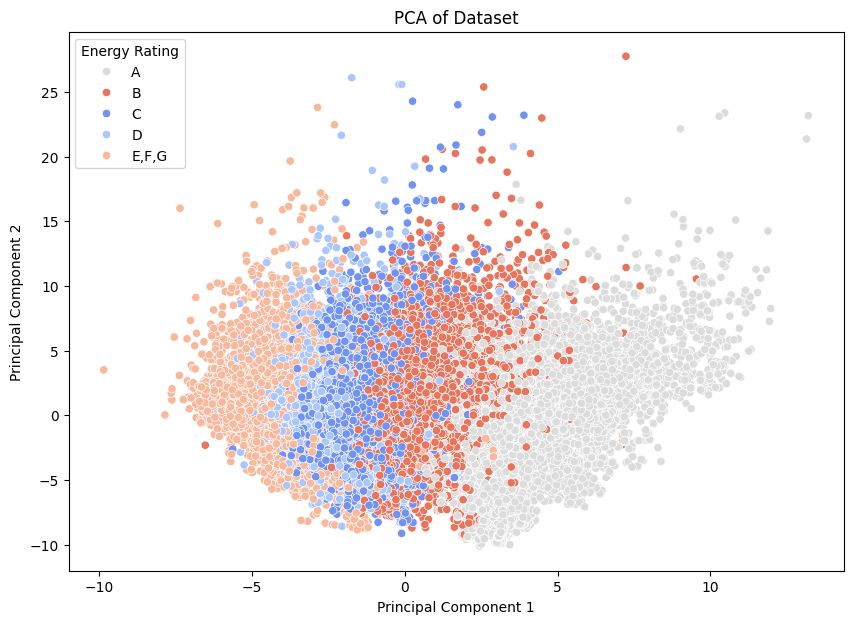
This research investigates the impact of retrofit interventions on the energy performance of domestic buildings in Ireland using predictive machine learning (ML) models. The study applies machine learning models to classify the Building Energy Rating (BER) of dwellings in County Dublin, Ireland. With a focus on feature selection in a highly correlated dataset, the study predicts energy ratings with an accuracy of 69%. The Light Gradient Boosting Machine classifier is observed to achieve the best performance among more than twenty ML models applied for prediction. The study also performs retrofit experiments on dwelling features and evaluates their effectiveness in improving energy performance, contributing to the Energy Performance of Buildings Directive (EPBD) applicable in Ireland, using statistical inference. This research highlights the potential of data-driven approaches for optimizing energy utilization and shaping policies for sustainable building practices.
Graphical Abstract
Keywords
Data Availability Statement
Funding
Conflicts of Interest
Ethical Approval and Consent to Participate
References
- Cho, S. H., Lee, K. T., Kim, S. H., & Kim, J. H. (2019). Image processing for sustainable remodeling: Introduction to real-time quality inspection system of external wall insulation works. Sustainability, 11(4), 1081.
[CrossRef] [Google Scholar] - Cai, W., Wen, X., Wang, S., & Wang, L. (2019). A real-time detection method of building energy efficiency based on image processing. Journal of Visual Communication and Image Representation, 60, 295-304.
[CrossRef] [Google Scholar] - Tang, Y., Ten, C. W., Wang, C., & Parker, G. (2015). Extraction of energy information from analog meters using image processing. IEEE transactions on smart grid, 6(4), 2032-2040.
[CrossRef] [Google Scholar] - Sharma, A., Singh, P. K., & Kumar, Y. (2020). An integrated fire detection system using IoT and image processing technique for smart cities. Sustainable Cities and Society, 61, 102332.
[CrossRef] [Google Scholar] - Burger, W., & Burge, M. J. (2022). Digital image processing: An algorithmic introduction. Springer Nature.
[Google Scholar] - Monga, V., Li, Y., & Eldar, Y. C. (2021). Algorithm unrolling: Interpretable, efficient deep learning for signal and image processing. IEEE Signal Processing Magazine, 38(2), 18-44.
[CrossRef] [Google Scholar] - Chitradevi, B., & Srimathi, P. (2014). An overview on image processing techniques. International Journal of Innovative Research in Computer and Communication Engineering, 2(11), 6466-6472.
[Google Scholar] - Nadkarni, P. M., Ohno-Machado, L., & Chapman, W. W. (2011). Natural language processing: an introduction. Journal of the American Medical Informatics Association, 18(5), 544-551.
[CrossRef] [Google Scholar] - Hirschberg, J., & Manning, C. D. (2015). Advances in natural language processing. Science, 349(6245), 261-266.
[CrossRef] [Google Scholar] - Min, B., Ross, H., Sulem, E., Veyseh, A. P. B., Nguyen, T. H., Sainz, O., ... & Roth, D. (2023). Recent advances in natural language processing via large pre-trained language models: A survey. ACM Computing Surveys, 56(2), 1-40.
[CrossRef] [Google Scholar] - Lauriola, I., Lavelli, A., & Aiolli, F. (2022). An introduction to deep learning in natural language processing: Models, techniques, and tools. Neurocomputing, 470, 443-456.
[CrossRef] [Google Scholar] - Purwins, H., Li, B., Virtanen, T., Schlüter, J., Chang, S. Y., & Sainath, T. (2019). Deep learning for audio signal processing. IEEE Journal of Selected Topics in Signal Processing, 13(2), 206-219.
[CrossRef] [Google Scholar] - Scott, S. K. (2005). Auditory processing—speech, space and auditory objects. Current opinion in neurobiology, 15(2), 197-201.
[CrossRef] [Google Scholar] - Yang, Y. Y., Hira, M., Ni, Z., Astafurov, A., Chen, C., Puhrsch, C., ... & Quenneville-Bélair, V. (2022, May). Torchaudio: Building blocks for audio and speech processing. In ICASSP 2022-2022 IEEE International Conference on Acoustics, Speech and Signal Processing (ICASSP) (pp. 6982-6986). IEEE.
[CrossRef] [Google Scholar] - Kumar, T., Park, J., & Bae, S. H. (2020). Intra-Class Random Erasing (ICRE) augmentation for audio classification. In Proceedings Of The Korean Society Of Broadcast Engineers Conference (pp. 244-247). The Korean Institute of Broadcast and Media Engineers.
[Google Scholar] - Borràs, I. M., Neves, D., & Gomes, R. (2023). Using urban building energy modeling data to assess energy communities’ potential. Energy and Buildings, 282, 112791.
[CrossRef] [Google Scholar] - Nutkiewicz, A., Yang, Z., & Jain, R. K. (2017). Data-driven Urban Energy Simulation (DUE-S): Integrating machine learning into an urban building energy simulation workflow. Energy Procedia, 142, 2114-2119.
[CrossRef] [Google Scholar] - Min, J., Yan, G., Abed, A. M., Elattar, S., Khadimallah, M. A., Jan, A., & Ali, H. E. (2022). The effect of carbon dioxide emissions on the building energy efficiency. Fuel, 326, 124842.
[CrossRef] [Google Scholar] - Ali, U., Bano, S., Shamsi, M. H., Sood, D., Hoare, C., Zuo, W., ... & O'Donnell, J. (2024). Urban residential building stock synthetic datasets for building energy performance analysis. Data in Brief, 53, 110241.
[CrossRef] [Google Scholar] - Ali, U., Bano, S., Shamsi, M. H., Sood, D., Hoare, C., Zuo, W., ... & O'Donnell, J. (2024). Urban building energy performance prediction and retrofit analysis using data-driven machine learning approach. Energy and Buildings, 303, 113768.
[CrossRef] [Google Scholar] - Li, Y., Kubicki, S., Guerriero, A., & Rezgui, Y. (2019). Review of building energy performance certification schemes towards future improvement. Renewable and Sustainable Energy Reviews, 113, 109244.
[CrossRef] [Google Scholar] - Wenninger, S., Kaymakci, C., & Wiethe, C. (2022). Explainable long-term building energy consumption prediction using QLattice. Applied Energy, 308, 118300.
[CrossRef] [Google Scholar] - Ferrantelli, A., Belikov, J., Petlenkov, E., Thalfeldt, M., & Kurnitski, J. (2022). Evaluating the energy readiness of national building stocks through benchmarking. IEEE Access, 10, 45430-45443.
[CrossRef] [Google Scholar] - Miller, C. (2019). What's in the box?! Towards explainable machine learning applied to non-residential building smart meter classification. Energy and Buildings, 199, 523-536.
[CrossRef] [Google Scholar] - Xiao, Q., Liu, D., & Credit, K. (2024). Model Failure or Data Corruption? Exploring Inconsistencies in Building Energy Ratings with Self-Supervised Contrastive Learning. arXiv preprint arXiv:2404.12399.
[CrossRef] [Google Scholar] - Hyland, M., Lyons, R. C., & Lyons, S. (2013). The value of domestic building energy efficiency—evidence from Ireland. Energy economics, 40, 943-952.
[CrossRef] [Google Scholar] - McGarry, K. (2023). What impact is occupancy behavior having on the energy performance gap of a cohort of A rated dwellings? [Master's dissertation, Technological University Dublin]. Arrow@TU Dublin.
[CrossRef] [Google Scholar] - Khayatian, F., & Sarto, L. (2016). Application of neural networks for evaluating energy performance certificates of residential buildings. Energy and Buildings, 125, 45-54.
[CrossRef] [Google Scholar] - Zhang, Y., Teoh, B. K., Wu, M., Chen, J., & Zhang, L. (2023). Data-driven estimation of building energy consumption and GHG emissions using explainable artificial intelligence. Energy, 262, 125468.
[CrossRef] [Google Scholar] - Seo, J., Kim, S., Lee, S., Jeong, H., Kim, T., & Kim, J. (2022). Data-driven approach to predicting the energy performance of residential buildings using minimal input data. Building and Environment, 214, 108911.
[CrossRef] [Google Scholar] - Araújo, G. R., Gomes, R., Ferrão, P., & Gomes, M. G. (2024). Optimizing building retrofit through data analytics: A study of multi-objective optimization and surrogate models derived from energy performance certificates. Energy and Built Environment, 5(6), 889-899.
[CrossRef] [Google Scholar] - Saravanan, R., Swaminathan, A., & Balaji, S. (2023). An intelligent shell game optimization based energy consumption analytics model for smart metering data. Scientific and Technical Journal of Information Technologies, Mechanics and Optics, 23(2), 374-381.
[CrossRef] [Google Scholar]
Cite This Article
TY  - JOUR
AU  - Tripath, Samiksha
AU  - Kumar, Teerath
PY  - 2024
DA  - 2024/11/21
TI  - Enhancing Energy Performance in Irish Dwellings: A Machine Learning Approach to Retrofit Interventions
JO  - Journal of Social Systems and Policy Analysis
T2  - Journal of Social Systems and Policy Analysis
JF  - Journal of Social Systems and Policy Analysis
VL  - 1
IS  - 4
SP  - 100
EP  - 112
DO  - 10.62762/JSSPA.2024.898106
UR  - https://www.icck.org/article/abs/JSSPA.2024.898106
KW  - machine learning
KW  - BER
KW  - statistical
KW  - optimizing
AB  - This research investigates the impact of retrofit interventions on the energy performance of domestic buildings in Ireland using predictive machine learning (ML) models. The study applies machine learning models to classify the Building Energy Rating (BER) of dwellings in County Dublin, Ireland. With a focus on feature selection in a highly correlated dataset, the study predicts energy ratings with an accuracy of 69%. The Light Gradient Boosting Machine classifier is observed to achieve the best performance among more than twenty ML models applied for prediction. The study also performs retrofit experiments on dwelling features and evaluates their effectiveness in improving energy performance, contributing to the Energy Performance of Buildings Directive (EPBD) applicable in Ireland, using statistical inference. This research highlights the potential of data-driven approaches for optimizing energy utilization and shaping policies for sustainable building practices.
SN  - 3068-5540
PB  - Institute of Central Computation and Knowledge
LA  - English
ER  -
@article{Tripath2024Enhancing,
  author = {Samiksha Tripath and Teerath Kumar},
  title = {Enhancing Energy Performance in Irish Dwellings: A Machine Learning Approach to Retrofit Interventions},
  journal = {Journal of Social Systems and Policy Analysis},
  year = {2024},
  volume = {1},
  number = {4},
  pages = {100-112},
  doi = {10.62762/JSSPA.2024.898106},
  url = {https://www.icck.org/article/abs/JSSPA.2024.898106},
  abstract = {This research investigates the impact of retrofit interventions on the energy performance of domestic buildings in Ireland using predictive machine learning (ML) models. The study applies machine learning models to classify the Building Energy Rating (BER) of dwellings in County Dublin, Ireland. With a focus on feature selection in a highly correlated dataset, the study predicts energy ratings with an accuracy of 69\%. The Light Gradient Boosting Machine classifier is observed to achieve the best performance among more than twenty ML models applied for prediction. The study also performs retrofit experiments on dwelling features and evaluates their effectiveness in improving energy performance, contributing to the Energy Performance of Buildings Directive (EPBD) applicable in Ireland, using statistical inference. This research highlights the potential of data-driven approaches for optimizing energy utilization and shaping policies for sustainable building practices.},
  keywords = {machine learning, BER, statistical, optimizing},
  issn = {3068-5540},
  publisher = {Institute of Central Computation and Knowledge}
}
Article Metrics
Publisher's Note
ICCK stays neutral with regard to jurisdictional claims in published maps and institutional affiliations.
Rights and Permissions
 Copyright © 2024 by the Author(s). Published by Institute of Central Computation and Knowledge. This article is an open access article distributed under the terms and conditions of the Creative Commons Attribution (CC BY) license (https://creativecommons.org/licenses/by/4.0/), which permits use, sharing, adaptation, distribution and reproduction in any medium or format, as long as you give appropriate credit to the original author(s) and the source, provide a link to the Creative Commons licence, and indicate if changes were made.


Portico
