

Has the Digitization of Education Improved Students' Academic Performance?--A Meta-Analysis Based on 21 Experimental and Quasi-Experimental Studies


Article Information
Abstract
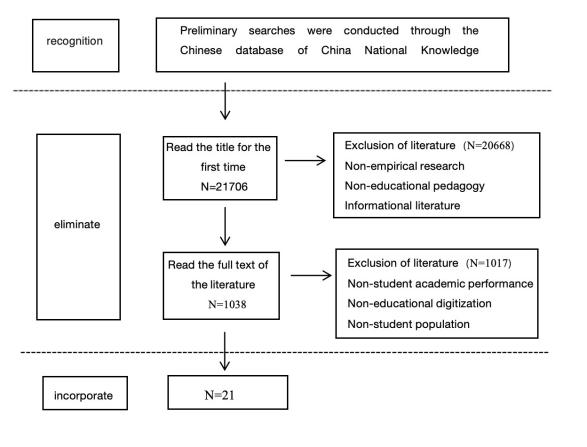
The breakthrough innovations in the application of digital technologies in education have become increasingly widespread, making educational digital transformation a focal point in the realm of education. Presently, numerous empirical studies have explored the impact of educational digital transformation on students' academic performance, yielding inconsistent findings regarding its effects on learning outcomes and capabilities in students' learning development. To this end, the article employs a meta-analysis approach to systematically review and analyze 21 experimental and quasi-experimental studies within China. The findings reveal that digital transformation in education significantly enhances students' academic performance.
Graphical Abstract
Keywords
Data Availability Statement
Funding
Conflicts of Interest
Ethical Approval and Consent to Participate
References
- Zhiting, Z. H. U., & Jiao, H. U. (2022). The Logic of Practice and Development Opportunities of Digital Transformation of Education. Frontiers of Education in China, 17(4).
[CrossRef] [Google Scholar] - Mozelius, P., Cleveland-Innes, M., Lindqvist, M. H., & Jaldemark, J. (2024). Critical Aspects of a Higher Education Reform for Continuous Lifelong Learning Opportunities in a Digital Era. Electronic Journal of Knowledge Management, 22(1), 26-39.
[CrossRef] [Google Scholar] - Mukul, E., & Büyüközkan, G. (2023). Digital transformation in education: A systematic review of education 4.0. Technological forecasting and social change, 194, 122664.
[CrossRef] [Google Scholar] - Liu, Q. (2024). Digital Transformation of Higher Education in China: Ways to Improve Academic Performance. Croatian Journal of Education: Hrvatski časopis za odgoj i obrazovanje, 26(1), 213-232.
[CrossRef] [Google Scholar] - Aljanazrah, A., Yerousis, G., Hamed, G., & Khlaif, Z. N. (2022, October). Digital transformation in times of crisis: Challenges, attitudes, opportunities and lessons learned from students’ and faculty members’ perspectives. In Frontiers in Education (Vol. 7, p. 1047035). Frontiers Media SA.
[CrossRef] [Google Scholar] - Harrer, M., Cuijpers, P., Furukawa, T., & Ebert, D. (2021). Doing meta-analysis with R: A hands-on guide. Chapman and Hall/CRC.
[Google Scholar] - Hordern, J., & Brooks, C. (2023). The core content framework and the ‘new science’of educational research. Oxford review of education, 49(6), 800-818.
[CrossRef] [Google Scholar] - Chen, H. L., & Chuang, Y. C. (2021). The effects of digital storytelling games on high school students' critical thinking skills. Journal of computer assisted learning, 37(1), 265-274.
[CrossRef] [Google Scholar] - Sulistyanto, H., Anif, S., Narimo, S., Sutopo, A., Haq, M. I., & Nasir, G. A. (2022). Education application testing perspective to empower students' higher order thinking skills related to the concept of adaptive learning media. Indonesian Journal on Learning and Advanced Education (IJOLAE), 257-271.
[CrossRef] [Google Scholar] - Yılmaz, A. (2021). The effect of technology integration in education on prospective teachers' critical and creative thinking, multidimensional 21st century skills and academic achievements. Participatory Educational Research, 8(2), 163-199.
[CrossRef] [Google Scholar] - Di, X., & Zheng, X. (2022). A meta-analysis of the impact of virtual technologies on students’ spatial ability. Educational technology research and development, 70(1), 73-98.
[CrossRef] [Google Scholar] - Paul, J., & Barari, M. (2022). Meta‐analysis and traditional systematic literature reviews—What, why, when, where, and how?. Psychology & Marketing, 39(6), 1099-1115.
[CrossRef] [Google Scholar] - Kallogjeri, D., & Piccirillo, J. F. (2023). A simple guide to effect size measures. JAMA Otolaryngology–Head & Neck Surgery, 149(5), 447-451.
[CrossRef] [Google Scholar] - Ydo, Y. (2022). Building stronger foundations for learning: The key for effective curriculum implementation and lifelong learning. Prospects, 52(1), 1-5.
[CrossRef] [Google Scholar] - Goldshmidt, E. S., Gritskevich, T. I., Mesheryakova, S. M., & Cherepanov, A. Y. (2018). Concept of noospheric education: innovative methods for developing personal cognitive strategies. European Proceedings of Social and Behavioural Sciences.
[CrossRef] [Google Scholar] - Istance, D., & Paniagua, A. (2019). Learning to Leapfrog: Innovative Pedagogies to Transform Education. Center for Universal Education at The Brookings Institution.
[Google Scholar] - Wang, J., Tigelaar, D. E., & Admiraal, W. (2019). Connecting rural schools to quality education: Rural teachers’ use of digital educational resources. Computers in Human Behavior, 101, 68-76.
[CrossRef] [Google Scholar] - Benavides, L. M. C., Tamayo Arias, J. A., Arango Serna, M. D., Branch Bedoya, J. W., & Burgos, D. (2020). Digital transformation in higher education institutions: A systematic literature review. Sensors, 20(11), 3291.
[CrossRef] [Google Scholar] - Kang, L. (2024). Revolutionizing vocational education: information-based instruction and the knowledge economy. Journal of the Knowledge Economy, 1-33.
[CrossRef] [Google Scholar] - Voronkova, V., Vasyl’chuk, G., Nikitenko, V., Kaganov, Y., & Metelenko, N. (2023). Transformation of digital education in the era of the fourth industrial revolution and globalization.
[Google Scholar] - Kong, S. C. (2014). Developing information literacy and critical thinking skills through domain knowledge learning in digital classrooms: An experience of practicing flipped classroom strategy. Computers \textbf{& education, 78, 160-173.
[CrossRef] [Google Scholar] - Haniya, S., & Rusch, A. (2017). Ubiquitous learning: Spatio-temporal dimensions of e-learning. In e-Learning Ecologies (pp. 46-64). Routledge.
[Google Scholar] - Ng'ambi, D., & Bozalek, V. (2016). Learning with Technologies in Resource‐constrained Environments. The Wiley handbook of learning technology, 200-220.
[CrossRef] [Google Scholar] - Ingavélez-Guerra, P., Robles-Bykbaev, V. E., Perez-Muñoz, A., Hilera-González, J., & Oton-Tortosa, S. (2022). Automatic adaptation of open educational resources: an approach from a multilevel methodology based on students’ preferences, educational special needs, artificial intelligence and accessibility metadata. IEEE Access, 10, 9703-9716.
[CrossRef] [Google Scholar] - Bouillion, L. M., & Gomez, L. M. (2001). Connecting school and community with science learning: Real world problems and school–community partnerships as contextual scaffolds. Journal of Research in Science Teaching: The Official Journal of the National Association for Research in Science Teaching, 38(8), 878-898.
[CrossRef] [Google Scholar] - Basantes-Andrade, A., Casillas-Martín, S., Cabezas-González, M., Naranjo-Toro, M., & Guerra-Reyes, F. (2022). Standards of teacher digital competence in higher education: A systematic literature review. Sustainability, 14(21), 13983.
[CrossRef] [Google Scholar]
Cited By (1)
-
Santosh Kumar. Impact of Digital Learning on Students.
Raj Rajeshwari Journal of Psychological & Educational Research, 2026 .
[CrossRef]
Cite This Article
TY  - JOUR
AU  - Lin, Jingjing
PY  - 2024
DA  - 2024/09/30
TI  - Has the Digitization of Education Improved Students' Academic Performance?--A Meta-Analysis Based on 21 Experimental and Quasi-Experimental Studies
JO  - Journal of Social Systems and Policy Analysis
T2  - Journal of Social Systems and Policy Analysis
JF  - Journal of Social Systems and Policy Analysis
VL  - 1
IS  - 3
SP  - 89
EP  - 99
DO  - 10.62762/JSSPA.2024.199620
UR  - https://www.icck.org/article/abs/JSSPA.2024.199620
KW  - digitization of education
KW  - transformation of education through digitization
KW  - student learning
KW  - academic performance of students
KW  - meta-analysis
AB  - The breakthrough innovations in the application of digital technologies in education have become increasingly widespread, making educational digital transformation a focal point in the realm of education. Presently, numerous empirical studies have explored the impact of educational digital transformation on students' academic performance, yielding inconsistent findings regarding its effects on learning outcomes and capabilities in students' learning development. To this end, the article employs a meta-analysis approach to systematically review and analyze 21 experimental and quasi-experimental studies within China. The findings reveal that digital transformation in education significantly enhances students' academic performance.
SN  - 3068-5540
PB  - Institute of Central Computation and Knowledge
LA  - English
ER  -
@article{Lin2024Has,
  author = {Jingjing Lin},
  title = {Has the Digitization of Education Improved Students' Academic Performance?--A Meta-Analysis Based on 21 Experimental and Quasi-Experimental Studies},
  journal = {Journal of Social Systems and Policy Analysis},
  year = {2024},
  volume = {1},
  number = {3},
  pages = {89-99},
  doi = {10.62762/JSSPA.2024.199620},
  url = {https://www.icck.org/article/abs/JSSPA.2024.199620},
  abstract = {The breakthrough innovations in the application of digital technologies in education have become increasingly widespread, making educational digital transformation a focal point in the realm of education. Presently, numerous empirical studies have explored the impact of educational digital transformation on students' academic performance, yielding inconsistent findings regarding its effects on learning outcomes and capabilities in students' learning development. To this end, the article employs a meta-analysis approach to systematically review and analyze 21 experimental and quasi-experimental studies within China. The findings reveal that digital transformation in education significantly enhances students' academic performance.},
  keywords = {digitization of education, transformation of education through digitization, student learning, academic performance of students, meta-analysis},
  issn = {3068-5540},
  publisher = {Institute of Central Computation and Knowledge}
}
Article Metrics
Publisher's Note
ICCK stays neutral with regard to jurisdictional claims in published maps and institutional affiliations.
Rights and Permissions
 Copyright © 2024 by the Author(s). Published by Institute of Central Computation and Knowledge. This article is an open access article distributed under the terms and conditions of the Creative Commons Attribution (CC BY) license (https://creativecommons.org/licenses/by/4.0/), which permits use, sharing, adaptation, distribution and reproduction in any medium or format, as long as you give appropriate credit to the original author(s) and the source, provide a link to the Creative Commons licence, and indicate if changes were made.


Portico
