

The Consumption Willingness of Medicinal Food in the Context of Traditional Chinese Medicine Cultural Identity: Taking Guangzhou City as an Example



Article Information
Abstract
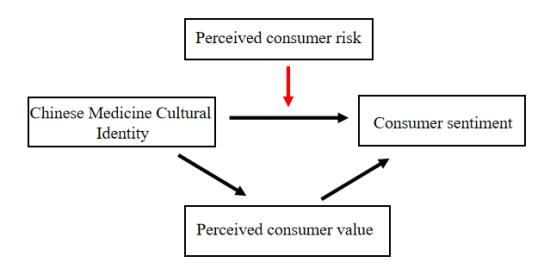
With the innovative development of traditional Chinese medicine and the implementation of China's Great Health Strategy, the food and medicine industry has ushered in new development opportunities. However, the development of traditional Chinese medicine still faces challenges such as irrational resource allocation and the need to modernize governance. This study explores the influence of traditional Chinese medicine (TCM) cultural identity on the consumption intention of medicinal food, as well as the roles of perceived consumption value and perceived consumption risk in this process. Based on cultural identity theory, perceived risk theory, and consumption value theory, a research model was constructed. Data were collected through questionnaires distributed to residents of Guangzhou City and analyzed using reliability and validity tests, multicollinearity diagnostics, confirmatory factor analysis, and structural equation modeling. The results show that TCM cultural identity has a significant positive effect on medicinal food consumption intention, and perceived consumption value plays a partial mediating role between TCM cultural identity and medicinal food consumption intention. However, perceived consumption risk does not have a significant moderating effect on the relationship between TCM cultural identity and medicinal food consumption intention. This study provides theoretical guidance for the government, hospitals, and the TCM industry to promote the healthy development of the medicinal food sector and to guide consumers toward scientific consumption, thereby highlighting the study's economic and social significance.
Graphical Abstract
Keywords
Data Availability Statement
Funding
Conflicts of Interest
Ethical Approval and Consent to Participate
References
- Chen, Y., & Guan, C. (2020, September). Research on the influencing factors of Chinese medicine cultural identity of international students in Chinese medicine schools. In Journal of Physics: Conference Series (Vol. 1629, No. 1, p. 012005). IOP Publishing.
[CrossRef] [Google Scholar] - Zhao, H., Zhang, R., & Chen, Y. (2023). The influencing role of cultural values on attitudes of the Chinese public towards traditional Chinese medicine (TCM) for the control of COVID-19. Patient preference and adherence, 3589-3605.
[CrossRef] [Google Scholar] - Conroy, D. M., Gan, C., Errmann, A., & Young, J. (2021). Fortifying wellbeing: How Chinese consumers and doctors navigate the role of functional foods. Appetite, 164, 105296.
[CrossRef] [Google Scholar] - Frewer, L., Scholderer, J., & Lambert, N. (2003). Consumer acceptance of functional foods: issues for the future. British food journal, 105(10), 714-731.
[CrossRef] [Google Scholar] - Yadav, R., & Pathak, G. S. (2016). Intention to purchase organic food among young consumers: Evidences from a developing nation. Appetite, 96, 122-128.
[CrossRef] [Google Scholar] - Lim, N. (2003). Consumers’ perceived risk: sources versus consequences. Electronic commerce research and applications, 2(3), 216-228.
[CrossRef] [Google Scholar] - Jacoby, J., & Kaplan, L. B. (1972). The components of perceived risk. In M. Venkatesan (Ed.). In Proceedings of the Third Annual Conference of the Association for Consumer Research (pp. 382–393). Association for Consumer Research.
[Google Scholar] - Kacen, J. J., & Lee, J. A. (2002). The influence of culture on consumer impulsive buying behavior. Journal of consumer psychology, 12(2), 163-176.
[CrossRef] [Google Scholar] - Sheth, J. N., Newman, B. I., & Gross, B. L. (1991). Why we buy what we buy: A theory of consumption values. Journal of business research, 22(2), 159-170.
[CrossRef] [Google Scholar] - Carvalho, S. W., Block, L. G., Sivaramakrishnan, S., Manchanda, R. V., & Mitakakis, C. (2008). Risk perception and risk avoidance: The role of cultural identity and personal relevance. International journal of research in marketing, 25(4), 319-326.
[CrossRef] [Google Scholar]
Cite This Article
TY  - JOUR
AU  - Liang, Zhiyuan
AU  - Lu, Youlan
AU  - He, Xiaoying
PY  - 2024
DA  - 2024/06/21
TI  - The Consumption Willingness of Medicinal Food in the Context of Traditional Chinese Medicine Cultural Identity: Taking Guangzhou City as an Example
JO  - Journal of Social Systems and Policy Analysis
T2  - Journal of Social Systems and Policy Analysis
JF  - Journal of Social Systems and Policy Analysis
VL  - 1
IS  - 2
SP  - 72
EP  - 82
DO  - 10.62762/JSSPA.2024.970448
UR  - https://www.icck.org/article/abs/JSSPA.2024.970448
KW  - Cultural identity of traditional Chinese medicine
KW  - Medicinal dietary consumption willingness
KW  - Perceived consumption value
KW  - Perceived consumption risk
KW  - Consumer behaviour
AB  - With the innovative development of traditional Chinese medicine and the implementation of China's Great Health Strategy, the food and medicine industry has ushered in new development opportunities. However, the development of traditional Chinese medicine still faces challenges such as irrational resource allocation and the need to modernize governance. This study explores the influence of traditional Chinese medicine (TCM) cultural identity on the consumption intention of medicinal food, as well as the roles of perceived consumption value and perceived consumption risk in this process. Based on cultural identity theory, perceived risk theory, and consumption value theory, a research model was constructed. Data were collected through questionnaires distributed to residents of Guangzhou City and analyzed using reliability and validity tests, multicollinearity diagnostics, confirmatory factor analysis, and structural equation modeling. The results show that TCM cultural identity has a significant positive effect on medicinal food consumption intention, and perceived consumption value plays a partial mediating role between TCM cultural identity and medicinal food consumption intention. However, perceived consumption risk does not have a significant moderating effect on the relationship between TCM cultural identity and medicinal food consumption intention. This study provides theoretical guidance for the government, hospitals, and the TCM industry to promote the healthy development of the medicinal food sector and to guide consumers toward scientific consumption, thereby highlighting the study's economic and social significance.
SN  - 3068-5540
PB  - Institute of Central Computation and Knowledge
LA  - English
ER  -
@article{Liang2024The,
  author = {Zhiyuan Liang and Youlan Lu and Xiaoying He},
  title = {The Consumption Willingness of Medicinal Food in the Context of Traditional Chinese Medicine Cultural Identity: Taking Guangzhou City as an Example},
  journal = {Journal of Social Systems and Policy Analysis},
  year = {2024},
  volume = {1},
  number = {2},
  pages = {72-82},
  doi = {10.62762/JSSPA.2024.970448},
  url = {https://www.icck.org/article/abs/JSSPA.2024.970448},
  abstract = {With the innovative development of traditional Chinese medicine and the implementation of China's Great Health Strategy, the food and medicine industry has ushered in new development opportunities. However, the development of traditional Chinese medicine still faces challenges such as irrational resource allocation and the need to modernize governance. This study explores the influence of traditional Chinese medicine (TCM) cultural identity on the consumption intention of medicinal food, as well as the roles of perceived consumption value and perceived consumption risk in this process. Based on cultural identity theory, perceived risk theory, and consumption value theory, a research model was constructed. Data were collected through questionnaires distributed to residents of Guangzhou City and analyzed using reliability and validity tests, multicollinearity diagnostics, confirmatory factor analysis, and structural equation modeling. The results show that TCM cultural identity has a significant positive effect on medicinal food consumption intention, and perceived consumption value plays a partial mediating role between TCM cultural identity and medicinal food consumption intention. However, perceived consumption risk does not have a significant moderating effect on the relationship between TCM cultural identity and medicinal food consumption intention. This study provides theoretical guidance for the government, hospitals, and the TCM industry to promote the healthy development of the medicinal food sector and to guide consumers toward scientific consumption, thereby highlighting the study's economic and social significance.},
  keywords = {Cultural identity of traditional Chinese medicine, Medicinal dietary consumption willingness, Perceived consumption value, Perceived consumption risk, Consumer behaviour},
  issn = {3068-5540},
  publisher = {Institute of Central Computation and Knowledge}
}
Publisher's Note
ICCK stays neutral with regard to jurisdictional claims in published maps and institutional affiliations.
Rights and Permissions
 Copyright © 2024 by the Author(s). Published by Institute of Central Computation and Knowledge. This article is an open access article distributed under the terms and conditions of the Creative Commons Attribution (CC BY) license (https://creativecommons.org/licenses/by/4.0/), which permits use, sharing, adaptation, distribution and reproduction in any medium or format, as long as you give appropriate credit to the original author(s) and the source, provide a link to the Creative Commons licence, and indicate if changes were made.


Portico
