

Modeling Marital Stability: A Dynamical Systems Analysis of Extramarital Affairs and Divorce


Article Information
Abstract
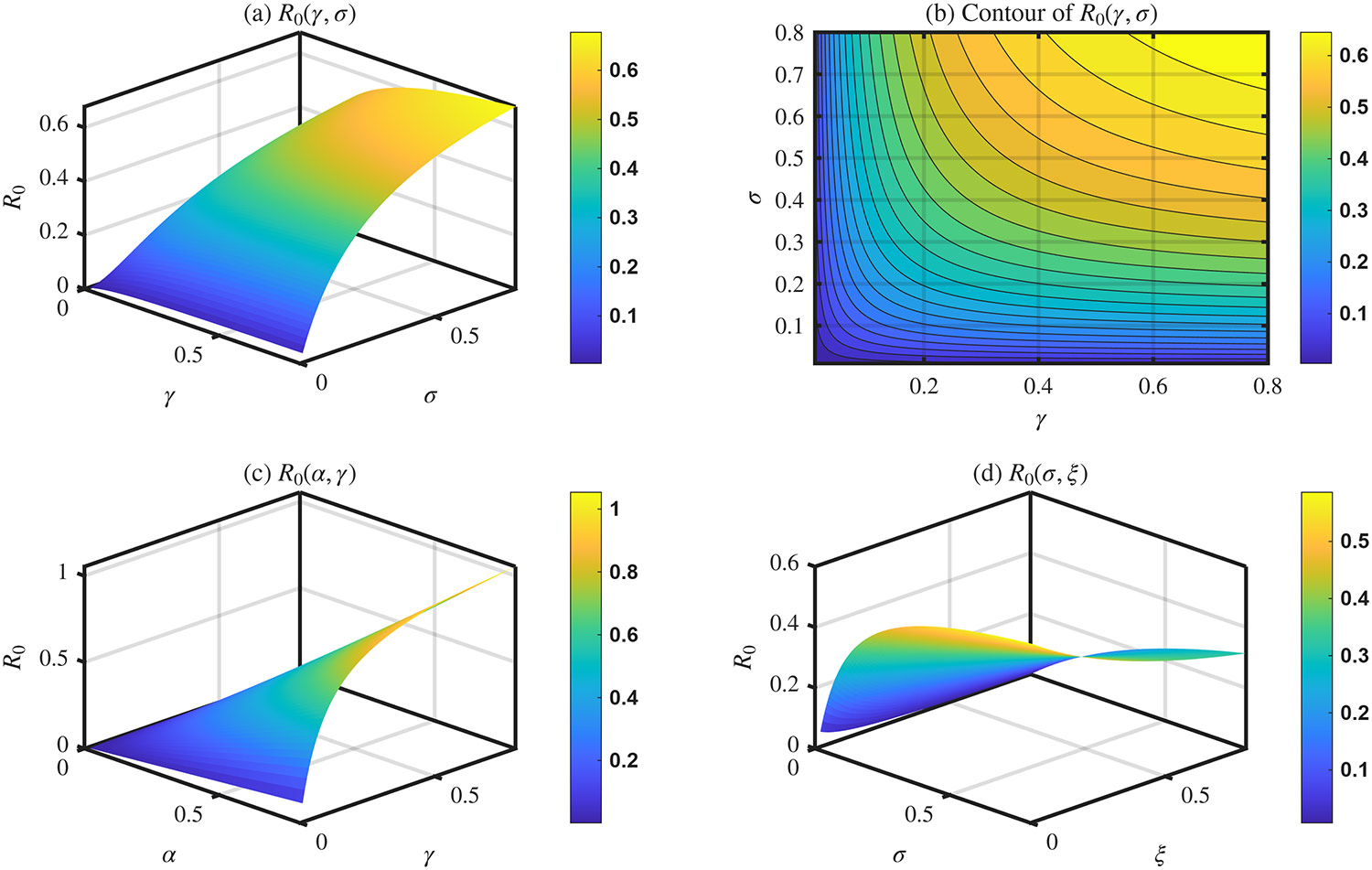
This study develops and analyzes a nonlinear mathematical model to describe the dynamics of marriage, extramarital affairs, marital breakdown, and divorce. The population is divided into five compartments: single $S(t)$, married $M(t)$, individuals in extramarital affairs $A(t)$, broken marriages $B(t)$, and divorced $D(t)$. The model is formulated as a system of nonlinear ordinary differential equations capturing transitions between these states through parameters representing marriage formation, affair initiation, reconciliation, separation, and divorce. Basic qualitative properties, including positivity and boundedness of solutions, are established to ensure the model is well posed. Equilibrium analysis reveals the trivial equilibrium $E_T=(0,0,0,0,0)$, the divorce-free equilibrium $E_0=(S^0,M^0,0,0,0)$, and a positive endemic equilibrium $E^*=(S^*,M^*,A^*,B^*,D^*)$. Stability is investigated via the Jacobian matrix and characteristic equation. The basic reproduction number $R_0$, derived using the next-generation matrix method, determines whether marital instability spreads in the population. The divorce-free equilibrium is locally asymptotically stable when $R_0<1$, whereas persistent instability occurs when $R_0>1$. Sensitivity analysis and numerical simulations are performed to examine the influence of key parameters, including marriage formation rate $\alpha$, affair initiation rate $\gamma$, instability rate $\sigma$, and reconciliation rate $\xi$. Phase portraits, parameter variation diagrams, and reproduction number plots confirm the analytical results. The findings highlight the roles of extramarital affairs and reconciliation in shaping marital stability and provide a quantitative framework for understanding long-term marriage and divorce dynamics.
Graphical Abstract
Keywords
Data Availability Statement
Funding
Conflicts of Interest
AI Use Statement
Ethical Approval and Consent to Participate
References
- United Nations Department of Economic and Social Affairs. (2000). World marriage patterns. Retrieved from https://digitallibrary.un.org/record/440031
[Google Scholar] - Cherlin, A. J. (2010). Demographic trends in the United States: A review of research in the 2000s. Journal of marriage and family, 72(3), 403-419.
[CrossRef] [Google Scholar] - Waite, L., & Gallagher, M. (2001). The case for marriage: Why married people are happier, healthier and better off financially. Crown.
[Google Scholar] - Hawkins, A. J., Willoughby, B. J., & Doherty, W. J. (2012). Reasons for divorce and openness to marital reconciliation. Journal of Divorce & Remarriage, 53(6), 453-463.
[CrossRef] [Google Scholar] - Hethcote, H. W. (2000). The mathematics of infectious diseases. SIAM Review, 42(4), 599--653.
[CrossRef] [Google Scholar] - Brauer, F., Castillo-Chavez, C., & Feng, Z. (2019). Mathematical models in epidemiology. Springer.
[CrossRef] [Google Scholar] - Diekmann, O., Heesterbeek, J. A. P., & Metz, J. A. J. (1990). On the definition and the computation of the basic reproduction ratio R 0 in models for infectious diseases in heterogeneous populations. Journal of mathematical biology, 28(4), 365-382.
[CrossRef] [Google Scholar] - Joseph Shine v.\ Union of India, Writ Petition (Criminal) No.\ 194 of 2017, (2019) 3 SCC 39, AIR 2018 SC 4898 (Supreme Court of India, decided September 27, 2018). Retrieved from https://indiankanoon.org/doc/42184625/
[Google Scholar] - Kumar, A. P. (2023). The Folly of Re-criminalising Adultery. Economic & Political Weekly, 58(47), 11. Available at https://www.epw.in/journal/2023/47/law-and-society/folly-re-criminalising-adultery.html
[Google Scholar] - Sandhu Law Offices. (2026, June 19). Evidence of adultery in divorce proceedings: Standards, challenges & judicial approach. Retrieved from https://sandhulawoffices.com/evidence-of-adultery-in-divorce-proceedings-standards-challenges-judicial-approach/
[Google Scholar] - National Crime Records Bureau. (2022). Crime in India 2022: Statistics. Ministry of Home Affairs, Government of India. Retrieved from https://images.assettype.com/barandbench/2023-12/dc0ba053-a1f0-4e6a-a5f8-e7668ddd2249/NCRB_STATS.pdf
[Google Scholar] - Chang, C. W., Qureshi, Z. A., Qureshi, S., Shaikh, A. A., & Shahani, M. Y. (2024). Real-data-based study on divorce dynamics and elimination strategies using nonlinear differential equations. Mathematics, 12(16), 2552.
[CrossRef] [Google Scholar] - Vincent, P., & Laveena, D. M. (2018). Changing trends of divorce in India: Issues & concerns. International Journal of Management, Technology, and Social Sciences (IJMTS), 3(2), 151-157.
[CrossRef] [Google Scholar] - Mukhopadhyay, R. (2021). Adultery laws in India. International Journal of Law Management and Humanities, 4(3), 1342-1346.
[CrossRef] [Google Scholar] - Dubey, H., & Chopra, R. (2023). Uncovering the Complexity of Adultery Agreements: A Legal Analysis in India. Indian Journal of Law and Legal Research, 5, 1. https://access.heinonline.com/HOL/LandingPage?handle=hein.journals/injlolw10
[Google Scholar] - GS Bagga & Associates. (2024, September 23). Impact of adultery on divorce proceedings in India: A legal perspective. Retrieved from https://www.gsbagga.com/blog/impact-of-adultery-on-divorce-proceedings-in-india-a-legal-perspective/
[Google Scholar] - Duato, R., & Jódar, L. (2013). Mathematical modeling of the spread of divorce in Spain. Mathematical and Computer Modelling, 57(7-8), 1732-1737.
[CrossRef] [Google Scholar] - Olaniyi, A. A. (2015). Analytical study of the causal factors of divorce in African homes. Research on humanities and social sciences, 5(14), 18-29. https://www.researchgate.net/publication/328216355
[Google Scholar] - Gambrah, P. P., & Adzadu, Y. (2018). Mathematical model of divorce epidemic in Ghana. International Journal of Statistics and Applied Mathematics, 3(2), 395-401. https://www.researchgate.net/publication/324583665
[Google Scholar] - Shah, J. N. H., Pandya, P. M., & Satia, M. H. (2019). Global stability for Divorce in Arrange/Love marriage due to extra marital affairs. International Journal of Scientific and Technology Research, 8(9), 371-376. https://www.researchgate.net/publication/337243796
[Google Scholar] - Izadi, M., Veeresha, P., & Adel, W. (2024). The fractional-order marriage–divorce mathematical model: numerical investigations and dynamical analysis. The European Physical Journal Plus, 139(3), 205.
[CrossRef] [Google Scholar] - Tessema, H., Haruna, I., Osman, S., & Kassa, E. (2022). A mathematical model analysis of marriage divorce. Communications in Mathematical Biology and Neuroscience, 1--20.
[CrossRef] [Google Scholar] - Lhous, M., Zakary, O., & Rachik, M. (2020). A mathematical overview of the monogamous marriage in a multiregion framework: Modelling and control. Discrete Dynamics in Nature and Society, 2020(1), 9385261.
[CrossRef] [Google Scholar] - Khalil, H. K. (2002). Nonlinear systems (3rd ed.). Prentice Hall.
[Google Scholar] - Strogatz, S. H. (2024). Nonlinear dynamics and chaos: with applications to physics, biology, chemistry, and engineering. Chapman and Hall/CRC.
[CrossRef] [Google Scholar] - Castillo-Chavez, C., & Song, B. (2004). Dynamical models of tuberculosis and their applications. Mathematical biosciences and engineering, 1(2), 361-404.
[CrossRef] [Google Scholar] - Hale, J. K., & Koçak, H. (1991). Dynamics and bifurcations. Springer Science & Business Media.
[CrossRef] [Google Scholar]
Cite This Article
TY  - JOUR
AU  - Pippal, Sarita
AU  - Ranga, Ajay
PY  - 2026
DA  - 2026/07/24
TI  - Modeling Marital Stability: A Dynamical Systems Analysis of Extramarital Affairs and Divorce
JO  - Journal of Mathematics and Interdisciplinary Applications
T2  - Journal of Mathematics and Interdisciplinary Applications
JF  - Journal of Mathematics and Interdisciplinary Applications
VL  - 2
IS  - 3
SP  - 164
EP  - 191
DO  - 10.62762/JMIA.2026.666866
UR  - https://www.icck.org/article/abs/JMIA.2026.666866
KW  - dynamical systems
KW  - marital stability
KW  - extramarital affairs
KW  - divorce dynamics
KW  - equilibrium analysis
KW  - sensitivity analysis
AB  - This study develops and analyzes a nonlinear mathematical model to describe the dynamics of marriage, extramarital affairs, marital breakdown, and divorce. The population is divided into five compartments: single $S(t)$, married $M(t)$, individuals in extramarital affairs $A(t)$, broken marriages $B(t)$, and divorced $D(t)$. The model is formulated as a system of nonlinear ordinary differential equations capturing transitions between these states through parameters representing marriage formation, affair initiation, reconciliation, separation, and divorce. Basic qualitative properties, including positivity and boundedness of solutions, are established to ensure the model is well posed. Equilibrium analysis reveals the trivial equilibrium $E_T=(0,0,0,0,0)$, the divorce-free equilibrium $E_0=(S^0,M^0,0,0,0)$, and a positive endemic equilibrium $E^*=(S^*,M^*,A^*,B^*,D^*)$. Stability is investigated via the Jacobian matrix and characteristic equation. The basic reproduction number $R_0$, derived using the next-generation matrix method, determines whether marital instability spreads in the population. The divorce-free equilibrium is locally asymptotically stable when $R_01$. Sensitivity analysis and numerical simulations are performed to examine the influence of key parameters, including marriage formation rate $\alpha$, affair initiation rate $\gamma$, instability rate $\sigma$, and reconciliation rate $\xi$. Phase portraits, parameter variation diagrams, and reproduction number plots confirm the analytical results. The findings highlight the roles of extramarital affairs and reconciliation in shaping marital stability and provide a quantitative framework for understanding long-term marriage and divorce dynamics.
SN  - 3070-393X
PB  - Institute of Central Computation and Knowledge
LA  - English
ER  -
@article{Pippal2026Modeling,
  author = {Sarita Pippal and Ajay Ranga},
  title = {Modeling Marital Stability: A Dynamical Systems Analysis of Extramarital Affairs and Divorce},
  journal = {Journal of Mathematics and Interdisciplinary Applications},
  year = {2026},
  volume = {2},
  number = {3},
  pages = {164-191},
  doi = {10.62762/JMIA.2026.666866},
  url = {https://www.icck.org/article/abs/JMIA.2026.666866},
  abstract = {This study develops and analyzes a nonlinear mathematical model to describe the dynamics of marriage, extramarital affairs, marital breakdown, and divorce. The population is divided into five compartments: single \$S(t)\$, married \$M(t)\$, individuals in extramarital affairs \$A(t)\$, broken marriages \$B(t)\$, and divorced \$D(t)\$. The model is formulated as a system of nonlinear ordinary differential equations capturing transitions between these states through parameters representing marriage formation, affair initiation, reconciliation, separation, and divorce. Basic qualitative properties, including positivity and boundedness of solutions, are established to ensure the model is well posed. Equilibrium analysis reveals the trivial equilibrium \$E\_T=(0,0,0,0,0)\$, the divorce-free equilibrium \$E\_0=(S^0,M^0,0,0,0)\$, and a positive endemic equilibrium \$E^*=(S^*,M^*,A^*,B^*,D^*)\$. Stability is investigated via the Jacobian matrix and characteristic equation. The basic reproduction number \$R\_0\$, derived using the next-generation matrix method, determines whether marital instability spreads in the population. The divorce-free equilibrium is locally asymptotically stable when \$R\_01\$. Sensitivity analysis and numerical simulations are performed to examine the influence of key parameters, including marriage formation rate \$\alpha\$, affair initiation rate \$\gamma\$, instability rate \$\sigma\$, and reconciliation rate \$\xi\$. Phase portraits, parameter variation diagrams, and reproduction number plots confirm the analytical results. The findings highlight the roles of extramarital affairs and reconciliation in shaping marital stability and provide a quantitative framework for understanding long-term marriage and divorce dynamics.},
  keywords = {dynamical systems, marital stability, extramarital affairs, divorce dynamics, equilibrium analysis, sensitivity analysis},
  issn = {3070-393X},
  publisher = {Institute of Central Computation and Knowledge}
}
Article Metrics
Publisher's Note
ICCK stays neutral with regard to jurisdictional claims in published maps and institutional affiliations.
Rights and Permissions
 Copyright © 2026 by the Author(s). Published by Institute of Central Computation and Knowledge. This article is an open access article distributed under the terms and conditions of the Creative Commons Attribution (CC BY) license (https://creativecommons.org/licenses/by/4.0/), which permits use, sharing, adaptation, distribution and reproduction in any medium or format, as long as you give appropriate credit to the original author(s) and the source, provide a link to the Creative Commons licence, and indicate if changes were made.


Portico
