

Analysis of a Pest-Natural Enemy Model with Time Delay in Impulsive Releasing Natural Enemy


Article Information
Abstract
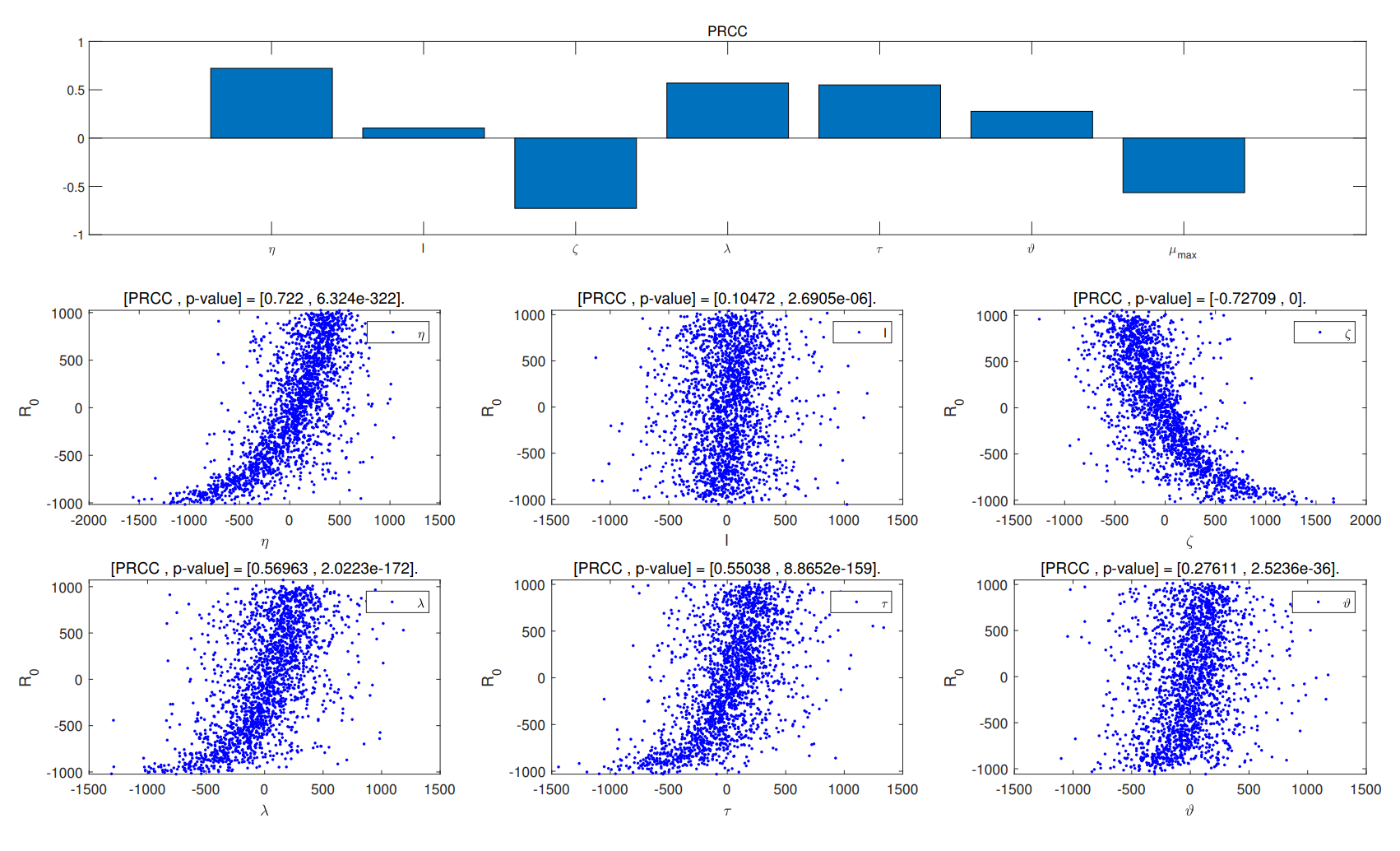
Releasing amount of natural enemy generally depends on its population data, while impulsive releasing natural enemy usually brings about a time delay after the data is observed in the practical pest management. Therefore, it is very important for pest managers to assess the impact of the time delay in pest management. In this paper, we construct a pest-natural enemy model with time delay in impulsive releasing natural enemy. We prove that the pest-free periodic solution of model $(2.1)$ is globally attractive with $\eta \tau<\frac{\zeta y^{\ast}(1-e^{-\lambda \tau})}{\lambda}$. We also prove that model $(2.1)$ is permanent with $\eta \tau>\frac{\zeta y^{\ast}(1-e^{-\lambda \tau})}{\lambda}$. Further influence of the time delay in impulsive releasing on dynamical behaviors of model $(2.1)$ is investigated by numerical simulations. Our results provide reliable tactics for pest management.
Graphical Abstract
Keywords
Data Availability Statement
Funding
Conflicts of Interest
Ethical Approval and Consent to Participate
References
- Mongillo, J. F., & Zierdt-Warshaw, L. (2000). Encyclopedia of environmental science. University Rochester Press.
[Google Scholar] - Lacey, L. A. (Ed.). (2016). Microbial control of insect and mite pests: from theory to practice. Academic Press.
[Google Scholar] - Amarathunga, D. C., Parry, H., Grundy, J., & Dorin, A. (2024). A predator–prey population dynamics simulation for biological control of Frankliniella occidentalis (Western Flower Thrips) by Orius laevigatus in strawberry plants. Biological Control, 188, 105409.
[CrossRef] [Google Scholar] - Barclay, H. J. (1987). Models for pest control: complementary effects of periodic releases of sterile pests and parasitoids. Theoretical Population Biology, 32(1), 76-89.
[CrossRef] [Google Scholar] - Liu, X., & Chen, L. (2003). Complex dynamics of Holling type II Lotka–Volterra predator–prey system with impulsive perturbations on the predator. Chaos, Solitons & Fractals, 16(2), 311-320.
[CrossRef] [Google Scholar] - Jiao, J., Chen, L., & Cai, S. (2009). A delayed stage-structured Holling II predator–prey model with mutual interference and impulsive perturbations on predator. Chaos, Solitons & Fractals, 40(4), 1946-1955.
[CrossRef] [Google Scholar] - Jiao, J., Chen, L., Cai, S., & Wang, L. (2010). Dynamics of a stage-structured predator–prey model with prey impulsively diffusing between two patches. Nonlinear Analysis: Real World Applications, 11(4), 2748-2756.
[CrossRef] [Google Scholar] - Wu, L., Jiao, J., & Dai, X. (2025). Dynamics of stage-structured ecological aquaculture management model with impulsive harvesting and nonlinearly releasing larval predators at different fixed moments. Journal of Computational Science, 85, 102532.
[CrossRef] [Google Scholar] - Pei, Y., Chen, L., Li, C., & Wang, C. (2006). Impulsive selective harvesting in a logistic fishery model with time delay. Journal of Biological Systems, 14(01), 91-99.
[CrossRef] [Google Scholar] - Lawson, J., & Braverman, E. (2023). Optimality and sustainability of delayed impulsive harvesting. Communications in Nonlinear Science and Numerical Simulation, 117, 106914.
[CrossRef] [Google Scholar] - Bainov, D., & Simeonov, P. (2017). Impulsive differential equations: periodic solutions and applications. Routledge.
[CrossRef] [Google Scholar]
Cited By (3)
-
Hongyan Gao, Jianjun Jiao, Hongyan Sun, Lu Lin. Dynamic analysis of a switching pest management model with incomplete hiding and complete exposure behaviors.
Journal of Mathematical Analysis and Applications, 2027 , 566 (1).
[CrossRef] -
Shirui Zhang, Jianjun Jiao, Guiyu Wu, Bingying Gao. Dynamics of a delayed stage-structured fishery management model with impulsive nonlinear harvesting and impulsive birth.
AIMS Mathematics, 2026 , 11 (6).
[CrossRef] -
Hui Jiao, Akanat Wetayawanich, Jianjun Jiao. Dynamics of a periodically switched predator-prey model with seasonal birth, predation-induced fear, intraspecific cooperative hunting and predator migrating for chasing foods.
AIMS Mathematics, 2026 , 11 (10).
[CrossRef]
Cite This Article
TY  - JOUR
AU  - Jiao, Hui
AU  - Meleshko, Sergey
PY  - 2025
DA  - 2025/11/26
TI  - Analysis of a Pest-Natural Enemy Model with Time Delay in Impulsive Releasing Natural Enemy
JO  - Journal of Mathematics and Interdisciplinary Applications
T2  - Journal of Mathematics and Interdisciplinary Applications
JF  - Journal of Mathematics and Interdisciplinary Applications
VL  - 1
IS  - 1
SP  - 20
EP  - 28
DO  - 10.62762/JMIA.2025.442174
UR  - https://www.icck.org/article/abs/JMIA.2025.442174
KW  - pest-natural enemy model
KW  - time delay
KW  - impulsive releasing
KW  - pest management
KW  - pest-free
AB  - Releasing amount of natural enemy generally depends on its population data, while impulsive releasing natural enemy usually brings about a time delay after the data is observed in the practical pest management. Therefore, it is very important for pest managers to assess the impact of the time delay in pest management. In this paper, we construct a pest-natural enemy model with time delay in impulsive releasing natural enemy. We prove that the pest-free periodic solution of model $(2.1)$ is globally attractive with $\eta \tau\frac{\zeta y^{\ast}(1-e^{-\lambda \tau})}{\lambda}$. Further influence of the time delay in impulsive releasing on dynamical behaviors of model $(2.1)$ is investigated by numerical simulations. Our results provide reliable tactics for pest management.
SN  - 3070-393X
PB  - Institute of Central Computation and Knowledge
LA  - English
ER  -
@article{Jiao2025Analysis,
  author = {Hui Jiao and Sergey Meleshko},
  title = {Analysis of a Pest-Natural Enemy Model with Time Delay in Impulsive Releasing Natural Enemy},
  journal = {Journal of Mathematics and Interdisciplinary Applications},
  year = {2025},
  volume = {1},
  number = {1},
  pages = {20-28},
  doi = {10.62762/JMIA.2025.442174},
  url = {https://www.icck.org/article/abs/JMIA.2025.442174},
  abstract = {Releasing amount of natural enemy generally depends on its population data, while impulsive releasing natural enemy usually brings about a time delay after the data is observed in the practical pest management. Therefore, it is very important for pest managers to assess the impact of the time delay in pest management. In this paper, we construct a pest-natural enemy model with time delay in impulsive releasing natural enemy. We prove that the pest-free periodic solution of model \$(2.1)\$ is globally attractive with \$\eta \tau\frac{\zeta y^{\ast}(1-e^{-\lambda \tau})}{\lambda}\$. Further influence of the time delay in impulsive releasing on dynamical behaviors of model \$(2.1)\$ is investigated by numerical simulations. Our results provide reliable tactics for pest management.},
  keywords = {pest-natural enemy model, time delay, impulsive releasing, pest management, pest-free},
  issn = {3070-393X},
  publisher = {Institute of Central Computation and Knowledge}
}
Publisher's Note
ICCK stays neutral with regard to jurisdictional claims in published maps and institutional affiliations.
Rights and Permissions
 Copyright © 2025 by the Author(s). Published by Institute of Central Computation and Knowledge. This article is an open access article distributed under the terms and conditions of the Creative Commons Attribution (CC BY) license (https://creativecommons.org/licenses/by/4.0/), which permits use, sharing, adaptation, distribution and reproduction in any medium or format, as long as you give appropriate credit to the original author(s) and the source, provide a link to the Creative Commons licence, and indicate if changes were made.


Portico
