

On Multi-Group Chickenpox Mathematical Epidemic Models with Effective Vaccination and Re-Infection Challenges


Article Information
Abstract
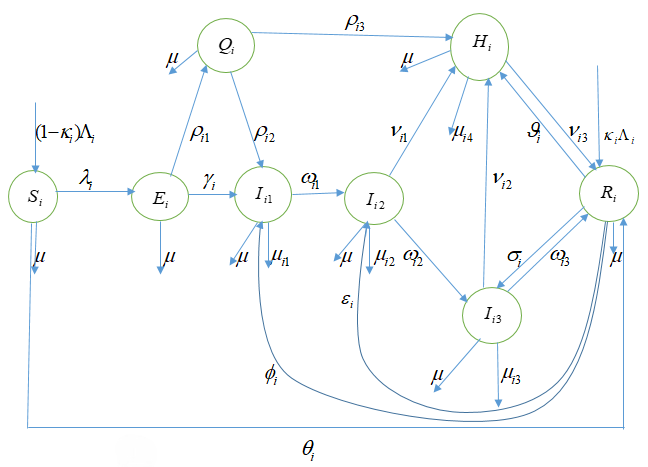
A class of multi-age group $SEQ_3IHR$ chickenpox epidemic models with effective vaccination in a different subpopulation size, is considered, in this paper. It is assumed that individual members of the subpopulations who recovered from the disease, may be re-infected by the disease. The models comprise of six infectious classes of subclasses and three distinct infected stages of subclasses. We establish that the global dynamics of the epidemic models are determined entirely by the basic reproduction number. In this paper, we determine that the disease-free and endemic equilibrium states, and carry out a stability analysis of the disease-free as well as the endemic equilibrium points of the model. The findings show that age heterogeneity and vaccination rate play prominent roles in the determination of epidemic spread and control of chickenpox disease in the population and also serve as the factors that influenced the basic reproduction number. We found numerically that re-infections have little or no influence on the basic reproduction number but contribute tremendously to the reduction and/or increase in the number of individuals in incubation, prodromal and active stages, as well as treatment compartment of chickenpox infection over time.
Graphical Abstract
Keywords
Data Availability Statement
Funding
Conflicts of Interest
AI Use Statement
Ethical Approval and Consent to Participate
References
- Medicover Hospitals. (2024, September 17). Types of chicken pox. Retrieved March 5, 2026, from https://www.medicoverhospitals.in/articles/types-of-chicken-pox
[Google Scholar] - Sehattak. (2024, December 24). Understanding the stages of chickenpox: Symptoms, progression, and recovery. Retrieved March 8, 2026, from https://sehattak.com/understanding-the-stages-of-chickenpox-symptoms-progression-and-recovery/
[Google Scholar] - Guo, H., Li, M. Y., & Shuai, Z. (2006). Global stability of the endemic equilibrium of multigroup SIR epidemic models. Canadian applied mathematics quarterly, 14(3), 259-284. https://sites.ualberta.ca/~myli/research/ps_files/multigp_sir.pdf
[Google Scholar] - Sun, R. (2010). Global stability of the endemic equilibrium of multigroup SIR models with nonlinear incidence. Computers & Mathematics with Applications, 60(8), 2286-2291.
[CrossRef] [Google Scholar] - Zhang, S., & Guo, H. (2018). Global analysis of age-structured multi-stage epidemic models for infectious diseases. Applied Mathematics and Computation, 337, 214-233.
[CrossRef] [Google Scholar] - Ayoola, T. A., Popoola, A. O., Olayiwola, M. O., & Alaje, A. I. (2024). Mathematical modeling of chickenpox transmission using the Laplace adomian decomposition method. Results in Control and Optimization, 15, 100436.
[CrossRef] [Google Scholar] - Nkeki, C., & Mbarie, I. (2025). On a mathematical model and the efficacy of control measures on the transmission dynamics of chickenpox. Bulletin of Biomathematics, 3(1), 37-61.
[CrossRef] [Google Scholar] - Almuallem, N. A., Ali, H. M., Elsaid, E. M., Eid, M. R., & Hassanin, W. S. (2025). Mathematical simulation of optimal control measures to avoid chickenpox infection. International Journal of Mathematics and Mathematical Sciences, 2025(1), 3238188.
[CrossRef] [Google Scholar] - Ibrahim, K. G., Andrawus, J., Abubakar, A., Yusuf, A., Maiwa, S. I., Bitrus, K., ... & Jonathan, J. (2025). Mathematical analysis of chickenpox population dynamics unveiling the impact of booster in enhancing recovery of infected individuals. Modeling Earth Systems and Environment, 11(1), 46.
[CrossRef] [Google Scholar] - Nkeki, C. I., & Mbarie, I. A. (2026). On mathematical modeling and stability analysis of chickenpox models in the presence of weakened-immune individuals in a population. Journal of Mathematical Modeling.
[CrossRef] [Google Scholar] - Mohapatra, R. N., Porchia, D., & Shuai, Z. (2015). Compartmental disease models with heterogeneous populations: a survey. In Mathematical Analysis and its Applications: Roorkee, India, December 2014 (pp. 619-631). New Delhi: Springer India.
[CrossRef] [Google Scholar] - Dawood, A. A. (2020). Chickenpox, review and prevalence varicella virus in Nineveh Province. Asian Journal of Advances in Medical Science, 2(1), 6-14. https://artix.article7submit.com/id/eprint/2993
[Google Scholar] - Centers for Disease Control and Prevention. (2025, April 3). About chickenpox. Retrieved March 5, 2026, from https://www.cdc.gov/chickenpox/about/index.html
[Google Scholar]
Cite This Article
TY  - JOUR
AU  - Nkeki, Charles Iwebuke
AU  - Omoregie, Rosemary
PY  - 2026
DA  - 2026/05/11
TI  - On Multi-Group Chickenpox Mathematical Epidemic Models with Effective Vaccination and Re-Infection Challenges
JO  - Journal of Mathematics and Interdisciplinary Applications
T2  - Journal of Mathematics and Interdisciplinary Applications
JF  - Journal of Mathematics and Interdisciplinary Applications
VL  - 2
IS  - 2
SP  - 91
EP  - 111
DO  - 10.62762/JMIA.2026.627569
UR  - https://www.icck.org/article/abs/JMIA.2026.627569
KW  - chickenpox
KW  - multi-age group $SEQ_3IHR$
KW  - mathematical epidemic models
KW  - effective vaccination
KW  - re-infection
KW  - subpopulation
AB  - A class of multi-age group $SEQ_3IHR$ chickenpox epidemic models with effective vaccination in a different subpopulation size, is considered, in this paper. It is assumed that individual members of the subpopulations who recovered from the disease, may be re-infected by the disease. The models comprise of six infectious classes of subclasses and three distinct infected stages of subclasses. We establish that the global dynamics of the epidemic models are determined entirely by the basic reproduction number. In this paper, we determine that the disease-free and endemic equilibrium states, and carry out a stability analysis of the disease-free as well as the endemic equilibrium points of the model. The findings show that age heterogeneity and vaccination rate play prominent roles in the determination of epidemic spread and control of chickenpox disease in the population and also serve as the factors that influenced the basic reproduction number. We found numerically that re-infections have little or no influence on the basic reproduction number but contribute tremendously to the reduction and/or increase in the number of individuals in incubation, prodromal and active stages, as well as treatment compartment of chickenpox infection over time.
SN  - 3070-393X
PB  - Institute of Central Computation and Knowledge
LA  - English
ER  -
@article{Nkeki2026On,
  author = {Charles Iwebuke Nkeki and Rosemary Omoregie},
  title = {On Multi-Group Chickenpox Mathematical Epidemic Models with Effective Vaccination and Re-Infection Challenges},
  journal = {Journal of Mathematics and Interdisciplinary Applications},
  year = {2026},
  volume = {2},
  number = {2},
  pages = {91-111},
  doi = {10.62762/JMIA.2026.627569},
  url = {https://www.icck.org/article/abs/JMIA.2026.627569},
  abstract = {A class of multi-age group \$SEQ\_3IHR\$ chickenpox epidemic models with effective vaccination in a different subpopulation size, is considered, in this paper. It is assumed that individual members of the subpopulations who recovered from the disease, may be re-infected by the disease. The models comprise of six infectious classes of subclasses and three distinct infected stages of subclasses. We establish that the global dynamics of the epidemic models are determined entirely by the basic reproduction number. In this paper, we determine that the disease-free and endemic equilibrium states, and carry out a stability analysis of the disease-free as well as the endemic equilibrium points of the model. The findings show that age heterogeneity and vaccination rate play prominent roles in the determination of epidemic spread and control of chickenpox disease in the population and also serve as the factors that influenced the basic reproduction number. We found numerically that re-infections have little or no influence on the basic reproduction number but contribute tremendously to the reduction and/or increase in the number of individuals in incubation, prodromal and active stages, as well as treatment compartment of chickenpox infection over time.},
  keywords = {chickenpox, multi-age group \$SEQ\_3IHR\$, mathematical epidemic models, effective vaccination, re-infection, subpopulation},
  issn = {3070-393X},
  publisher = {Institute of Central Computation and Knowledge}
}
Article Metrics
Publisher's Note
ICCK stays neutral with regard to jurisdictional claims in published maps and institutional affiliations.
Rights and Permissions
 Copyright © 2026 by the Author(s). Published by Institute of Central Computation and Knowledge. This article is an open access article distributed under the terms and conditions of the Creative Commons Attribution (CC BY) license (https://creativecommons.org/licenses/by/4.0/), which permits use, sharing, adaptation, distribution and reproduction in any medium or format, as long as you give appropriate credit to the original author(s) and the source, provide a link to the Creative Commons licence, and indicate if changes were made.


Portico
