

Strategy Dynamics of Three-Strategy Snowdrift Game Induced by Reward Strategy and Payoff Delay


Article Information
Abstract
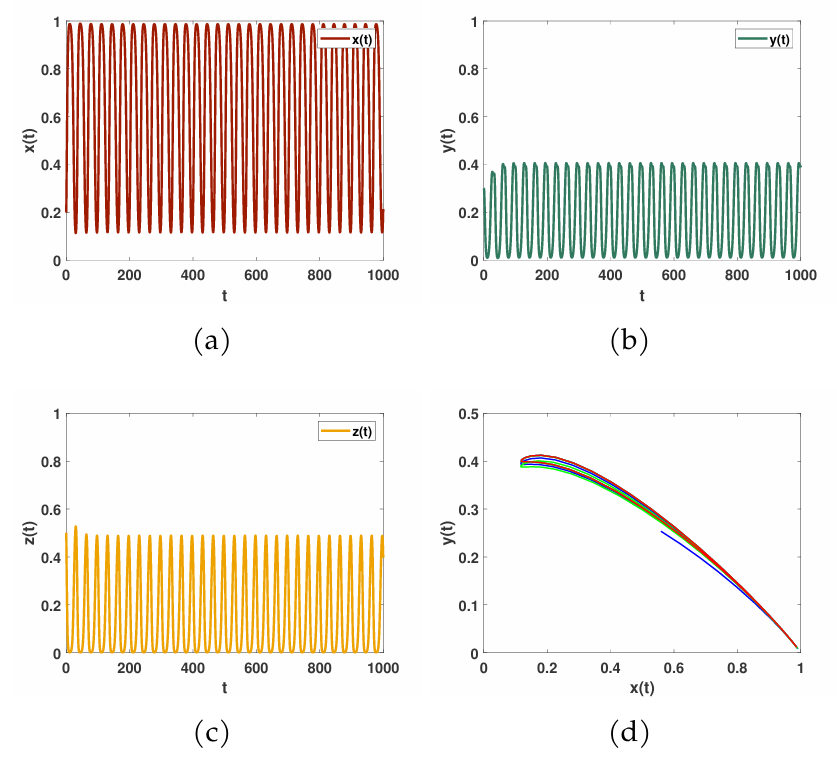
In the evolutionary game, the introduction of the third or more specific strategies to study cooperative evolution has attracted widespread attention recently. The main feature of this paper is to adopt a special reward strategy as the third choice to observe the evolution dynamics. This strategy can improve the utilization of resources and help cooperators and defectors get greater benefits. We investigate the evolutionary game dynamics of a three-strategy snowdrift game with special reward strategy and payoff delay. First, for the nondelay system, we discuss the dynamic properties of strategies, including the existence, stability and bistability of equilibrium states. Furthermore for the time-delay system, we explore the existence conditions of Hopf bifurcation with payoff delay as a parameter. Then we get the direction and stability of Hopf bifurcation through theoretical derivations and numerical simulations. The results show that (i) cooperators, defectors and rewarders can coexist stably; (ii) as the reward increases, the defective strategy gradually disappears, which helps to promote cooperation; (iii) the stable equilibrium becomes unstable when the payoff delay is large, and Hopf bifurcation and stable periodic oscillation appears; (iv) when the payoff delay is large enough, the defective strategy disappears. Our work may promote the prosperity of cooperation among biological populations.
Graphical Abstract
Keywords
Data Availability Statement
Funding
Conflicts of Interest
AI Use Statement
Ethical Approval and Consent to Participate
References
- Doebeli, M., & Hauert, C. (2005). Models of cooperation based on the Prisoner's Dilemma and the Snowdrift game. Ecology letters, 8(7), 748-766.
[CrossRef] [Google Scholar] - Gore, J., Youk, H., & Van Oudenaarden, A. (2009). Snowdrift game dynamics and facultative cheating in yeast. Nature, 459(7244), 253-256.
[CrossRef] [Google Scholar] - Clutton-Brock, T. H., O'riain, M. J., Brotherton, P. N., Gaynor, D., Kansky, R., Griffin, A. S., & Manser, M. (1999). Selfish sentinels in cooperative mammals. science, 284(5420), 1640-1644.
[CrossRef] [Google Scholar] - Smith, J. M. (1982). Evolution and the Theory of Games. In Did Darwin get it right? Essays on games, sex and evolution (pp. 202-215). Boston, MA: Springer US.
[CrossRef] [Google Scholar] - Sachs, J. L., Mueller, U. G., Wilcox, T. P., & Bull, J. J. (2004). The evolution of cooperation. The Quarterly review of biology, 79(2), 135-160.
[CrossRef] [Google Scholar] - Weibull, J. W. (1997). Evolutionary game theory. MIT press.
[Google Scholar] - Nowak, M. A. (2006). Five rules for the evolution of cooperation. science, 314(5805), 1560-1563.
[CrossRef] [Google Scholar] - Hauert, C., & Doebeli, M. (2004). Spatial structure often inhibits the evolution of cooperation in the snowdrift game. Nature, 428(6983), 643-646.
[CrossRef] [Google Scholar] - Zhong, L. X., Zheng, D. F., Zheng, B., Xu, C., & Hui, P. M. (2006). Networking effects on cooperation in evolutionary snowdrift game. EPL (Europhysics Letters), 76(4), 724-730.
[CrossRef] [Google Scholar] - Kun, Á., Boza, G., & Scheuring, I. (2006). Asynchronous snowdrift game with synergistic effect as a model of cooperation. Behavioral Ecology, 17(4), 633-641.
[CrossRef] [Google Scholar] - Ji, J., Pan, Q., Zhu, W., & He, M. (2023). The influence of own historical information and environmental historical information on the evolution of cooperation. Applied Mathematics and Computation, 446, 127902.
[CrossRef] [Google Scholar] - Han, J. X., & Wang, R. W. (2023). Complex interactions promote the frequency of cooperation in snowdrift game. Physica A: Statistical Mechanics and its Applications, 609, 128386.
[CrossRef] [Google Scholar] - Krapohl, S., Ocelík, V., & Walentek, D. M. (2021). The instability of globalization: applying evolutionary game theory to global trade cooperation. Public Choice, 188(1), 31-51.
[CrossRef] [Google Scholar] - Cheng, H., & Meng, X. (2023). Evolution of cooperation in multigame with environmental space and delay. Biosystems, 223, 104801.
[CrossRef] [Google Scholar] - Chowdhury, S. N., Kundu, S., Banerjee, J., Perc, M., & Ghosh, D. (2021). Eco-evolutionary dynamics of cooperation in the presence of policing. Journal of Theoretical Biology, 518, 110606.
[CrossRef] [Google Scholar] - Wu, Y. E., & Li, J. J. (2023). Impact of social reward on the evolution of cooperation in voluntary prisoner’s dilemma. Biosystems, 223, 104821.
[CrossRef] [Google Scholar] - Zheng, D. F., Yin, H. P., Chan, C. H., & Hui, P. M. (2007). Cooperative behavior in a model of evolutionary snowdrift games with N-person interactions. EPL (Europhysics Letters), 80(1), 18002.
[CrossRef] [Google Scholar] - Li, K., Mao, Y., Wei, Z., & Cong, R. (2021). Pool-rewarding in N-person snowdrift game. Chaos, Solitons & Fractals, 143, 110591.
[CrossRef] [Google Scholar] - Pan, Q., Wang, Y., & He, M. (2022). Impacts of special cooperation strategy with reward and punishment mechanism on cooperation evolution. Chaos, Solitons & Fractals, 162, 112432.
[CrossRef] [Google Scholar] - Fujita, H., Aoki, S., & Kawaguchi, M. (2014). Evolutionary dynamics of nitrogen fixation in the legume–rhizobia symbiosis. PloS one, 9(4), e93670.
[CrossRef] [Google Scholar] - Yan, F., Chen, X., Qiu, Z., & Szolnoki, A. (2021). Cooperator driven oscillation in a time-delayed feedback-evolving game. New Journal of Physics, 23(5), 053017.
[CrossRef] [Google Scholar] - Chang, L., Zhang, Z., & Xia, C. (2023). Impact of decision feedback on networked evolutionary game with delays in control channel. Dynamic Games and Applications, 13(3), 783-800.
[CrossRef] [Google Scholar] - Roy, S., Nag Chowdhury, S., Kundu, S., Sar, G. K., Banerjee, J., Rakshit, B., ... & Ghosh, D. (2023). Time delays shape the eco-evolutionary dynamics of cooperation. Scientific reports, 13(1), 14331.
[CrossRef] [Google Scholar] - Yi, T., & Zuwang, W. (1997). Effect of time delay and evolutionarily stable strategy. Journal of theoretical biology, 187(1), 111-116.
[CrossRef] [Google Scholar] - Miekisz, J. (2011). Stochasticity and time delays in gene expression and evolutionary game theory. Probabilistic engineering mechanics, 26(1), 33-38.
[CrossRef] [Google Scholar] - Alfaro, G., & Sanjuan, M. A. (2022). Time-dependent effects hinder cooperation on the public goods game. Chaos, Solitons & Fractals, 160, 112206.
[CrossRef] [Google Scholar] - Miękisz, J., & Bodnar, M. (2021). Evolution of populations with strategy-dependent time delays. Physical Review E, 103(1), 012414.
[CrossRef] [Google Scholar] - Bshary, R., & Noë, R. (2023). A marine cleaning mutualism provides new insights in biological market dynamics. Philosophical Transactions of the Royal Society B, 378(1876), 20210501.
[CrossRef] [Google Scholar] - Hassard, B. D., Kazarinoff, N. D., & Wan, Y. H. (1981). Theory and applications of Hopf bifurcation (Vol. 41). CUP Archive.
[Google Scholar] - Wang, Y., Meng, X., & Alzahrani, A. K. (2024). Stability, period and chaos of the evolutionary game strategy induced by time-delay and mutation feedback. Chaos, Solitons & Fractals, 181, 114698.
[CrossRef] [Google Scholar] - Chen, W., Quan, J., Wang, X., & Liu, Y. (2023). Evolutionary dynamics from fluctuating environments with deterministic and stochastic noises. Nonlinear Dynamics, 111(6), 5499-5511.
[CrossRef] [Google Scholar] - Feng, T. J., Mei, J., Wang, R. W., Lessard, S., Tao, Y., & Zheng, X. D. (2022). Noise-induced quasi-heteroclinic cycle in a rock–paper–scissors game with random payoffs. Dynamic Games and Applications, 12(4), 1280-1292.
[CrossRef] [Google Scholar] - Cheng, H., Meng, X., Hayat, T., & Hobiny, A. (2024). Dynamics analysis for a prey–predator evolutionary game system with delays. Dynamic Games and Applications, 14(2), 480-507.
[CrossRef] [Google Scholar] - Li, B. Q., Wu, Z. X., & Guan, J. Y. (2022). Critical thresholds of benefit distribution in an extended snowdrift game model. Chaos, Solitons & Fractals, 157, 111948.
[CrossRef] [Google Scholar]
Cite This Article
TY  - JOUR
AU  - Wang, Yifei
AU  - Meng, Xinzhu
PY  - 2026
DA  - 2026/05/10
TI  - Strategy Dynamics of Three-Strategy Snowdrift Game Induced by Reward Strategy and Payoff Delay
JO  - Journal of Mathematics and Interdisciplinary Applications
T2  - Journal of Mathematics and Interdisciplinary Applications
JF  - Journal of Mathematics and Interdisciplinary Applications
VL  - 2
IS  - 2
SP  - 74
EP  - 90
DO  - 10.62762/JMIA.2026.346326
UR  - https://www.icck.org/article/abs/JMIA.2026.346326
KW  - evolutionary game theory
KW  - reward
KW  - three-strategy
KW  - time delay
KW  - hopf bifurcation
AB  - In the evolutionary game, the introduction of the third or more specific strategies to study cooperative evolution has attracted widespread attention recently. The main feature of this paper is to adopt a special reward strategy as the third choice to observe the evolution dynamics. This strategy can improve the utilization of resources and help cooperators and defectors get greater benefits. We investigate the evolutionary game dynamics of a three-strategy snowdrift game with special reward strategy and payoff delay. First, for the nondelay system, we discuss the dynamic properties of strategies, including the existence, stability and bistability of equilibrium states. Furthermore for the time-delay system, we explore the existence conditions of Hopf bifurcation with payoff delay as a parameter. Then we get the direction and stability of Hopf bifurcation through theoretical derivations and numerical simulations. The results show that (i) cooperators, defectors and rewarders can coexist stably; (ii) as the reward increases, the defective strategy gradually disappears, which helps to promote cooperation; (iii) the stable equilibrium becomes unstable when the payoff delay is large, and Hopf bifurcation and stable periodic oscillation appears; (iv) when the payoff delay is large enough, the defective strategy disappears. Our work may promote the prosperity of cooperation among biological populations.
SN  - 3070-393X
PB  - Institute of Central Computation and Knowledge
LA  - English
ER  -
@article{Wang2026Strategy,
  author = {Yifei Wang and Xinzhu Meng},
  title = {Strategy Dynamics of Three-Strategy Snowdrift Game Induced by Reward Strategy and Payoff Delay},
  journal = {Journal of Mathematics and Interdisciplinary Applications},
  year = {2026},
  volume = {2},
  number = {2},
  pages = {74-90},
  doi = {10.62762/JMIA.2026.346326},
  url = {https://www.icck.org/article/abs/JMIA.2026.346326},
  abstract = {In the evolutionary game, the introduction of the third or more specific strategies to study cooperative evolution has attracted widespread attention recently. The main feature of this paper is to adopt a special reward strategy as the third choice to observe the evolution dynamics. This strategy can improve the utilization of resources and help cooperators and defectors get greater benefits. We investigate the evolutionary game dynamics of a three-strategy snowdrift game with special reward strategy and payoff delay. First, for the nondelay system, we discuss the dynamic properties of strategies, including the existence, stability and bistability of equilibrium states. Furthermore for the time-delay system, we explore the existence conditions of Hopf bifurcation with payoff delay as a parameter. Then we get the direction and stability of Hopf bifurcation through theoretical derivations and numerical simulations. The results show that (i) cooperators, defectors and rewarders can coexist stably; (ii) as the reward increases, the defective strategy gradually disappears, which helps to promote cooperation; (iii) the stable equilibrium becomes unstable when the payoff delay is large, and Hopf bifurcation and stable periodic oscillation appears; (iv) when the payoff delay is large enough, the defective strategy disappears. Our work may promote the prosperity of cooperation among biological populations.},
  keywords = {evolutionary game theory, reward, three-strategy, time delay, hopf bifurcation},
  issn = {3070-393X},
  publisher = {Institute of Central Computation and Knowledge}
}
Article Metrics
Publisher's Note
ICCK stays neutral with regard to jurisdictional claims in published maps and institutional affiliations.
Rights and Permissions
 Copyright © 2026 by the Author(s). Published by Institute of Central Computation and Knowledge. This article is an open access article distributed under the terms and conditions of the Creative Commons Attribution (CC BY) license (https://creativecommons.org/licenses/by/4.0/), which permits use, sharing, adaptation, distribution and reproduction in any medium or format, as long as you give appropriate credit to the original author(s) and the source, provide a link to the Creative Commons licence, and indicate if changes were made.


Portico
