Volume 2, Issue 2


Volume 2, Issue 2 (June, 2025) – 5 articles
Citations: Crossref logo 0,   0   |   Viewed: 1115, Download: 335

Table of Contents

Open Access | Research Article | 21 June 2026
Dynamic Inertia Weight Whale Optimization Algorithm for Numerical and Engineering Optimization Problems
Journal of Mathematics and Interdisciplinary Applications | Volume 2, Issue 2: 125-142, 2026 | DOI: 10.62762/JMIA.2026.111913
Abstract
Whale optimization algorithm (WOA) is a relatively new population-based metaheuristic optimization method, which has the advantage of fewer control parameters, strong global optimization ability and easy to implement. However, when being used for high-dimensional problems, WOA may be trapped in the local optimum. In this study, we propose an effective whale optimization algorithm called EWOA. Inspired by particle swarm optimization (PSO), a modified position-updated equation by introducing dynamic inertia weight parameter to guide the search of new candidate individuals is presented. In addition, in order to make full use of and balance the exploration and the exploitation of WOA, a nonlinea... More >

Graphical Abstract
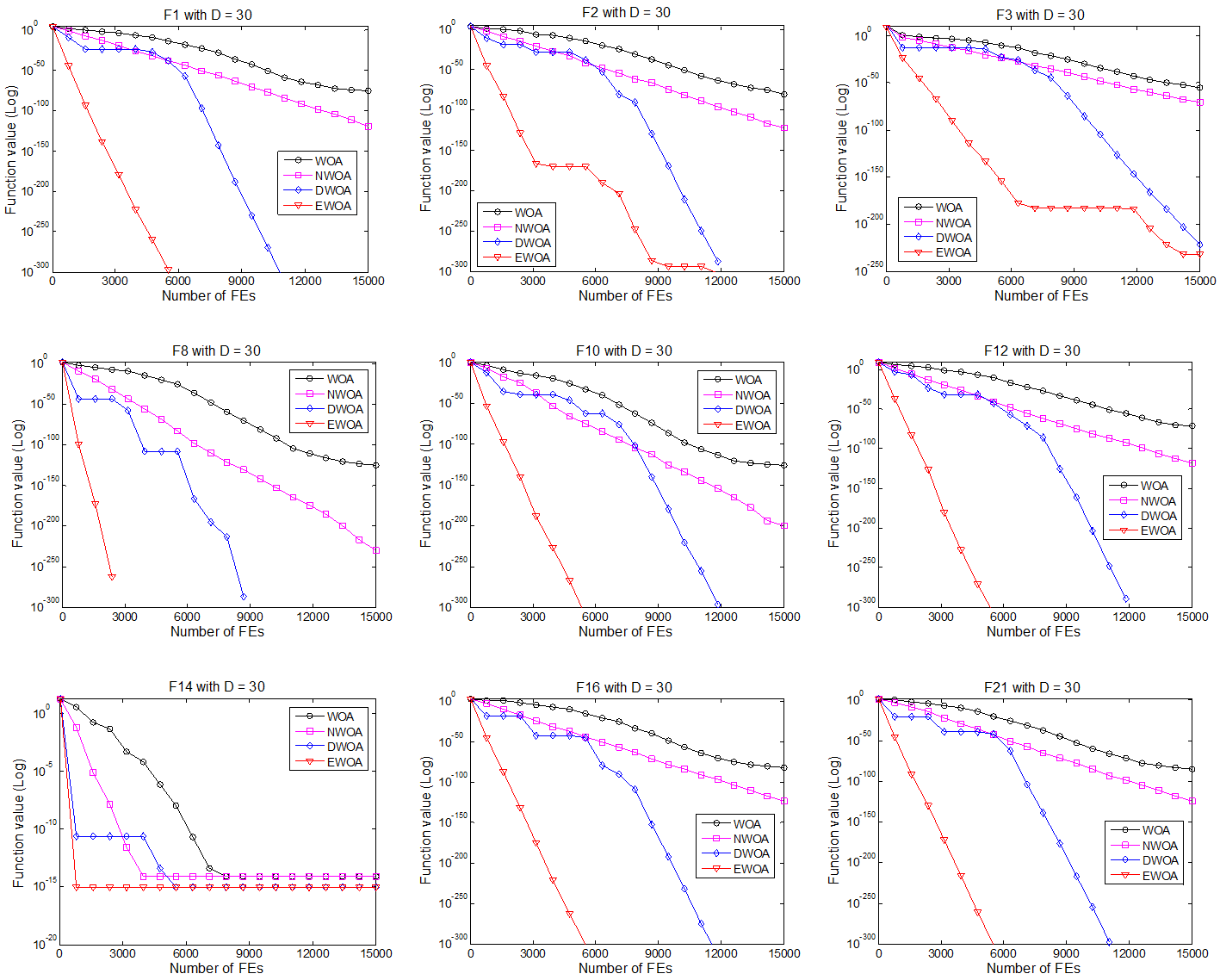
Dynamic Inertia Weight Whale Optimization Algorithm for Numerical and Engineering Optimization Problems
Open Access | Research Article | 06 June 2026
Dynamic Behavior of a Population Model Based on Second-order Fuzzy Difference Equation
Journal of Mathematics and Interdisciplinary Applications | Volume 2, Issue 2: 112-124, 2026 | DOI: 10.62762/JMIA.2026.547303
Abstract
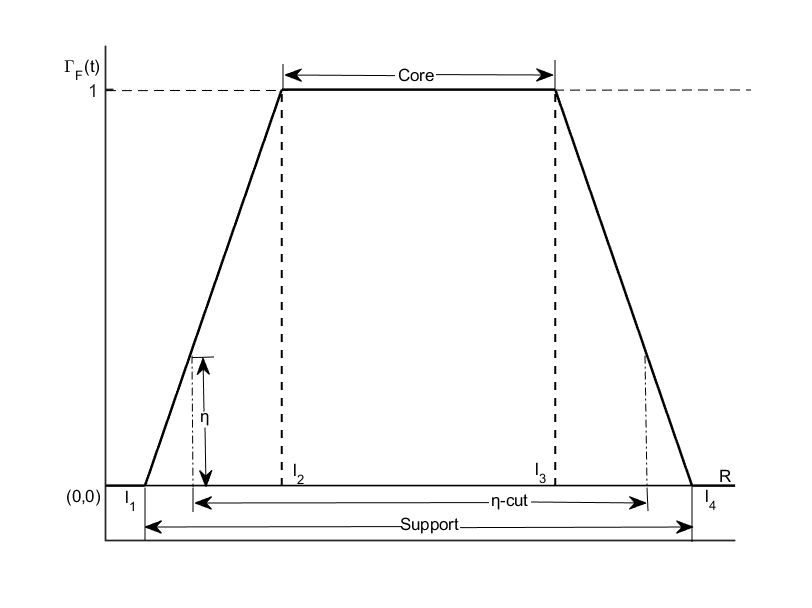
This article examines the dynamic behavior of a second-order fuzzy difference equation that models the quantitative changes in a specific biological population: $$ E_{n+1}=\frac{S}{C+E_n+E_{n-1}},\ n\in \mathbb{Z}\ and\ n\ge 0,$$ Here, parameter $S$ represents the carrying capacity of the environment, while $C$ signifies the minimum resources required for population survival. The initial values $E_0$, $E_{-1}$, and parameters $S$ , $C$ are all positive fuzzy numbers. By employing the generalized division (g-division) with respect to fuzzy numbers, we establish the existence, uniqueness, persistence, and boundedness of positive fuzzy solutions to the equation under specified conditions. Furth... More >

Graphical Abstract
Dynamic Behavior of a Population Model Based on Second-order Fuzzy Difference Equation
Open Access | Research Article | 11 May 2026
On Multi-Group Chickenpox Mathematical Epidemic Models with Effective Vaccination and Re-Infection Challenges
Journal of Mathematics and Interdisciplinary Applications | Volume 2, Issue 2: 91-111, 2026 | DOI: 10.62762/JMIA.2026.627569
Abstract
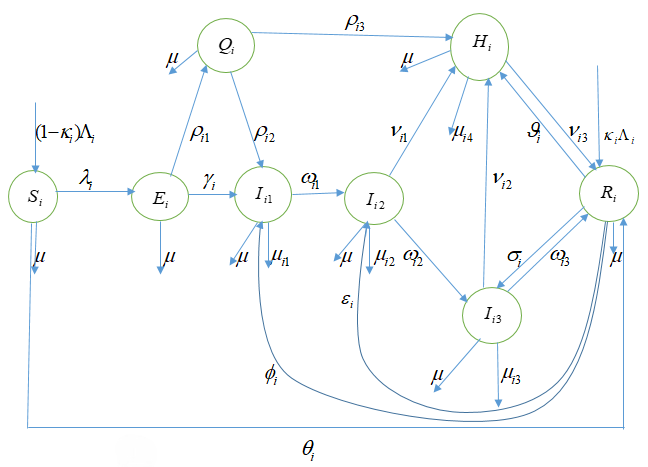
A class of multi-age group $SEQ_3IHR$ chickenpox epidemic models with effective vaccination in a different subpopulation size, is considered, in this paper. It is assumed that individual members of the subpopulations who recovered from the disease, may be re-infected by the disease. The models comprise of six infectious classes of subclasses and three distinct infected stages of subclasses. We establish that the global dynamics of the epidemic models are determined entirely by the basic reproduction number. In this paper, we determine that the disease-free and endemic equilibrium states, and carry out a stability analysis of the disease-free as well as the endemic equilibrium points of the m... More >

Graphical Abstract
On Multi-Group Chickenpox Mathematical Epidemic Models with Effective Vaccination and Re-Infection Challenges
Open Access | Research Article | 10 May 2026
Strategy Dynamics of Three-Strategy Snowdrift Game Induced by Reward Strategy and Payoff Delay
Journal of Mathematics and Interdisciplinary Applications | Volume 2, Issue 2: 74-90, 2026 | DOI: 10.62762/JMIA.2026.346326
Abstract
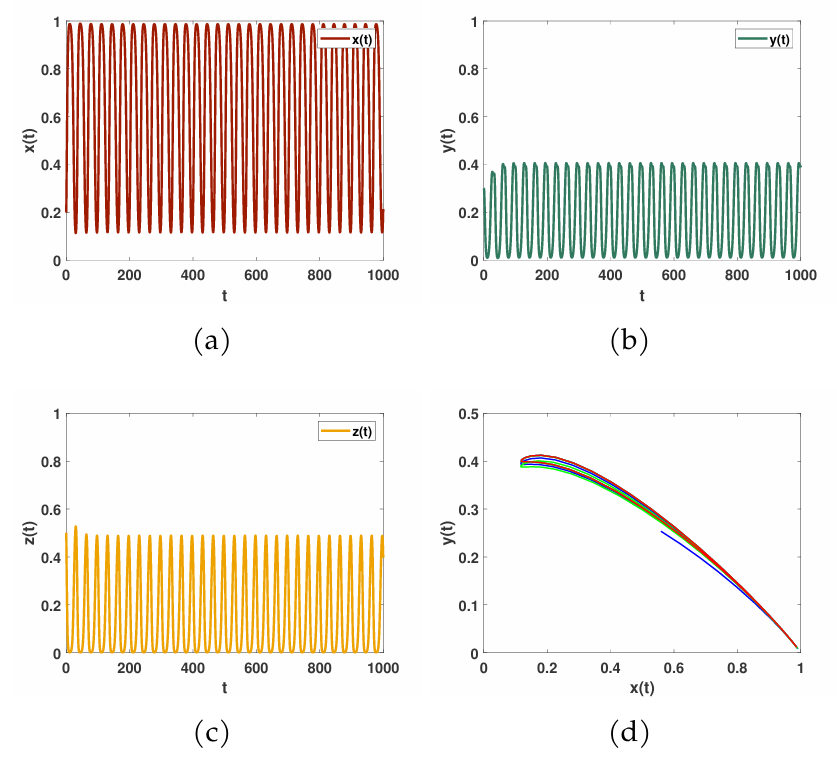
In the evolutionary game, the introduction of the third or more specific strategies to study cooperative evolution has attracted widespread attention recently. The main feature of this paper is to adopt a special reward strategy as the third choice to observe the evolution dynamics. This strategy can improve the utilization of resources and help cooperators and defectors get greater benefits. We investigate the evolutionary game dynamics of a three-strategy snowdrift game with special reward strategy and payoff delay. First, for the nondelay system, we discuss the dynamic properties of strategies, including the existence, stability and bistability of equilibrium states. Furthermore for the t... More >

Graphical Abstract
Strategy Dynamics of Three-Strategy Snowdrift Game Induced by Reward Strategy and Payoff Delay
Open Access | Research Article | 06 May 2026
A Proposal Toward the Painlevé Equivalence Problem
Journal of Mathematics and Interdisciplinary Applications | Volume 2, Issue 2: 59-73, 2026 | DOI: 10.62762/JMIA.2026.937794
Abstract
This article develops a constructive approach to the Painlevé equivalence problem based on explicit normalization and residual obstruction analysis. Instead of starting from the full invariant complexity of the general point-equivalence problem, we use target-adapted reductions that convert equivalence into a finite algebraic comparison problem inside canonical normalized families. For derivative-free polynomial classes, the method yields exact results. We obtain a constructive criterion for equivalence to the first Painlevé equation in the quadratic case and an exact criterion for equivalence to the second Painlevé equation in the cubic case. In both settings, the method provides explici... More >