Volume 2, Issue 3 (In Progress)


In Progress
Citations: Crossref logo 0,   0   |   Viewed: 1108, Download: 269

Table of Contents

Open Access | Research Article | 06 September 2026
A Stiffly Stable Adaptive Fifth-Order Block Time-Stepping Method for Stiff Oscillatory Differential Equations
Journal of Mathematics and Interdisciplinary Applications | Volume 2, Issue 3: 209-228, 2026 | DOI: 10.62762/JMIA.2026.142673
Abstract
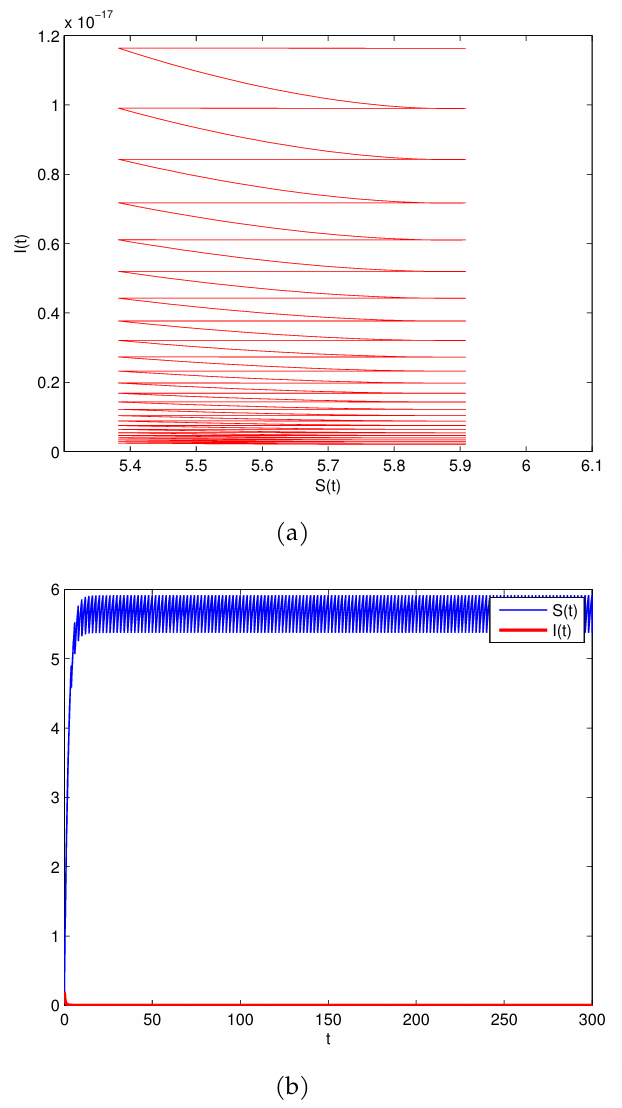
This paper presents an adaptive block time-stepping algorithm designed for the numerical integration of first-order stiff oscillatory problems, which typically involve multiple time scales and stringent stability conditions. The proposed method integrates a block formulation enabling the simultaneous evaluation of several solution points with an adaptive step size mechanism to effectively regulate local truncation errors. A predictor-corrector strategy is employed, where an explicit predictor generates initial estimates, and an implicit block corrector enhances stability for stiff systems. The resulting nonlinear equations are resolved using Newton's iterative method. The scheme is proven to... More >

Graphical Abstract
A Stiffly Stable Adaptive Fifth-Order Block Time-Stepping Method for Stiff Oscillatory Differential Equations
Open Access | Research Article | 04 September 2026
Generative AI Updates, Organizational Adaptation, and Enterprise Process Stability
Journal of Mathematics and Interdisciplinary Applications | Volume 2, Issue 3: 192-208, 2026 | DOI: 10.62762/JMIA.2026.104092
Abstract
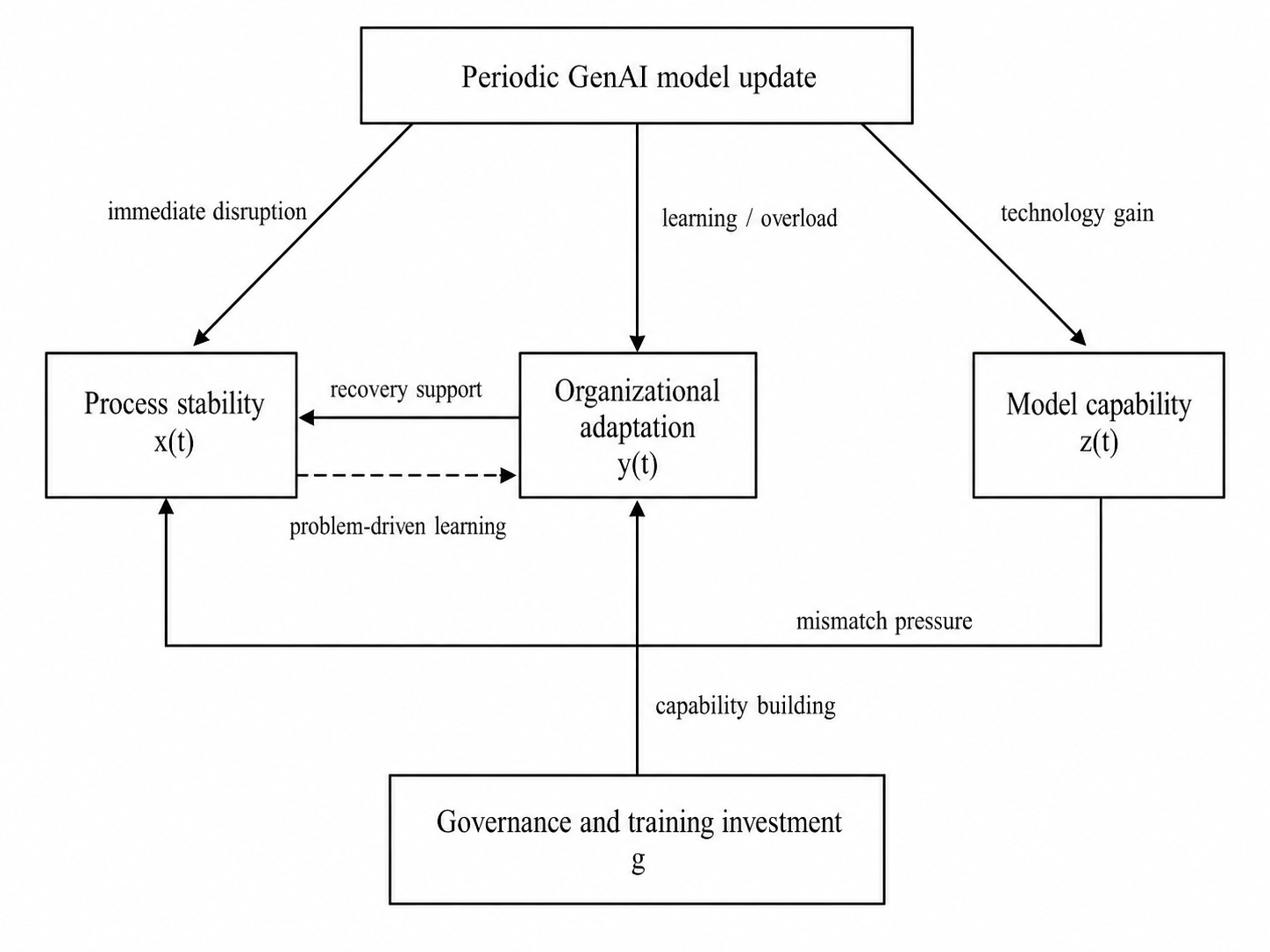
Generative artificial intelligence (GenAI) is increasingly embedded in enterprise workflows, yet the models that support these workflows are updated at discrete and sometimes frequent intervals. Each update can improve technical effectiveness while simultaneously invalidating prompts, interfaces, controls, and employee routines. This study develops an impulsive dynamical system to analyze the resulting tension between technical improvement and organizational disruption. The continuous subsystem tracks enterprise process stability, organizational adaptation, and effective model capability between updates. The impulsive subsystem represents the instantaneous effects of a model release on workf... More >

Graphical Abstract
Generative AI Updates, Organizational Adaptation, and Enterprise Process Stability
Open Access | Research Article | 24 July 2026
Modeling Marital Stability: A Dynamical Systems Analysis of Extramarital Affairs and Divorce
Journal of Mathematics and Interdisciplinary Applications | Volume 2, Issue 3: 164-191, 2026 | DOI: 10.62762/JMIA.2026.666866
Abstract
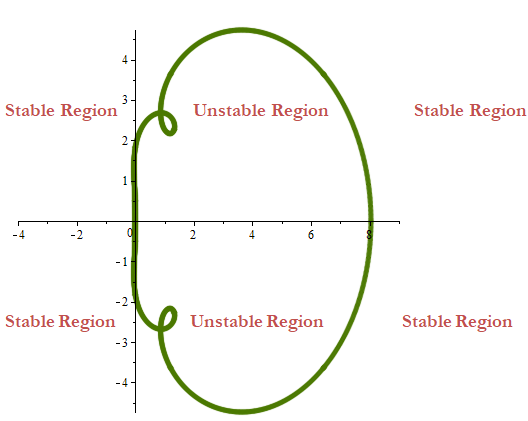
This study develops and analyzes a nonlinear mathematical model to describe the dynamics of marriage, extramarital affairs, marital breakdown, and divorce. The population is divided into five compartments: single $S(t)$, married $M(t)$, individuals in extramarital affairs $A(t)$, broken marriages $B(t)$, and divorced $D(t)$. The model is formulated as a system of nonlinear ordinary differential equations capturing transitions between these states through parameters representing marriage formation, affair initiation, reconciliation, separation, and divorce. Basic qualitative properties, including positivity and boundedness of solutions, are established to ensure the model is well posed. Equil... More >

Graphical Abstract
Modeling Marital Stability: A Dynamical Systems Analysis of Extramarital Affairs and Divorce
Open Access | Research Article | 13 July 2026
A Formal Analytic Program for the Three-Dimensional Navier–Stokes Equations
Journal of Mathematics and Interdisciplinary Applications | Volume 2, Issue 3: 143-163, 2026 | DOI: 10.62762/JMIA.2026.481220
Abstract
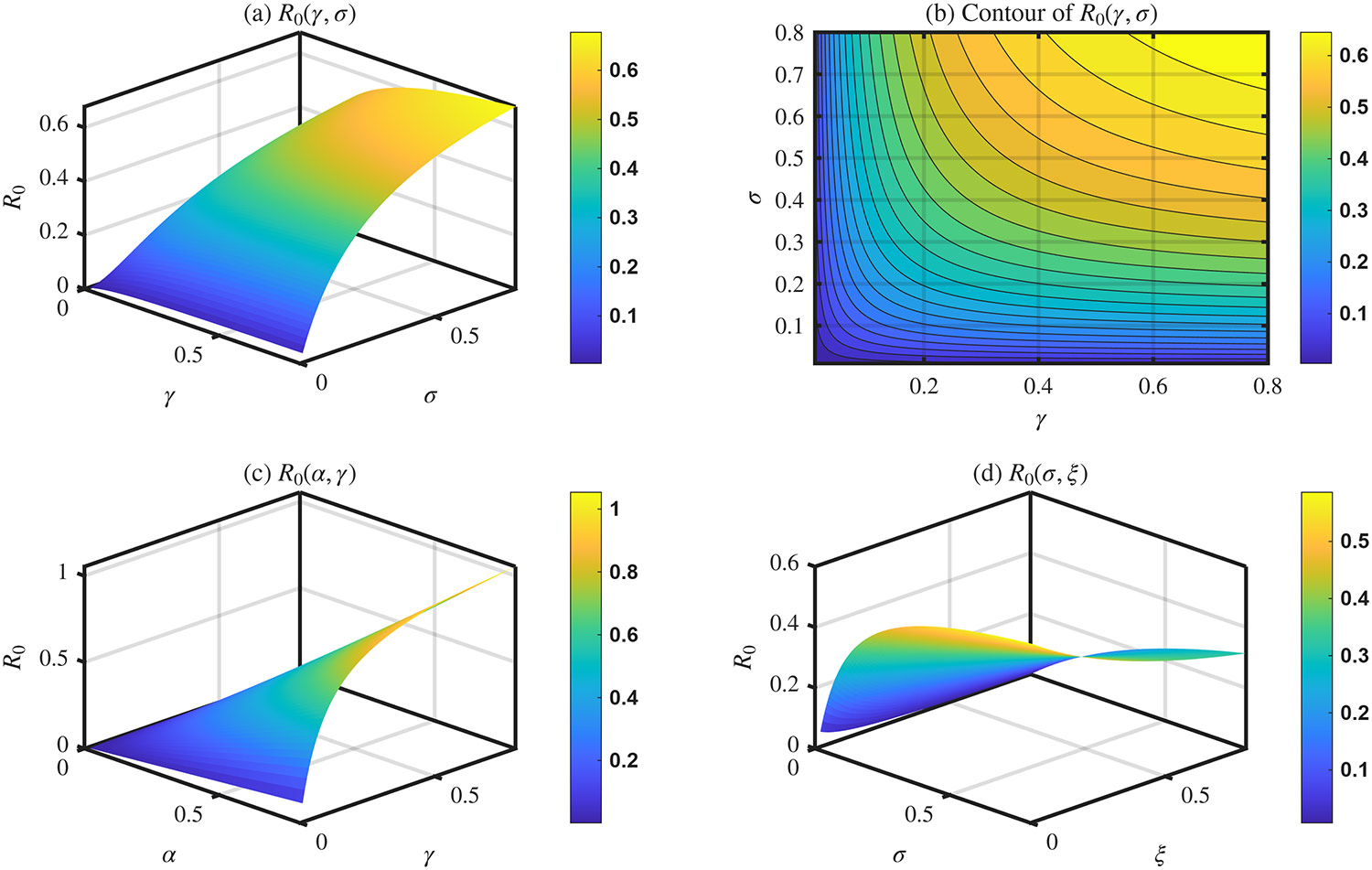
This paper develops a deliberately expanded analytic program around the three-dimensional incompressible Navier--Stokes equations. The exposition is intentionally heavy in algebra, index notation, multilinear expansions, differentiated hierarchies, and page-filling calculations. The central idea is to organize the continuation problem around a mixed pressure--vorticity--anisotropic functional, while keeping visible every major nonlinear channel: energy, Hessian growth, high-order commutators, vorticity stretching, elliptic pressure reconstruction, dyadic localization, paradifferential splitting, kernel representation, cylindrical-coordinate geometry, and dense symbolic closure systems. The r... More >