

Generative AI Updates, Organizational Adaptation, and Enterprise Process Stability


Article Information
Abstract
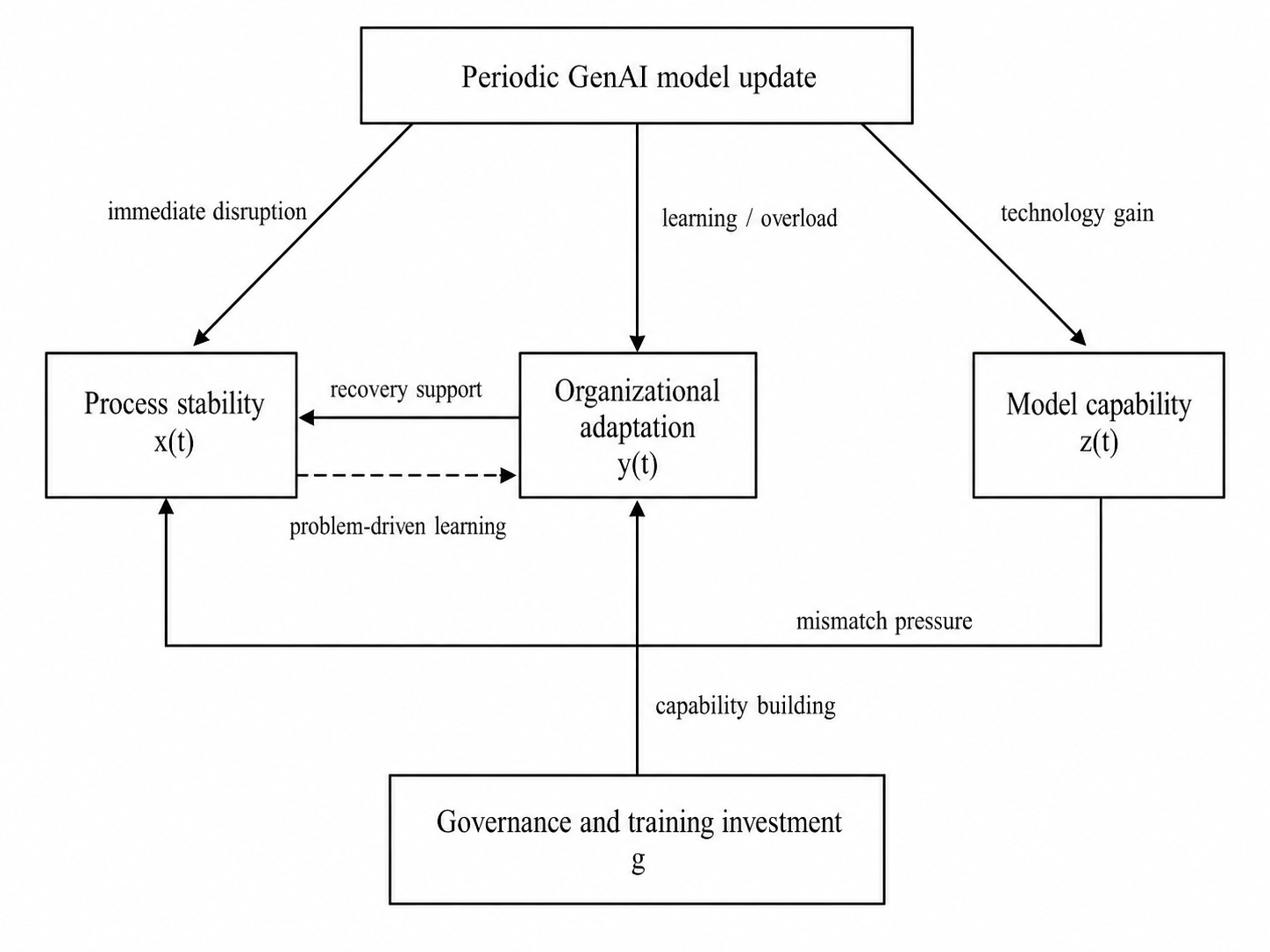
Generative artificial intelligence (GenAI) is increasingly embedded in enterprise workflows, yet the models that support these workflows are updated at discrete and sometimes frequent intervals. Each update can improve technical effectiveness while simultaneously invalidating prompts, interfaces, controls, and employee routines. This study develops an impulsive dynamical system to analyze the resulting tension between technical improvement and organizational disruption. The continuous subsystem tracks enterprise process stability, organizational adaptation, and effective model capability between updates. The impulsive subsystem represents the instantaneous effects of a model release on workflow stability, learning, cognitive overload, and technical performance. Positive invariance of the state space is established, the existence of at least one periodic operating trajectory is proved, a closed-form periodic solution for the technical-effectiveness subsystem is derived, and a local stability condition is formulated through the spectral radius of the one-cycle Poincaré map. Numerical experiments compare high-frequency incremental updates, low-frequency major updates, higher governance investment, and cognitive-overload conditions. A long-run performance objective is then used to identify a joint update interval, update intensity, and governance investment policy. The results show that update interval and update intensity should not be selected independently. Small but frequent updates reduce the amplitude of process disruption but may impose persistent coordination costs, whereas large infrequent updates produce deeper stability losses. Organizational adaptation expands the robust operating region, while cognitive overload contracts it. Under the normalized baseline calibration, the best grid policy combines a moderate update interval, a moderate update intensity, and relatively high governance investment. The paper contributes a formal framework for treating GenAI model releases as organizational impulses rather than as purely technical upgrades.
Graphical Abstract
Keywords
Data Availability Statement
Funding
Conflicts of Interest
AI Use Statement
Ethical Approval and Consent to Participate
References
- Dumas, M., Fournier, F., Limonad, L., Marrella, A., Montali, M., Rehse, J. R., ... & Weber, I. (2023). AI-augmented business process management systems: a research manifesto. ACM Transactions on Management Information Systems, 14(1), 1-19.
[CrossRef] [Google Scholar] - Rosemann, M., Brocke, J. V., Van Looy, A., & Santoro, F. (2024). Business process management in the age of AI–three essential drifts. Information Systems and e-Business Management, 22(3), 415-429.
[CrossRef] [Google Scholar] - Wornow, M., Narayan, A., Opsahl-Ong, K., McIntyre, Q., Shah, N. H., & Re, C. (2024). Automating the enterprise with foundation models. arXiv preprint arXiv:2405.03710.
[CrossRef] [Google Scholar] - Bommasani, R., Hudson, D. A., Adeli, E., Altman, R., Arora, S., von Arx, S., ... & Liang, P. (2021). On the opportunities and risks of foundation models. arXiv preprint arXiv:2108.07258.
[CrossRef] [Google Scholar] - Beheshti, A., Yang, J., Sheng, Q. Z., Benatallah, B., Casati, F., Dustdar, S., ... & Xue, S. (2023, July). ProcessGPT: transforming business process management with generative artificial intelligence. In 2023 IEEE international conference on web services (ICWS) (pp. 731-739). IEEE.
[CrossRef] [Google Scholar] - Kampik, T., Warmuth, C., Rebmann, A., Agam, R., Egger, L. N., Gerber, A., ... & Weidlich, M. (2025). Large process models: a vision for business process management in the age of generative AI. KI-Künstliche Intelligenz, 39(2), 81-95.
[CrossRef] [Google Scholar] - Vidgof, M., Bachhofner, S., & Mendling, J. (2023, September). Large language models for business process management: Opportunities and challenges. In International conference on business process management (pp. 107-123). Cham: Springer Nature Switzerland.
[CrossRef] [Google Scholar] - Klievtsova, N., Benzin, J. V., Kampik, T., Mangler, J., & Rinderle-Ma, S. (2023, September). Conversational process modelling: state of the art, applications, and implications in practice. In International conference on business process management (pp. 319-336). Cham: Springer Nature Switzerland.
[CrossRef] [Google Scholar] - Kourani, H., Berti, A., Schuster, D., & Van der Aalst, W. M. (2025). Evaluating large language models on business process modeling: framework, benchmark, and self-improvement analysis. Software and Systems Modeling, 1-36.
[CrossRef] [Google Scholar] - Rana, N. P., Pillai, R., Sivathanu, B., & Malik, N. (2024). Assessing the nexus of Generative AI adoption, ethical considerations and organizational performance. Technovation, 135, 103064.
[CrossRef] [Google Scholar] - Yang, J., Blount, Y., & Amrollahi, A. (2024). Artificial intelligence adoption in a professional service industry: A multiple case study. Technological Forecasting and Social Change, 201, 123251.
[CrossRef] [Google Scholar] - Hughes, L., Davies, F., Li, K., Gunaratnege, S. M., Malik, T., & Dwivedi, Y. K. (2026). Beyond the hype: Organisational adoption of Generative AI through the lens of the TOE framework–A mixed methods perspective. International journal of information management, 86, 102982.
[CrossRef] [Google Scholar] - Noy, S., & Zhang, W. (2023). Experimental evidence on the productivity effects of generative artificial intelligence. Science, 381(6654), 187-192.
[CrossRef] [Google Scholar] - Dell'Acqua, F., McFowland III, E., Mollick, E., Lifshitz, H., Kellogg, K. C., Rajendran, S., ... & Lakhani, K. R. (2026). Navigating the jagged technological frontier: Field experimental evidence of the effects of artificial intelligence on knowledge worker productivity and quality. Organization Science, 37(2), 403-423.
[CrossRef] [Google Scholar] - Röglinger, M., Plattfaut, R., Borghoff, V., Kerpedzhiev, G., Becker, J., Beverungen, D., ... & Trkman, P. (2022). Exogenous shocks and business process management: a scholars' perspective on challenges and opportunities. Business & Information Systems Engineering, 64(5), 669-687.
[CrossRef] [Google Scholar] - Zhu, H., Ji, X., & Lu, J. (2023). Impulsive strategies in nonlinear dynamical systems: A brief overview. Mathematical Biosciences and Engineering, 20(2), 4274-4321. http://dx.doi.org/10.3934/mbe.2023200
[Google Scholar] - Dashkovskiy, S., & Slynko, V. (2022). Stability conditions for impulsive dynamical systems. Mathematics of Control, Signals, and Systems, 34(1), 95-128.
[CrossRef] [Google Scholar] - Liu, K. (2022). Stability analysis for $(\omega, c)$-periodic non-instantaneous impulsive differential equations. AIMS Mathematics, 7(2), 1758-1774.
[CrossRef] [Google Scholar] - Teubner, T., Flath, C. M., Weinhardt, C., van der Aalst, W., & Hinz, O. (2023). Welcome to the era of ChatGPT et al. Business & Information Systems Engineering, 65(2), 95-101.
[CrossRef] [Google Scholar] - Chen, L., Zaharia, M., & Zou, J. (2023). How is ChatGPT's behavior changing over time? arXiv preprint arXiv:2307.09009.
[CrossRef] [Google Scholar] - Mariani, M., & Dwivedi, Y. K. (2024). Generative artificial intelligence in innovation management: A preview of future research developments. Journal of Business Research, 175, 114542.
[CrossRef] [Google Scholar] - Brynjolfsson, E., Li, D., & Raymond, L. (2025). Generative AI at Work. The Quarterly Journal of Economics, 140(2), 889-942.
[CrossRef] [Google Scholar] - Bouha, C., & Benhayoun, L. (2026). From Promise to Pressure: An Employee‐Focused, Context‐Aware Framework of AI Adoption Balancing Performance and Cognitive Load. Knowledge and Process Management.
[CrossRef] [Google Scholar] - Raisch, S., & Krakowski, S. (2021). Artificial intelligence and management: The automation–augmentation paradox. Academy of management review, 46(1), 192-210.
[CrossRef] [Google Scholar] - Jöhnk, J., Weißert, M., & Wyrtki, K. (2021). Ready or Not, AI Comes— An Interview Study of Organizational AI Readiness Factors. Business & information systems engineering, 63(1), 5-20.
[CrossRef] [Google Scholar] - Kreuzberger, D., K\"uhl, N., & Hirschl, S. (2023). Machine learning operations (MLOps): Overview, definition, and architecture. IEEE Access, 11, 31866-31879.
[CrossRef] [Google Scholar] - Amrit, C., & Narayanappa, A. K. (2025). An analysis of the challenges in the adoption of MLOps. Journal of Innovation & Knowledge, 10(1), 100637.
[CrossRef] [Google Scholar] - Serban, A., van der Blom, K., Hoos, H., & Visser, J. (2024). Software engineering practices for machine learning—adoption, effects, and team assessment. Journal of Systems and Software, 209, 111907.
[CrossRef] [Google Scholar] - Eck, B., Kabakci-Zorlu, D., Chen, Y., Savard, F., & Bao, X. (2022, December). A monitoring framework for deployed machine learning models with supply chain examples. In 2022 IEEE International Conference on Big Data (Big Data) (pp. 2231-2238). IEEE.
[CrossRef] [Google Scholar] - Bayram, F., Ahmed, B. S., & Kassler, A. (2022). From concept drift to model degradation: An overview on performance-aware drift detectors. Knowledge-Based Systems, 245, 108632.
[CrossRef] [Google Scholar] - Dwivedi, Y. K., Kshetri, N., Hughes, L., Slade, E. L., Jeyaraj, A., Kar, A. K., ... & Wright, R. (2023). Opinion Paper:"So what if ChatGPT wrote it?" Multidisciplinary perspectives on opportunities, challenges and implications of generative conversational AI for research, practice and policy. International journal of information management, 71, 102642.
[CrossRef] [Google Scholar] - Xu, H., Zhu, Q., & Zheng, W. X. (2023). Exponential stability of stochastic nonlinear delay systems subject to multiple periodic impulses. IEEE Transactions on Automatic Control, 69(4), 2621-2628.
[CrossRef] [Google Scholar] - Li, X., Wang, Y., & Song, S. (2022). Stability of nonlinear impulsive systems: Self-triggered comparison system approach. IEEE Transactions on Automatic Control, 68(8), 4940-4947.
[CrossRef] [Google Scholar] - Wang, M., Li, P., & Li, X. (2023). Event-triggered delayed impulsive control for input-to-state stability of nonlinear impulsive systems. Nonlinear Analysis: Hybrid Systems, 47, 101277.
[CrossRef] [Google Scholar] - Dwivedi, Y. K., Hughes, L., Ismagilova, E., Aarts, G., Coombs, C., Crick, T., ... & Williams, M. D. (2021). Artificial Intelligence (AI): Multidisciplinary perspectives on emerging challenges, opportunities, and agenda for research, practice and policy. International journal of information management, 57, 101994.
[CrossRef] [Google Scholar] - Mäntymäki, M., Minkkinen, M., Birkstedt, T., & Viljanen, M. (2022). Putting AI ethics into practice: The hourglass model of organizational AI governance. arXiv preprint arXiv:2206.00335.
[CrossRef] [Google Scholar] - Mäntymäki, M., Minkkinen, M., Birkstedt, T., & Viljanen, M. (2022). Defining organizational AI governance. AI and Ethics, 2(4), 603-609.
[CrossRef] [Google Scholar] - Fettke, P., & Di Francescomarino, C. (2025). KI-SI: Business Process Management (BPM) in the Era of AI (BPM-AI). KI-Künstliche Intelligenz, 39(2), 63-65.
[CrossRef] [Google Scholar] - Zhang, K., & Braverman, E. (2022). Event-triggered impulsive control for nonlinear systems with actuation delays. IEEE Transactions on Automatic Control, 68(1), 540-547.
[CrossRef] [Google Scholar] - Li, X., & Wang, M. (2024). Stability for nonlinear delay systems: Self-triggered impulsive control. Automatica, 160, 111469.
[CrossRef] [Google Scholar]
Cite This Article
TY  - JOUR
AU  - Sun, Fang
PY  - 2026
DA  - 2026/09/04
TI  - Generative AI Updates, Organizational Adaptation, and Enterprise Process Stability
JO  - Journal of Mathematics and Interdisciplinary Applications
T2  - Journal of Mathematics and Interdisciplinary Applications
JF  - Journal of Mathematics and Interdisciplinary Applications
VL  - 2
IS  - 3
SP  - 192
EP  - 208
DO  - 10.62762/JMIA.2026.104092
UR  - https://www.icck.org/article/abs/JMIA.2026.104092
KW  - generative artificial intelligence
KW  - impulsive dynamical system
KW  - organizational adaptation
KW  - process stability
KW  - optimal update policy
AB  - Generative artificial intelligence (GenAI) is increasingly embedded in enterprise workflows, yet the models that support these workflows are updated at discrete and sometimes frequent intervals. Each update can improve technical effectiveness while simultaneously invalidating prompts, interfaces, controls, and employee routines. This study develops an impulsive dynamical system to analyze the resulting tension between technical improvement and organizational disruption. The continuous subsystem tracks enterprise process stability, organizational adaptation, and effective model capability between updates. The impulsive subsystem represents the instantaneous effects of a model release on workflow stability, learning, cognitive overload, and technical performance. Positive invariance of the state space is established, the existence of at least one periodic operating trajectory is proved, a closed-form periodic solution for the technical-effectiveness subsystem is derived, and a local stability condition is formulated through the spectral radius of the one-cycle Poincaré map. Numerical experiments compare high-frequency incremental updates, low-frequency major updates, higher governance investment, and cognitive-overload conditions. A long-run performance objective is then used to identify a joint update interval, update intensity, and governance investment policy. The results show that update interval and update intensity should not be selected independently. Small but frequent updates reduce the amplitude of process disruption but may impose persistent coordination costs, whereas large infrequent updates produce deeper stability losses. Organizational adaptation expands the robust operating region, while cognitive overload contracts it. Under the normalized baseline calibration, the best grid policy combines a moderate update interval, a moderate update intensity, and relatively high governance investment. The paper contributes a formal framework for treating GenAI model releases as organizational impulses rather than as purely technical upgrades.
SN  - 3070-393X
PB  - Institute of Central Computation and Knowledge
LA  - English
ER  -
@article{Sun2026Generative,
  author = {Fang Sun},
  title = {Generative AI Updates, Organizational Adaptation, and Enterprise Process Stability},
  journal = {Journal of Mathematics and Interdisciplinary Applications},
  year = {2026},
  volume = {2},
  number = {3},
  pages = {192-208},
  doi = {10.62762/JMIA.2026.104092},
  url = {https://www.icck.org/article/abs/JMIA.2026.104092},
  abstract = {Generative artificial intelligence (GenAI) is increasingly embedded in enterprise workflows, yet the models that support these workflows are updated at discrete and sometimes frequent intervals. Each update can improve technical effectiveness while simultaneously invalidating prompts, interfaces, controls, and employee routines. This study develops an impulsive dynamical system to analyze the resulting tension between technical improvement and organizational disruption. The continuous subsystem tracks enterprise process stability, organizational adaptation, and effective model capability between updates. The impulsive subsystem represents the instantaneous effects of a model release on workflow stability, learning, cognitive overload, and technical performance. Positive invariance of the state space is established, the existence of at least one periodic operating trajectory is proved, a closed-form periodic solution for the technical-effectiveness subsystem is derived, and a local stability condition is formulated through the spectral radius of the one-cycle Poincaré map. Numerical experiments compare high-frequency incremental updates, low-frequency major updates, higher governance investment, and cognitive-overload conditions. A long-run performance objective is then used to identify a joint update interval, update intensity, and governance investment policy. The results show that update interval and update intensity should not be selected independently. Small but frequent updates reduce the amplitude of process disruption but may impose persistent coordination costs, whereas large infrequent updates produce deeper stability losses. Organizational adaptation expands the robust operating region, while cognitive overload contracts it. Under the normalized baseline calibration, the best grid policy combines a moderate update interval, a moderate update intensity, and relatively high governance investment. The paper contributes a formal framework for treating GenAI model releases as organizational impulses rather than as purely technical upgrades.},
  keywords = {generative artificial intelligence, impulsive dynamical system, organizational adaptation, process stability, optimal update policy},
  issn = {3070-393X},
  publisher = {Institute of Central Computation and Knowledge}
}
Article Metrics
Publisher's Note
ICCK stays neutral with regard to jurisdictional claims in published maps and institutional affiliations.
Rights and Permissions
 Copyright © 2026 by the Author(s). Published by Institute of Central Computation and Knowledge. This article is an open access article distributed under the terms and conditions of the Creative Commons Attribution (CC BY) license (https://creativecommons.org/licenses/by/4.0/), which permits use, sharing, adaptation, distribution and reproduction in any medium or format, as long as you give appropriate credit to the original author(s) and the source, provide a link to the Creative Commons licence, and indicate if changes were made.


Portico
