

Quantile Deviation Ensemble Based on Multi-Layer Perceptrons for Cervical Cancer Classification with Uncertainty Perception



Article Information
Abstract
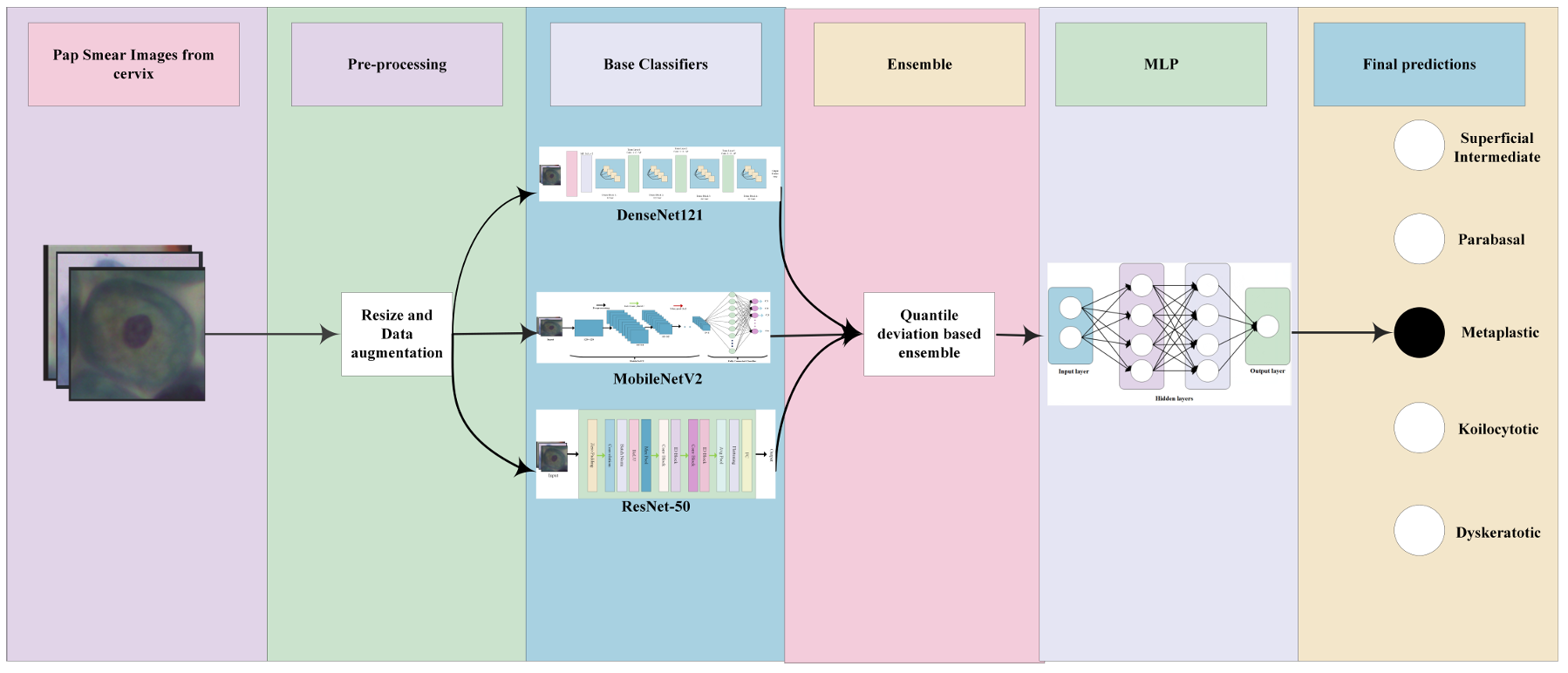
The accurate classification of cervical cytology in Pap smear images remains a critical challenge in computer-aided diagnosis, largely due to the inherent uncertainty and subtle morphological variations among different pathological categories. To address this, we propose a novel uncertainty-aware ensemble framework that integrates statistical quantile analysis with deep learning for robust and interpretable classification. Our framework first leverages three deep convolutional neural networks DenseNet121, MobileNetV2, and ResNet-50 as base feature extractors. Instead of employing naive ensemble strategies, we introduce a quantile deviation based weighting mechanism to dynamically assess and integrate the prediction confidence of each model, explicitly quantifying performance bias across different probability quantiles. This approach not only enhances ensemble stability but also provides a statistical measure of model uncertainty. Subsequently, the weighted probabilistic outputs are fed into a multi-layer perceptron (MLP) for further non-linear optimization and decision refinement, forming a hybrid statistical deep learning pipeline. Evaluated on the publicly available SIPaKMeD dataset, our framework achieves an average accuracy of 98.10%, outperforming both individual base models and existing ensemble methods. Visualization via Grad-CAM further confirms that the framework focuses on clinically relevant cellular structures, validating its diagnostic relevance. By bridging statistical uncertainty quantification with deep ensemble learning, this work offers a principled and transparent methodology for medical image classification, with potential extensibility to other domains requiring reliable and interpretable predictions under uncertainty.
Graphical Abstract
Keywords
Data Availability Statement
Funding
Conflicts of Interest
AI Use Statement
Ethical Approval and Consent to Participate
References
- Manna, A., Kundu, R., Kaplun, D., Sinitca, A., & Sarkar, R. (2021). A fuzzy rank-based ensemble of CNN models for classification of cervical cytology. Scientific Reports, 11(1), 14538.
[CrossRef] [Google Scholar] - Sahoo, P., Saha, S., Sharma, S. K., Kanungo, A., & Verma, N. (2025). Boosting cervical cancer detection with a multi-stage architecture and complementary information fusion. Soft Computing, 29(2), 1191–1206.
[CrossRef] [Google Scholar] - Wasswa, W., Ware, A., Basaza-Ejiri, A. H., & Obungoloch, J. (2018). A review of image analysis and machine learning techniques for automated cervical cancer screening from pap-smear images. Computer Methods and Programs in Biomedicine, 164, 15–22.
[CrossRef] [Google Scholar] - Attallah, O. (2022). Deep learning-based CAD system for COVID-19 diagnosis via spectral-temporal images. In Proceedings of the 12th International Conference on Information Communication and Management (pp. 25–33).
[CrossRef] [Google Scholar] - Plissiti, M. E., Dimitrakopoulos, P., Sfikas, G., Nikou, C., Krikoni, O., & Charchanti, A. (2018). Sipakmed: A new dataset for feature and image based classification of normal and pathological cervical cells in pap smear images. In 2018 25th IEEE International Conference on Image Processing (ICIP) (pp. 3144–3148). IEEE.
[CrossRef] [Google Scholar] - Nanni, L., Ghidoni, S., & Brahnam, S. (2017). Handcrafted vs. non-handcrafted features for computer vision classification. Pattern Recognition, 71, 158–172.
[CrossRef] [Google Scholar] - Rahaman, M. M., Li, C., Yao, Y., Kulwa, F., Wu, X., Li, X., & Wang, Q. (2021). DeepCervix: A deep learning-based framework for the classification of cervical cells using hybrid deep feature fusion techniques. Computers in Biology and Medicine, 136, 104649.
[CrossRef] [Google Scholar] - Basak, H., Kundu, R., Chakraborty, S., & Das, N. (2021). Cervical cytology classification using PCA and GWO enhanced deep features selection. SN Computer Science, 2(5), 369.
[CrossRef] [Google Scholar] - Liu, W., Li, C., Xu, N., Jiang, P., & Jiang, Y. (2022). CVM-Cervix: A hybrid cervical Pap-smear image classification framework using CNN, visual transformer and multilayer perceptron. Pattern Recognition, 130, 108829.
[CrossRef] [Google Scholar] - Newaz, A., Muhtadi, S., & Haq, F. S. (2022). An intelligent decision support system for the accurate diagnosis of cervical cancer. Knowledge-Based Systems, 245, 108634.
[CrossRef] [Google Scholar] - Ghoneim, A., Muhammad, G., & Hossain, M. S. (2020). Cervical cancer classification using convolutional neural networks and extreme learning machines. Future Generation Computer Systems, 102, 643–649.
[CrossRef] [Google Scholar] - Tawalbeh, S., Alquran, H., & Alsalatie, M. (2023). Deep feature engineering in colposcopy image recognition: A comparative study. Bioengineering, 10(1), 105.
[CrossRef] [Google Scholar] - Kalbhor, M. M., & Shinde, S. V. (2023). Cervical cancer diagnosis using convolution neural network: feature learning and transfer learning approaches. Soft Computing, 1-11.
[CrossRef] [Google Scholar] - Akpinar, M. H., Atila, O., Sengur, A., Salvi, M., & Acharya, U. R. (2025). A novel uncertainty-aware liquid neural network for noise-resilient time series forecasting and classification. Chaos, Solitons & Fractals, 193, 116130.
[CrossRef] [Google Scholar] - Han, Q., Qian, X., Xu, H., Wang, Y., He, F., & Shi, Y. (2024). DM-CNN: Dynamic multi-scale convolutional neural network with uncertainty quantification for medical image classification. Computers in Biology and Medicine, 168, 107758.
[CrossRef] [Google Scholar] - Ullah, N., Guzmán-Aroca, F., Martínez-Álvarez, F., & Troncoso, A. (2025). A novel explainable AI framework for medical image classification integrating statistical, visual, and rule-based methods. Medical Image Analysis, 97, 103665.
[CrossRef] [Google Scholar] - Wang, K., Shariatmadar, K., Manchingal, S. K., Mirzazadeh, M., Ghorbani, M., Kuhn, S., & Cuzzolin, F. (2025). Creinns: Credal-set interval neural networks for uncertainty estimation in classification tasks. Neural Networks, 185, 107198.
[CrossRef] [Google Scholar] - Huang, G., Liu, Z., Van Der Maaten, L., & Weinberger, K. Q. (2017, July). Densely Connected Convolutional Networks. In 2017 IEEE Conference on Computer Vision and Pattern Recognition (CVPR) (pp. 2261-2269). IEEE Computer Society.
[CrossRef] [Google Scholar] - Sandler, M., Howard, A., Zhu, M., Zhmoginov, A., & Chen, L. C. (2018, June). MobileNetV2: Inverted Residuals and Linear Bottlenecks. In 2018 IEEE/CVF Conference on Computer Vision and Pattern Recognition (pp. 4510-4520). IEEE.
[CrossRef] [Google Scholar] - He, K., Zhang, X., Ren, S., & Sun, J. (2016). Deep residual learning for image recognition. In Proceedings of the IEEE Conference on Computer Vision and Pattern Recognition (CVPR) (pp. 770–778).
[CrossRef] [Google Scholar] - Hechtlinger, Y., Póczos, B., & Wasserman, L. (2018). Cautious deep learning. arXiv preprint arXiv:1805.09460.
[Google Scholar] - Pramanik, R., Banerjee, B., & Sarkar, R. (2023). MSENet: Mean and standard deviation based ensemble network for cervical cancer detection. Engineering Applications of Artificial Intelligence, 123, 106336.
[CrossRef] [Google Scholar] - Pramanik, R., Biswas, M., Sen, S., de Souza Júnior, L. A., Papa, J. P., & Sarkar, R. (2022). A fuzzy distance-based ensemble of deep models for cervical cancer detection. Computer Methods and Programs in Biomedicine, 219, 106776.
[CrossRef] [Google Scholar] - Wubineh, B. Z., Rusiecki, A., & Halawa, K. (2024). Classification of cervical cells from the Pap smear image using the RES\_DCGAN data augmentation and ResNet50V2 with self-attention architecture. Neural Computing and Applications, 36(34), 21801–21815.
[CrossRef] [Google Scholar] - Selvaraju, R. R., Cogswell, M., Das, A., Vedantam, R., Parikh, D., & Batra, D. (2017). Grad-cam: Visual explanations from deep networks via gradient-based localization. In Proceedings of the IEEE International Conference on Computer Vision (ICCV) (pp. 618–626).
[CrossRef] [Google Scholar]
Cite This Article
TY  - JOUR
AU  - Hu, Hui
AU  - Huang, Jiewu
AU  - Cao, Shoumei
AU  - Dai, Anna
PY  - 2026
DA  - 2026/02/07
TI  - Quantile Deviation Ensemble Based on Multi-Layer Perceptrons for Cervical Cancer Classification with Uncertainty Perception
JO  - Journal of Mathematics and Interdisciplinary Applications
T2  - Journal of Mathematics and Interdisciplinary Applications
JF  - Journal of Mathematics and Interdisciplinary Applications
VL  - 2
IS  - 1
SP  - 12
EP  - 27
DO  - 10.62762/JMIA.2026.403659
UR  - https://www.icck.org/article/abs/JMIA.2026.403659
KW  - cervical cytology classification
KW  - uncertainty quantification
KW  - ensemble learning
KW  - quantile deviation
KW  - deep learning
AB  - The accurate classification of cervical cytology in Pap smear images remains a critical challenge in computer-aided diagnosis, largely due to the inherent uncertainty and subtle morphological variations among different pathological categories. To address this, we propose a novel uncertainty-aware ensemble framework that integrates statistical quantile analysis with deep learning for robust and interpretable classification. Our framework first leverages three deep convolutional neural networks DenseNet121, MobileNetV2, and ResNet-50 as base feature extractors. Instead of employing naive ensemble strategies, we introduce a quantile deviation based weighting mechanism to dynamically assess and integrate the prediction confidence of each model, explicitly quantifying performance bias across different probability quantiles. This approach not only enhances ensemble stability but also provides a statistical measure of model uncertainty. Subsequently, the weighted probabilistic outputs are fed into a multi-layer perceptron (MLP) for further non-linear optimization and decision refinement, forming a hybrid statistical deep learning pipeline. Evaluated on the publicly available SIPaKMeD dataset, our framework achieves an average accuracy of 98.10%, outperforming both individual base models and existing ensemble methods. Visualization via Grad-CAM further confirms that the framework focuses on clinically relevant cellular structures, validating its diagnostic relevance. By bridging statistical uncertainty quantification with deep ensemble learning, this work offers a principled and transparent methodology for medical image classification, with potential extensibility to other domains requiring reliable and interpretable predictions under uncertainty.
SN  - 3070-393X
PB  - Institute of Central Computation and Knowledge
LA  - English
ER  -
@article{Hu2026Quantile,
  author = {Hui Hu and Jiewu Huang and Shoumei Cao and Anna Dai},
  title = {Quantile Deviation Ensemble Based on Multi-Layer Perceptrons for Cervical Cancer Classification with Uncertainty Perception},
  journal = {Journal of Mathematics and Interdisciplinary Applications},
  year = {2026},
  volume = {2},
  number = {1},
  pages = {12-27},
  doi = {10.62762/JMIA.2026.403659},
  url = {https://www.icck.org/article/abs/JMIA.2026.403659},
  abstract = {The accurate classification of cervical cytology in Pap smear images remains a critical challenge in computer-aided diagnosis, largely due to the inherent uncertainty and subtle morphological variations among different pathological categories. To address this, we propose a novel uncertainty-aware ensemble framework that integrates statistical quantile analysis with deep learning for robust and interpretable classification. Our framework first leverages three deep convolutional neural networks DenseNet121, MobileNetV2, and ResNet-50 as base feature extractors. Instead of employing naive ensemble strategies, we introduce a quantile deviation based weighting mechanism to dynamically assess and integrate the prediction confidence of each model, explicitly quantifying performance bias across different probability quantiles. This approach not only enhances ensemble stability but also provides a statistical measure of model uncertainty. Subsequently, the weighted probabilistic outputs are fed into a multi-layer perceptron (MLP) for further non-linear optimization and decision refinement, forming a hybrid statistical deep learning pipeline. Evaluated on the publicly available SIPaKMeD dataset, our framework achieves an average accuracy of 98.10\%, outperforming both individual base models and existing ensemble methods. Visualization via Grad-CAM further confirms that the framework focuses on clinically relevant cellular structures, validating its diagnostic relevance. By bridging statistical uncertainty quantification with deep ensemble learning, this work offers a principled and transparent methodology for medical image classification, with potential extensibility to other domains requiring reliable and interpretable predictions under uncertainty.},
  keywords = {cervical cytology classification, uncertainty quantification, ensemble learning, quantile deviation, deep learning},
  issn = {3070-393X},
  publisher = {Institute of Central Computation and Knowledge}
}
Article Metrics
Publisher's Note
ICCK stays neutral with regard to jurisdictional claims in published maps and institutional affiliations.
Rights and Permissions
 Copyright © 2026 by the Author(s). Published by Institute of Central Computation and Knowledge. This article is an open access article distributed under the terms and conditions of the Creative Commons Attribution (CC BY) license (https://creativecommons.org/licenses/by/4.0/), which permits use, sharing, adaptation, distribution and reproduction in any medium or format, as long as you give appropriate credit to the original author(s) and the source, provide a link to the Creative Commons licence, and indicate if changes were made.


Portico
