



Journal of Mathematics and Interdisciplinary Applications | Volume 2, Issue 1: 54-58, 2026 | DOI: 10.62762/JMIA.2026.947879
Volume 2, Issue 1
Volume 2, Issue 1 (March, 2026) – 5 articles
Citations:  2, 4 | Viewed: 5441, Download: 1929
2, 4 | Viewed: 5441, Download: 1929Table of Contents
Proof of Morse’s Lemma
A Stochastic Impulsive Competition Model for Tumor Evolution under Intermittent Androgen Deprivation Therapy
Journal of Mathematics and Interdisciplinary Applications | Volume 2, Issue 1: 36-53, 2026 | DOI: 10.62762/JMIA.2025.355794
Abstract
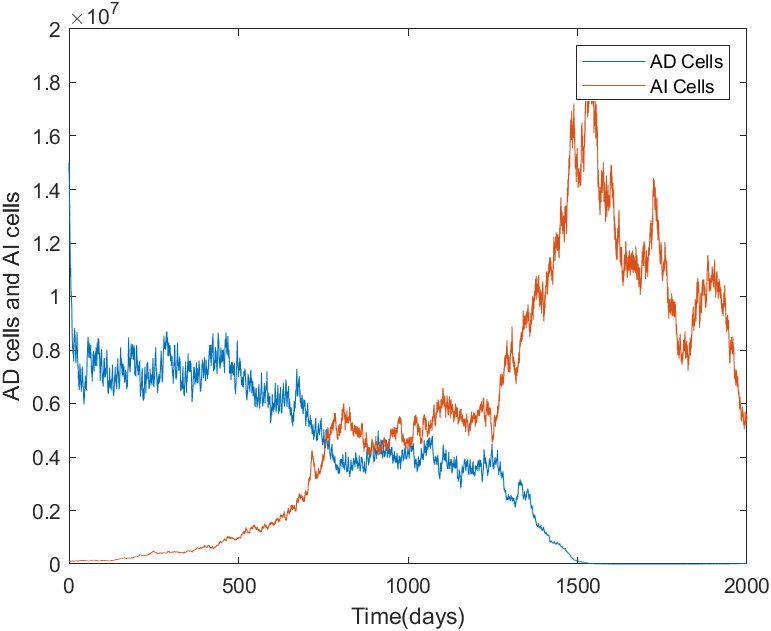
In prostate cancer treatment, intermittent androgen deprivation therapy can delay the emergence of drug resistance, yet its efficacy is influenced by environmental fluctuations, treatment parameters, and competition among tumor cell populations. To investigate the mechanisms underlying resistance during intermittent therapy, we developed a stochastic impulsive differential equation model. First, a global analysis of the model without environmental noise is conducted. Subsequently, sufficient conditions for tumor extinction and persistence are established based on stochastic stability theory. Numerical simulations further demonstrate that moderate noise suppresses tumor growth, and an optimal... More >
Graphical Abstract
Analysis of Trajectory Structure and GAS for a High-Order Nonlinear Difference Equation
by
,

Journal of Mathematics and Interdisciplinary Applications | Volume 2, Issue 1: 28-35, 2026 | DOI: 10.62762/JMIA.2025.554313
Abstract
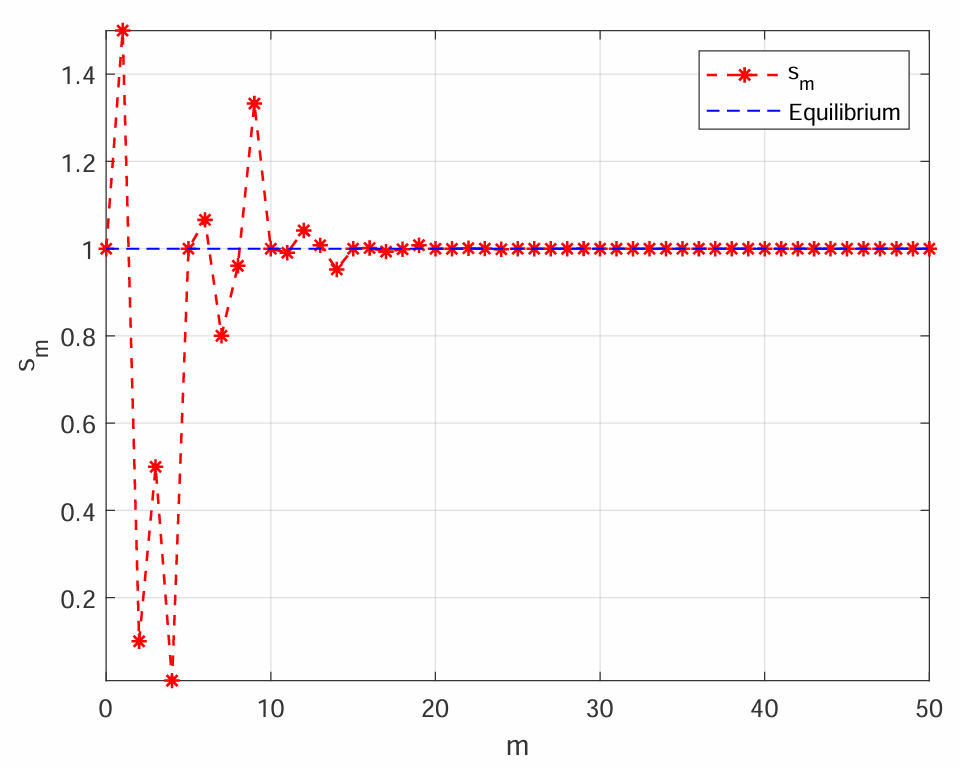
This article delves into the trajectory structure rules of a specific fifth-order rational difference equation:
$$
s_{m+1}=\frac{s_ms_{m-2}s_{m-3}s_{m-4}+s_ms_{m-2}+s_ms_{m-3}+s_{m-2}s_{m-3}+s_{m-4}+a}{s_ms_{m-2}s_{m-3}+s_ms_{m-2}s_{m-4}+s_ms_{m-3}s_{m-4}+s_{m-2}s_{m-3}s_{m-4}+1+a}
$$
where the initial conditions satisfy $s_i\in (0,\infty)$, $i=-4,-3,-2,-1,0$, and the parameters $a\in [0,\infty).$ As the initial values vary, the lengths of consecutive positive and negative semi-cycles for non-trivial solutions exhibit a periodic pattern with a prime period of 31. The rule within one period is $1^-, 2^+, 1^-, 1^+, 1^-, 1^+, 2^-, 4^+, 3^-, 2^+, 2^-, 1^+, 5^-, 1^+, 1^-,$ $ 3^+ $. Through t... More >
Graphical Abstract
Quantile Deviation Ensemble Based on Multi-Layer Perceptrons for Cervical Cancer Classification with Uncertainty Perception
Journal of Mathematics and Interdisciplinary Applications | Volume 2, Issue 1: 12-27, 2026 | DOI: 10.62762/JMIA.2026.403659
Abstract
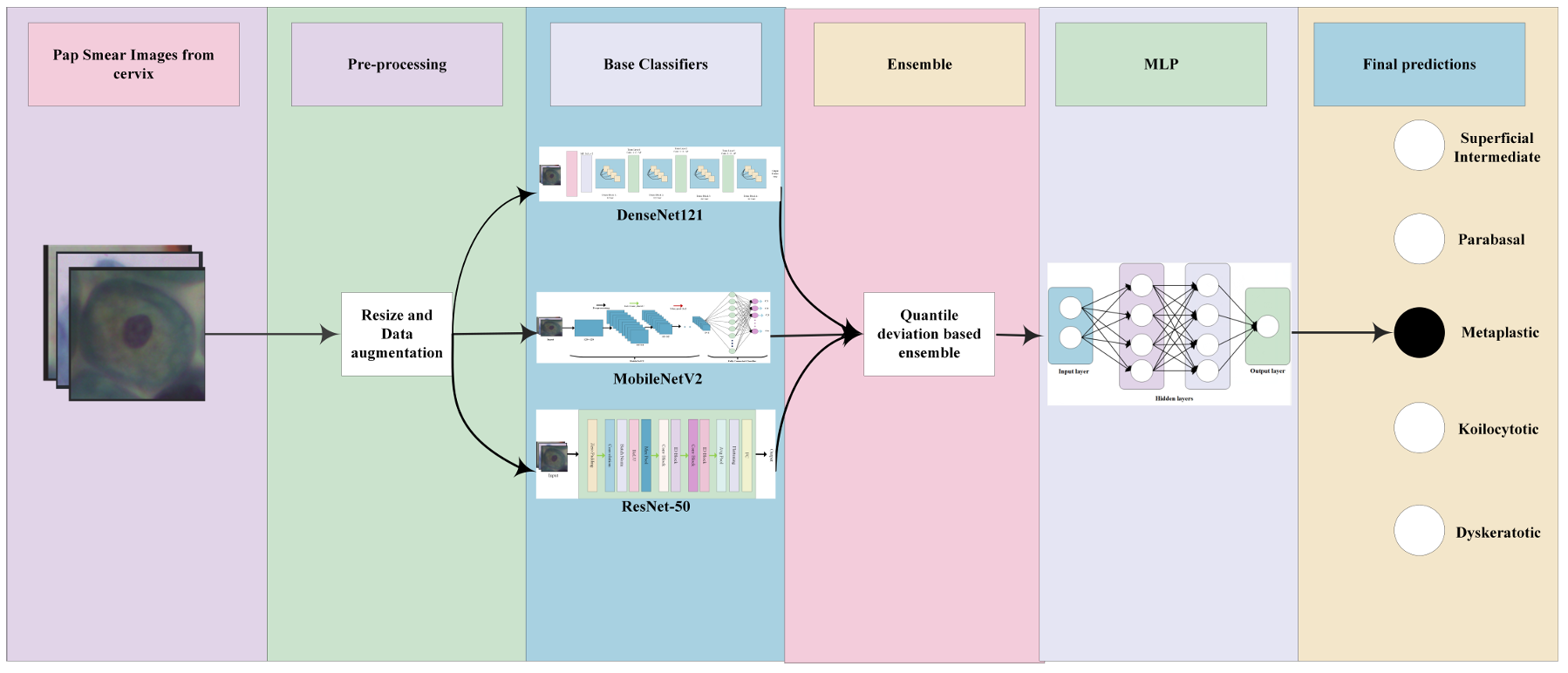
The accurate classification of cervical cytology in Pap smear images remains a critical challenge in computer-aided diagnosis, largely due to the inherent uncertainty and subtle morphological variations among different pathological categories. To address this, we propose a novel uncertainty-aware ensemble framework that integrates statistical quantile analysis with deep learning for robust and interpretable classification. Our framework first leverages three deep convolutional neural networks DenseNet121, MobileNetV2, and ResNet-50 as base feature extractors. Instead of employing naive ensemble strategies, we introduce a quantile deviation based weighting mechanism to dynamically assess and... More >
Graphical Abstract
Modeling the Mediating Effect of Anxiety on Cell Phone Addiction and Depression Among College Students: A Structural Equation Analysis
by
,
,
,
,
,
,
,
,

Journal of Mathematics and Interdisciplinary Applications | Volume 2, Issue 1: 1-11, 2026 | DOI: 10.62762/JMIA.2025.883899
Abstract
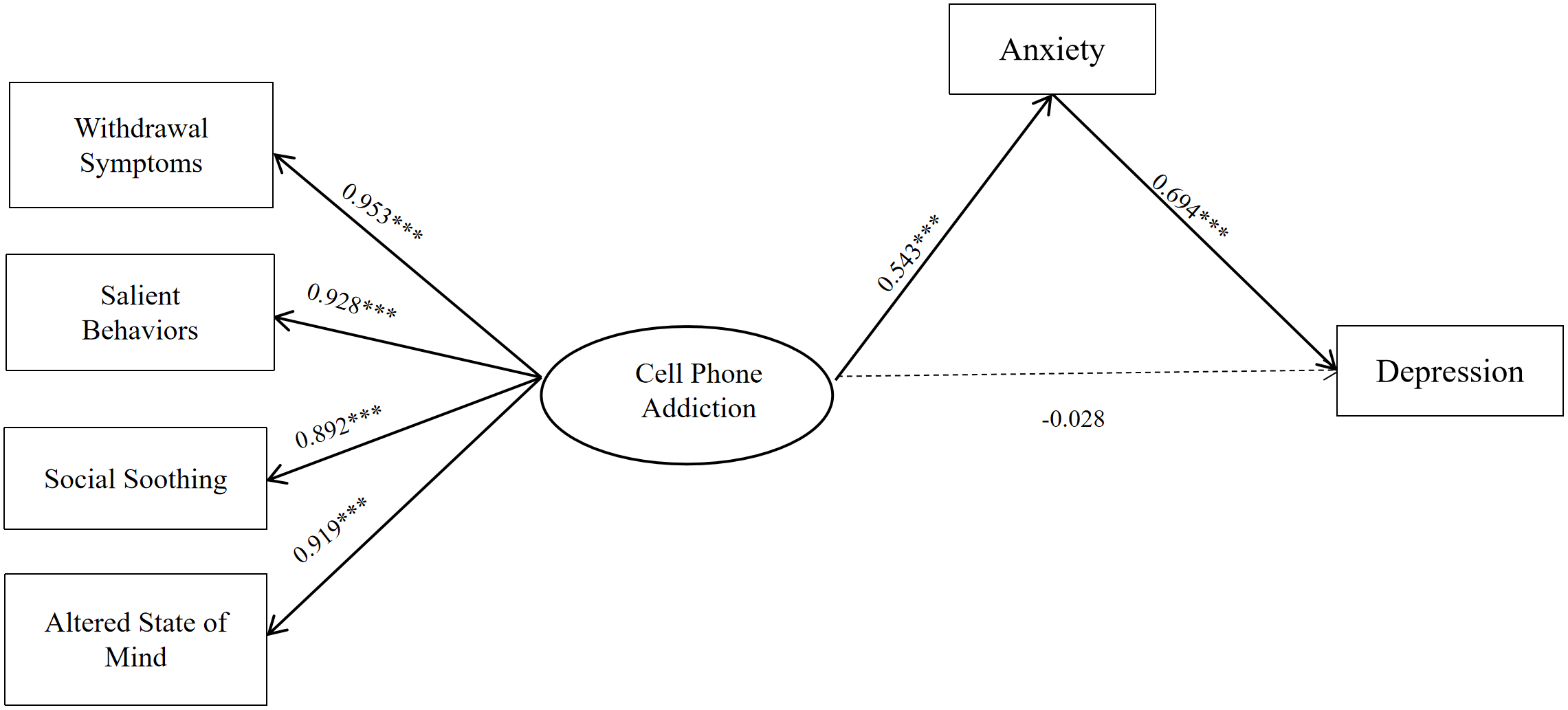
(1) Objective: This study aims to examine the relationships between college students' cell phone addiction, anxiety, and depression, and to explore the mediating role of anxiety in the association between cell phone addiction and depression. (2) Methods: Data were statistically analyzed using SPSS and AMOS. Independent samples t-tests and F-tests were employed to analyze differences in cell phone addiction (and its dimensions) across demographic variables. Pearson correlation analysis was conducted to assess the relationships among cell phone addiction, anxiety, and depression. Structural equation modeling (SEM) via AMOS was used to validate the hypothetical model, and regression analysis co... More >
Graphical Abstract