Volume 2, Issue 1, Journal of Mathematics and Interdisciplinary Applications
Volume 2, Issue 1, 2026
Submit Manuscript Edit a Special Issue
Article QR Code
Article QR Code
Scan the QR code for reading
Popular articles
Journal of Mathematics and Interdisciplinary Applications, Volume 2, Issue 1, 2026: 1-11

Open Access | Research Article | 28 January 2026
Modeling the Mediating Effect of Anxiety on Cell Phone Addiction and Depression Among College Students: A Structural Equation Analysis
1 School of Mathematics and Statistics, Guizhou University of Finance and Economics, Guiyang 550025, China
2 School of Medicine and Health Management, Guizhou Medical University, Guiyang 561113, China
3 The First Hospital of Guizhou Medical University, Guiyang, China
* Corresponding Authors: Quan Zhang, [email protected] ; Jianjun Jiao, [email protected]
ARK: ark:/57805/jmia.2025.883899
Received: 30 August 2025, Accepted: 09 November 2025, Published: 28 January 2026  
Abstract
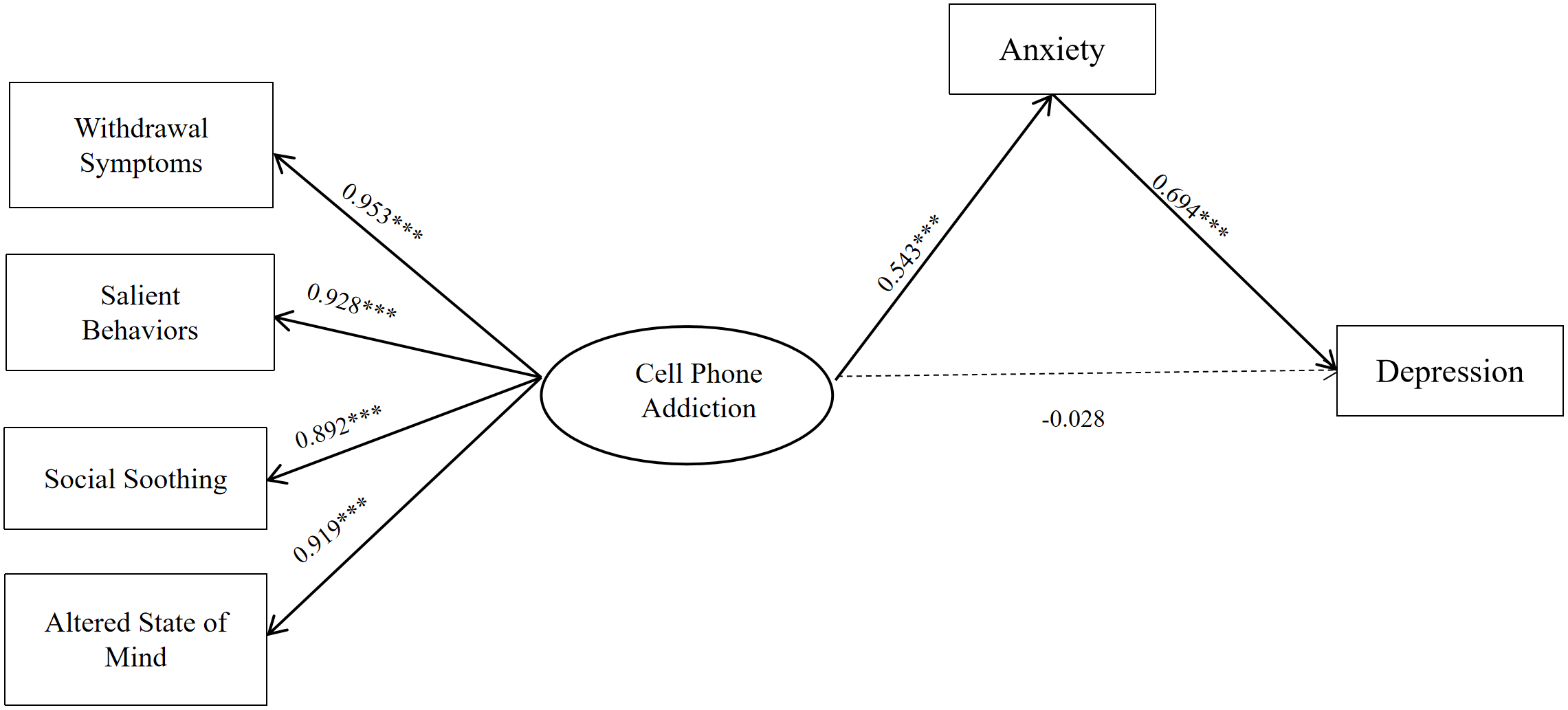
(1) Objective: This study aims to examine the relationships between college students' cell phone addiction, anxiety, and depression, and to explore the mediating role of anxiety in the association between cell phone addiction and depression. (2) Methods: Data were statistically analyzed using SPSS and AMOS. Independent samples t-tests and F-tests were employed to analyze differences in cell phone addiction (and its dimensions) across demographic variables. Pearson correlation analysis was conducted to assess the relationships among cell phone addiction, anxiety, and depression. Structural equation modeling (SEM) via AMOS was used to validate the hypothetical model, and regression analysis combined with the bias-corrected percentile Bootstrap method was applied to test the mediating effect. (3) Results: College students' cell phone addiction showed significant differences by gender and grade. Their addiction characteristics were primarily reflected in prominent withdrawal symptoms, with a mean score of 16.64±5.40. Significant positive correlations were observed among cell phone addiction, anxiety, and depression (all p<0.05). Furthermore, anxiety played a fully mediating role in the relationship between cell phone addiction and depression. (4) Conclusions: Cell phone addiction among college students is not an isolated issue but is closely associated with mental health problems such as anxiety and depression. Cell phone addiction can indirectly influence the development of depression through the mediating effect of anxiety. Therefore, interventions and treatments for college students' cell phone addiction should consider the underlying psychological mechanisms—particularly the mediating role of anxiety—to develop more comprehensive and effective strategies.

Graphical Abstract
Modeling the Mediating Effect of Anxiety on Cell Phone Addiction and Depression Among College Students: A Structural Equation Analysis

Keywords
cell phone addiction
anxiety
depression
mediating effect
structural equation

Data Availability Statement
Data will be made available on request.

Funding
This work was supported by the National Cancer Institute National Natural Science Foundation of China under Grant 12261018.

Conflicts of Interest
The authors declare no conflicts of interest. 

AI Use Statement
The authors declare that no generative AI was used in the preparation of this manuscript.

Ethical Approval and Consent to Participate
This study was exempt from ethical approval as it involved anonymous questionnaire surveys with no collection of personally identifiable information. All participants provided informed consent prior to completing the survey.

References
  1. China Internet Network Information Center (CNNIC). (2023). The 52nd Statistical Report on China's Internet Development. Beijing, China. Retrieved from https://www.cnnic.com.cn/IDR/ReportDownloads/202311/P020231121355042476714.pdf
    [Google Scholar]
  2. Zhang, G., Yang, X., Tu, X., Ding, N., & Lau, J. T. (2020). Prospective relationships between mobile phone dependence and mental health status among Chinese undergraduate students with college adjustment as a mediator. Journal of affective disorders, 260, 498-505.
    [CrossRef]   [Google Scholar]
  3. Leung, L. (2008). Linking psychological attributes to addiction and improper use of the mobile phone among adolescents in Hong Kong. Journal of children and media, 2(2), 93-113.
    [CrossRef]   [Google Scholar]
  4. Liu, M., & Lu, C. (2022). Mobile phone addiction and depressive symptoms among Chinese University students: The mediating role of sleep disturbances and the moderating role of gender. Frontiers in public health, 10, 965135.
    [CrossRef]   [Google Scholar]
  5. Li, S., Deng, Y., Cai, L., & Wu, L. (2025). The relationship between smartphone addiction and sleep disorder among college students: negative emotions as a mediator and gender as a moderator. Frontiers in Psychiatry, 16, 1542243.
    [CrossRef]   [Google Scholar]
  6. Yang, X., Yang, Y., Qin, D., & Zhong, M. (2025). Who is the antecedent? Mapping the relation from mental health to mobile phone addiction using cross-lagged panel network analysis. Current Psychology, 44(4), 2334-2347.
    [CrossRef]   [Google Scholar]
  7. Kil, N., Kim, J., McDaniel, J. T., Kim, J., & Kensinger, K. (2021). Examining associations between smartphone use, smartphone addiction, and mental health outcomes: A cross-sectional study of college students. Health Promotion Perspectives, 11(1), 36.
    [CrossRef]   [Google Scholar]
  8. Hu, Y., Guo, J., Jou, M., Zhou, S., Wang, D., Maguire, P., ... & Qu, F. (2020). Investigating the attentional bias and information processing mechanism of mobile phone addicts towards emotional information. Computers in Human Behavior, 110, 106378.
    [CrossRef]   [Google Scholar]
  9. Yang, G. H., Cao, X. X., Fu, Y. Y., Wang, N. D., & Lian, S. L. (2024). Mobile phone addiction and academic burnout: the mediating role of technology conflict and the protective role of mindfulness. Frontiers in Psychiatry, 15, 1365914.
    [CrossRef]   [Google Scholar]
  10. Elhai, J. D., Levine, J. C., Dvorak, R. D., & Hall, B. J. (2016). Fear of missing out, need for touch, anxiety and depression are related to problematic smartphone use. Computers in Human Behavior, 63, 509-516.
    [CrossRef]   [Google Scholar]
  11. Fauzi, M. F., Anuar, T. S., Teh, L. K., Lim, W. F., James, R. J., Ahmad, R., ... & Salleh, M. Z. (2021). Stress, anxiety and depression among a cohort of health sciences undergraduate students: the prevalence and risk factors. International journal of environmental research and public health, 18(6), 3269.
    [CrossRef]   [Google Scholar]
  12. Cummings, C. M., Caporino, N. E., & Kendall, P. C. (2014). Comorbidity of anxiety and depression in children and adolescents: 20 years after. Psychological bulletin, 140(3), 816. https://psycnet.apa.org/doi/10.1037/a0034733
    [Google Scholar]
  13. Jacobson, N. C., & Newman, M. G. (2014). Avoidance mediates the relationship between anxiety and depression over a decade later. Anxiety Disorders, 28(5), 437–445.
    [CrossRef]   [Google Scholar]
  14. Zeng, M., Chen, S., Zhou, X., Zhang, J., Chen, X., & Sun, J. (2022). The relationship between physical exercise and mobile phone addiction among Chinese college students: Testing mediation and moderation effects. Frontiers in Psychology, 13, 1000109.
    [CrossRef]   [Google Scholar]
  15. Li, X., Li, W., Liu, M., Xiao, W., & Zhou, H. (2022). How does shyness affect Chinese college Students' tendency to Mobile phone addiction? Testing the mediating roles of social anxiety and self-control. Frontiers in Public Health, 10, 902425.
    [CrossRef]   [Google Scholar]
  16. Xiao, Z., & Huang, J. (2022). The relation between college students’ social anxiety and mobile phone addiction: the mediating role of regulatory emotional self-efficacy and subjective well-being. Frontiers in Psychology, 13, 861527.
    [CrossRef]   [Google Scholar]
  17. Li, G., Xie, J., An, L., Hou, G., Jian, H., & Wang, W. (2019). A generalizability analysis of the mobile phone addiction tendency scale for Chinese college students. Frontiers in psychiatry, 10, 241.
    [CrossRef]   [Google Scholar]
  18. Zung, W. W. (1971). Depression in the normal adult population. Psychosomatics: Journal of Consultation and Liaison Psychiatry. https://psycnet.apa.org/doi/10.1016/S0033-3182(71)71529-1
    [Google Scholar]
  19. Dugan, W., McDonald, M. V., Passik, S. D., Rosenfeld, B. D., Theobald, D., & Edgerton, S. (1998). Use of the Zung Self‐Rating Depression Scale in cancer patients: Feasibility as a screening tool. Psycho‐Oncology: Journal of the Psychological, Social and Behavioral Dimensions of Cancer, 7(6), 483-493.
    [CrossRef]   [Google Scholar]
  20. Diao, Y., Feng, Z., Ma, H., Liu, M., Zhao, S., Long, M., ... & Wang, Y. (2023). Loneliness and anxiety among Chinese medical students: the mediating role of mobile phone addiction and the moderating role of gender. Social Science Computer Review, 41(2), 482-494.
    [CrossRef]   [Google Scholar]
  21. Uchegbu, I. C., Igiriogu, J. U., & Ngala, C. O. (2021). Personality traits, social anxiety and gender as predictors of smartphone addiction among students in tertiary institutions. African Journal of Social and Behavioural Sciences, 11(1).
    [Google Scholar]
  22. Ding, Y., Wan, X., Lu, G., Huang, H., Liang, Y., Yu, J., & Chen, C. (2022). The associations between smartphone addiction and self-esteem, self-control, and social support among Chinese adolescents: A meta-analysis. Frontiers in psychology, 13, 1029323.
    [CrossRef]   [Google Scholar]
  23. Li, Y., Li, G., Liu, L., & Wu, H. (2020). Correlations between mobile phone addiction and anxiety, depression, impulsivity, and poor sleep quality among college students: A systematic review and meta-analysis. Journal of behavioral addictions, 9(3), 551-571.
    [CrossRef]   [Google Scholar]
  24. Xie, G., Wu, Q., Guo, X., Zhang, J., & Yin, D. (2023). Psychological resilience buffers the association between cell phone addiction and sleep quality among college students in Jiangsu Province, China. Frontiers in Psychiatry, 14, 1105840.
    [CrossRef]   [Google Scholar]
  25. Wang, J. L., Rost, D. H., Qiao, R. J., & Monk, R. (2020). Academic stress and smartphone dependence among Chinese adolescents: A moderated mediation model. Children and Youth Services Review, 118, 105029.
    [CrossRef]   [Google Scholar]
  26. Arpaci, I. (2020). Gender differences in the relationship between problematic internet use and nomophobia. Current Psychology, 41(9), 4644–4653.
    [CrossRef]   [Google Scholar]
  27. Tu, W., Jiang, H., & Liu, Q. (2022). Peer victimization and adolescent mobile social addiction: Mediation of social anxiety and gender differences. International journal of environmental research and public health, 19(17), 10978.
    [CrossRef]   [Google Scholar]
  28. Dong, W., Li, S., & Wang, X. (2023). Parental phubbing and Chinese adolescents’ SNSs addiction: Loneliness as a mediator and self-esteem as a moderator. Current Psychology, 42(19), 16560-16572.
    [CrossRef]   [Google Scholar]
  29. Wang, Z., & Xuan, B. (2024). The effect of adult attachment on mobile phone dependence among university students: the mediating role of loneliness. Frontiers in Psychology, 15, 1494262.
    [CrossRef]   [Google Scholar]
  30. Ding, X., Jin, X., Tang, Y. Y., & Yang, Z. (2024, March). Associations between mobile phone addiction and depressive symptoms in college students: A conditional process model. In Annales Médico-psychologiques, revue psychiatrique (Vol. 182, No. 3, pp. 258-265). Elsevier Masson.
    [CrossRef]   [Google Scholar]
  31. Liu, M., Li, X., & He, Z. (2022). Self-control mediates, and mobile phone dependence moderates, the relationship between psychological capital and attitudes toward physical exercise among Chinese university students. Frontiers in Psychology, 13, 888175.
    [CrossRef]   [Google Scholar]
  32. Chen, H., Wang, C., Lu, T., Tao, B., Gao, Y., & Yan, J. (2022). The relationship between physical activity and college students’ mobile phone addiction: the chain-based mediating role of psychological capital and social adaptation. International journal of environmental research and public health, 19(15), 9286.
    [CrossRef]   [Google Scholar]
  33. Ko, C. H., Liu, T. L., Wang, P. W., Chen, C. S., Yen, C. F., & Yen, J. Y. (2014). The exacerbation of depression, hostility, and social anxiety in the course of Internet addiction among adolescents: A prospective study. Comprehensive psychiatry, 55(6), 1377-1384.
    [CrossRef]   [Google Scholar]
  34. Wang, H., Ji, M., Tu, H., Qi, Y., Wu, S., & Wang, X. (2025). College students’ loneliness and mobile phone addiction: mediating role of mobile phone anthropomorphism and moderating role of interpersonal relationship quality. Frontiers in Psychiatry, 16, 1581421.
    [CrossRef]   [Google Scholar]
  35. Bi, T., Kou, H., Xie, Q., & Dong, J. (2022). Mediating roles of social anxiety and interpersonal distress in the relationship between mobile phone addiction and loneliness. Journal of Psychology in Africa, 32(5), 487-493.
    [CrossRef]   [Google Scholar]
  36. Saeb, S., Zhang, M., Karr, C. J., Schueller, S. M., Corden, M. E., Kording, K. P., & Mohr, D. C. (2015). Mobile phone sensor correlates of depressive symptom severity in daily-life behavior: an exploratory study. Journal of medical Internet research, 17(7), e4273.
    [CrossRef]   [Google Scholar]
  37. Thomée, S., Härenstam, A., & Hagberg, M. (2011). Mobile phone use and stress, sleep disturbances, and symptoms of depression among young adults-a prospective cohort study. BMC public health, 11(1), 66.
    [CrossRef]   [Google Scholar]
  38. Nyer, M., Farabaugh, A., Fehling, K., Soskin, D., Holt, D., Papakostas, G. I., ... & Mischoulon, D. (2013). Relationship between sleep disturbance and depression, anxiety, and functioning in college students. Depression and anxiety, 30(9), 873-880.
    [CrossRef]   [Google Scholar]
  39. Demirci, K., Akgönül, M., & Akpinar, A. (2015). Relationship of smartphone use severity with sleep quality, depression, and anxiety in university students. Journal of behavioral addictions, 4(2), 85-92.
    [CrossRef]   [Google Scholar]
  40. Ernst, C., Olson, A. K., Pinel, J. P., Lam, R. W., & Christie, B. R. (2006). Antidepressant effects of exercise: evidence for an adult-neurogenesis hypothesis?. Journal of Psychiatry and Neuroscience, 31(2), 84-92.
    [CrossRef]   [Google Scholar]
  41. Meng, S., Qi, K., Shen, P., Zhang, M., Zhang, Y., Onyebuchi, N., ... & Ge, X. (2025). The effects of mobile phone addiction on learning engagement of Chinese college students-the mediating role of physical activity and academic self-efficacy. BMC Public Health, 25(1), 110.
    [CrossRef]   [Google Scholar]

Cite This Article
APA Style
Deng, H., He, Q., Hua, F., Dai, K., Tao, L., Yao, L., Yang, Z., Zhang, Q., & Jiao, J. (2026). Modeling the Mediating Effect of Anxiety on Cell Phone Addiction and Depression Among College Students: A Structural Equation Analysis. Journal of Mathematics and Interdisciplinary Applications, 2(1), 1–11. https://doi.org/10.62762/JMIA.2025.883899
Export Citation
RIS Format
Compatible with EndNote, Zotero, Mendeley, and other reference managers
RIS format data for reference managers
TY  - JOUR
AU  - Deng, Haijun
AU  - He, Qun
AU  - Hua, Feiyan
AU  - Dai, Keyue
AU  - Tao, Lisha
AU  - Yao, Lan
AU  - Yang, Zhengfeng
AU  - Zhang, Quan
AU  - Jiao, Jianjun
PY  - 2026
DA  - 2026/01/28
TI  - Modeling the Mediating Effect of Anxiety on Cell Phone Addiction and Depression Among College Students: A Structural Equation Analysis
JO  - Journal of Mathematics and Interdisciplinary Applications
T2  - Journal of Mathematics and Interdisciplinary Applications
JF  - Journal of Mathematics and Interdisciplinary Applications
VL  - 2
IS  - 1
SP  - 1
EP  - 11
DO  - 10.62762/JMIA.2025.883899
UR  - https://www.icck.org/article/abs/JMIA.2025.883899
KW  - cell phone addiction
KW  - anxiety
KW  - depression
KW  - mediating effect
KW  - structural equation
AB  - (1) Objective: This study aims to examine the relationships between college students' cell phone addiction, anxiety, and depression, and to explore the mediating role of anxiety in the association between cell phone addiction and depression. (2) Methods: Data were statistically analyzed using SPSS and AMOS. Independent samples t-tests and F-tests were employed to analyze differences in cell phone addiction (and its dimensions) across demographic variables. Pearson correlation analysis was conducted to assess the relationships among cell phone addiction, anxiety, and depression. Structural equation modeling (SEM) via AMOS was used to validate the hypothetical model, and regression analysis combined with the bias-corrected percentile Bootstrap method was applied to test the mediating effect. (3) Results: College students' cell phone addiction showed significant differences by gender and grade. Their addiction characteristics were primarily reflected in prominent withdrawal symptoms, with a mean score of 16.64±5.40. Significant positive correlations were observed among cell phone addiction, anxiety, and depression (all p
SN  - 3070-393X
PB  - Institute of Central Computation and Knowledge
LA  - English
ER  - 
BibTeX Format
Compatible with LaTeX, BibTeX, and other reference managers
BibTeX format data for LaTeX and reference managers
@article{Deng2026Modeling,
  author = {Haijun Deng and Qun He and Feiyan Hua and Keyue Dai and Lisha Tao and Lan Yao and Zhengfeng Yang and Quan Zhang and Jianjun Jiao},
  title = {Modeling the Mediating Effect of Anxiety on Cell Phone Addiction and Depression Among College Students: A Structural Equation Analysis},
  journal = {Journal of Mathematics and Interdisciplinary Applications},
  year = {2026},
  volume = {2},
  number = {1},
  pages = {1-11},
  doi = {10.62762/JMIA.2025.883899},
  url = {https://www.icck.org/article/abs/JMIA.2025.883899},
  abstract = {(1) Objective: This study aims to examine the relationships between college students' cell phone addiction, anxiety, and depression, and to explore the mediating role of anxiety in the association between cell phone addiction and depression. (2) Methods: Data were statistically analyzed using SPSS and AMOS. Independent samples t-tests and F-tests were employed to analyze differences in cell phone addiction (and its dimensions) across demographic variables. Pearson correlation analysis was conducted to assess the relationships among cell phone addiction, anxiety, and depression. Structural equation modeling (SEM) via AMOS was used to validate the hypothetical model, and regression analysis combined with the bias-corrected percentile Bootstrap method was applied to test the mediating effect. (3) Results: College students' cell phone addiction showed significant differences by gender and grade. Their addiction characteristics were primarily reflected in prominent withdrawal symptoms, with a mean score of 16.64±5.40. Significant positive correlations were observed among cell phone addiction, anxiety, and depression (all p},
  keywords = {cell phone addiction, anxiety, depression, mediating effect, structural equation},
  issn = {3070-393X},
  publisher = {Institute of Central Computation and Knowledge}
}

Article Metrics
Citations:

Crossref

0

Scopus

0

Web of Science

0
Article Access Statistics:
Views: 36
PDF Downloads: 10

Publisher's Note
ICCK stays neutral with regard to jurisdictional claims in published maps and institutional affiliations.

Rights and Permissions
CC BY Copyright © 2026 by the Author(s). Published by Institute of Central Computation and Knowledge. This article is an open access article distributed under the terms and conditions of the Creative Commons Attribution (CC BY) license (https://creativecommons.org/licenses/by/4.0/), which permits use, sharing, adaptation, distribution and reproduction in any medium or format, as long as you give appropriate credit to the original author(s) and the source, provide a link to the Creative Commons licence, and indicate if changes were made.
Journal of Mathematics and Interdisciplinary Applications

Journal of Mathematics and Interdisciplinary Applications

ISSN: 3070-393X (Online)

Email: [email protected]

Portico

Portico

All published articles are preserved here permanently:
https://www.portico.org/publishers/icck/