

A Stochastic Impulsive Competition Model for Tumor Evolution under Intermittent Androgen Deprivation Therapy


Article Information
Abstract
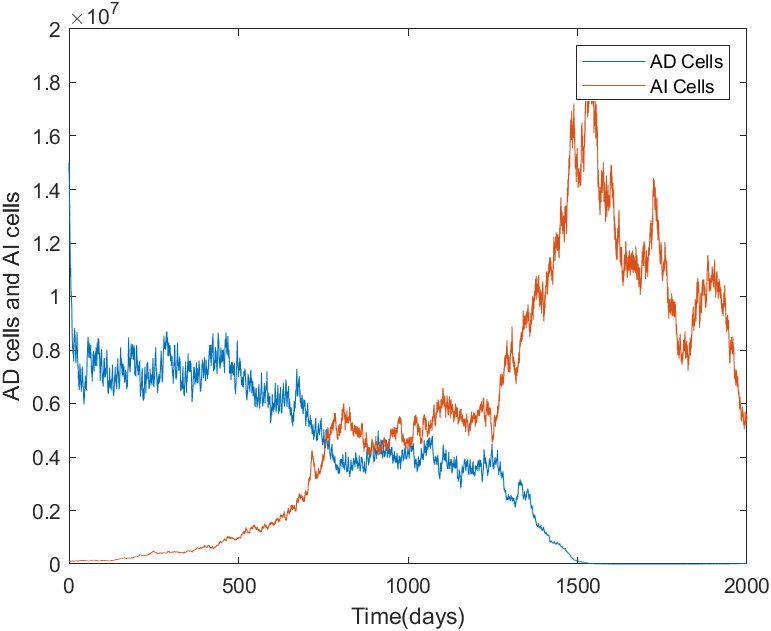
In prostate cancer treatment, intermittent androgen deprivation therapy can delay the emergence of drug resistance, yet its efficacy is influenced by environmental fluctuations, treatment parameters, and competition among tumor cell populations. To investigate the mechanisms underlying resistance during intermittent therapy, we developed a stochastic impulsive differential equation model. First, a global analysis of the model without environmental noise is conducted. Subsequently, sufficient conditions for tumor extinction and persistence are established based on stochastic stability theory. Numerical simulations further demonstrate that moderate noise suppresses tumor growth, and an optimal treatment intensity exists beyond which excessive intervention accelerates drug resistance. Moreover, excessively high treatment frequency impairs the recovery of androgen‑dependent cells, thereby compromising resistance control.
Graphical Abstract
Keywords
Data Availability Statement
Funding
Conflicts of Interest
AI Use Statement
Ethical Approval and Consent to Participate
References
- Kimura, S., & Kimura, T. (2021). Diagnosis and treatment of prostate adenocarcinoma. Cancers, 13(15), 3660.
[CrossRef] [Google Scholar] - Rawla, P. (2019). Epidemiology of prostate cancer. World journal of oncology, 10(2), 63.
[CrossRef] [Google Scholar] - Liu, S., Jiang, A., Tang, F., Duan, M., & Li, B. (2025). Drug-induced tolerant persisters in tumor: mechanism, vulnerability and perspective implication for clinical treatment. Molecular cancer, 24(1), 150.
[CrossRef] [Google Scholar] - Siegel, R. L., Miller, K. D., Wagle, N. S., & Jemal, A. (2023). Cancer statistics, 2023. CA: a cancer journal for clinicians, 73(1), 17-48.
[CrossRef] [Google Scholar] - West, J. B., Dinh, M. N., Brown, J. S., Zhang, J., Anderson, A. R., & Gatenby, R. A. (2019). Multidrug cancer therapy in metastatic castrate-resistant prostate cancer: an evolution-based strategy. Clinical Cancer Research, 25(14), 4413-4421.
[CrossRef] [Google Scholar] - Lonergan, P. E., & Tindall, D. J. (2011). Androgen receptor signaling in prostate cancer development and progression. Journal of carcinogenesis, 10, 20.
[CrossRef] [Google Scholar] - Suzuki, H., Ueda, T., Ichikawa, T., & Ito, H. (2003). Androgen receptor involvement in the progression of prostate cancer. Endocrine-related cancer, 10(2), 209-216.
[CrossRef] [Google Scholar] - Feng, Q., & He, B. (2019). Androgen receptor signaling in the development of castration-resistant prostate cancer. Frontiers in Oncology, 9, 858.
[CrossRef] [Google Scholar] - Perera, M., Roberts, M. J., Klotz, L., Higano, C. S., Papa, N., Sengupta, S., ... & Lawrentschuk, N. (2020). Intermittent versus continuous androgen deprivation therapy for advanced prostate cancer. Nature Reviews Urology, 17(8), 469-481.
[CrossRef] [Google Scholar] - Ideta, A. M., Tanaka, G., Takeuchi, T., & Aihara, K. (2008). A mathematical model of intermittent androgen suppression for prostate cancer. Journal of nonlinear science, 18(6), 593.
[CrossRef] [Google Scholar] - Tanaka, G., Hirata, Y., Goldenberg, S. L., Bruchovsky, N., & Aihara, K. (2010). Mathematical modelling of prostate cancer growth and its application to hormone therapy. Philosophical Transactions of the Royal Society A: Mathematical, Physical and Engineering Sciences, 368(1930), 5029-5044.
[CrossRef] [Google Scholar] - Rutter, E. M., & Kuang, Y. (2017). Global dynamics of a model of joint hormone treatment with dendritic cell vaccine for prostate cancer. Discrete and Continuous Dynamical Systems-Series B, 22(3), 1001–1021.
[CrossRef] [Google Scholar] - Zazoua, A., & Wang, W. (2019). Analysis of mathematical model of prostate cancer with androgen deprivation therapy. Communications in Nonlinear Science and Numerical Simulation, 66, 41–60.
[CrossRef] [Google Scholar] - Yang, H., & Tan, Y. (2021). Dynamic behavior of prostate cancer cells under antitumor immunity and pulse vaccination in a random environment. Nonlinear Dynamics, 105(3), 2645-2664.
[CrossRef] [Google Scholar] - Maitland, N. J. (2021). Resistance to antiandrogens in prostate cancer: is it inevitable, intrinsic or induced?. Cancers, 13(2), 327.
[CrossRef] [Google Scholar] - Jiang, D., & Shi, N. (2005). A note on nonautonomous logistic equation with random perturbation. Journal of Mathematical Analysis and Applications, 303(1), 164-172.
[CrossRef] [Google Scholar] - Ceder, Y., Bjartell, A., Culig, Z., Rubin, M. A., Tomlins, S., & Visakorpi, T. (2016). The molecular evolution of castration-resistant prostate cancer. European Urology Focus, 2(5), 506-513.
[CrossRef] [Google Scholar] - Culig, Z., & Santer, F. R. (2014). Androgen receptor signaling in prostate cancer. Cancer and Metastasis Reviews, 33(2), 413-427.
[CrossRef] [Google Scholar] - Choi, E., Buie, J., Camacho, J., Sharma, P., & de Riese, W. T. (2022). Evolution of androgen deprivation therapy (ADT) and its new emerging modalities in prostate cancer: an update for practicing urologists, clinicians and medical providers. Research and reports in urology, 87-108.
[CrossRef] [Google Scholar] - Baez, J., & Kuang, Y. (2016). Mathematical models of androgen resistance in prostate cancer patients under intermittent androgen suppression therapy. Applied Sciences, 6(11), 352.
[CrossRef] [Google Scholar] - Li, D., Xu, W., Guo, Y., & Xu, Y. (2011). Fluctuations induced extinction and stochastic resonance effect in a model of tumor growth with periodic treatment. Physics Letters A, 375(5), 886-890.
[CrossRef] [Google Scholar] - Li, D., Xu, W., Sun, C., & Wang, L. (2012). Stochastic fluctuation induced the competition between extinction and recurrence in a model of tumor growth. Physics Letters A, 376(22), 1771-1776.
[CrossRef] [Google Scholar] - Yang, J., Tan, Y., & Cheke, R. A. (2019). Thresholds for extinction and proliferation in a stochastic tumour-immune model with pulsed comprehensive therapy. Communications in Nonlinear Science and Numerical Simulation, 73, 363-378.
[CrossRef] [Google Scholar] - Yang, H., Tan, Y., Yang, J., & Liu, Z. (2021). Extinction and persistence of a tumor-immune model with white noise and pulsed comprehensive therapy. Mathematics and Computers in Simulation, 182, 456-470.
[CrossRef] [Google Scholar] - Liu, M., Wang, K., & Wu, Q. (2011). Survival analysis of stochastic competitive models in a polluted environment and stochastic competitive exclusion principle. Bulletin of mathematical biology, 73(9), 1969-2012.
[CrossRef] [Google Scholar] - Huang, Z. Y. (1984). A comparison theorem for solutions of stochastic differential equations and its applications. Proceedings of the American Mathematical Society, 91(4), 611-617.
[CrossRef] [Google Scholar] - Koralov, L., & Sinai, Y. (2012). Theory of Probability and Random Processes (2nd ed.). Springer.
[CrossRef] [Google Scholar] - Brady-Nicholls, R., Nagy, J. D., Gerke, T. A., Zhang, T., Wang, A. Z., Zhang, J., ... & Enderling, H. (2020). Prostate-specific antigen dynamics predict individual responses to intermittent androgen deprivation. Nature communications, 11(1), 1750.
[CrossRef] [Google Scholar] - Sciarra, A., Cattarino, S., Gentilucci, A., Alfarone, A., Innocenzi, M., Gentile, V., & Salciccia, S. (2013, July). Predictors for response to intermittent androgen deprivation (IAD) in prostate cancer cases with biochemical progression after surgery. In Urologic Oncology: Seminars and Original Investigations (Vol. 31, No. 5, pp. 607-614). Elsevier.
[CrossRef] [Google Scholar]
Cite This Article
TY  - JOUR
AU  - Chang, Bingting
AU  - Tan, Yuanshun
PY  - 2026
DA  - 2026/03/11
TI  - A Stochastic Impulsive Competition Model for Tumor Evolution under Intermittent Androgen Deprivation Therapy
JO  - Journal of Mathematics and Interdisciplinary Applications
T2  - Journal of Mathematics and Interdisciplinary Applications
JF  - Journal of Mathematics and Interdisciplinary Applications
VL  - 2
IS  - 1
SP  - 36
EP  - 53
DO  - 10.62762/JMIA.2025.355794
UR  - https://www.icck.org/article/abs/JMIA.2025.355794
KW  - prostate cancer
KW  - intermittent androgen suppression
KW  - stochastic impulsive model
KW  - drug resistance
AB  - In prostate cancer treatment, intermittent androgen deprivation therapy can delay the emergence of drug resistance, yet its efficacy is influenced by environmental fluctuations, treatment parameters, and competition among tumor cell populations. To investigate the mechanisms underlying resistance during intermittent therapy, we developed a stochastic impulsive differential equation model. First, a global analysis of the model without environmental noise is conducted. Subsequently, sufficient conditions for tumor extinction and persistence are established based on stochastic stability theory. Numerical simulations further demonstrate that moderate noise suppresses tumor growth, and an optimal treatment intensity exists beyond which excessive intervention accelerates drug resistance. Moreover, excessively high treatment frequency impairs the recovery of androgen‑dependent cells, thereby compromising resistance control.
SN  - 3070-393X
PB  - Institute of Central Computation and Knowledge
LA  - English
ER  -
@article{Chang2026A,
  author = {Bingting Chang and Yuanshun Tan},
  title = {A Stochastic Impulsive Competition Model for Tumor Evolution under Intermittent Androgen Deprivation Therapy},
  journal = {Journal of Mathematics and Interdisciplinary Applications},
  year = {2026},
  volume = {2},
  number = {1},
  pages = {36-53},
  doi = {10.62762/JMIA.2025.355794},
  url = {https://www.icck.org/article/abs/JMIA.2025.355794},
  abstract = {In prostate cancer treatment, intermittent androgen deprivation therapy can delay the emergence of drug resistance, yet its efficacy is influenced by environmental fluctuations, treatment parameters, and competition among tumor cell populations. To investigate the mechanisms underlying resistance during intermittent therapy, we developed a stochastic impulsive differential equation model. First, a global analysis of the model without environmental noise is conducted. Subsequently, sufficient conditions for tumor extinction and persistence are established based on stochastic stability theory. Numerical simulations further demonstrate that moderate noise suppresses tumor growth, and an optimal treatment intensity exists beyond which excessive intervention accelerates drug resistance. Moreover, excessively high treatment frequency impairs the recovery of androgen‑dependent cells, thereby compromising resistance control.},
  keywords = {prostate cancer, intermittent androgen suppression, stochastic impulsive model, drug resistance},
  issn = {3070-393X},
  publisher = {Institute of Central Computation and Knowledge}
}
Article Metrics
Publisher's Note
ICCK stays neutral with regard to jurisdictional claims in published maps and institutional affiliations.
Rights and Permissions
 Copyright © 2026 by the Author(s). Published by Institute of Central Computation and Knowledge. This article is an open access article distributed under the terms and conditions of the Creative Commons Attribution (CC BY) license (https://creativecommons.org/licenses/by/4.0/), which permits use, sharing, adaptation, distribution and reproduction in any medium or format, as long as you give appropriate credit to the original author(s) and the source, provide a link to the Creative Commons licence, and indicate if changes were made.


Portico
