

Dynamical Behavior of a Second-Order Exponential-Type Fuzzy Difference Equation with Quadratic Term




Article Information
Abstract
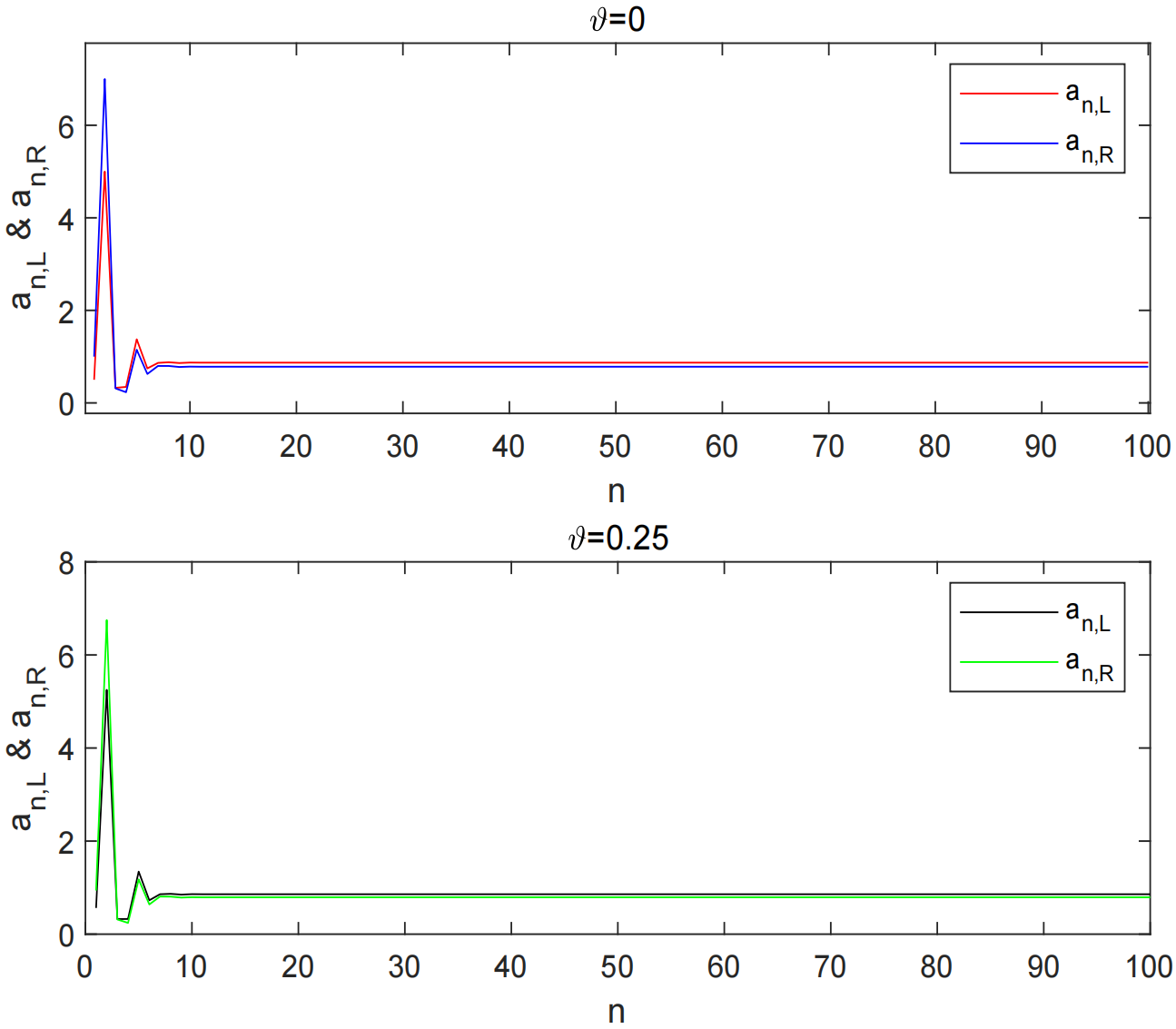
The paper discusses the dynamical characteristics of solutions to a model with quadratic term. More precisely, an exponential-type fuzzy difference equation is proposed as follows $$ a_{n+1}=\frac{D+Pe^{-a_n}}{T+a^2_{n-1}},\ \ n=0,1,\cdots ,$$ here $D, P, T$ and $a_0, a_{-1}$ belong to positive fuzzy numbers. This model can be used to characterize the diffusion modeling of a class of infectious diseases with uncertainty, such as the transmission prediction of dengue fever, monkeypox, and other infectious diseases. In addition, by highlighting the advantages of using Stefanini's the generalization of division of fuzzy number (it is also known as g-division) and constructing a Lyapunov function, we primarily obtain the dynamical characteristics of the model discussed above, such as convergence of single positive equilibrium and persistence, global asymptotical stability and boundedness of positive solutions. Furthermore, some numerical examples are provided to confirm the theoretical findings.
Graphical Abstract
Keywords
Data Availability Statement
Funding
Conflicts of Interest
Ethical Approval and Consent to Participate
References
- Camouzis, E., & Ladas, G. (2008). Dynamics of third-order rational difference equations with open problems and conjectures. Chapman and Hall/CRC.
[Google Scholar] - Kulenovic, M. R., & Ladas, G. (2001). Dynamics of second order rational difference equations: with open problems and conjectures. Chapman and Hall/CRC.
[Google Scholar] - Deeba, E. Y., & De Korvin, A. (1999). Analysis by fuzzy difference equations of a model of CO2 level in the blood. Applied Mathematics Letters, 12(2), 33–40.
[CrossRef] [Google Scholar] - Deeba, E. Y., Korvin, A. D., & Koh, E. L. (1996). A fuzzy difference equation with an application. Journal of Difference Equations and Applications, 2(4), 365–374.
[CrossRef] [Google Scholar] - Chrysafis, K. A., Papadopoulos, B. K., & Papaschinopoulos, G. (2008). On the fuzzy difference equations of finance. Fuzzy Sets and Systems, 159(24), 3259–3270.
[CrossRef] [Google Scholar] - Kocic, V. L., & Ladas, G. (1993). Global behavior of nonlinear difference equations of higher order with applications (Vol. 256). Springer Science & Business Media.
[Google Scholar] - Stefanidou, G., Papaschinopoulos, G., & Schinas, C. J. (2010). On an exponential-type fuzzy difference equation. Advances in Difference Equations, 2010(1), 196920.
[CrossRef] [Google Scholar] - El-Metwally, H., Grove, E. A., Ladas, G., Levins, R., & Radin, M. (2001). On the difference equation 𝑥𝑛+ 1= 𝛼+ 𝛽𝑥𝑛− 1𝑒− 𝑥𝑛. Nonlinear Analysis: Theory, Methods & Applications, 47(7), 4623-4634.
[CrossRef] [Google Scholar] - Papaschinopoulos, G., Radin, M. A., & Schinas, C. J. (2011). On the system of two difference equations of exponential form: xn+ 1= a+ bxn− 1e− yn, yn+ 1= c+ dyn− 1e− xn. Mathematical and computer modelling, 54(11-12), 2969-2977.
[CrossRef] [Google Scholar] - Ozturk, I., Bozkurt, F., & Ozen, S. (2006). On the difference equation $\frac{\alpha_1+\alpha_2e^{-x_n{\alpha_3+x_{n-1$. Applied Mathematics and Computation, 181(2), 1387–1393.
[Google Scholar] - Bozkurt, F. (2013). Stability analysis of a nonlinear difference equation. International Journal of Modern Nonlinear Theory and Application, 2(1), 1–6.
[Google Scholar] - Wang, C., & Li, J. (2020). Periodic Solution for a Max‐Type Fuzzy Difference Equation. Journal of Mathematics, 2020(1), 3094391.
[CrossRef] [Google Scholar] - Usman, M., Khaliq, A., Azeem, M., Swaray, S., & Kallel, M. (2024). The dynamics and behavior of logarithmic type fuzzy difference equation of order two. PloS one, 19(10), e0309198.
[CrossRef] [Google Scholar] - Wang, G., & Zhang, Q. (2018). Dynamical Behavior of First-Order Nonlinear Fuzzy Difference Equation. IAENG International Journal of Computer Science, 45(4).
[Google Scholar] - Zhang, Q., Zhang, W., Lin, F., & Li, D. (2021). On dynamic behavior of second-order exponential-type fuzzy difference equation. Fuzzy Sets and Systems, 419, 169–187.
[CrossRef] [Google Scholar] - Din, Q., Khan, K. A., & Nosheen, A. (2014). Stability analysis of a system of exponential difference equations. Discrete Dynamics in Nature and Society, 2014(1), 375890.
[CrossRef] [Google Scholar] - Bešo, E., Kalačušić, S., Mujić, N., & Pilav, E. (2020). Boundedness of solutions and stability of certain second-order difference equation with quadratic term. Advances in Difference Equations, 2020(19), Article 1–22.
[CrossRef] [Google Scholar] - Khyat, T., Kulenović, M. R. S., & Pilav, E. (2017). The Naimarck-Sacker bifurcation of a certain difference equation. Journal of Computational Analysis and Applications, 23(8), 1335–1346.
[Google Scholar] - Zhang, Q., Ouyang, M., Pan, B., & Lin, F. (2023). Qualitative analysis of second-order fuzzy difference equation with quadratic term. Journal of Applied Mathematics and Computing, 69(2), 1355-1376.
[CrossRef] [Google Scholar] - Lakshmikantham, V., & Vatsala, A. S. (2002). Basic theory of fuzzy difference equations. Journal of Difference Equations and Applications, 8(11), 957–968.
[CrossRef] [Google Scholar] - Papaschinopoulos, G., & Papadopoulos, B. K. (2002). On the fuzzy difference equation xn+ 1= A+ B/xn. Soft Computing, 6(6), 456-461.
[CrossRef] [Google Scholar] - Mondal, S. P., Vishwakarma, D. K., & Saha, A. K. (2016). Solution of second order linear fuzzy difference equation by Lagrange's multiplier method. Journal of Soft Computing and Applications, 2016(1), 11–27.
[Google Scholar] - Stefanini, L. (2010). A generalization of Hukuhara difference and division for interval and fuzzy arithmetic. Fuzzy Sets and Systems, 161(11), 1564–1584.
[CrossRef] [Google Scholar] - Khastan, A. (2018). Fuzzy logistic difference equation. Iranian Journal of Fuzzy Systems, 15(2), 55–66.
[Google Scholar] - Sun, T., Su, G., & Qin, B. (2020). On the fuzzy difference equation xn= F (xn− 1, xn− k). Fuzzy Sets and Systems, 387, 81-88.
[CrossRef] [Google Scholar] - Papaschinopoulos, G., & Schinas, C. J. (2000). On the fuzzy difference equation x_{n+1}=\sum_{i=0}^{k-1}A_i/x_{n-i}^{p_i}+1/x_{n-k}^{p_k}. Journal of Difference Equations and Applications, 6(1), 75–89.
[CrossRef] [Google Scholar] - Papaschinopoulos, G., & Papadopoulos, B. K. (2002). On the fuzzy difference equation xn+1=A+xn/xn−m. Fuzzy Sets and Systems, 129(1), 73–81.
[CrossRef] [Google Scholar] - Stefanidou, G., & Papaschinopoulos, G. (2005). A fuzzy difference equation of a rational form. Journal of Nonlinear Mathematical Physics, 12(2), 300–315.
[CrossRef] [Google Scholar] - Papaschinopoulos, G., & Stefanidou, G. (2003). Boundedness and asymptotic behavior of the solutions of a fuzzy difference equation. Fuzzy Sets and Systems, 140(3), 523–539.
[CrossRef] [Google Scholar] - Zhang, Q., Yang, L., & Liao, D. (2012). Behavior of solutions to a fuzzy nonlinear difference equation. Iranian Journal of Fuzzy Systems, 9(4), 1–12.
[Google Scholar] - Zhang, Q., Yang, L., & Liao, D. (2014). On first order fuzzy Ricatti difference equation. Information Sciences, 270, 226–236.
[CrossRef] [Google Scholar] - Jia, L. (2020). Dynamic Behaviors of a Class of High‐Order Fuzzy Difference Equations. Journal of Mathematics, 2020(1), 1737983.
[CrossRef] [Google Scholar] - Wang, C., Su, X., Liu, P., Hu, X., & Li, R. (2017). On the dynamics of a five-order fuzzy difference equation. Journal of Nonlinear Science and Applications, 10(6), 3303–3319.
[CrossRef] [Google Scholar] - Tzvieli, A. (1990). Possibility theory: An approach to computerized processing of uncertainty. Plenum Publishing Corporation.
[CrossRef] [Google Scholar] - Wu, C., & Zhang, B. (1999). Embedding problem of noncompact fuzzy number space E-(I). Fuzzy Sets and Systems, 105(1), 165-169.
[CrossRef] [Google Scholar] - Grove, E. A., & Ladas, G. (2004). Periodicities in nonlinear difference equations. Chapman & Hall/CRC.
[Google Scholar] - Ibrahim, T. F., & Zhang, Q. (2013). Stability of an anti-competitive system of rational difference equations. Archives des Sciences, 66(5), 44–58.
[Google Scholar] - Zhang, Q., Yang, L., & Liu, J. (2012). Dynamics of a system of rational third-order difference equation. Advances in Difference Equations, 2012(1), 136.
[CrossRef] [Google Scholar] - Hu, L. X., & Li, W. T. (2007). Global stability of a rational difference equation. Applied Mathematics and Computation, 190(2), 1322–1327.
[CrossRef] [Google Scholar] - Li, W. T., & Sun, H. R. (2005). Dynamic of a rational difference equation. Applied Mathematics and Computation, 163(2), 577–591.
[CrossRef] [Google Scholar] - Su, Y. H., & Li, W. T. (2005). Global attractivity of a higher order nonlinear difference equation. Journal of Difference Equations and Applications, 11(10), 947–958.
[CrossRef] [Google Scholar]
Cited By (4)
-
Bingyan Li, Qianhong Zhang. Neimark-Sacker bifurcation and dynamical behavior in a discrete predator-prey system with exponential terms.
AIMS Mathematics, 2026 , 11 (8).
[CrossRef] -
Xiong Xiao, Qianhong Zhang. Global asymptotic stability and qualitative analysis of fuzzy difference equations with composite exponential saturation and parabolic fuzzy parameters.
AIMS Mathematics, 2026 , 11 (6).
[CrossRef] -
Zerong Luo, Qianhong Zhang, Jing Wu, Smritijit Sen. Systematic Analysis of Qualitative Dynamics in High‐Order Exponential Fuzzy Difference Equations.
Journal of Mathematics, 2026 , 2026 (1).
[CrossRef] -
Kexiang Lin, Qianhong Zhang. Global stability of a nonlinear fuzzy difference equation.
Physica Scripta, 2026 , 101 (36).
[CrossRef]
Cite This Article
TY  - JOUR
AU  - Lin, Kexiang
AU  - Zhang, Qianhong
PY  - 2025
DA  - 2025/11/28
TI  - Dynamical Behavior of a Second-Order Exponential-Type Fuzzy Difference Equation with Quadratic Term
JO  - Journal of Mathematics and Interdisciplinary Applications
T2  - Journal of Mathematics and Interdisciplinary Applications
JF  - Journal of Mathematics and Interdisciplinary Applications
VL  - 1
IS  - 1
SP  - 29
EP  - 50
DO  - 10.62762/JMIA.2025.999827
UR  - https://www.icck.org/article/abs/JMIA.2025.999827
KW  - fuzzy difference equation
KW  - boundedness
KW  - global asymptotic behavior
KW  - g-Division
AB  - The paper discusses the dynamical characteristics of solutions to a model with quadratic term. More precisely, an exponential-type fuzzy difference equation is proposed as follows $$ a_{n+1}=\frac{D+Pe^{-a_n}}{T+a^2_{n-1}},\ \ n=0,1,\cdots ,$$ here $D, P, T$ and $a_0, a_{-1}$ belong to positive fuzzy numbers. This model can be used to characterize the diffusion modeling of a class of infectious diseases with uncertainty, such as the transmission prediction of dengue fever, monkeypox, and other infectious diseases. In addition, by highlighting the advantages of using Stefanini's the generalization of division of fuzzy number (it is also known as g-division) and constructing a Lyapunov function, we primarily obtain the dynamical characteristics of the model discussed above, such as convergence of single positive equilibrium and persistence, global asymptotical stability and boundedness of positive solutions. Furthermore, some numerical examples are provided to confirm the theoretical findings.
SN  - 3070-393X
PB  - Institute of Central Computation and Knowledge
LA  - English
ER  -
@article{Lin2025Dynamical,
  author = {Kexiang Lin and Qianhong Zhang},
  title = {Dynamical Behavior of a Second-Order Exponential-Type Fuzzy Difference Equation with Quadratic Term},
  journal = {Journal of Mathematics and Interdisciplinary Applications},
  year = {2025},
  volume = {1},
  number = {1},
  pages = {29-50},
  doi = {10.62762/JMIA.2025.999827},
  url = {https://www.icck.org/article/abs/JMIA.2025.999827},
  abstract = {The paper discusses the dynamical characteristics of solutions to a model with quadratic term. More precisely, an exponential-type fuzzy difference equation is proposed as follows \$\$ a\_{n+1}=\frac{D+Pe^{-a\_n}}{T+a^2\_{n-1}},\ \ n=0,1,\cdots ,\$\$ here \$D, P, T\$ and \$a\_0, a\_{-1}\$ belong to positive fuzzy numbers. This model can be used to characterize the diffusion modeling of a class of infectious diseases with uncertainty, such as the transmission prediction of dengue fever, monkeypox, and other infectious diseases. In addition, by highlighting the advantages of using Stefanini's the generalization of division of fuzzy number (it is also known as g-division) and constructing a Lyapunov function, we primarily obtain the dynamical characteristics of the model discussed above, such as convergence of single positive equilibrium and persistence, global asymptotical stability and boundedness of positive solutions. Furthermore, some numerical examples are provided to confirm the theoretical findings.},
  keywords = {fuzzy difference equation, boundedness, global asymptotic behavior, g-Division},
  issn = {3070-393X},
  publisher = {Institute of Central Computation and Knowledge}
}
Publisher's Note
ICCK stays neutral with regard to jurisdictional claims in published maps and institutional affiliations.
Rights and Permissions
 Copyright © 2025 by the Author(s). Published by Institute of Central Computation and Knowledge. This article is an open access article distributed under the terms and conditions of the Creative Commons Attribution (CC BY) license (https://creativecommons.org/licenses/by/4.0/), which permits use, sharing, adaptation, distribution and reproduction in any medium or format, as long as you give appropriate credit to the original author(s) and the source, provide a link to the Creative Commons licence, and indicate if changes were made.


Portico
