

Dynamic Inertia Weight Whale Optimization Algorithm for Numerical and Engineering Optimization Problems



Article Information
Abstract
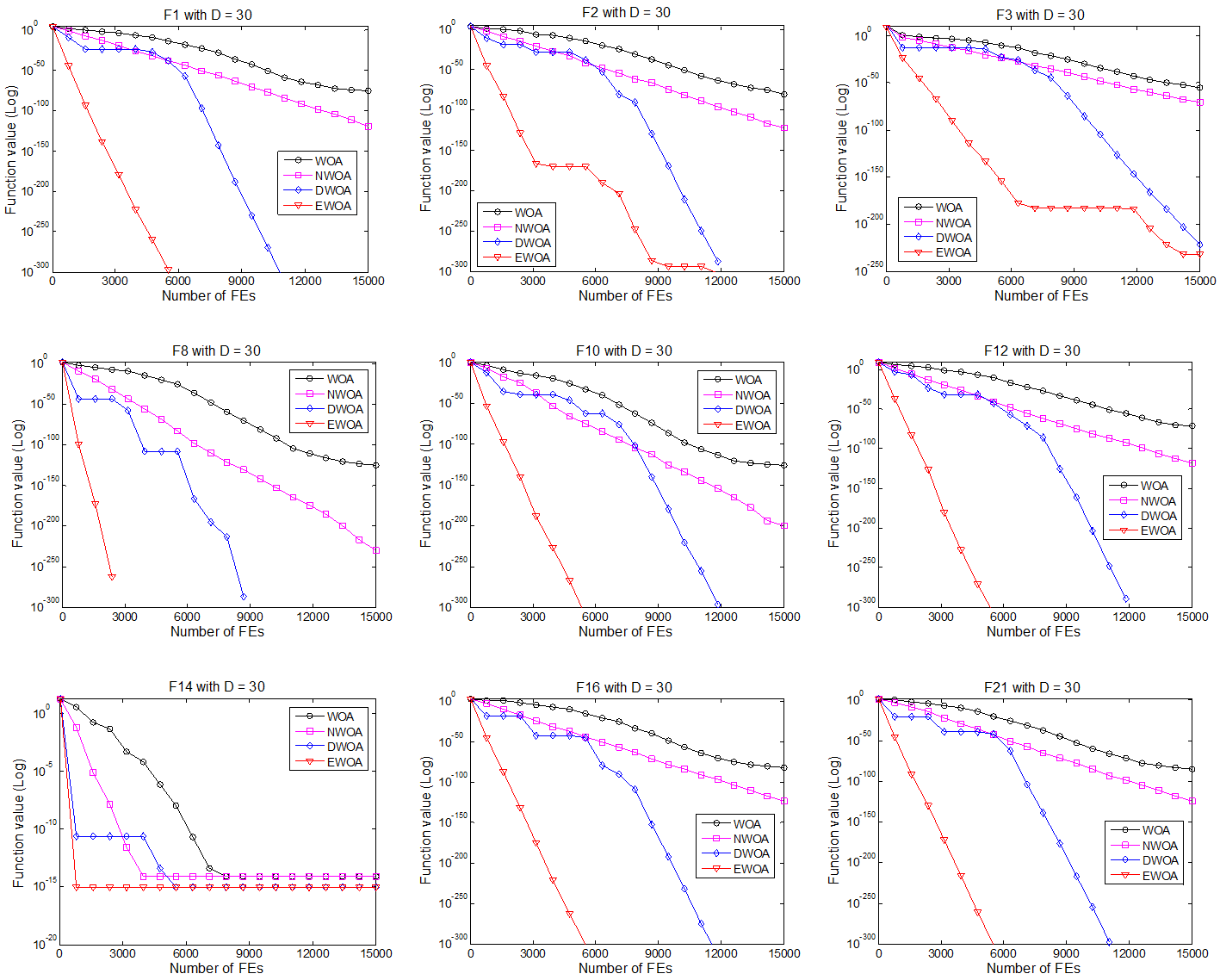
Whale optimization algorithm (WOA) is a relatively new population-based metaheuristic optimization method, which has the advantage of fewer control parameters, strong global optimization ability and easy to implement. However, when being used for high-dimensional problems, WOA may be trapped in the local optimum. In this study, we propose an effective whale optimization algorithm called EWOA. Inspired by particle swarm optimization (PSO), a modified position-updated equation by introducing dynamic inertia weight parameter to guide the search of new candidate individuals is presented. In addition, in order to make full use of and balance the exploration and the exploitation of WOA, a nonlinear distance control parameter strategy is proposed. The effectiveness of EWOA is tested based on 26 traditional high-dimensional benchmark problems (D = 30, 100, and 500) and four real-world engineering applications. The experimental and statistical test results demonstrate that EWOA converges to the global optima faster and provides more accurate results than the classical WOA, variants WOA, and other considered population-based metaheuristic algorithms in most cases, especially in solving an optimization problem that has high dimensionality.
Graphical Abstract
Keywords
Data Availability Statement
Funding
Conflicts of Interest
AI Use Statement
Ethical Approval and Consent to Participate
References
- Long, W., Wang, Y., Long, Q., Yang, Y., & Xu, M. (2026). Phased-Enhancement Marine Predators Algorithm for Global Optimization and Medical Insurance Fraud Detection. Journal of Bionic Engineering, 23(2), 1088-1111.
[CrossRef] [Google Scholar] - Skakovski, A., & Jędrzejowicz, P. (2019). An island-based differential evolution algorithm with the multi-size populations. Expert Systems with Applications, 126, 308-320.
[CrossRef] [Google Scholar] - Xiang, Z., Ji, D., Zhang, H., Wu, H., & Li, Y. (2019). A simple PID-based strategy for particle swarm optimization algorithm. Information Sciences, 502, 558-574.
[CrossRef] [Google Scholar] - Saad, M. R., Emam, M. M., Hosney, M. E., Samee, N. A., Alkanhel, R. I., & Houssein, E. H. (2026). Fourier transform optimizer: A novel physics-inspired metaheuristic algorithm for optimization problems. Knowledge-Based Systems, 115651.
[CrossRef] [Google Scholar] - Fu, Y., Liu, D., Chen, J., & He, L. (2024). Secretary bird optimization algorithm: a new metaheuristic for solving global optimization problems. Artificial Intelligence Review, 57(5), 123.
[CrossRef] [Google Scholar] - Trojovský, P., Dehghani, M., Trojovská, E., & Milkova, E. (2023). Language Education Optimization: A New Human-Based Metaheuristic Algorithm for Solving Optimization Problems. CMES-Computer Modeling in Engineering and Sciences, 136(2), 1527-1573.
[CrossRef] [Google Scholar] - Zhang, J., Xiao, M., Gao, L., & Pan, Q. (2018). Queuing search algorithm: A novel metaheuristic algorithm for solving engineering optimization problems. Applied Mathematical Modelling, 63, 464-490.
[CrossRef] [Google Scholar] - Kundu, R., Chattopadhyay, S., Nag, S., Navarro, M. A., & Oliva, D. (2024). Prism refraction search: a novel physics-based metaheuristic algorithm. The Journal of Supercomputing, 80(8), 10746-10795.
[CrossRef] [Google Scholar] - Azizi, M., Talatahari, S., & Gandomi, A. H. (2023). Fire Hawk Optimizer: A novel metaheuristic algorithm. Artificial Intelligence Review, 56(1), 287-363.
[CrossRef] [Google Scholar] - Bohat, V. K., Hashim, F. A., Batra, H., & Abd Elaziz, M. (2025). Phototropic growth algorithm: A novel metaheuristic inspired from phototropic growth of plants. Knowledge-Based Systems, 322, 113548.
[CrossRef] [Google Scholar] - Shadravan, S., Naji, H. R., & Bardsiri, V. K. (2019). The Sailfish Optimizer: A novel nature-inspired metaheuristic algorithm for solving constrained engineering optimization problems. Engineering Applications of Artificial Intelligence, 80, 20-34.
[CrossRef] [Google Scholar] - Alimoradi, M., Azgomi, H., & Asghari, A. (2022). Trees social relations optimization algorithm: a new swarm-based metaheuristic technique to solve continuous and discrete optimization problems. Mathematics and computers in simulation, 194, 629-664.
[CrossRef] [Google Scholar] - Mozhdehi, A. T., Khodadadi, N., Aboutalebi, M., El-Kenawy, E. S. M., Hussien, A. G., Zhao, W., ... & Mirjalili, S. (2025). Divine Religions Algorithm: A novel social-inspired metaheuristic algorithm for engineering and continuous optimization problems. Cluster Computing, 28(4), 253.
[CrossRef] [Google Scholar] - Abdel-Basset, M., Mohamed, R., & Abouhawwash, M. (2024). Crested Porcupine Optimizer: A new nature-inspired metaheuristic. Knowledge-Based Systems, 284, 111257.
[CrossRef] [Google Scholar] - Zhao, W., Xie, Y., Wang, L., Zhang, Z., Khodadadi, N., & Mirjalili, S. (2026). An effective Bezier curve-based optimization (BCO) for large-scale numerical problems and 3D unmanned aerial vehicle path planning with efficient multiple threats evasion. Advanced Engineering Informatics, 73, 104524.
[CrossRef] [Google Scholar] - Uymaz, S. A., Tezel, G., & Yel, E. (2015). Artificial algae algorithm (AAA) for nonlinear global optimization. Applied soft computing, 31, 153-171.
[CrossRef] [Google Scholar] - Mirjalili, S., Gandomi, A. H., Mirjalili, S. Z., Saremi, S., Faris, H., & Mirjalili, S. M. (2017). Salp Swarm Algorithm: A bio-inspired optimizer for engineering design problems. Advances in engineering software, 114, 163-191.
[CrossRef] [Google Scholar] - Mirjalili, S., & Lewis, A. (2016). The whale optimization algorithm. Advances in engineering software, 95, 51-67.
[CrossRef] [Google Scholar] - Mirjalili, S., Mirjalili, S. M., & Lewis, A. (2014). Grey wolf optimizer. Advances in engineering software, 69, 46-61.
[CrossRef] [Google Scholar] - Derrac, J., García, S., Molina, D., & Herrera, F. (2011). A practical tutorial on the use of nonparametric statistical tests as a methodology for comparing evolutionary and swarm intelligence algorithms. Swarm and Evolutionary Computation, 1(1), 3-18.
[CrossRef] [Google Scholar] - Peng, Y., Gu, S., Liang, Y., Ouyang, K., Li, Y., Wang, K., ... & Fan, C. (2025). Wave Optics Optimizer: A novel meta-heuristic algorithm for engineering optimization. Communications in Nonlinear Science and Numerical Simulation, 109337.
[CrossRef] [Google Scholar] - Gharehchopogh, F. S., & Gholizadeh, H. (2019). A comprehensive survey: Whale Optimization Algorithm and its applications. Swarm and Evolutionary Computation, 48, 1-24.
[CrossRef] [Google Scholar] - Oliva, D., Abd El Aziz, M., & Hassanien, A. E. (2017). Parameter estimation of photovoltaic cells using an improved chaotic whale optimization algorithm. Applied energy, 200, 141-154.
[CrossRef] [Google Scholar] - Abd Elaziz, M., & Oliva, D. (2018). Parameter estimation of solar cells diode models by an improved opposition-based whale optimization algorithm. Energy conversion and management, 171, 1843-1859.
[CrossRef] [Google Scholar] - Li, Z. (2026). An improved chaotic whale optimization algorithm for MHA-MLP stock trend forecasting. Alexandria Engineering Journal, 134, 69-80.
[CrossRef] [Google Scholar] - Manafi, E., Domenech, B., Tavakkoli-Moghaddam, R., & Ranaboldo, M. (2025). A self-learning whale optimization algorithm based on reinforcement learning for a dual-resource flexible job shop scheduling problem. Applied Soft Computing, 180, 113436.
[CrossRef] [Google Scholar] - Tubishat, M., Abushariah, M. A., Idris, N., & Aljarah, I. (2019). Improved whale optimization algorithm for feature selection in Arabic sentiment analysis. Applied Intelligence, 49(5), 1688-1707.
[CrossRef] [Google Scholar] - Yousri, D., Allam, D., & Eteiba, M. B. (2019). Chaotic whale optimizer variants for parameters estimation of the chaotic behavior in Permanent Magnet Synchronous Motor. Applied Soft Computing, 74, 479-503.
[CrossRef] [Google Scholar] - Zhang, Y., Li, J., Ma, H., Su, Z., & Wu, J. (2026). MIWOA: A multi-strategy improved whale optimization algorithm with hybrid perturbation for engineering optimization. Expert Systems with Applications, 302, 130245.
[CrossRef] [Google Scholar] - Yang, W., Shang, W., & Liu, Z. (2025). Dynamic Cooperative Whale Optimization Algorithm for Multivehicle IoV Path Planning. IEEE Internet of Things Journal, 12(15), 29844-29859.
[CrossRef] [Google Scholar] - Raj, S., & Bhattacharyya, B. (2018). Optimal placement of TCSC and SVC for reactive power planning using Whale optimization algorithm. Swarm and Evolutionary Computation, 40, 131-143.
[CrossRef] [Google Scholar] - Chifu, V. R., Cioara, T., Anitei, C. D., Pop, C. B., Anghel, I., & Toderean, L. (2025). A federated learning model with the whale optimization algorithm for renewable energy prediction. Computers and Electrical Engineering, 123, 110259.
[CrossRef] [Google Scholar] - Petrović, M., Miljković, Z., & Jokić, A. (2019). A novel methodology for optimal single mobile robot scheduling using whale optimization algorithm. Applied Soft Computing, 81, 105520.
[CrossRef] [Google Scholar] - Ghahremani-Nahr, J., Kian, R., & Sabet, E. (2019). A robust fuzzy mathematical programming model for the closed-loop supply chain network design and a whale optimization solution algorithm. Expert systems with applications, 116, 454-471.
[CrossRef] [Google Scholar] - Zhang, J., Liu, W., Zhang, G., & Zhang, T. (2025). Quantum encoding whale optimization algorithm for global optimization and adaptive infinite impulse response system identification. Artificial Intelligence Review, 58(5), 158.
[CrossRef] [Google Scholar] - Soltanpour, M., & Zhang, H. (2024). Near-global-optimal resource allocation for uplink SCMA systems based on whale optimization algorithm. IEEE Transactions on Wireless Communications, 24(2), 1089-1103.
[CrossRef] [Google Scholar] - Ling, Y., Zhou, Y., & Luo, Q. (2017). Lévy flight trajectory-based whale optimization algorithm for global optimization. IEEE Access, 5, 6168-6186.
[CrossRef] [Google Scholar] - Luo, J., Chen, H., Heidari, A. A., Xu, Y., Zhang, Q., & Li, C. (2019). Multi-strategy boosted mutative whale-inspired optimization approaches. Applied Mathematical Modelling, 73, 109-123.
[CrossRef] [Google Scholar] - Hu, H., Bai, Y., & Xu, T. (2017). Improved whale optimization algorithm based on inertia weights and their applications. International Journal of Circuits, Systems and Signal Processing, 11, 12-26. https://www.naun.org/main/NAUN/circuitssystemssignal/2017/a042005-aat.pdf
[Google Scholar] - Sun, Y., Wang, X., Chen, Y., & Liu, Z. (2018). A modified whale optimization algorithm for large-scale global optimization problems. Expert Systems with Applications, 114, 563-577.
[CrossRef] [Google Scholar] - Chen, H., Xu, Y., Wang, M., & Zhao, X. (2019). A balanced whale optimization algorithm for constrained engineering design problems. Applied Mathematical Modelling, 71, 45-59.
[CrossRef] [Google Scholar] - Wang, W. L., Li, W. K., Wang, Z., & Li, L. (2019). Opposition-based multi-objective whale optimization algorithm with global grid ranking. Neurocomputing, 341, 41-59.
[CrossRef] [Google Scholar] - Liu, J., Mei, Y., & Li, X. (2015). An analysis of the inertia weight parameter for binary particle swarm optimization. IEEE Transactions on Evolutionary Computation, 20(5), 666-681.
[CrossRef] [Google Scholar] - Wolpert, D. H., & Macready, W. G. (2002). No free lunch theorems for optimization. IEEE transactions on evolutionary computation, 1(1), 67-82.
[CrossRef] [Google Scholar] - Kennedy, J., & Eberhart, R. (1995, November). Particle swarm optimization. In Proceedings of ICNN'95-international conference on neural networks (Vol. 4, pp. 1942-1948). ieee.
[CrossRef] [Google Scholar] - Shi, Y., & Eberhart, R. (1998, May). A modified particle swarm optimizer. In 1998 IEEE International Conference on Evolutionary Computation Proceedings. IEEE World Congress on Computational Intelligence (Cat. No. 98TH8360) (pp. 69-73). IEEE.
[CrossRef] [Google Scholar] - Chatterjee, A., & Siarry, P. (2006). Nonlinear inertia weight variation for dynamic adaptation in particle swarm optimization. Computers & operations research, 33(3), 859-871.
[CrossRef] [Google Scholar] - Mirjalili, S., Mirjalili, S. M., & Hatamlou, A. (2016). Multi-verse optimizer: a nature-inspired algorithm for global optimization. Neural computing and applications, 27(2), 495-513.
[CrossRef] [Google Scholar] - Rao, R. V., Savsani, V. J., & Vakharia, D. (2012). Teaching–learning-based optimization: an optimization method for continuous non-linear large scale problems. Information sciences, 183(1), 1-15.
[CrossRef] [Google Scholar] - Zhou, X., Wu, Z., & Wang, H. (2012, December). Elite opposition-based differential evolution for solving large-scale optimization problems and its implementation on GPU. In 2012 13th international conference on parallel and distributed computing, applications and technologies (pp. 727-732). IEEE.
[CrossRef] [Google Scholar] - Deb, K. (2000). An efficient constraint handling method for genetic algorithms. Computer methods in applied mechanics and engineering, 186(2-4), 311-338.
[CrossRef] [Google Scholar] - Coello, C. A. C. (2000). Use of a self-adaptive penalty approach for engineering optimization problems. Computers in Industry, 41(2), 113-127.
[CrossRef] [Google Scholar] - He, Q., & Wang, L. (2007). An effective co-evolutionary particle swarm optimization for constrained engineering design problems. Engineering applications of artificial intelligence, 20(1), 89-99.
[CrossRef] [Google Scholar] - Becerra, R. L., & Coello, C. A. C. (2006). Cultured differential evolution for constrained optimization. Computer Methods in Applied Mechanics and Engineering, 195(33-36), 4303-4322.
[CrossRef] [Google Scholar] - Maruta, I., Kim, T. H., & Sugie, T. (2009). Fixed-structure H$_\infty$ controller synthesis: A meta-heuristic approach using simple constrained particle swarm optimization. Automatica, 45(2), 553-559.
[CrossRef] [Google Scholar] - Gandomi, A. H., Yang, X. S., & Alavi, A. H. (2013). Cuckoo search algorithm: a metaheuristic approach to solve structural optimization problems. Engineering with computers, 29(1), 17-35.
[CrossRef] [Google Scholar] - Askarzadeh, A. (2016). A novel metaheuristic method for solving constrained engineering optimization problems: crow search algorithm. Computers & structures, 169, 1-12.
[CrossRef] [Google Scholar] - Long, W., Jiao, J., Liang, X., & Tang, M. (2018). An exploration-enhanced grey wolf optimizer to solve high-dimensional numerical optimization. Engineering Applications of Artificial Intelligence, 68, 63-80.
[CrossRef] [Google Scholar] - He, Q., & Wang, L. (2007). A hybrid particle swarm optimization with a feasibility-based rule for constrained optimization. Applied Mathematics and Computation, 186, 1407-1422.
[CrossRef] [Google Scholar] - Coello, C. A. C., & Montes, E. M. (2002). Constraint-handling in genetic algorithms through the use of dominance-based tournament selection. Advanced Engineering Informatics, 16(3), 193-203.
[CrossRef] [Google Scholar] - Ray, T., & Liew, K. M. (2003). Society and civilization: an optimization algorithm based on the simulation of social behavior. IEEE Transactions on Evolutionary Computation, 7(4), 386-396.
[CrossRef] [Google Scholar] - Wang, Y., Cai, Z., & Zhou, Y. (2009). Accelerating adaptive trade‐off model using shrinking space technique for constrained evolutionary optimization. International journal for numerical methods in engineering, 77(11), 1501-1534.
[CrossRef] [Google Scholar] - Zhang, M., Luo, W., & Wang, X. (2008). Differential evolution with dynamic stochastic selection for constrained optimization. Information Sciences, 178(15), 3043-3074.
[CrossRef] [Google Scholar] - Rashedi, E., Nezamabadi-Pour, H., & Saryazdi, S. (2009). GSA: a gravitational search algorithm. Information sciences, 179(13), 2232-2248.
[CrossRef] [Google Scholar] - Wang, Y., Cai, Z., Zhou, Y., & Fan, Z. (2009). Constrained optimization based on hybrid evolutionary algorithm and adaptive constraint-handling technique. Structural and Multidisciplinary Optimization, 37(4), 395-413.
[CrossRef] [Google Scholar] - Hedar, A. R., & Fukushima, M. (2006). Derivative-free filter simulated annealing method for constrained continuous global optimization. Journal of Global optimization, 35(4), 521-549.
[CrossRef] [Google Scholar]
Cite This Article
TY  - JOUR
AU  - Long, Wen
AU  - Hu, Tiantian
PY  - 2026
DA  - 2026/06/21
TI  - Dynamic Inertia Weight Whale Optimization Algorithm for Numerical and Engineering Optimization Problems
JO  - Journal of Mathematics and Interdisciplinary Applications
T2  - Journal of Mathematics and Interdisciplinary Applications
JF  - Journal of Mathematics and Interdisciplinary Applications
VL  - 2
IS  - 2
SP  - 125
EP  - 142
DO  - 10.62762/JMIA.2026.111913
UR  - https://www.icck.org/article/abs/JMIA.2026.111913
KW  - whale optimization algorithm
KW  - inertia weight
KW  - global optimization
KW  - high-dimensional complex problem
KW  - engineering application
AB  - Whale optimization algorithm (WOA) is a relatively new population-based metaheuristic optimization method, which has the advantage of fewer control parameters, strong global optimization ability and easy to implement. However, when being used for high-dimensional problems, WOA may be trapped in the local optimum. In this study, we propose an effective whale optimization algorithm called EWOA. Inspired by particle swarm optimization (PSO), a modified position-updated equation by introducing dynamic inertia weight parameter to guide the search of new candidate individuals is presented. In addition, in order to make full use of and balance the exploration and the exploitation of WOA, a nonlinear distance control parameter strategy is proposed. The effectiveness of EWOA is tested based on 26 traditional high-dimensional benchmark problems (D = 30, 100, and 500) and four real-world engineering applications. The experimental and statistical test results demonstrate that EWOA converges to the global optima faster and provides more accurate results than the classical WOA, variants WOA, and other considered population-based metaheuristic algorithms in most cases, especially in solving an optimization problem that has high dimensionality.
SN  - 3070-393X
PB  - Institute of Central Computation and Knowledge
LA  - English
ER  -
@article{Long2026Dynamic,
  author = {Wen Long and Tiantian Hu},
  title = {Dynamic Inertia Weight Whale Optimization Algorithm for Numerical and Engineering Optimization Problems},
  journal = {Journal of Mathematics and Interdisciplinary Applications},
  year = {2026},
  volume = {2},
  number = {2},
  pages = {125-142},
  doi = {10.62762/JMIA.2026.111913},
  url = {https://www.icck.org/article/abs/JMIA.2026.111913},
  abstract = {Whale optimization algorithm (WOA) is a relatively new population-based metaheuristic optimization method, which has the advantage of fewer control parameters, strong global optimization ability and easy to implement. However, when being used for high-dimensional problems, WOA may be trapped in the local optimum. In this study, we propose an effective whale optimization algorithm called EWOA. Inspired by particle swarm optimization (PSO), a modified position-updated equation by introducing dynamic inertia weight parameter to guide the search of new candidate individuals is presented. In addition, in order to make full use of and balance the exploration and the exploitation of WOA, a nonlinear distance control parameter strategy is proposed. The effectiveness of EWOA is tested based on 26 traditional high-dimensional benchmark problems (D = 30, 100, and 500) and four real-world engineering applications. The experimental and statistical test results demonstrate that EWOA converges to the global optima faster and provides more accurate results than the classical WOA, variants WOA, and other considered population-based metaheuristic algorithms in most cases, especially in solving an optimization problem that has high dimensionality.},
  keywords = {whale optimization algorithm, inertia weight, global optimization, high-dimensional complex problem, engineering application},
  issn = {3070-393X},
  publisher = {Institute of Central Computation and Knowledge}
}
Article Metrics
Publisher's Note
ICCK stays neutral with regard to jurisdictional claims in published maps and institutional affiliations.
Rights and Permissions
 Copyright © 2026 by the Author(s). Published by Institute of Central Computation and Knowledge. This article is an open access article distributed under the terms and conditions of the Creative Commons Attribution (CC BY) license (https://creativecommons.org/licenses/by/4.0/), which permits use, sharing, adaptation, distribution and reproduction in any medium or format, as long as you give appropriate credit to the original author(s) and the source, provide a link to the Creative Commons licence, and indicate if changes were made.


Portico
