by
,


Chinese Journal of Information Fusion | Volume 3, Issue 3: 178-188, 2026 | DOI: 10.62762/CJIF.2025.472730
Abstract
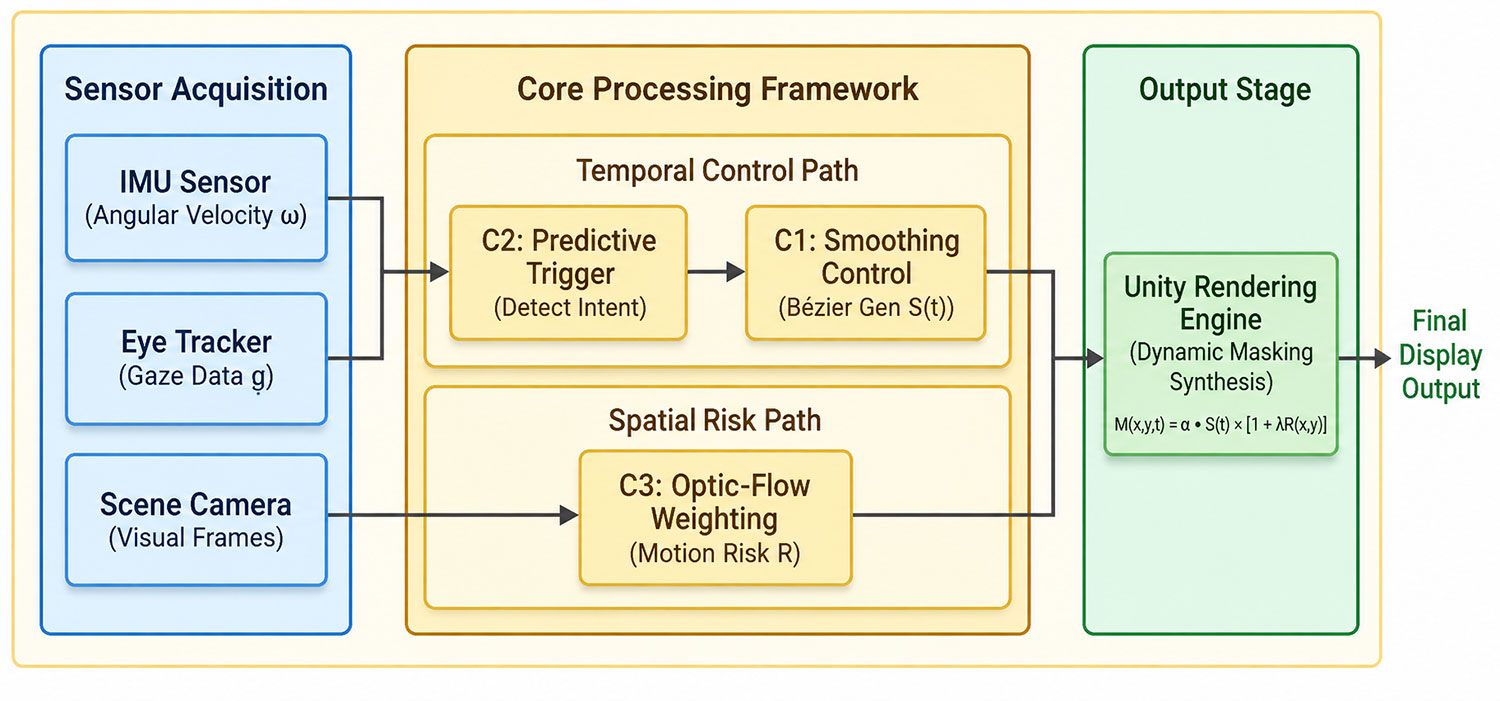
Virtual Reality (VR) systems require extremely low latency and accurate user intent prediction to ensure immersion. However, traditional visual modulation techniques primarily rely on single-sensor inputs (e.g., IMU angular velocity), which suffer from inherent mechanical delays and fail to capture complex spatial-temporal dynamics, ultimately leading to severe visually induced motion sickness (VIMS). Existing methods lack effective fusion of multi-source heterogeneous data, resulting in delayed responses and abrupt visual transitions. To address this, this study proposes a novel spatio-temporal information fusion framework for adaptive visual modulation in VR. The proposed architecture deep... More >
Graphical Abstract