Adaptive Field-of-View Restriction Based on Sigmoid and Bézier Smoothing Control Functions



Article Information
Abstract
Virtual Reality (VR) systems require extremely low latency and accurate user intent prediction to ensure immersion. However, traditional visual modulation techniques primarily rely on single-sensor inputs (e.g., IMU angular velocity), which suffer from inherent mechanical delays and fail to capture complex spatial-temporal dynamics, ultimately leading to severe visually induced motion sickness (VIMS). Existing methods lack effective fusion of multi-source heterogeneous data, resulting in delayed responses and abrupt visual transitions. To address this, this study proposes a novel spatio-temporal information fusion framework for adaptive visual modulation in VR. The proposed architecture deeply fuses high-frequency eye-tracking signals (physiological intent), IMU data (physical kinematics), and dense optic flow (environmental spatial features). Specifically, a cross-modal temporal intent prediction model is established to fuse gaze and head-motion data, achieving early action anticipation. Simultaneously, a spatial data fusion module dynamically allocates asymmetric visual weights based on motion-risk mapping. Finally, a fusion-driven continuous state modulation solver, utilizing Bézier and Sigmoid functions, is introduced to eliminate multi-source asynchronous jitter and ensure C1 continuity. Experimental results demonstrate that the proposed multimodal fusion framework, by exploiting the known 80--120\,ms physiological precedence of eye movements over head rotation, enables approximately 100\,ms of anticipatory visual modulation, significantly outperforming baseline single-source methods. The approach yields a 27% reduction in Simulator Sickness Questionnaire (SSQ) scores, improves physiological comfort (an 18% increase in HRV), and drastically reduces mask perceptibility to 34%, all without sacrificing task performance. The findings provide an effective multimodal information fusion paradigm for human-in-the-loop immersive systems.
Graphical Abstract
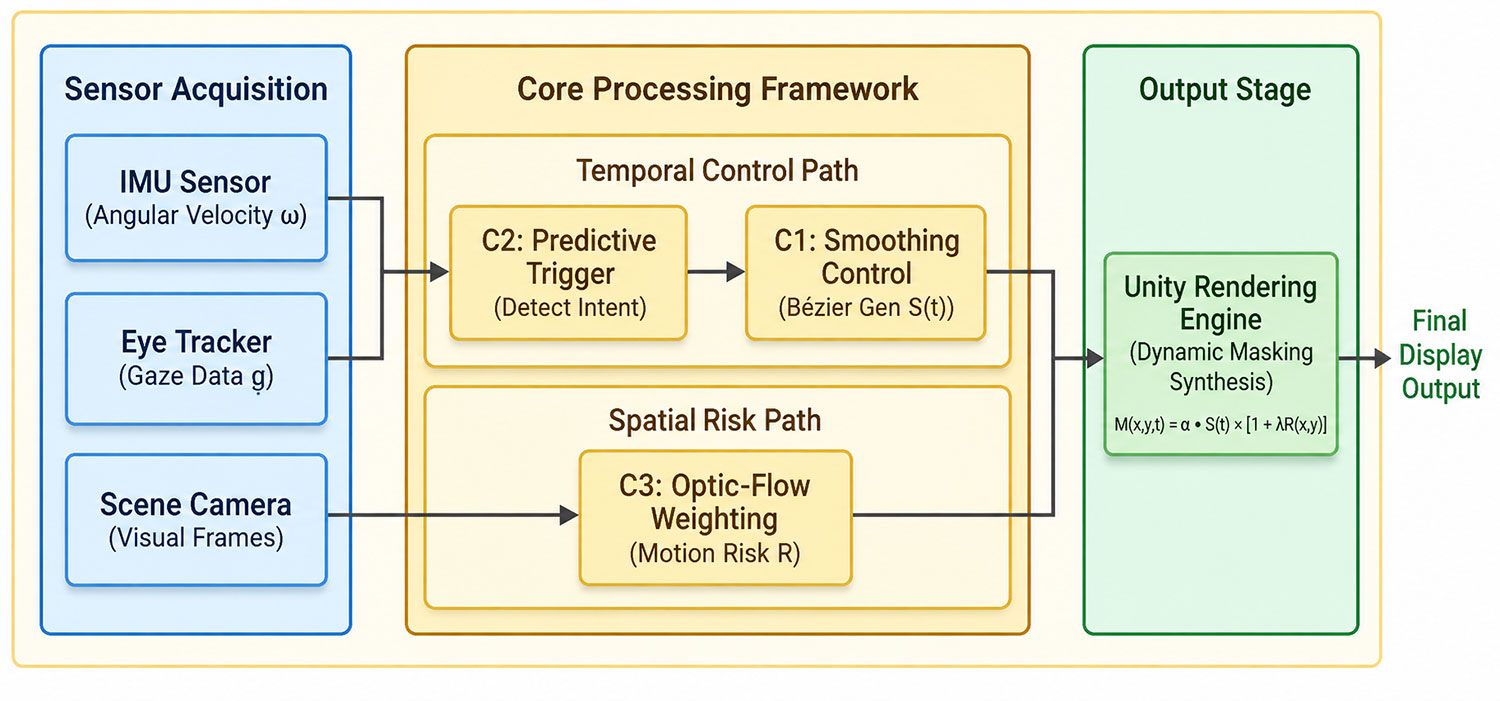
Keywords
Data Availability Statement
Funding
Conflicts of Interest
AI Use Statement
Ethical Approval and Consent to Participate
References
- Oman, C. M. (1990). Motion sickness: a synthesis and evaluation of the sensory conflict theory. Canadian journal of physiology and pharmacology, 68(2), 294-303.
[CrossRef] [Google Scholar] - Fernandes, A. S., & Feiner, S. K. (2016, March). Combating VR sickness through subtle dynamic field-of-view modification. In 2016 IEEE symposium on 3D user interfaces (3DUI) (pp. 201-210). IEEE.
[CrossRef] [Google Scholar] - Wu, F., & Suma Rosenberg, E. (2022, November). Adaptive field-of-view restriction: Limiting optical flow to mitigate cybersickness in virtual reality. In Proceedings of the 28th ACM symposium on virtual reality software and technology (pp. 1-11).
[CrossRef] [Google Scholar] - Adhanom, I. B., Griffin, N. N., MacNeilage, P., & Folmer, E. (2020, March). The effect of a foveated field-of-view restrictor on VR sickness. In 2020 IEEE conference on virtual reality and 3D user interfaces (VR) (pp. 645-652). IEEE.
[CrossRef] [Google Scholar] - Patney, A., Salvi, M., Kim, J., Kaplanyan, A., Wyman, C., Benty, N., ... & Lefohn, A. (2016). Towards foveated rendering for gaze-tracked virtual reality. ACM Transactions On Graphics (TOG), 35(6), 1-12.
[CrossRef] [Google Scholar] - Carnegie, K., & Rhee, T. (2015). Reducing visual discomfort with HMDs using dynamic depth of field. IEEE computer graphics and applications, 35(5), 34-41.
[CrossRef] [Google Scholar] - Lim, K., Lee, J., Won, K., Kala, N., & Lee, T. (2021). A novel method for VR sickness reduction based on dynamic field of view processing. Virtual Reality, 25(2), 331-340.
[CrossRef] [Google Scholar] - So, R. H., Lo, W. T., & Ho, A. T. (2001). Effects of navigation speed on motion sickness caused by an immersive virtual environment. Human factors, 43(3), 452-461.
[CrossRef] [Google Scholar] - Li, Y., Guo, L., Sun, G., Fu, R., Yan, Z., & Liang, J. (2022). Eye tracking calibration based on smooth pursuit with regulated visual guidance. In Proceedings of the 14th International Joint Conference on Computational Intelligence (IJCCI) (pp. 417-425).
[CrossRef] [Google Scholar] - Chang, E., Kim, H. T., & Yoo, B. (2021). Predicting cybersickness based on user’s gaze behaviors in HMD-based virtual reality. Journal of Computational Design and Engineering, 8(2), 728-739.
[CrossRef] [Google Scholar] - Lou, Z., Cui, Q., Wang, H., Tang, X., & Zhou, H. (2024, June). Multimodal sense-informed forecasting of 3d human motions. In 2024 IEEE/CVF Conference on Computer Vision and Pattern Recognition (CVPR) (pp. 2144-2154). IEEE.
[CrossRef] [Google Scholar] - Ernst, M. O., & Banks, M. S. (2002). Humans integrate visual and haptic information in a statistically optimal fashion. Nature, 415(6870), 429-433.
[CrossRef] [Google Scholar] - Reason, J. T. (1978). Motion sickness adaptation: a neural mismatch model. Journal of the royal society of medicine, 71(11), 819-829.
[CrossRef] [Google Scholar] - Saredakis, D., Szpak, A., Birckhead, B., Keage, H. A., Rizzo, A., & Loetscher, T. (2020). Factors associated with virtual reality sickness in head-mounted displays: a systematic review and meta-analysis. Frontiers in human neuroscience, 14, 96.
[CrossRef] [Google Scholar] - Iftikar, M., Asiedu, D. K. P., Nishio, T., & Yun, J. H. (2024). Deep reinforcement learning-based overfill rendering, offloading, and subband allocation for edge-assisted VR system. IEEE Access, 12, 149147-149161.
[CrossRef] [Google Scholar] - Zielasko, D., Meißner, A., Freitag, S., Weyers, B., & Kuhlen, T. W. (2024). Dynamic field of view reduction related to subjective sickness measures in an HMD-based data analysis task. arXiv preprint arXiv:2403.07992.
[CrossRef] [Google Scholar] - Bahill, A. T., Clark, M. R., & Stark, L. (1975). The main sequence, a tool for studying human eye movements. Mathematical biosciences, 24(3-4), 191-204.
[CrossRef] [Google Scholar] - Kim, S., Lee, S., Kala, N., Lee, J., & Choe, W. (2018). An effective FoV restriction approach to mitigate VR sickness on mobile devices. Journal of the Society for Information Display, 26(6), 376-384.
[CrossRef] [Google Scholar] - Park, M. H., Yun, K., & Kim, G. J. (2023). Reducing VR sickness by directing user gaze to motion singularity point/region as effective rest frame. IEEE Access, 11, 34227-34237.
[CrossRef] [Google Scholar] - Ang, S., & Quarles, J. (2023). Reduction of cybersickness in head mounted displays use: A systematic review and taxonomy of current strategies. Frontiers in Virtual reality, 4, 1027552.
[CrossRef] [Google Scholar] - Shimada, S., Ikei, Y., Nishiuchi, N., & Yem, V. (2023, March). Study of cybersickness prediction in real time using eye tracking data. In 2023 IEEE conference on virtual reality and 3D user interfaces abstracts and workshops (VRW) (pp. 871-872). IEEE.
[CrossRef] [Google Scholar] - Yang, Y., Kim, H., & Kim, G. J. (2024, March). u-DFOV: User-activated dynamic field of view restriction for managing cybersickness and task performance. In 2024 IEEE Conference on Virtual Reality and 3D User Interfaces Abstracts and Workshops (VRW) (pp. 729-730). IEEE.
[CrossRef] [Google Scholar]
Cite This Article
TY  - JOUR
AU  - Shang, Wenli
AU  - Alena, Kazlova
PY  - 2026
DA  - 2026/09/26
TI  - Adaptive Field-of-View Restriction Based on Sigmoid and Bézier Smoothing Control Functions
JO  - Chinese Journal of Information Fusion
T2  - Chinese Journal of Information Fusion
JF  - Chinese Journal of Information Fusion
VL  - 3
IS  - 3
SP  - 178
EP  - 188
DO  - 10.62762/CJIF.2025.472730
UR  - https://www.icck.org/article/abs/CJIF.2025.472730
KW  - multimodal sensor fusion
KW  - spatio-temporal information
KW  - intent prediction
KW  - dynamic visual modulation
KW  - virtual reality
KW  - human-in-the-loop systems
AB  - Virtual Reality (VR) systems require extremely low latency and accurate user intent prediction to ensure immersion. However, traditional visual modulation techniques primarily rely on single-sensor inputs (e.g., IMU angular velocity), which suffer from inherent mechanical delays and fail to capture complex spatial-temporal dynamics, ultimately leading to severe visually induced motion sickness (VIMS). Existing methods lack effective fusion of multi-source heterogeneous data, resulting in delayed responses and abrupt visual transitions. To address this, this study proposes a novel spatio-temporal information fusion framework for adaptive visual modulation in VR. The proposed architecture deeply fuses high-frequency eye-tracking signals (physiological intent), IMU data (physical kinematics), and dense optic flow (environmental spatial features). Specifically, a cross-modal temporal intent prediction model is established to fuse gaze and head-motion data, achieving early action anticipation. Simultaneously, a spatial data fusion module dynamically allocates asymmetric visual weights based on motion-risk mapping. Finally, a fusion-driven continuous state modulation solver, utilizing Bézier and Sigmoid functions, is introduced to eliminate multi-source asynchronous jitter and ensure C1 continuity. Experimental results demonstrate that the proposed multimodal fusion framework, by exploiting the known 80--120\,ms physiological precedence of eye movements over head rotation, enables approximately 100\,ms of anticipatory visual modulation, significantly outperforming baseline single-source methods. The approach yields a 27% reduction in Simulator Sickness Questionnaire (SSQ) scores, improves physiological comfort (an 18% increase in HRV), and drastically reduces mask perceptibility to 34%, all without sacrificing task performance. The findings provide an effective multimodal information fusion paradigm for human-in-the-loop immersive systems.
SN  - 2998-3371
PB  - Institute of Central Computation and Knowledge
LA  - English
ER  -
@article{Shang2026Adaptive,
  author = {Wenli Shang and Kazlova Alena},
  title = {Adaptive Field-of-View Restriction Based on Sigmoid and Bézier Smoothing Control Functions},
  journal = {Chinese Journal of Information Fusion},
  year = {2026},
  volume = {3},
  number = {3},
  pages = {178-188},
  doi = {10.62762/CJIF.2025.472730},
  url = {https://www.icck.org/article/abs/CJIF.2025.472730},
  abstract = {Virtual Reality (VR) systems require extremely low latency and accurate user intent prediction to ensure immersion. However, traditional visual modulation techniques primarily rely on single-sensor inputs (e.g., IMU angular velocity), which suffer from inherent mechanical delays and fail to capture complex spatial-temporal dynamics, ultimately leading to severe visually induced motion sickness (VIMS). Existing methods lack effective fusion of multi-source heterogeneous data, resulting in delayed responses and abrupt visual transitions. To address this, this study proposes a novel spatio-temporal information fusion framework for adaptive visual modulation in VR. The proposed architecture deeply fuses high-frequency eye-tracking signals (physiological intent), IMU data (physical kinematics), and dense optic flow (environmental spatial features). Specifically, a cross-modal temporal intent prediction model is established to fuse gaze and head-motion data, achieving early action anticipation. Simultaneously, a spatial data fusion module dynamically allocates asymmetric visual weights based on motion-risk mapping. Finally, a fusion-driven continuous state modulation solver, utilizing Bézier and Sigmoid functions, is introduced to eliminate multi-source asynchronous jitter and ensure C1 continuity. Experimental results demonstrate that the proposed multimodal fusion framework, by exploiting the known 80--120\,ms physiological precedence of eye movements over head rotation, enables approximately 100\,ms of anticipatory visual modulation, significantly outperforming baseline single-source methods. The approach yields a 27\% reduction in Simulator Sickness Questionnaire (SSQ) scores, improves physiological comfort (an 18\% increase in HRV), and drastically reduces mask perceptibility to 34\%, all without sacrificing task performance. The findings provide an effective multimodal information fusion paradigm for human-in-the-loop immersive systems.},
  keywords = {multimodal sensor fusion, spatio-temporal information, intent prediction, dynamic visual modulation, virtual reality, human-in-the-loop systems},
  issn = {2998-3371},
  publisher = {Institute of Central Computation and Knowledge}
}
Article Metrics
Publisher's Note
ICCK stays neutral with regard to jurisdictional claims in published maps and institutional affiliations.
Rights and Permissions
 Copyright © 2026 by the Author(s). Published by Institute of Central Computation and Knowledge. This article is an open access article distributed under the terms and conditions of the Creative Commons Attribution (CC BY) license (https://creativecommons.org/licenses/by/4.0/), which permits use, sharing, adaptation, distribution and reproduction in any medium or format, as long as you give appropriate credit to the original author(s) and the source, provide a link to the Creative Commons licence, and indicate if changes were made.


Portico