Radar Multi-Feature Graph Representation and Graph Network Fusion Target Detection Methods






Article Information
Abstract
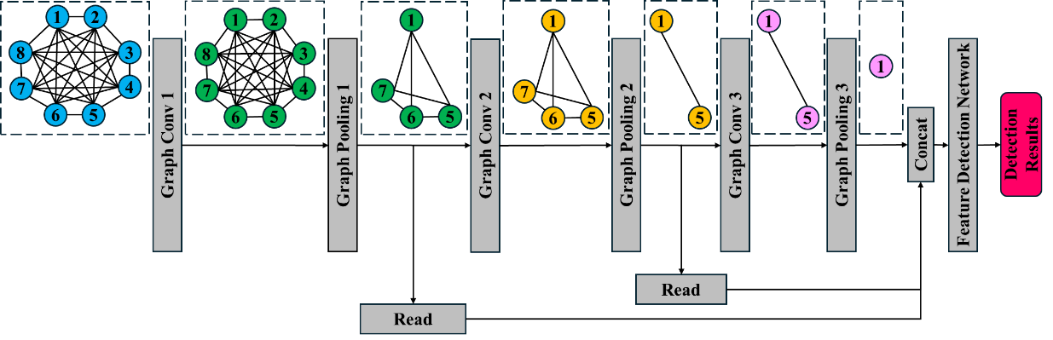
In the context of neural network-based radar feature extraction and detection methods, single-feature detection approaches exhibit limited capability in distinguishing targets from background in complex environments such as sea clutter. To address this, a Multi-Feature Extraction Network and Graph Fusion Detection Network (MFEn-GFDn) method is proposed, leveraging feature complementarity and enhanced information utilization. MFEn extracts features from various time-frequency maps of radar signals to construct Multi-Feature Graph Data (MFG) for multi-feature graphical representation. Subsequently, GFDn performs fusion detection on MFG containing multi-feature information. By expanding the feature dimension, detection performance is further improved. Experimental results on dataset composed of real measured IPIX data demonstrate that MFEn-GFDn detection probability is approximately 8% higher than that of the Dual-Channel Convolutional Neural Network (DCCNN). Additionally, MFEn-GFDn enhances detection performance by expanding the feature dimension, particularly in environments lacking corresponding training samples.
Graphical Abstract
Keywords
Data Availability Statement
Funding
Conflicts of Interest
Ethical Approval and Consent to Participate
References
- Xin, Z., Liao, G., Yang, Z., Zhang, Y., & Dang, H. (2016). A deterministic sea-clutter space–time model based on physical sea surface. IEEE Transactions on Geoscience and Remote Sensing, 54(11), 6659-6673.
[CrossRef] [Google Scholar] - del-Rey-Maestre, N., Jarabo-Amores, M. P., Mata-Moya, D., Barcena-Humanes, J. L., & del Hoyo, P. G. (2017). Machine learning techniques for coherent CFAR detection based on statistical modeling of UHF passive ground clutter. IEEE Journal of Selected Topics in Signal Processing, 12(1), 104-118.
[CrossRef] [Google Scholar] - Jarabo-Amores, M. P., Rosa-Zurera, M., Gil-Pita, R., & Lopez-Ferreras, F. (2009). Study of two error functions to approximate the Neyman–Pearson detector using supervised learning machines. IEEE Transactions on Signal Processing, 57(11), 4175-4181.
[CrossRef] [Google Scholar] - del-Rey-Maestre, N., Mata-Moya, D., Jarabo-Amores, M. P., Gomez-del-Hoyo, P. J., & Barcena-Humanes, J. L. (2018). Artificial intelligence techniques for small boats detection in radar clutter. Real data validation. Engineering Applications of Artificial Intelligence, 67, 296-308.
[CrossRef] [Google Scholar] - Li, J., & Stoica, P. (2008). MIMO radar signal processing. John Wiley & Sons.
[Google Scholar] - Cheikh, K., & Soltani, F. (2006). Application of neural networks to radar signal detection in K-distributed clutter. IEE Proceedings-Radar, Sonar & Navigation, 153(5), 460-466.
[CrossRef] [Google Scholar] - Vicen-Bueno, R., Rosa-Zurera, M., Jarabo-Amores, M. P., & Gil-Pita, R. (2010). Automatic target detection in simulated ground clutter (Weibull distributed) by multilayer perceptrons in a low-resolution coherent radar. IET radar, sonar & navigation, 4(2), 315-328.
[CrossRef] [Google Scholar] - Vicen-Bueno, R., Rosa-Zurera, M., Jarabo-Amores, M. P., & de la Mata-Moya, D. (2010). Coherent detection of Swerling 0 targets in sea-ice Weibull-distributed clutter using neural networks. IEEE Transactions on Instrumentation and Measurement, 59(12), 3139-3151.
[CrossRef] [Google Scholar] - Cai, Z., Zhang, M., & Liu, Y. (2018). Sea‐surface weak target detection scheme using a cultural algorithm aided time‐frequency fusion strategy. IET radar, sonar & navigation, 12(7), 711-720.
[CrossRef] [Google Scholar] - Zhang, R., & Cao, S. (2018). Real-time human motion behavior detection via CNN using mmWave radar. IEEE Sensors Letters, 3(2), 1-4.
[CrossRef] [Google Scholar] - Tang, X., Li, D., Cheng, W., Su, J., & Wan, J. (2021, March). A novel sea clutter suppression method based on deep learning with exploiting time-frequency features. In 2021 IEEE 5th Advanced Information Technology, Electronic and Automation Control Conference (IAEAC) (Vol. 5, pp. 2548-2552). IEEE.
[CrossRef] [Google Scholar] - Rui, G. U. O., Yue, Z., Biao, T. I. A. N., Yu, X. I. A. O., Jun, H. U., Shiyou, X. U., & Zengping, C. H. E. N. (2022). Review of the technology, development and applications of holographic staring radar. Journal of Radars, 12(2), 389-411.
[CrossRef] [Google Scholar] - Chen, X., Su, N., Huang, Y., & Guan, J. (2021). False-alarm-controllable radar detection for marine target based on multi features fusion via CNNs. IEEE Sensors Journal, 21(7), 9099-9111.
[CrossRef] [Google Scholar] - Feng, K., Chen, H., Kong, Y., Zhang, L., Yu, X., & Yi, W. (2022, July). Prediction of Multi-Function Radar Signal Sequence Using Encoder-Decoder Structure. In 2022 7th International Conference on Signal and Image Processing (ICSIP) (pp. 152-156). IEEE.
[CrossRef] [Google Scholar] - Lee, J., Lee, I., & Kang, J. (2019, May). Self-attention graph pooling. In International conference on machine learning (pp. 3734-3743). pmlr.
[Google Scholar] - Mei, X. A. (2007). A study on the statistical characteristics of IPIX radar sea spikes. Journal of Spacecraft TT C Technology, 26(2), 19-23.
[Google Scholar] - Ningyuan, S., Xiaolong, C., Jian, G., Xiaoqian, M., & Ningbo, L. (2018). Detection and classification of maritime target with micro-motion based on CNNs. Journal of Radars, 7(5), 565-574.
[CrossRef] [Google Scholar]
Cited By (2)
-
Xiaolong Chen, Jinhao Wang, Zhijian Zhao, Jian Guan, Xiaolin Du, Yifeng Wu, Hai Zhang. Physics-Guided Learnable Wavelet Framework for Micro-Doppler Characterization of Low-Altitude Radar Targets.
IEEE Transactions on Radar Systems, 2026 , 4 .
[CrossRef] -
Bin Wu, Mei Xue, Ying Jia, Ning Zhang, GuoJin Zhao, XiuPing Wang, Chunlei Zhang, Guangyin Jin. Lightweight and efficient skeleton-based sports activity recognition with ASTM-Net.
PLOS One, 2025 , 20 (7).
[CrossRef]
Cite This Article
TY  - JOUR
AU  - Su, Ningyuan
AU  - Chen, Xiaolong
AU  - Guan, Jian
AU  - Wang, Xinghai
AU  - Zhou, Liangjiang
AU  - Wang, Jinhao
AU  - Wang, Hongyong
PY  - 2025
DA  - 2025/03/26
TI  - Radar Multi-Feature Graph Representation and Graph Network Fusion Target Detection Methods
JO  - Chinese Journal of Information Fusion
T2  - Chinese Journal of Information Fusion
JF  - Chinese Journal of Information Fusion
VL  - 2
IS  - 1
SP  - 59
EP  - 69
DO  - 10.62762/CJIF.2025.413277
UR  - https://www.icck.org/article/abs/CJIF.2025.413277
KW  - radar target detection
KW  - feature fusion
KW  - graph data
KW  - graph fusion detection network
AB  - In the context of neural network-based radar feature extraction and detection methods, single-feature detection approaches exhibit limited capability in distinguishing targets from background in complex environments such as sea clutter. To address this, a Multi-Feature Extraction Network and Graph Fusion Detection Network (MFEn-GFDn) method is proposed, leveraging feature complementarity and enhanced information utilization. MFEn extracts features from various time-frequency maps of radar signals to construct Multi-Feature Graph Data (MFG) for multi-feature graphical representation. Subsequently, GFDn performs fusion detection on MFG containing multi-feature information. By expanding the feature dimension, detection performance is further improved. Experimental results on dataset composed of real measured IPIX data demonstrate that MFEn-GFDn detection probability is approximately 8% higher than that of the Dual-Channel Convolutional Neural Network (DCCNN). Additionally, MFEn-GFDn enhances detection performance by expanding the feature dimension, particularly in environments lacking corresponding training samples.
SN  - 2998-3371
PB  - Institute of Central Computation and Knowledge
LA  - English
ER  -
@article{Su2025Radar,
  author = {Ningyuan Su and Xiaolong Chen and Jian Guan and Xinghai Wang and Liangjiang Zhou and Jinhao Wang and Hongyong Wang},
  title = {Radar Multi-Feature Graph Representation and Graph Network Fusion Target Detection Methods},
  journal = {Chinese Journal of Information Fusion},
  year = {2025},
  volume = {2},
  number = {1},
  pages = {59-69},
  doi = {10.62762/CJIF.2025.413277},
  url = {https://www.icck.org/article/abs/CJIF.2025.413277},
  abstract = {In the context of neural network-based radar feature extraction and detection methods, single-feature detection approaches exhibit limited capability in distinguishing targets from background in complex environments such as sea clutter. To address this, a Multi-Feature Extraction Network and Graph Fusion Detection Network (MFEn-GFDn) method is proposed, leveraging feature complementarity and enhanced information utilization. MFEn extracts features from various time-frequency maps of radar signals to construct Multi-Feature Graph Data (MFG) for multi-feature graphical representation. Subsequently, GFDn performs fusion detection on MFG containing multi-feature information. By expanding the feature dimension, detection performance is further improved. Experimental results on dataset composed of real measured IPIX data demonstrate that MFEn-GFDn detection probability is approximately 8\% higher than that of the Dual-Channel Convolutional Neural Network (DCCNN). Additionally, MFEn-GFDn enhances detection performance by expanding the feature dimension, particularly in environments lacking corresponding training samples.},
  keywords = {radar target detection, feature fusion, graph data, graph fusion detection network},
  issn = {2998-3371},
  publisher = {Institute of Central Computation and Knowledge}
}
Publisher's Note
ICCK stays neutral with regard to jurisdictional claims in published maps and institutional affiliations.
Rights and Permissions
 Copyright © 2025 by the Author(s). Published by Institute of Central Computation and Knowledge. This article is an open access article distributed under the terms and conditions of the Creative Commons Attribution (CC BY) license (https://creativecommons.org/licenses/by/4.0/), which permits use, sharing, adaptation, distribution and reproduction in any medium or format, as long as you give appropriate credit to the original author(s) and the source, provide a link to the Creative Commons licence, and indicate if changes were made.


Portico