Complex Evidence Theory for Multisource Data Fusion






Article Information
Abstract
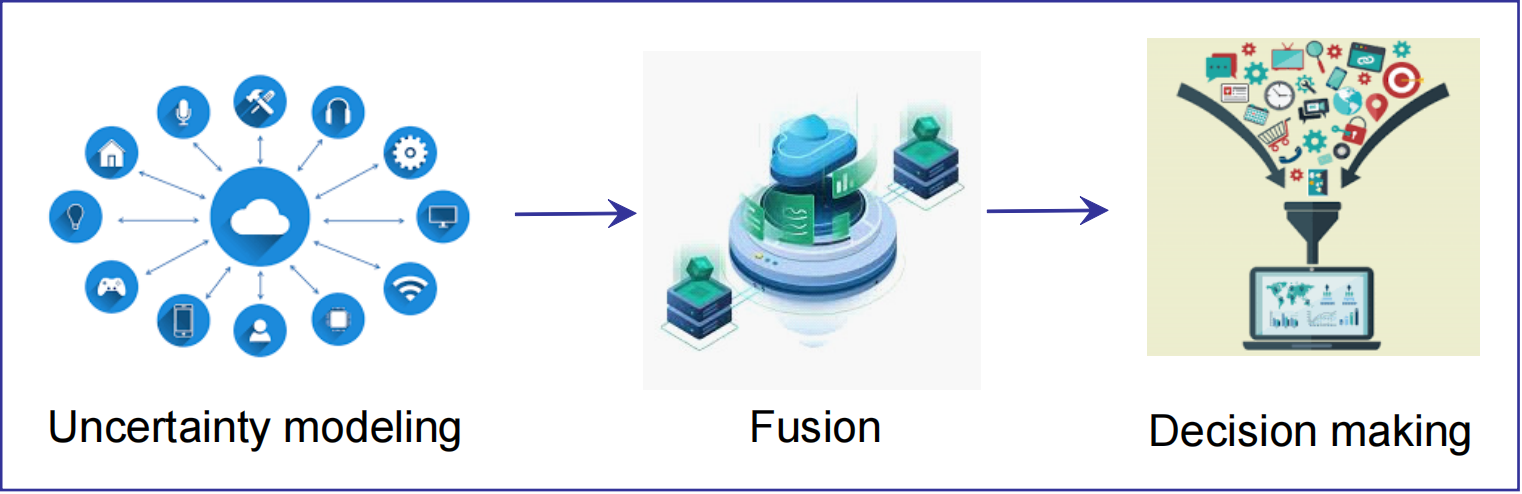
Data fusion is a prevalent technique for assembling imperfect raw data coming from multiple sources to capture reliable and accurate information. Dempster–Shafer evidence theory is one of useful methodologies in the fusion of uncertain multisource information. The existing literature lacks a thorough and comprehensive review of the recent advances of Dempster– Shafer evidence theory for data fusion. Therefore, the state of the art has to be surveyed to gain insight into how Dempster–Shafer evidence theory is beneficial for data fusion and how it evolved over time. In this paper, we first provide a comprehensive review of data fusion methods based on Dempster–Shafer evidence theory and its extensions, collectively referred to as classical evidence theory, from three aspects of uncertainty modeling, fusion, and decision making. Next, we study and explore complex evidence theory for data fusion in both closed world and open world contexts that benefits from the frame of complex plane modelling. We then present classical and complex evidence theory framework-based multisource data fusion algorithms, which are applied to pattern classification to compare and demonstrate their applicabilities. The research results indicate that the complex evidence theory framework can enhance the capabilities of uncertainty modeling and reasoning by generating constructive interference through the fusion of appropriate complex basic belief assignment functions modeled by complex numbers. Through analysis and comparison, we finally propose several challenges and identify open future research directions in evidence theorybased data fusion.
Graphical Abstract
Keywords
Data Availability Statement
Funding
Conflicts of Interest
Ethical Approval and Consent to Participate
References
- Zhang, L., Xie, Y., Xidao, L., & Zhang, X. (2018, May). Multi-source heterogeneous data fusion. In 2018 International conference on artificial intelligence and big data (ICAIBD) (pp. 47-51). IEEE.
[CrossRef] [Google Scholar] - Albahri, A. S., Duhaim, A. M., Fadhel, M. A., Alnoor, A., Baqer, N. S., Alzubaidi, L., ... & Deveci, M. (2023). A systematic review of trustworthy and explainable artificial intelligence in healthcare: Assessment of quality, bias risk, and data fusion. Information Fusion, 96, 156-191.
[CrossRef] [Google Scholar] - Lai, J. W., Chang, J., Ang, L. K., & Cheong, K. H. (2020). Multi-level information fusion to alleviate network congestion. Information Fusion, 63, 248-255.
[CrossRef] [Google Scholar] - Yager, R. R. (2004). A framework for multi-source data fusion. Information Sciences, 163(1-3), 175-200.
[CrossRef] [Google Scholar] - Yang, J. B., Xu, D. L., Xu, X., & Fu, C. (2023). Likelihood analysis of imperfect data. IEEE Transactions on Systems, Man, and Cybernetics: Systems, 53(8), 5046-5057.
[CrossRef] [Google Scholar] - Cao, B., Li, C., Song, Y., Qin, Y., & Chen, C. (2022). Network intrusion detection model based on CNN and GRU. Applied Sciences, 12(9), 4184.
[CrossRef] [Google Scholar] - Miao, W., Xu, Z., Geng, J., & Jiang, W. (2023). ECAE: Edge-aware class activation enhancement for semisupervised remote sensing image semantic segmentation. IEEE Transactions on Geoscience and Remote Sensing, 61, 1-14.
[CrossRef] [Google Scholar] - Judah, A., & Hu, B. (2022). An advanced data fusion method to improve wetland classification using multi-source remotely sensed data. Sensors, 22(22), 8942.
[CrossRef] [Google Scholar] - Charte, D., Charte, F., García, S., del Jesus, M. J., & Herrera, F. (2018). A practical tutorial on autoencoders for nonlinear feature fusion: Taxonomy, models, software and guidelines. Information Fusion, 44, 78-96.
[CrossRef] [Google Scholar] - Li, T., Song, Y., & Fan, H. (2023). From target tracking to targeting track: A data-driven yet analytical approach to joint target detection and tracking. Signal Processing, 205, 108883.
[CrossRef] [Google Scholar] - Deng, X., Xue, S., & Jiang, W. (2023). A novel quantum model of mass function for uncertain information fusion. Information Fusion, 89, 619-631.
[CrossRef] [Google Scholar] - Hussain, L. A., Singh, S., Mizouni, R., Otrok, H., & Damiani, E. (2023). A predictive target tracking framework for IoT using CNN–LSTM. Internet of Things, 22, 100744.
[CrossRef] [Google Scholar] - Kang, B., & Zhao, C. (2024). Deceptive evidence detection in information fusion of belief functions based on reinforcement learning. Information Fusion, 103, 102102.
[CrossRef] [Google Scholar] - Liu, Z., Chen, F., Xu, J., Pei, W., & Lu, G. (2022). Image-text retrieval with cross-modal semantic importance consistency. IEEE Transactions on Circuits and Systems for Video Technology, 33(5), 2465-2476.
[CrossRef] [Google Scholar] - Wang, X., Zhu, D., Li, G., Zhang, X. P., & He, Y. (2022). Proposal-Copula-Based Fusion of Spaceborne and Airborne SAR Images for Ship Target Detection⁎⁎. Information Fusion, 77, 247-260.
[CrossRef] [Google Scholar] - Chenghai, L. I., Ke, W. A. N. G., Yafei, S. O. N. G., Peng, W. A. N. G., & Lemin, L. I. (2024). Air target intent recognition method combining graphing time series and diffusion models. Chinese Journal of Aeronautics.
[CrossRef] [Google Scholar] - Zhang, Y., Wang, X., Jiang, Z., Li, G., & He, Y. (2022). An efficient center-based method with multilevel auxiliary supervision for multiscale SAR ship detection. IEEE Journal of Selected Topics in Applied Earth Observations and Remote Sensing, 15, 7065-7075.
[CrossRef] [Google Scholar] - Lau, B. P. L., Marakkalage, S. H., Zhou, Y., Hassan, N. U., Yuen, C., Zhang, M., & Tan, U. X. (2019). A survey of data fusion in smart city applications. Information Fusion, 52, 357-374.
[CrossRef] [Google Scholar] - Ding, W., Jing, X., Yan, Z., & Yang, L. T. (2019). A survey on data fusion in internet of things: Towards secure and privacy-preserving fusion. Information Fusion, 51, 129-144.
[CrossRef] [Google Scholar] - Deng, X., Jiang, Y., Yang, L. T., Lin, M., Yi, L., & Wang, M. (2019). Data fusion based coverage optimization in heterogeneous sensor networks: A survey. Information Fusion, 52, 90-105.
[CrossRef] [Google Scholar] - Ghamisi, P., Rasti, B., Yokoya, N., Wang, Q., Hofle, B., Bruzzone, L., ... & Benediktsson, J. A. (2019). Multisource and multitemporal data fusion in remote sensing: A comprehensive review of the state of the art. IEEE Geoscience and Remote Sensing Magazine, 7(1), 6-39.
[CrossRef] [Google Scholar] - Meng, T., Jing, X., Yan, Z., & Pedrycz, W. (2020). A survey on machine learning for data fusion. Information Fusion, 57, 115-129.
[CrossRef] [Google Scholar] - El Fissaoui, M., Beni-hssane, A., Ouhmad, S., & El Makkaoui, K. (2021). A survey on mobile agent itinerary planning for information fusion in wireless sensor networks. Archives of computational methods in engineering, 28(3), 1323-1334.
[CrossRef] [Google Scholar] - Zhang, Y., Jiang, C., Yue, B., Wan, J., & Guizani, M. (2022). Information fusion for edge intelligence: A survey. Information Fusion, 81, 171-186.
[CrossRef] [Google Scholar] - Xinde, L. I., DUNKIN, F., & DEZERT, J. (2023). Multi-source information fusion: Progress and future. Chinese Journal of Aeronautics.
[CrossRef] [Google Scholar] - Dempster, A. P. (2008). Upper and lower probabilities induced by a multivalued mapping. In Classic works of the Dempster-Shafer theory of belief functions (pp. 57-72). Berlin, Heidelberg: Springer Berlin Heidelberg.
[CrossRef] [Google Scholar] - Shafer, G. et~al. (1976). A mathematical theory of evidence, volume~1. Princeton University Press Princeton.
[Google Scholar] - Zhang, Z., Ye, S., Zhang, Y., Ding, W., & Wang, H. (2022). Belief combination of classifiers for incomplete data. IEEE/CAA Journal of Automatica Sinica, 9(4), 652-667.
[CrossRef] [Google Scholar] - Fujita, H., & Ko, Y. C. (2020). A heuristic representation learning based on evidential memberships: Case study of UCI-SPECTF. International Journal of Approximate Reasoning, 120, 125-137.
[CrossRef] [Google Scholar] - Yager, R.~R. and Liu, L. (2008). Classic works of the Dempster--Shafer theory of belief functions, volume 219. Springer.
[Google Scholar] - Xiong, L., Su, X., & Qian, H. (2021). Conflicting evidence combination from the perspective of networks. Information Sciences, 580, 408-418.
[CrossRef] [Google Scholar] - Liu, P., Li, Y., Zhang, X., & Pedrycz, W. (2022). A multiattribute group decision-making method with probabilistic linguistic information based on an adaptive consensus reaching model and evidential reasoning. IEEE Transactions on Cybernetics, 53(3), 1905-1919.
[CrossRef] [Google Scholar] - Xu, X., Zheng, J., Yang, J. B., Xu, D. L., & Chen, Y. W. (2017). Data classification using evidence reasoning rule. Knowledge-Based Systems, 116, 144-151.
[CrossRef] [Google Scholar] - Tang, S. W., Zhou, Z. J., Hu, C. H., Yang, J. B., & Cao, Y. (2019). Perturbation analysis of evidential reasoning rule. IEEE transactions on systems, man, and cybernetics: systems, 51(8), 4895-4910.
[CrossRef] [Google Scholar] - Zhang, B., Zhang, Y., Hu, G., Zhou, Z., Wu, L., & Lv, S. (2020). A method of automatically generating initial parameters for large-scale belief rule base. Knowledge-Based Systems, 199, 105904.
[CrossRef] [Google Scholar] - Fu, C., Hou, B., Xue, M., Chang, L., & Liu, W. (2022). Extended belief rule-based system with accurate rule weights and efficient rule activation for diagnosis of thyroid nodules. IEEE Transactions on Systems, Man, and Cybernetics: Systems, 53(1), 251-263.
[CrossRef] [Google Scholar] - Zhou, Z. J., Hu, G. Y., Hu, C. H., Wen, C. L., & Chang, L. L. (2019). A survey of belief rule-base expert system. IEEE Transactions on Systems, Man, and Cybernetics: Systems, 51(8), 4944-4958.
[CrossRef] [Google Scholar] - Chang, L., Zhang, L., Fu, C., & Chen, Y. W. (2021). Transparent digital twin for output control using belief rule base. IEEE Transactions on cybernetics, 52(10), 10364-10378.
[CrossRef] [Google Scholar] - Cao, Y., Zhou, Z., Hu, C., He, W., & Tang, S. (2020). On the interpretability of belief rule-based expert systems. IEEE Transactions on Fuzzy Systems, 29(11), 3489-3503.
[CrossRef] [Google Scholar] - Xu, X., Guo, H., Zhang, Z., Shi, P., Huang, W., Li, X., & Brunauer, G. (2024). Fault diagnosis method via one vs rest evidence classifier considering imprecise feature samples. Applied Soft Computing, 161, 111761.
[CrossRef] [Google Scholar] - Xu, X., Guo, H., Zhang, Z., Yu, S., Chang, L., Steyskal, F., & Brunauer, G. (2024). A cloud model-based interval-valued evidence fusion method and its application in fault diagnosis. Information Sciences, 658, 119995.
[CrossRef] [Google Scholar] - Chen, X., & Deng, Y. (2024). Evidential software risk assessment model on ordered frame of discernment. Expert Systems with Applications, 250, 123786.
[CrossRef] [Google Scholar] - Zhou, M., Zheng, Y. Q., Chen, Y. W., Cheng, B. Y., Herrera-Viedma, E., & Wu, J. (2023). A large-scale group consensus reaching approach considering self-confidence with two-tuple linguistic trust/distrust relationship and its application in life cycle sustainability assessment. Information Fusion, 94, 181-199.
[CrossRef] [Google Scholar] - Fei, L., Liu, X., & Zhang, C. (2024). An evidential linguistic ELECTRE method for selection of emergency shelter sites. Artificial Intelligence Review, 57(4), 81.
[CrossRef] [Google Scholar] - Zadeh, L. A. (1986). A simple view of the Dempster-Shafer theory of evidence and its implication for the rule of combination. AI magazine, 7(2), 85-85.
[CrossRef] [Google Scholar] - Smets, P. (2002). The combination of evidence in the transferable belief model. IEEE Transactions on pattern analysis and machine intelligence, 12(5), 447-458.
[CrossRef] [Google Scholar] - Dezert, J., & Smarandache, F. (2006). DSmT: A new paradigm shift for information fusion. Infinite Study.
[Google Scholar] - Deng, Y. (2015). Generalized evidence theory. Applied Intelligence, 43(3), 530-543.
[CrossRef] [Google Scholar] - Smarandache, F., Dezert, J., & Tchamova, A. (Eds.). (2023). Advances and Applications of DSmT for Information Fusion (Collected Works. Volume 5).
[Google Scholar] - Deng, Y. (2022). Random permutation set. International Journal of Computers Communications & Control, 17(1).
[CrossRef] [Google Scholar] - Deng, J., Deng, Y., & Yang, J. B. (2024). Random permutation set reasoning. IEEE Transactions on Pattern Analysis and Machine Intelligence.
[CrossRef] [Google Scholar] - Deng, X., & Jiang, W. (2023). A framework for the fusion of non-exclusive and incomplete information on the basis of D number theory. Applied Intelligence, 53(10), 11861-11884.
[CrossRef] [Google Scholar] - Kouatli, I. (2020). The use of fuzzy logic as augmentation to quantitative analysis to unleash knowledge of participants’ uncertainty when filling a survey: case of cloud computing. IEEE Transactions on Knowledge and Data Engineering, 34(3), 1489-1500.
[CrossRef] [Google Scholar] - Akcora, C. G., Gel, Y. R., Kantarcioglu, M., Lyubchich, V., & Thuraisingham, B. (2019). Graphboot: Quantifying uncertainty in node feature learning on large networks. IEEE Transactions on Knowledge and Data Engineering, 33(1), 116-127.
[CrossRef] [Google Scholar] - Fei, L., & Wang, Y. (2022). An optimization model for rescuer assignments under an uncertain environment by using Dempster–Shafer theory. Knowledge-Based Systems, 255, 109680.
[CrossRef] [Google Scholar] - An, L., Li, M., Boudaren, M. E. Y., & Pieczynski, W. (2018). Unsupervised segmentation of hidden Markov fields corrupted by correlated non-Gaussian noise. International journal of approximate reasoning, 102, 41-59.
[CrossRef] [Google Scholar] - Zhang, Z. W., Liu, Z. G., Martin, A., & Zhou, K. (2022). BSC: Belief shift clustering. IEEE Transactions on Systems, Man, and Cybernetics: Systems, 53(3), 1748-1760.
[CrossRef] [Google Scholar] - Denoeux, T. (2021). NN-EVCLUS: Neural network-based evidential clustering. Information Sciences, 572, 297-330.
[CrossRef] [Google Scholar] - Zhou, K., Martin, A., Pan, Q., & Liu, Z. (2018). SELP: Semi-supervised evidential label propagation algorithm for graph data clustering. International Journal of Approximate Reasoning, 92, 139-154.
[CrossRef] [Google Scholar] - He, H., Han, D., & Dezert, J. (2020). Disagreement based semi-supervised learning approaches with belief functions. Knowledge-Based Systems, 193, 105426.
[CrossRef] [Google Scholar] - Antoine, V., Guerrero, J. A., & Xie, J. (2021). Fast semi-supervised evidential clustering. International Journal of Approximate Reasoning, 133, 116-132.
[CrossRef] [Google Scholar] - Xu, P., Davoine, F., Zha, H., & Denoeux, T. (2016). Evidential calibration of binary SVM classifiers. International Journal of Approximate Reasoning, 72, 55-70.
[CrossRef] [Google Scholar] - Denœux, T. (2019). Logistic regression, neural networks and Dempster–Shafer theory: A new perspective. Knowledge-Based Systems, 176, 54-67.
[CrossRef] [Google Scholar] - Tong, Z., Xu, P., & Denoeux, T. (2021). An evidential classifier based on Dempster-Shafer theory and deep learning. Neurocomputing, 450, 275-293.
[CrossRef] [Google Scholar] - Yager, R. R. (1987). On the Dempster-Shafer framework and new combination rules. Information sciences, 41(2), 93-137.
[CrossRef] [Google Scholar] - Dubois, D., & Prade, H. (1988). Representation and combination of uncertainty with belief functions and possibility measures. Computational intelligence, 4(3), 244-264.
[CrossRef] [Google Scholar] - Inagaki, T. (2002). Interdependence between safety-control policy and multiple-sensor schemes via Dempster-Shafer theory. IEEE Transactions on Reliability, 40(2), 182-188.
[CrossRef] [Google Scholar] - Lefevre, E., Colot, O., & Vannoorenberghe, P. (2002). Belief function combination and conflict management. Information fusion, 3(2), 149-162.
[CrossRef] [Google Scholar] - Zhang, L. (1994). Representation, independence, and combination of evidence in the Dempster-Shafer theory. In Advances in the Dempster-Shafer theory of evidence (pp. 51-69). https://dl.acm.org/doi/abs/10.5555/186965.186968
[Google Scholar] - Mahler, R. P. (1996). Combining ambiguous evidence with respect to ambiguous a priori knowledge. I. Boolean logic. IEEE Transactions on Systems, Man, and Cybernetics-Part A: Systems and Humans, 26(1), 27-41.
[CrossRef] [Google Scholar] - Jiang, W., & Zhan, J. (2017). A modified combination rule in generalized evidence theory. Applied Intelligence, 46(3), 630-640.
[CrossRef] [Google Scholar] - Xiao, F. (2020). Generalization of Dempster–Shafer theory: A complex mass function. Applied Intelligence, 50(10), 3266-3275.
[CrossRef] [Google Scholar] - Xiao, F. (2020). Generalized belief function in complex evidence theory. Journal of Intelligent & Fuzzy Systems, 38(4), 3665-3673.
[CrossRef] [Google Scholar] - Chen, X., & Deng, Y. (2023). A novel combination rule for conflict management in data fusion. Soft Computing, 27(22), 16483-16492.
[CrossRef] [Google Scholar] - Jousselme, A. L., Grenier, D., & Bossé, É. (2001). A new distance between two bodies of evidence. Information fusion, 2(2), 91-101.
[CrossRef] [Google Scholar] - Jousselme, A. L., & Maupin, P. (2012). Distances in evidence theory: Comprehensive survey and generalizations. International Journal of Approximate Reasoning, 53(2), 118-145.
[CrossRef] [Google Scholar] - Han, D., Dezert, J., & Yang, Y. (2016). Belief interval-based distance measures in the theory of belief functions. IEEE Transactions on Systems, Man, and Cybernetics: Systems, 48(6), 833-850.
[CrossRef] [Google Scholar] - Smets, P., & Kennes, R. (1994). The transferable belief model. Artificial intelligence, 66(2), 191-234.
[CrossRef] [Google Scholar] - Liu, W. (2006). Analyzing the degree of conflict among belief functions. Artificial intelligence, 170(11), 909-924.
[CrossRef] [Google Scholar] - Jiang, W. (2018). A correlation coefficient for belief functions. International Journal of Approximate Reasoning, 103, 94-106.
[CrossRef] [Google Scholar] - Deng, Y. (2020). Uncertainty measure in evidence theory. Science China Information Sciences, 63(11), 210201.
[CrossRef] [Google Scholar] - Abellán, J. (2017). Analyzing properties of Deng entropy in the theory of evidence. Chaos, Solitons & Fractals, 95, 195-199.
[CrossRef] [Google Scholar] - Deng, Y. (2020). Information volume of mass function. International Journal of Computers Communications & Control, 15(6).
[Google Scholar] - Liao, H., Ren, Z., & Fang, R. (2020). A Deng-entropy-based evidential reasoning approach for multi-expert multi-criterion decision-making with uncertainty. International Journal of Computational Intelligence Systems, 13(1), 1281-1294.
[CrossRef] [Google Scholar] - Zhao, T., Li, Z., & Deng, Y. (2024). Linearity in Deng entropy. Chaos, Solitons & Fractals, 178, 114388.
[CrossRef] [Google Scholar] - Cui, Y., & Deng, X. (2023). Plausibility entropy: A new total uncertainty measure in evidence theory based on plausibility function. IEEE Transactions on Systems, Man, and Cybernetics: Systems, 53(6), 3833-3844.
[CrossRef] [Google Scholar] - Qiang, C., Deng, Y., & Cheong, K. H. (2022). Information fractal dimension of mass function. Fractals, 30(06), 2250110.
[CrossRef] [Google Scholar] - Zhu, L., Zhou, Q., Deng, Y., & Cheong, K. H. (2024). Fractal-based basic probability assignment: A transient mass function. Information Sciences, 652, 119767.
[CrossRef] [Google Scholar] - Li, D., Deng, Y., & Cheong, K. H. (2021). Multisource basic probability assignment fusion based on information quality. International Journal of Intelligent Systems, 36(4), 1851-1875.
[CrossRef] [Google Scholar] - Daniel, M. (2010, June). Conflicts within and between belief functions. In International Conference on Information Processing and Management of Uncertainty in Knowledge-Based Systems (pp. 696-705). Berlin, Heidelberg: Springer Berlin Heidelberg.
[CrossRef] [Google Scholar] - Lefevre, E., & Elouedi, Z. (2013). How to preserve the conflict as an alarm in the combination of belief functions?. Decision Support Systems, 56, 326-333.
[CrossRef] [Google Scholar] - Abellán, J., & Bossé, É. (2016). Drawbacks of uncertainty measures based on the pignistic transformation. IEEE Transactions on Systems, Man, and Cybernetics: Systems, 48(3), 382-388.
[CrossRef] [Google Scholar] - Martin, L., & Sudano, J. J. (2006, July). Yet another paradigm illustrating evidence fusion (YAPIEF). In 2006 9th international conference on information fusion (pp. 1-7). IEEE.
[CrossRef] [Google Scholar] - Cuzzolin, F. (2007). Two new Bayesian approximations of belief functions based on convex geometry. IEEE Transactions on Systems, Man, and Cybernetics, Part B (Cybernetics), 37(4), 993-1008.
[CrossRef] [Google Scholar] - Han, D., Dezert, J., & Duan, Z. (2015). Evaluation of probability transformations of belief functions for decision making. IEEE Transactions on Systems, Man, and Cybernetics: Systems, 46(1), 93-108.
[CrossRef] [Google Scholar] - Liu, Z. G., Fu, Y. M., Pan, Q., & Zhang, Z. W. (2022). Orientational distribution learning with hierarchical spatial attention for open set recognition. IEEE Transactions on Pattern Analysis and Machine Intelligence, 45(7), 8757-8772.
[CrossRef] [Google Scholar] - Liu, Z. G., Qiu, G. H., Wang, S. Y., Li, T. C., & Pan, Q. (2021). A new belief-based bidirectional transfer classification method. IEEE Transactions on Cybernetics, 52(8), 8101-8113.
[CrossRef] [Google Scholar] - Xiao, F., & Pedrycz, W. (2022). Negation of the quantum mass function for multisource quantum information fusion with its application to pattern classification. IEEE Transactions on Pattern Analysis and Machine Intelligence, 45(2), 2054-2070.
[CrossRef] [Google Scholar] - Hu, B. G. (2013). What are the differences between Bayesian classifiers and mutual-information classifiers?. IEEE transactions on neural networks and learning systems, 25(2), 249-264.
[CrossRef] [Google Scholar] - Veenman, C. J., & Reinders, M. J. (2005). The nearest subclass classifier: A compromise between the nearest mean and nearest neighbor classifier. IEEE Transactions on Pattern Analysis and Machine Intelligence, 27(9), 1417-1429.
[CrossRef] [Google Scholar] - Cover, T., & Hart, P. (1967). Nearest neighbor pattern classification. IEEE transactions on information theory, 13(1), 21-27.
[CrossRef] [Google Scholar] - Freund, Y., & Mason, L. (1999, June). The alternating decision tree learning algorithm. In icml (Vol. 99, pp. 124-133).
[Google Scholar] - Chang, C. C., & Lin, C. J. (2011). LIBSVM: A library for support vector machines. ACM transactions on intelligent systems and technology (TIST), 2(3), 1-27.
[CrossRef] [Google Scholar] - Castro, C. L., & Braga, A. P. (2013). Novel cost-sensitive approach to improve the multilayer perceptron performance on imbalanced data. IEEE transactions on neural networks and learning systems, 24(6), 888-899.
[CrossRef] [Google Scholar] - CHEN S, G. M., & Grant, P. M. (1991). Orthogonal Least Squares Learning Algorithm for Radial Basis Function Networks. IEEE Transactions on Neural Networks, 2(2), 302-309.
[CrossRef] [Google Scholar] - Denoeux, T. (1995). A k-nearest neighbor classification rule based on Dempster-Shafer theory. IEEE transactions on systems, man, and cybernetics, 25(5), 804-813.
[CrossRef] [Google Scholar] - Xu, P., Deng, Y., Su, X., & Mahadevan, S. (2013). A new method to determine basic probability assignment from training data. Knowledge-Based Systems, 46, 69-80.
[CrossRef] [Google Scholar] - Wang, Y. M., Pan, X. H., He, S. F., Dutta, B., García-Zamora, D., & Martínez, L. (2022). A new decision-making framework for site selection of electric vehicle charging station with heterogeneous information and multigranular linguistic terms. IEEE Transactions on Fuzzy Systems, 31(2), 485-499.
[CrossRef] [Google Scholar] - Xiao, F. (2023). Generalized quantum evidence theory. Applied Intelligence, 53(11), 14329-14344.
[CrossRef] [Google Scholar]
Cited By (36)
-
Ruihan Li, Junjie Huang, Fuyuan Xiao, Xiaoling Li. .
Belief Functions: Theory and Applications, 2027 , 17186 .
[CrossRef] -
Naiwei Lu, Juntao Wei, Jian Cui, Xiangyuan Xiao. Multi-source data fusion-based structural strain prediction of long-span arch bridges via CNN-GRU-Attention network.
Physica Scripta, 2026 , 101 (34).
[CrossRef] -
Qianqian Shi, Jinghua Zhou. Digital Twin-Driven Dynamic Reactive Power and Voltage Optimization for Large Grid-Connected PV Stations.
Electronics, 2026 , 15 (4).
[CrossRef] -
Liu Yang, Jiangtao Guo, Meifang Ma, Jiao Wan, Zihao Wang. .
2026 4th International Conference on Integrated Circuits and Communication Systems (ICICACS), 2026 .
[CrossRef] -
Liang Hao, Yunfeng Gao, Jiyuan Hu, Yadong Yu, Kun Li. Intelligent Pre-Assessment Algorithm for Earthquake Disaster Losses Integrating Deep Learning and Multi-Source Big Data.
Procedia Computer Science, 2026 , 281 .
[CrossRef] -
Xuan Yang, Fuyuan Xiao. A novel deep multi-view clustering algorithm based on feature learning and evidence theory.
Computational and Applied Mathematics, 2026 , 45 (9).
[CrossRef] -
Yangyang Zhao, Fuyuan Xiao, Xiaohong Zhang, Masayoshi Aritsugi. Quantum association entropy for characterizing coherence and entanglement-related quantum correlations.
Chaos, Solitons & Fractals, 2026 , 213 .
[CrossRef] -
Xiaolong Chen, Fuyuan Xiao, Xiaoling Li, Masayoshi Aritsugi, Guan Gui, Fumiyuki Adachi. .
2026 41st Youth Academic Annual Conference of Chinese Association of Automation (YAC), 2026 .
[CrossRef] -
Alperen Kaçar, İbrahim Türkoğlu. A Theoretical and Methodological Review of the Data Fusion Process: Architectures, Algorithms, and Challenges.
Türk Doğa ve Fen Dergisi, 2026 , 15 (1).
[CrossRef] -
Kang Sun, Daijun Wei, Mingli Lei, Ningkui Wang. Complex evidential reasoning-based multi-source information fusion for pattern classification.
Neurocomputing, 2026 , 674 .
[CrossRef] -
Xiaolong Chen, Yunwei Li, Fuyuan Xiao, Zehong Cao. A Fractal Belief Entropy-of-χ2-divergence with its application in time series analysis.
Chaos, Solitons & Fractals, 2026 , 211 .
[CrossRef] -
Junxiang Mao, Ling Chen, Wenming Xia, Junjun Gong, Chengqiang Liang, Yuhang Zhang, Dengjian Wu. The “Mechanism–Detection–Data–Algorithm” Framework: A review of Multi-Source fusion for fuel cladding failure monitoring.
Measurement, 2026 , 274 .
[CrossRef] -
Hui Zhang, Lan Zhang. A Reliable Defect Confirmation Method for Drainage Pipeline Inspection Based on Vision–LiDAR–Ultrasonic Fusion.
Processes, 2026 , 14 (17).
[CrossRef] -
Zunmin Hou, Haibin Wan. .
2026 5th International Symposium on Computer Applications and Information Technology (ISCAIT), 2026 .
[CrossRef] -
Ren C. Luo, Hsu-Chia Kao. Multisensor Fusion Enhanced Evidential Space Transformation Model (ESTM) for Structural Defects Inspection of Porcelain Bushings in Power Systems.
IEEE Transactions on Industrial Electronics, 2026 , 73 (7).
[CrossRef] -
Junhao Yu, Fuyuan Xiao, Yi Zhang, Zehong Cao, Chin-Teng Lin. A CDGFN-Based Quantum Multisource Information Fusion With Its Application in Time Series Classification.
IEEE Transactions on Knowledge and Data Engineering, 2026 , 38 (3).
[CrossRef] -
Yangyang Zhao, Fuyuan Xiao. A Novel Intuitionistic Fuzzy Set for Decision‐Making.
Expert Systems, 2026 , 43 (10).
[CrossRef] -
Shuoshuo Liu, Fuyuan Xiao, Xiaoling Li, Masayoshi Aritsugi, Guan Gui, Fumiyuki Adachi. .
2026 41st Youth Academic Annual Conference of Chinese Association of Automation (YAC), 2026 .
[CrossRef] -
Nve Xiao, Boyang Li, Xiaocong Wang, Jie Bai, Kan Xie. Safety Assessment of Critical Aircraft Systems Under Multisource Uncertainty Based on Evidence Network.
International Journal of Aerospace Engineering, 2026 , 2026 (1).
[CrossRef] -
Zixuan Zhou, Fuyuan Xiao. Conflict management in sequential evidence combination.
Information Sciences, 2026 , 734 .
[CrossRef]
Cite This Article
TY  - JOUR
AU  - Xiao, Fuyuan
AU  - Wen, Junhao
AU  - Pedrycz, Witold
AU  - Aritsugi, Masayoshi
PY  - 2024
DA  - 2024/09/30
TI  - Complex Evidence Theory for Multisource Data Fusion
JO  - Chinese Journal of Information Fusion
T2  - Chinese Journal of Information Fusion
JF  - Chinese Journal of Information Fusion
VL  - 1
IS  - 2
SP  - 134
EP  - 159
DO  - 10.62762/CJIF.2024.999646
UR  - https://www.icck.org/article/abs/CJIF.2024.999646
KW  - multisource data fusion
KW  - Dempster-Shafer evidence theory
KW  - complex evidence theory
KW  - quantum evidence theory
KW  - uncertainty modeling
KW  - conflict management
KW  - belief function
KW  - decision making
KW  - pattern classification
AB  - Data fusion is a prevalent technique for assembling imperfect raw data coming from multiple sources to capture reliable and accurate information. Dempster–Shafer evidence theory is one of useful methodologies in the fusion of uncertain multisource information. The existing literature lacks a thorough and comprehensive review of the recent advances of Dempster– Shafer evidence theory for data fusion. Therefore, the state of the art has to be surveyed to gain insight into how Dempster–Shafer evidence theory is beneficial for data fusion and how it evolved over time. In this paper, we first provide a comprehensive review of data fusion methods based on Dempster–Shafer evidence theory and its extensions, collectively referred to as classical evidence theory, from three aspects of uncertainty modeling, fusion, and decision making. Next, we study and explore complex evidence theory for data fusion in both closed world and open world contexts that benefits from the frame of complex plane modelling. We then present classical and complex evidence theory framework-based multisource data fusion algorithms, which are applied to pattern classification to compare and demonstrate their applicabilities. The research results indicate that the complex evidence theory framework can enhance the capabilities of uncertainty modeling and reasoning by generating constructive interference through the fusion of appropriate complex basic belief assignment functions modeled by complex numbers. Through analysis and comparison, we finally propose several challenges and identify open future research directions in evidence theorybased data fusion.
SN  - 2998-3371
PB  - Institute of Central Computation and Knowledge
LA  - English
ER  -
@article{Xiao2024Complex,
  author = {Fuyuan Xiao and Junhao Wen and Witold Pedrycz and Masayoshi Aritsugi},
  title = {Complex Evidence Theory for Multisource Data Fusion},
  journal = {Chinese Journal of Information Fusion},
  year = {2024},
  volume = {1},
  number = {2},
  pages = {134-159},
  doi = {10.62762/CJIF.2024.999646},
  url = {https://www.icck.org/article/abs/CJIF.2024.999646},
  abstract = {Data fusion is a prevalent technique for assembling imperfect raw data coming from multiple sources to capture reliable and accurate information. Dempster–Shafer evidence theory is one of useful methodologies in the fusion of uncertain multisource information. The existing literature lacks a thorough and comprehensive review of the recent advances of Dempster– Shafer evidence theory for data fusion. Therefore, the state of the art has to be surveyed to gain insight into how Dempster–Shafer evidence theory is beneficial for data fusion and how it evolved over time. In this paper, we first provide a comprehensive review of data fusion methods based on Dempster–Shafer evidence theory and its extensions, collectively referred to as classical evidence theory, from three aspects of uncertainty modeling, fusion, and decision making. Next, we study and explore complex evidence theory for data fusion in both closed world and open world contexts that benefits from the frame of complex plane modelling. We then present classical and complex evidence theory framework-based multisource data fusion algorithms, which are applied to pattern classification to compare and demonstrate their applicabilities. The research results indicate that the complex evidence theory framework can enhance the capabilities of uncertainty modeling and reasoning by generating constructive interference through the fusion of appropriate complex basic belief assignment functions modeled by complex numbers. Through analysis and comparison, we finally propose several challenges and identify open future research directions in evidence theorybased data fusion.},
  keywords = {multisource data fusion, Dempster-Shafer evidence theory, complex evidence theory, quantum evidence theory, uncertainty modeling, conflict management, belief function, decision making, pattern classification},
  issn = {2998-3371},
  publisher = {Institute of Central Computation and Knowledge}
}
Publisher's Note
ICCK stays neutral with regard to jurisdictional claims in published maps and institutional affiliations.
Rights and Permissions
 Copyright © 2024 by the Author(s). Published by Institute of Central Computation and Knowledge. This article is an open access article distributed under the terms and conditions of the Creative Commons Attribution (CC BY) license (https://creativecommons.org/licenses/by/4.0/), which permits use, sharing, adaptation, distribution and reproduction in any medium or format, as long as you give appropriate credit to the original author(s) and the source, provide a link to the Creative Commons licence, and indicate if changes were made.


Portico