Intelligent System Architecture Based on System Theory



Article Information
Abstract
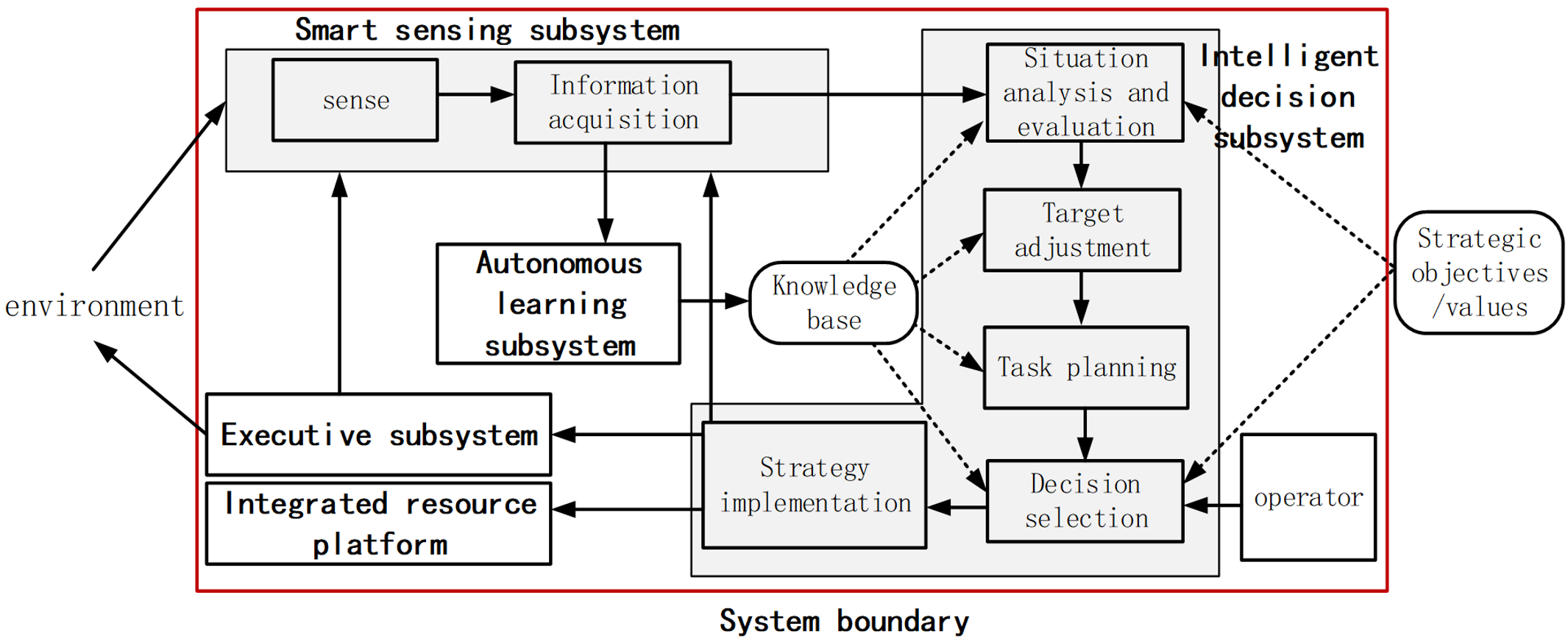
Intelligent system is a research field that attracts much attention at present. Most of the researches on intelligent system focus on intelligent technology and its application. However, an intelligent system is first of all a system, which means it should have the characteristics of a system. Design of conventional system is mainly function- or task-oriented, and adaptation to environment is passive, static and regular. However, intelligent system is faced with a complex, random and dynamic environment, and has dynamic interaction with the environment. Behind this interaction behavior is a fusion of perception, cognition, and decision-making processes, supported by multi-source information fusion techniques. Therefore, intelligent system design needs to be oriented towards system behavior, where information fusion plays a crucial role in integrating heterogeneous data for coherent situational awareness. This paper will examine intelligent system from the perspective of system behavior characteristics, and put forward a new definition of intelligent system based on information fusion principles. The core feature of intelligent system is intelligence, which relies on advanced fusion algorithms to combine sensory inputs, knowledge, and contextual information. To construct an intelligent system, we develop a framework of five core capabilities, aligning with the traditional Chinese philosophical fusion of knowledge and action – the Unity of Knowledge and Action. Finally, we give a design case of an intelligent system (intelligent vehicle) to demonstrate the practical viability of the proposed architecture and concept, highlighting the role of multi-modal fusion in perception and decision-making.
Graphical Abstract
Keywords
Data Availability Statement
Funding
Conflicts of Interest
Ethical Approval and Consent to Participate
References
- Turing A M. (1950). Computing machinery and intelligence. Mind,59(236), 433-460.
[Google Scholar] - Minsky, M. (1961). Steps toward artificial intelligence. Proceedings of the IRE, 49(1), 8-30.
[CrossRef] [Google Scholar] - Searle, J. R. (1990). Is the brain's mind a computer program?. Scientific American, 262(1), 25-31.
[Google Scholar] - Hu, Y., Yang, J., Chen, L., Li, K., Sima, C., Zhu, X., ... & Li, H. (2023). Planning-oriented autonomous driving. In Proceedings of the IEEE/CVF Conference on Computer Vision and Pattern Recognition (pp. 17853-17862).
[Google Scholar] - Arents, J., & Greitans, M. (2022). Smart industrial robot control trends, challenges and opportunities within manufacturing. Applied Sciences, 12(2), 937.
[CrossRef] [Google Scholar] - Grosan, C., & Abraham, A. (2011). Intelligent systems (Vol. 17, pp. 261-268). Berlin: Springer.
[Google Scholar] - Molina, M. (2020). What is an intelligent system?. arXiv preprint arXiv:2009.09083.
[CrossRef] [Google Scholar] - Kaliraj, P., & Devi, T. (Eds.). (2021). Artificial intelligence theory, models, and applications. CRC press.
[Google Scholar] - Hopgood, A. A. (2021). Intelligent systems for engineers and scientists: a practical guide to artificial intelligence. CRC press.
[Google Scholar] - Behera, L., & Kar, I. (2010). Intelligent systems and control principles and applications. Oxford University Press.
[Google Scholar] - Mgbemena, E. (2020). Man-machine systems: A review of current trends and applications. FUPRE Journal of Scientific and Industrial Research (FJSIR), 4(2), 91-117.
[Google Scholar] - Mandal, J. K., Satapathy, S. C., Sanyal, M. K., Sarkar, P. P., & Mukhopadhyay, A. (2015). Information Systems Design and Intelligent Applications Proceedings of Second International Conference INDIA 2015, Volume. In Proceedings of Second International Conference INDIA (Vol. 1, p. 1).
[CrossRef] [Google Scholar] - Wilamowski, B. M., & Irwin, J. D. (Eds.). (2018). Intelligent systems. CRC press.
[Google Scholar] - Pathak, S., Bhatt, P. K., Singh, S. K., Tripathi, A., & Pandey, P. K. (Eds.). (2022). Intelligent System Algorithms and Applications in Science and Technology. CRC Press.
[Google Scholar] - Daabub, A. M., & Abdalla, H. S. (1999). A computer-based intelligent system for design for assembly. Computers & Industrial Engineering, 37(1-2), 111-115.
[CrossRef] [Google Scholar] - Bertalanffy, L. V. (1969). General system theory: Foundations, development, applications. http://hdl.handle.net/10822/763002
[Google Scholar] - Jensen, H. J. (2022). Complexity science: the study of emergence. Cambridge University Press.
[Google Scholar] - Bogdanov, V. (2022). Application of Onsager and Prigozhin Variational Principles of Nonequilibrium Thermodynamics to Obtain MHD-Equation Dissipative System in Drift Approximation. In Magnetosphere and Solar Winds, Humans and Communication. IntechOpen.
[CrossRef] [Google Scholar] - Haken, H., & Schiepek, G. (2006). Synergetik in der Psychologie: Selbstorganisation verstehen und gestalten (Vol. 780). Göttingen: Hogrefe.
[Google Scholar] - Thom, R. (2018). Structural stability and morphogenesis. CRC press.
[Google Scholar] - Qian, X., Yu, J., & Dai, R. (1993). A new discipline of science—The study of open complex giant system and its methodology. Journal of Systems Engineering and Electronics, 4(2), 2-12.
[Google Scholar] - Crawley, E., Cameron, B., & Selva, D. (2015). System architecture: strategy and product development for complex systems. Prentice Hall Press.
[Google Scholar] - Hitchins, D. K. (2008). Systems engineering: a 21st century systems methodology. John Wiley & Sons.
[CrossRef] [Google Scholar] - Holland, J. H., & Sigmund, K. (1995). Hidden order: how adaptation builds complexity. Nature, 378(6556), 453-453.
[Google Scholar] - Wooldridge, M., & Jennings, N. R. (1995). Intelligent agents: Theory and practice. The knowledge engineering review, 10(2), 115-152.
[Google Scholar] - Shi, Z. (2000). Intelligent agent and its application. Scientific Publishing Company, 8, 05-8.
[Google Scholar] - Singh, M. P. (1994). Multiagent Systems: A Theoretical Framework for Intentions, Know-How, and Communications. Lecture Notes in Artificial Intelligence.
[CrossRef] [Google Scholar] - Zhang, W., Zhou, H., Sun, S., Wang, Z., Shi, J., & Loy, C. C. (2019). Robust multi-modality multi-object tracking. In Proceedings of the IEEE/CVF international conference on computer vision (pp. 2365-2374).
[Google Scholar]
Cited By (2)
-
Xin Zhou, Yuping Feng, Xiaokai Yan, Jiarui Sun, Yian Lu, Ji Lu. Constructing Embodied Intelligent Spaces from an Architectural Perspective: Technical Frameworks, Integration Mechanisms, and Implementation Pathways.
Buildings, 2026 , 16 (19).
[CrossRef] -
Yuchen Song, Nianqi Wei. Multi-modal affective computing framework for real-time monitoring of children's learning engagement.
Connection Science, 2026 , 38 (1).
[CrossRef]
Cite This Article
TY  - JOUR
AU  - Chen, Fuhu
AU  - Wang, Zhe
PY  - 2025
DA  - 2025/01/23
TI  - Intelligent System Architecture Based on System Theory
JO  - Chinese Journal of Information Fusion
T2  - Chinese Journal of Information Fusion
JF  - Chinese Journal of Information Fusion
VL  - 2
IS  - 1
SP  - 1
EP  - 13
DO  - 10.62762/CJIF.2024.872211
UR  - https://www.icck.org/article/abs/CJIF.2024.872211
KW  - intelligent system
KW  - system architecture
KW  - system theory
KW  - information fusion
AB  - Intelligent system is a research field that attracts much attention at present. Most of the researches on intelligent system focus on intelligent technology and its application. However, an intelligent system is first of all a system, which means it should have the characteristics of a system. Design of conventional system is mainly function- or task-oriented, and adaptation to environment is passive, static and regular. However, intelligent system is faced with a complex, random and dynamic environment, and has dynamic interaction with the environment. Behind this interaction behavior is a fusion of perception, cognition, and decision-making processes, supported by multi-source information fusion techniques. Therefore, intelligent system design needs to be oriented towards system behavior, where information fusion plays a crucial role in integrating heterogeneous data for coherent situational awareness. This paper will examine intelligent system from the perspective of system behavior characteristics, and put forward a new definition of intelligent system based on information fusion principles. The core feature of intelligent system is intelligence, which relies on advanced fusion algorithms to combine sensory inputs, knowledge, and contextual information. To construct an intelligent system, we develop a framework of five core capabilities, aligning with the traditional Chinese philosophical fusion of knowledge and action – the Unity of Knowledge and Action. Finally, we give a design case of an intelligent system (intelligent vehicle) to demonstrate the practical viability of the proposed architecture and concept, highlighting the role of multi-modal fusion in perception and decision-making.
SN  - 2998-3371
PB  - Institute of Central Computation and Knowledge
LA  - English
ER  -
@article{Chen2025Intelligen,
  author = {Fuhu Chen and Zhe Wang},
  title = {Intelligent System Architecture Based on System Theory},
  journal = {Chinese Journal of Information Fusion},
  year = {2025},
  volume = {2},
  number = {1},
  pages = {1-13},
  doi = {10.62762/CJIF.2024.872211},
  url = {https://www.icck.org/article/abs/CJIF.2024.872211},
  abstract = {Intelligent system is a research field that attracts much attention at present. Most of the researches on intelligent system focus on intelligent technology and its application. However, an intelligent system is first of all a system, which means it should have the characteristics of a system. Design of conventional system is mainly function- or task-oriented, and adaptation to environment is passive, static and regular. However, intelligent system is faced with a complex, random and dynamic environment, and has dynamic interaction with the environment. Behind this interaction behavior is a fusion of perception, cognition, and decision-making processes, supported by multi-source information fusion techniques. Therefore, intelligent system design needs to be oriented towards system behavior, where information fusion plays a crucial role in integrating heterogeneous data for coherent situational awareness. This paper will examine intelligent system from the perspective of system behavior characteristics, and put forward a new definition of intelligent system based on information fusion principles. The core feature of intelligent system is intelligence, which relies on advanced fusion algorithms to combine sensory inputs, knowledge, and contextual information. To construct an intelligent system, we develop a framework of five core capabilities, aligning with the traditional Chinese philosophical fusion of knowledge and action – the Unity of Knowledge and Action. Finally, we give a design case of an intelligent system (intelligent vehicle) to demonstrate the practical viability of the proposed architecture and concept, highlighting the role of multi-modal fusion in perception and decision-making.},
  keywords = {intelligent system, system architecture, system theory, information fusion},
  issn = {2998-3371},
  publisher = {Institute of Central Computation and Knowledge}
}
Publisher's Note
ICCK stays neutral with regard to jurisdictional claims in published maps and institutional affiliations.
Rights and Permissions
 Copyright © 2025 by the Author(s). Published by Institute of Central Computation and Knowledge. This article is an open access article distributed under the terms and conditions of the Creative Commons Attribution (CC BY) license (https://creativecommons.org/licenses/by/4.0/), which permits use, sharing, adaptation, distribution and reproduction in any medium or format, as long as you give appropriate credit to the original author(s) and the source, provide a link to the Creative Commons licence, and indicate if changes were made.


Portico