Unsupervised Industrial Anomaly Detection Based on Feature Mask Generation and Reverse Distillation






Article Information
Abstract
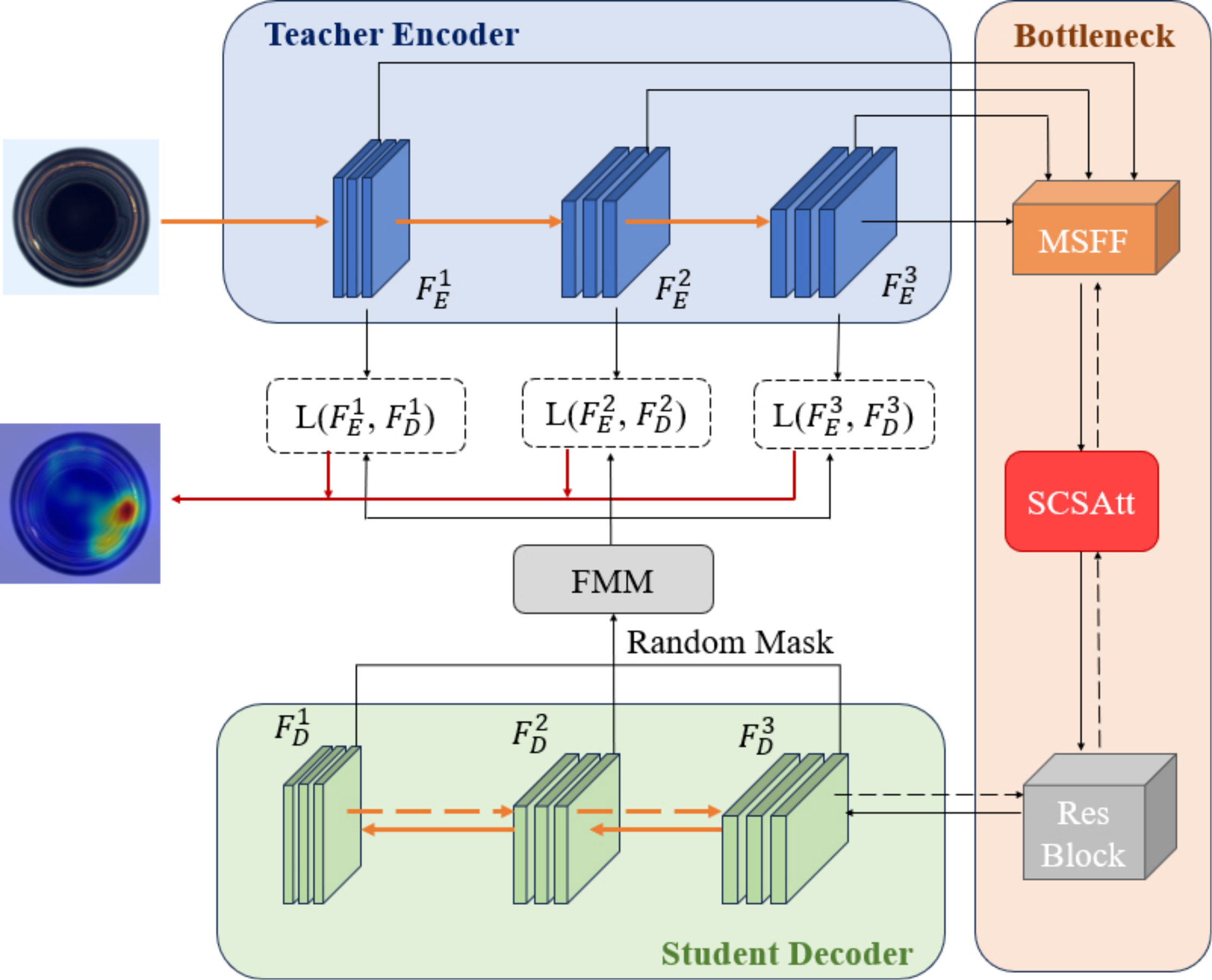
In the realm of industrial defect detection, unsupervised anomaly detection methods draw considerable attention as a result of their exceptional accomplishments. Among these, knowledge distillation-based methods have emerged as a prominent research focus, favored for their streamlined architecture, precision, and efficiency. However, the challenge of characterizing the variability in anomaly samples hinders the accuracy of detection. To address this issue, our research presents a novel approach for anomaly detection and localization, leveraging feature fusion through inverse knowledge distillation as its cornerstone. We employ the encoder as the guiding teacher model and designate the decoder as the learning student model, leveraging the structural disparity wthin the model fusion framework to mitigate the generalization challenge. Additionally, we integrate an attention-based feature fusion mechanism into the distillation process to concentrate on the precise extraction and reconstruction of image features, thereby preventing the loss of nuanced details. To further refine the feature fusion learning process, we have developed a feature mask generation module that minimizes the impact of spatial redundancy in the teacher's features, thereby enhancing the acquisition and fusion of pivotal information. Comprehensive experimental evaluations, carried out meticulously on the MVTec AD dataset, convincingly illustrate the superiority of our proposed method over prevalent methodologies in both detecting and pinpointing anomalies across a diverse range of 15 categories. The proposed methodology attains superior outcomes, evinced by the detection AUROC, localization AUROC, and localization PRO metrics achieving respective values of 99.1%, 98.5%, and 95.9%. To substantiate the significance of individual components within the model, we conduct ablation studies, thereby reinforcing both the efficacy and applicability of our feature fusion approach.
Graphical Abstract
Keywords
Data Availability Statement
Funding
Conflicts of Interest
Ethical Approval and Consent to Participate
References
- Ruff, L., Kauffmann, J. R., Vandermeulen, R. A., Montavon, G., Samek, W., Kloft, M., ... & Müller, K. R. (2021). A unifying review of deep and shallow anomaly detection. Proceedings of the IEEE, 109(5), 756-795.
[CrossRef] [Google Scholar] - Li, Z., Wang, C., Han, M., Xue, Y., Wei, W., Li, L. J., & Fei-Fei, L. (2018). Thoracic disease identification and localization with limited supervision. In Proceedings of the IEEE conference on computer vision and pattern recognition (pp. 8290-8299).
[CrossRef] [Google Scholar] - Lin, D., Li, Y., Prasad, S., Nwe, T. L., Dong, S., & Oo, Z. M. (2021). CAM-guided Multi-Path Decoding U-Net with Triplet Feature Regularization for defect detection and segmentation. Knowledge-Based Systems, 228, 107272.
[CrossRef] [Google Scholar] - Luo, J., Yang, Z., Li, S., & Wu, Y. (2021). FPCB surface defect detection: A decoupled two-stage object detection framework. IEEE Transactions on Instrumentation and Measurement, 70, 1-11.
[CrossRef] [Google Scholar] - Chen, F., Wang, W., Yang, H., Pei, W., & Lu, G. (2022). Multiscale feature fusion for surveillance video diagnosis. Knowledge-Based Systems, 240, 108103.
[CrossRef] [Google Scholar] - Niu, S., Li, B., Wang, X., & Peng, Y. (2021). Region-and strength-controllable GAN for defect generation and segmentation in industrial images. IEEE Transactions on Industrial Informatics, 18(7), 4531-4541.
[CrossRef] [Google Scholar] - Bergmann, P., Fauser, M., Sattlegger, D., & Steger, C. (2020). Uninformed students: Student-teacher anomaly detection with discriminative latent embeddings. In Proceedings of the IEEE/CVF conference on computer vision and pattern recognition (pp. 4183-4192).
[CrossRef] [Google Scholar] - Atlason, H. E., Love, A., Sigurdsson, S., Gudnason, V., & Ellingsen, L. M. (2019, March). Unsupervised brain lesion segmentation from MRI using a convolutional autoencoder. In Medical Imaging 2019: Image Processing (Vol. 10949, pp. 372-378). SPIE.
[CrossRef] [Google Scholar] - Zhao, R., Yan, R., Chen, Z., Mao, K., Wang, P., & Gao, R. X. (2019). Deep learning and its applications to machine health monitoring. Mechanical Systems and Signal Processing, 115, 213-237.
[CrossRef] [Google Scholar] - Kingma, D. P., & Welling, M. (2013, December). Auto-encoding variational bayes.
[Google Scholar] - Goodfellow, I. J., Pouget-Abadie, J., Mirza, M., Xu, B., Warde-Farley, D., Ozair, S., ... & Bengio, Y. (2014). Generative adversarial nets. Advances in neural information processing systems, 27.
[Google Scholar] - Kwon, G., Prabhushankar, M., Temel, D., & AlRegib, G. (2020, August). Backpropagated gradient representations for anomaly detection. In European conference on computer vision (pp. 206-226). Cham: Springer International Publishing.
[CrossRef] [Google Scholar] - Chu, W. H., & Kitani, K. M. (2020, August). Neural batch sampling with reinforcement learning for semi-supervised anomaly detection. In European conference on computer vision (pp. 751-766). Cham: Springer International Publishing.
[CrossRef] [Google Scholar] - Kim, D., Jeong, D., Kim, H., Chong, K., Kim, S., & Cho, H. (2022). Spatial contrastive learning for anomaly detection and localization. IEEE Access, 10, 17366-17376.
[CrossRef] [Google Scholar] - Schlegl, T., Seeböck, P., Waldstein, S. M., Schmidt-Erfurth, U., & Langs, G. (2017). Unsupervised anomaly detection with generative adversarial networks to guide marker discovery. In M. Niethammer, et al. (Eds.), Information processing in medical imaging: IPMI 2017 (Lecture Notes in Computer Science, Vol. 10265, pp. 146–157). Springer.
[CrossRef] [Google Scholar] - Akcay, S., Atapour-Abarghouei, A., & Breckon, T. P. (2018, December). Ganomaly: Semi-supervised anomaly detection via adversarial training. In Asian conference on computer vision (pp. 622-637). Cham: Springer International Publishing.
[CrossRef] [Google Scholar] - Schlegl, T., Seeböck, P., Waldstein, S. M., Langs, G., & Schmidt-Erfurth, U. (2019). f-AnoGAN: Fast unsupervised anomaly detection with generative adversarial networks. Medical image analysis, 54, 30-44.
[CrossRef] [Google Scholar] - Salehi, M., Sadjadi, N., Baselizadeh, S., Rohban, M. H., & Rabiee, H. R. (2021). Multiresolution knowledge distillation for anomaly detection. In Proceedings of the IEEE/CVF conference on computer vision and pattern recognition (pp. 14902-14912).
[CrossRef] [Google Scholar] - Deng, H., & Li, X. (2022). Anomaly detection via reverse distillation from one-class embedding. In Proceedings of the IEEE/CVF conference on computer vision and pattern recognition (pp. 9737-9746).
[CrossRef] [Google Scholar] - He, K., Zhang, X., Ren, S., & Sun, J. (2016). Deep residual learning for image recognition. In Proceedings of the IEEE conference on computer vision and pattern recognition (pp. 770-778).
[Google Scholar] - Zagoruyko, S., & Komodakis, N. (2016). Wide residual networks. arXiv preprint arXiv:1605.07146.
[Google Scholar] - Deng, J., Dong, W., Socher, R., Li, L. J., Li, K., & Fei-Fei, L. (2009, June). Imagenet: A large-scale hierarchical image database. In 2009 IEEE conference on computer vision and pattern recognition (pp. 248-255). Ieee.
[CrossRef] [Google Scholar] - Li, J., Wen, Y., & He, L. (2023). Scconv: Spatial and channel reconstruction convolution for feature redundancy. In Proceedings of the IEEE/CVF conference on computer vision and pattern recognition (pp. 6153-6162).
[CrossRef] [Google Scholar] - Yang, L., Zhang, R. Y., Li, L., & Xie, X. (2021, July). Simam: A simple, parameter-free attention module for convolutional neural networks. In International conference on machine learning (pp. 11863-11874). PMLR.
[Google Scholar] - Yang, Z., Li, Z., Shao, M., Shi, D., Yuan, Z., & Yuan, C. (2022, October). Masked generative distillation. In European conference on computer vision (pp. 53-69). Cham: Springer Nature Switzerland.
[CrossRef] [Google Scholar] - Bergmann, P., Fauser, M., Sattlegger, D., & Steger, C. (2019). MVTec AD--A comprehensive real-world dataset for unsupervised anomaly detection. In Proceedings of the IEEE/CVF conference on computer vision and pattern recognition (pp. 9592-9600).
[CrossRef] [Google Scholar] - Aytekin, C., Ni, X., Cricri, F., & Aksu, E. (2018, July). Clustering and unsupervised anomaly detection with l 2 normalized deep auto-encoder representations. In 2018 International Joint Conference on Neural Networks (IJCNN) (pp. 1-6). IEEE.
[CrossRef] [Google Scholar] - Cohen, N., & Hoshen, Y. (2020). Sub-image anomaly detection with deep pyramid correspondences. arXiv preprint arXiv:2005.02357.
[CrossRef] [Google Scholar] - Yi, J., & Yoon, S. (2020). Patch svdd: Patch-level svdd for anomaly detection and segmentation. In Proceedings of the Asian conference on computer vision.
[CrossRef] [Google Scholar] - Defard, T., Setkov, A., Loesch, A., & Audigier, R. (2021, January). Padim: a patch distribution modeling framework for anomaly detection and localization. In International conference on pattern recognition (pp. 475-489). Cham: Springer International Publishing.
[CrossRef] [Google Scholar] - Wang, G., Han, S., Ding, E., & Huang, D. (2021). Student-teacher feature pyramid matching for anomaly detection. arXiv preprint arXiv:2103.04257.
[CrossRef] [Google Scholar] - Li, C. L., Sohn, K., Yoon, J., & Pfister, T. (2021). Cutpaste: Self-supervised learning for anomaly detection and localization. In Proceedings of the IEEE/CVF conference on computer vision and pattern recognition (pp. 9664-9674).
[Google Scholar] - Zavrtanik, V., Kristan, M., & Skočaj, D. (2021). Draem-a discriminatively trained reconstruction embedding for surface anomaly detection. In Proceedings of the IEEE/CVF international conference on computer vision (pp. 8330-8339).
[Google Scholar] - Perera, P., Nallapati, R., & Xiang, B. (2019). Ocgan: One-class novelty detection using gans with constrained latent representations. In Proceedings of the IEEE/CVF conference on computer vision and pattern recognition (pp. 2898-2906).
[Google Scholar] - Abati, D., Porrello, A., Calderara, S., & Cucchiara, R. (2019). Latent space autoregression for novelty detection. In Proceedings of the IEEE/CVF Conference on Computer Vision and Pattern Recognition (pp. 481-490).
[CrossRef] [Google Scholar] - Venkataramanan, S., Peng, K. C., Singh, R. V., & Mahalanobis, A. (2020, August). Attention guided anomaly localization in images. In European Conference on Computer Vision (pp. 485-503). Cham: Springer International Publishing.
[CrossRef] [Google Scholar] - Golan, I., & El-Yaniv, R. (2018). Deep anomaly detection using geometric transformations. Advances in neural information processing systems, 31.
[Google Scholar] - Xu, H., Xu, S., & Yang, W. (2023). Unsupervised industrial anomaly detection with diffusion models. Journal of Visual Communication and Image Representation, 97, 103983.
[CrossRef] [Google Scholar] - Yang, Q., & Guo, R. (2024). An unsupervised method for industrial image anomaly detection with vision transformer-based autoencoder. Sensors, 24(8), 2440.
[CrossRef] [Google Scholar] - Shen, H., Wei, B., Ma, Y., & Gu, X. (2023). Unsupervised industrial image ensemble anomaly detection based on object pseudo-anomaly generation and normal image feature combination enhancement. Computers & Industrial Engineering, 182, 109337.
[CrossRef] [Google Scholar]
Cited By (6)
-
Junpu Wang, Guili Xu, Chunlei Li, Guangshuai Gao, Yuehua Cheng. Multi-feature reconstruction network using crossed-mask restoration for unsupervised industrial anomaly detection.
Signal, Image and Video Processing, 2026 , 20 (7).
[CrossRef] -
Zhenjun Yu, Lin Sun, Kai Wang, Fengxiang Jin. Abnormal Discrepancy-Guided Knowledge Distillation for Image Anomaly Detection.
Journal of Imaging, 2026 , 12 (7).
[CrossRef] -
Mengyang Zhao, Qiang Guo. Reconstruction-based distillation for anomaly detection.
Computers & Graphics, 2025 , 132 .
[CrossRef] -
Yu Mao, Ziyang Chen, Ying Liu, Cong Dong, Kechen Song. A survey on industrial image anomaly detection: methods, benchmarks and rethinks.
Measurement, 2025 , 256 .
[CrossRef] -
Tiyu Fang, Mingxin Zhang, Ran Song, Xiaolei Li, Zhiyuan Wei, Wei Zhang. Human-Guided Data Augmentation via Diffusion Model for Surface Defect Recognition Under Limited Data.
IEEE Transactions on Instrumentation and Measurement, 2025 , 74 .
[CrossRef] -
Xin Wen, Xiao Zheng, Yu He. MSCM-Net: Rail Surface Defect Detection Based on a Multi-Scale Cross-Modal Network.
Computers, Materials & Continua, 2025 , 82 (3).
[CrossRef]
Cite This Article
TY  - JOUR
AU  - Qi, Pei
AU  - Chai, Lin
AU  - Ye, Xinyu
PY  - 2024
DA  - 2024/09/30
TI  - Unsupervised Industrial Anomaly Detection Based on Feature Mask Generation and Reverse Distillation
JO  - Chinese Journal of Information Fusion
T2  - Chinese Journal of Information Fusion
JF  - Chinese Journal of Information Fusion
VL  - 1
IS  - 2
SP  - 160
EP  - 174
DO  - 10.62762/CJIF.2024.734267
UR  - https://www.icck.org/article/abs/CJIF.2024.734267
KW  - unsupervised learning
KW  - feature fusion
KW  - anomaly detection
KW  - knowledge distillation
KW  - attention mechanism
AB  - In the realm of industrial defect detection, unsupervised anomaly detection methods draw considerable attention as a result of their exceptional accomplishments. Among these, knowledge distillation-based methods have emerged as a prominent research focus, favored for their streamlined architecture, precision, and efficiency. However, the challenge of characterizing the variability in anomaly samples hinders the accuracy of detection. To address this issue, our research presents a novel approach for anomaly detection and localization, leveraging feature fusion through inverse knowledge distillation as its cornerstone. We employ the encoder as the guiding teacher model and designate the decoder as the learning student model, leveraging the structural disparity wthin the model fusion framework to mitigate the generalization challenge. Additionally, we integrate an attention-based feature fusion mechanism into the distillation process to concentrate on the precise extraction and reconstruction of image features, thereby preventing the loss of nuanced details. To further refine the feature fusion learning process, we have developed a feature mask generation module that minimizes the impact of spatial redundancy in the teacher's features, thereby enhancing the acquisition and fusion of pivotal information. Comprehensive experimental evaluations, carried out meticulously on the MVTec AD dataset, convincingly illustrate the superiority of our proposed method over prevalent methodologies in both detecting and pinpointing anomalies across a diverse range of 15 categories. The proposed methodology attains superior outcomes, evinced by the detection AUROC, localization AUROC, and localization PRO metrics achieving respective values of 99.1%, 98.5%, and 95.9%. To substantiate the significance of individual components within the model, we conduct ablation studies, thereby reinforcing both the efficacy and applicability of our feature fusion approach.
SN  - 2998-3371
PB  - Institute of Central Computation and Knowledge
LA  - English
ER  -
@article{Qi2024Unsupervis,
  author = {Pei Qi and Lin Chai and Xinyu Ye},
  title = {Unsupervised Industrial Anomaly Detection Based on Feature Mask Generation and Reverse Distillation},
  journal = {Chinese Journal of Information Fusion},
  year = {2024},
  volume = {1},
  number = {2},
  pages = {160-174},
  doi = {10.62762/CJIF.2024.734267},
  url = {https://www.icck.org/article/abs/CJIF.2024.734267},
  abstract = {In the realm of industrial defect detection, unsupervised anomaly detection methods draw considerable attention as a result of their exceptional accomplishments. Among these, knowledge distillation-based methods have emerged as a prominent research focus, favored for their streamlined architecture, precision, and efficiency. However, the challenge of characterizing the variability in anomaly samples hinders the accuracy of detection. To address this issue, our research presents a novel approach for anomaly detection and localization, leveraging feature fusion through inverse knowledge distillation as its cornerstone. We employ the encoder as the guiding teacher model and designate the decoder as the learning student model, leveraging the structural disparity wthin the model fusion framework to mitigate the generalization challenge. Additionally, we integrate an attention-based feature fusion mechanism into the distillation process to concentrate on the precise extraction and reconstruction of image features, thereby preventing the loss of nuanced details. To further refine the feature fusion learning process, we have developed a feature mask generation module that minimizes the impact of spatial redundancy in the teacher's features, thereby enhancing the acquisition and fusion of pivotal information. Comprehensive experimental evaluations, carried out meticulously on the MVTec AD dataset, convincingly illustrate the superiority of our proposed method over prevalent methodologies in both detecting and pinpointing anomalies across a diverse range of 15 categories. The proposed methodology attains superior outcomes, evinced by the detection AUROC, localization AUROC, and localization PRO metrics achieving respective values of 99.1\%, 98.5\%, and 95.9\%. To substantiate the significance of individual components within the model, we conduct ablation studies, thereby reinforcing both the efficacy and applicability of our feature fusion approach.},
  keywords = {unsupervised learning, feature fusion, anomaly detection, knowledge distillation, attention mechanism},
  issn = {2998-3371},
  publisher = {Institute of Central Computation and Knowledge}
}
Publisher's Note
ICCK stays neutral with regard to jurisdictional claims in published maps and institutional affiliations.
Rights and Permissions
 Copyright © 2024 by the Author(s). Published by Institute of Central Computation and Knowledge. This article is an open access article distributed under the terms and conditions of the Creative Commons Attribution (CC BY) license (https://creativecommons.org/licenses/by/4.0/), which permits use, sharing, adaptation, distribution and reproduction in any medium or format, as long as you give appropriate credit to the original author(s) and the source, provide a link to the Creative Commons licence, and indicate if changes were made.


Portico