Basic Belief Assignment Determination Based on Radial Basis Function Network





Article Information
Abstract
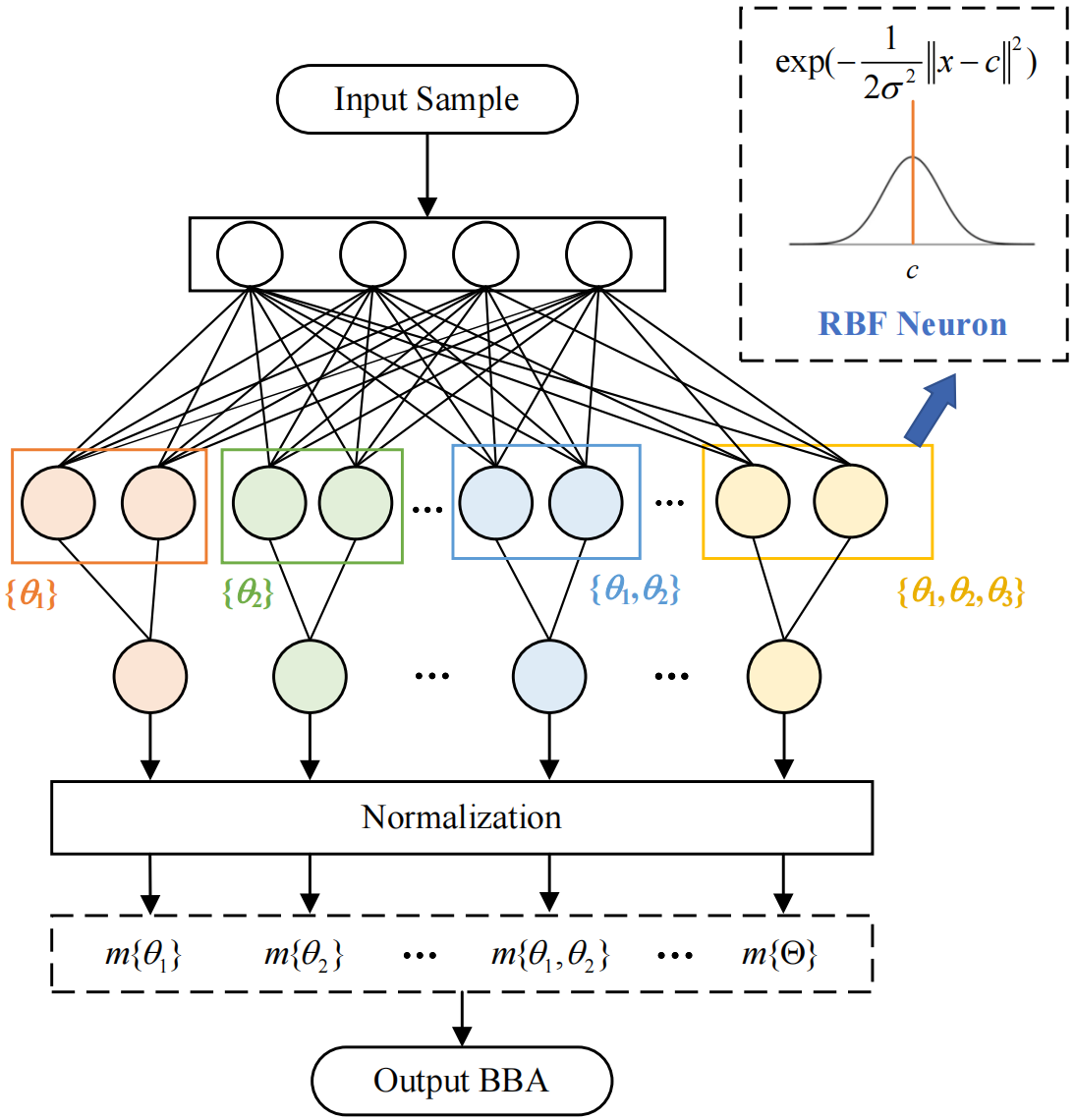
In Dempster-Shafer evidence theory (DST), the determination of basic belief assignment (BBA) is an important yet challenging issue before the evidence fusion. The rational mass determination of compound focal elements is crucial for fully taking advantage of DST, i.e., the ability to represent the ambiguity. In this paper, for the compound focal elements, we select and construct the compound-class samples with ambiguous class membership. Then, we use these samples to construct an end-to-end model called Evidential Radial Basis Function Network (E-RBFN), with the input as the sample and the output as the corresponding BBA. The E-RBFN can directly determine the mass values for all focal elements (including the singleton and compound ones).Experimental results of evidence decision-based pattern classification on multiple UCI and image datasets show that our proposed method is rational and effective.
Graphical Abstract
Keywords
Data Availability Statement
Funding
Conflicts of Interest
Ethical Approval and Consent to Participate
References
- Dempster, A.P. (1967) Upper and Lower Probabilities Induced by a Multivalued Mapping. The Annals of Mathematical Statistics, 38, 325-339.
[Google Scholar] - Shafer, G. (1976). A Mathematical Theory of Evidence. Princeton University Press.
[Google Scholar] - Richter, S., Bieder, F., Wirges, S., Kinzig, C., & Stiller, C. (2022, July). Sensor data fusion in top-view grid maps using evidential reasoning with advanced conflict resolution. In 2022 25th International Conference on Information Fusion (FUSION) (pp. 1-7). IEEE.
[CrossRef] [Google Scholar] - Sharma, M., & Maity, T. (2022, November). Fault-tolerant multi-sensor data fusion system for underground mine gas hazard prediction using Dempster Shafer Evidence Theory. In 2022 IEEE 6th Conference on Information and Communication Technology (CICT) (pp. 1-5). IEEE.
[CrossRef] [Google Scholar] - Jin, J., Qu, T., Xu, R., Wang, X., & Cichocki, A. (2022). Motor imagery EEG classification based on Riemannian sparse optimization and dempster-shafer fusion of multi-time-frequency patterns. IEEE Transactions on Neural Systems and Rehabilitation Engineering, 31, 58-67.
[CrossRef] [Google Scholar] - Zhao, J., Shi, Y., Liu, W., Zhou, T., Li, Z., & Li, X. (2023). A hybrid method fusing frequency recognition with attention detection to enhance an asynchronous brain-computer interface. IEEE Transactions on Neural Systems and Rehabilitation Engineering, 31, 2391-2398.
[CrossRef] [Google Scholar] - Sun, L., & Wang, Y. (2018). A multi-attribute fusion approach extending Dempster–Shafer theory for combinatorial-type evidences. Expert Systems with Applications, 96, 218-229.
[CrossRef] [Google Scholar] - Xiao, F., Wen, J., & Pedrycz, W. (2022). Generalized divergence-based decision making method with an application to pattern classification. IEEE transactions on knowledge and data engineering, 35(7), 6941-6956.
[CrossRef] [Google Scholar] - Han, D., Yang, Y., & Han, C. (2014). Advances in DS evidence theory and related discussions. Control and Decision, 29(1), 1-11.
[Google Scholar] - Selzer, F., & Gutfinger, D. (1989, January). LADAR and FLIR based sensor fusion for automatic target classification. In Sensor fusion: Spatial reasoning and scene interpretation (Vol. 1003, pp. 236-246). SPIE.
[CrossRef] [Google Scholar] - Bi, Y., Bell, D., & Guan, J. (2004). Combining evidence from classifiers in text categorization. In Knowledge-Based Intelligent Information and Engineering Systems: 8th International Conference, KES 2004, Wellington, New Zealand, September 20-25, 2004, Proceedings, Part III 8 (pp. 521-528). Springer Berlin Heidelberg.
[Google Scholar] - Zhang, Z., Han, D., & Yang, Y. (2015, October). Image segmentation based on evidential Markov random field model. In 2015 International Conference on Control, Automation and Information Sciences (ICCAIS) (pp. 239-244). IEEE.
[CrossRef] [Google Scholar] - Dezert, J., Liu, Z. G., & Mercier, G. (2011, July). Edge detection in color images based on DSmT. In 14th International Conference on Information Fusion (pp. 1-8). IEEE.
[Google Scholar] - Jiang, W., Duanmu, D., Fan, X., & Deng, Y. (2012, May). A new method to determine basic probability assignment under fuzzy environment. In 2012 International Conference on Systems and Informatics (ICSAI2012) (pp. 758-762). IEEE.
[CrossRef] [Google Scholar] - Han, D., Han, C., & Deng, Y. (2013). Novel approaches for the transformation of fuzzy membership function into basic probability assignment based on uncertainty optimization. International Journal of Uncertainty, Fuzziness and Knowledge-Based Systems, 21(02), 289-322.
[CrossRef] [Google Scholar] - Kang, B. Y., Li, Y. A., Deng, Y., Zhang, Y. J., & Deng, X. Y. (2012). Determination of basic probability assignment based on interval numbers and its application. Dianzi Xuebao(Acta Electronica Sinica), 40(6), 1092-1096.
[Google Scholar] - Zhang, S., Han, D., & Yang, Y. (2020). Active learning based on belief functions. SCIENCE CHINA-INFORMATION SCIENCES, 63(11).
[Google Scholar] - Smets, P., & Kennes, R. (1994). The transferable belief model. Artificial intelligence, 66(2), 191-234.
[CrossRef] [Google Scholar] - Kanungo, T., Mount, D. M., Netanyahu, N. S., Piatko, C. D., Silverman, R., & Wu, A. Y. (2002). An efficient k-means clustering algorithm: Analysis and implementation. IEEE transactions on pattern analysis and machine intelligence, 24(7), 881-892.
[CrossRef] [Google Scholar] - Zhu, Q., Cai, Y., & Liu, L. (1999). A global learning algorithm for a RBF network. Neural Networks, 12(3), 527-540.
[CrossRef] [Google Scholar] - Asuncion, A., & Newman, D. (2007, November). UCI machine learning repository. Retrieved from https://archive.ics.uci.edu/ml
[Google Scholar] - Kaggle. (n.d.). Kaggle: Your machine learning and data science community. Retrieved from https://www.kaggle.com
[Google Scholar] - He, K., Zhang, X., Ren, S., & Sun, J. (2016). Deep residual learning for image recognition. In Proceedings of the IEEE conference on computer vision and pattern recognition (pp. 770-778).
[Google Scholar]
Cited By (6)
-
Qianli Zhou, Mingxi Yin, Xinyang Deng, Wen Jiang. .
Belief Functions: Theory and Applications, 2027 , 17186 .
[CrossRef] -
Wei Li, Deqiang Han, Jean Dezert, Yi Yang. Basic belief assignment determination based on contrastive learning for pattern classification.
Information Fusion, 2026 , 136 .
[CrossRef] -
Abd El-Hay A. Farrag, Nourham M. Sayed, Amnah Aldohan, Ahmed Gad, Youssef M. Youssef, Hanaa A. Megahed. Advancing sustainable groundwater mapping and management in arid quaternary aquifers using machine learning and geospatial analytics integrating remote sensing and field hydrogeological data.
Environmental Earth Sciences, 2026 , 85 (14).
[CrossRef] -
Xinghua Zhou, Luyuan Chen, Enze Mao, Yutong He. ODE-BPA: A Novel Basic Probability Assignment Generation Method Based on OTSU and Deng Entropy.
Entropy, 2026 , 28 (6).
[CrossRef] -
Luyuan Chen, Xinghua Zhou, Peidong Gao, Zhan Deng, Yu Yang, Yin Wu, Pierpaolo D’Urso. DDHRPS: A Data-Driven Hierarchical Method for Constructing Random Permutation Set From the Perspective of Layer-2 Belief Structure.
IEEE Transactions on Fuzzy Systems, 2026 , 34 (4).
[CrossRef] -
Qianli Zhou, Li Zhu, Yong Deng. Measure-based uncertainty with Dempster-Shafer structure.
Science China Information Sciences, 2025 , 68 (10).
[CrossRef]
Cite This Article
TY  - JOUR
AU  - Li, Wei
AU  - Han, Deqiang
AU  - Dezert, Jean
AU  - Yang, Yi
PY  - 2024
DA  - 2024/12/07
TI  - Basic Belief Assignment Determination Based on Radial Basis Function Network
JO  - Chinese Journal of Information Fusion
T2  - Chinese Journal of Information Fusion
JF  - Chinese Journal of Information Fusion
VL  - 1
IS  - 3
SP  - 175
EP  - 182
DO  - 10.62762/CJIF.2024.841250
UR  - https://www.icck.org/article/abs/CJIF.2024.841250
KW  - Dempster-Shafer evidence theory
KW  - evidence fusion
KW  - basic belief assignment
KW  - uncertainty modeling
KW  - radial basis function network
KW  - pattern classification
AB  - In Dempster-Shafer evidence theory (DST), the determination of basic belief assignment (BBA) is an important yet challenging issue before the evidence fusion. The rational mass determination of compound focal elements is crucial for fully taking advantage of DST, i.e., the ability to represent the ambiguity. In this paper, for the compound focal elements, we select and construct the compound-class samples with ambiguous class membership. Then, we use these samples to construct an end-to-end model called Evidential Radial Basis Function Network (E-RBFN), with the input as the sample and the output as the corresponding BBA. The E-RBFN can directly determine the mass values for all focal elements (including the singleton and compound ones).Experimental results of evidence decision-based pattern classification on multiple UCI and image datasets show that our proposed method is rational and effective.
SN  - 2998-3371
PB  - Institute of Central Computation and Knowledge
LA  - English
ER  -
@article{Li2024Basic,
  author = {Wei Li and Deqiang Han and Jean Dezert and Yi Yang},
  title = {Basic Belief Assignment Determination Based on Radial Basis Function Network},
  journal = {Chinese Journal of Information Fusion},
  year = {2024},
  volume = {1},
  number = {3},
  pages = {175-182},
  doi = {10.62762/CJIF.2024.841250},
  url = {https://www.icck.org/article/abs/CJIF.2024.841250},
  abstract = {In Dempster-Shafer evidence theory (DST), the determination of basic belief assignment (BBA) is an important yet challenging issue before the evidence fusion. The rational mass determination of compound focal elements is crucial for fully taking advantage of DST, i.e., the ability to represent the ambiguity. In this paper, for the compound focal elements, we select and construct the compound-class samples with ambiguous class membership. Then, we use these samples to construct an end-to-end model called Evidential Radial Basis Function Network (E-RBFN), with the input as the sample and the output as the corresponding BBA. The E-RBFN can directly determine the mass values for all focal elements (including the singleton and compound ones).Experimental results of evidence decision-based pattern classification on multiple UCI and image datasets show that our proposed method is rational and effective.},
  keywords = {Dempster-Shafer evidence theory, evidence fusion, basic belief assignment, uncertainty modeling, radial basis function network, pattern classification},
  issn = {2998-3371},
  publisher = {Institute of Central Computation and Knowledge}
}
Publisher's Note
ICCK stays neutral with regard to jurisdictional claims in published maps and institutional affiliations.
Rights and Permissions
 Copyright © 2024 by the Author(s). Published by Institute of Central Computation and Knowledge. This article is an open access article distributed under the terms and conditions of the Creative Commons Attribution (CC BY) license (https://creativecommons.org/licenses/by/4.0/), which permits use, sharing, adaptation, distribution and reproduction in any medium or format, as long as you give appropriate credit to the original author(s) and the source, provide a link to the Creative Commons licence, and indicate if changes were made.


Portico