GPS Tracking Based on Stacked-Serial LSTM Network








Article Information
Abstract
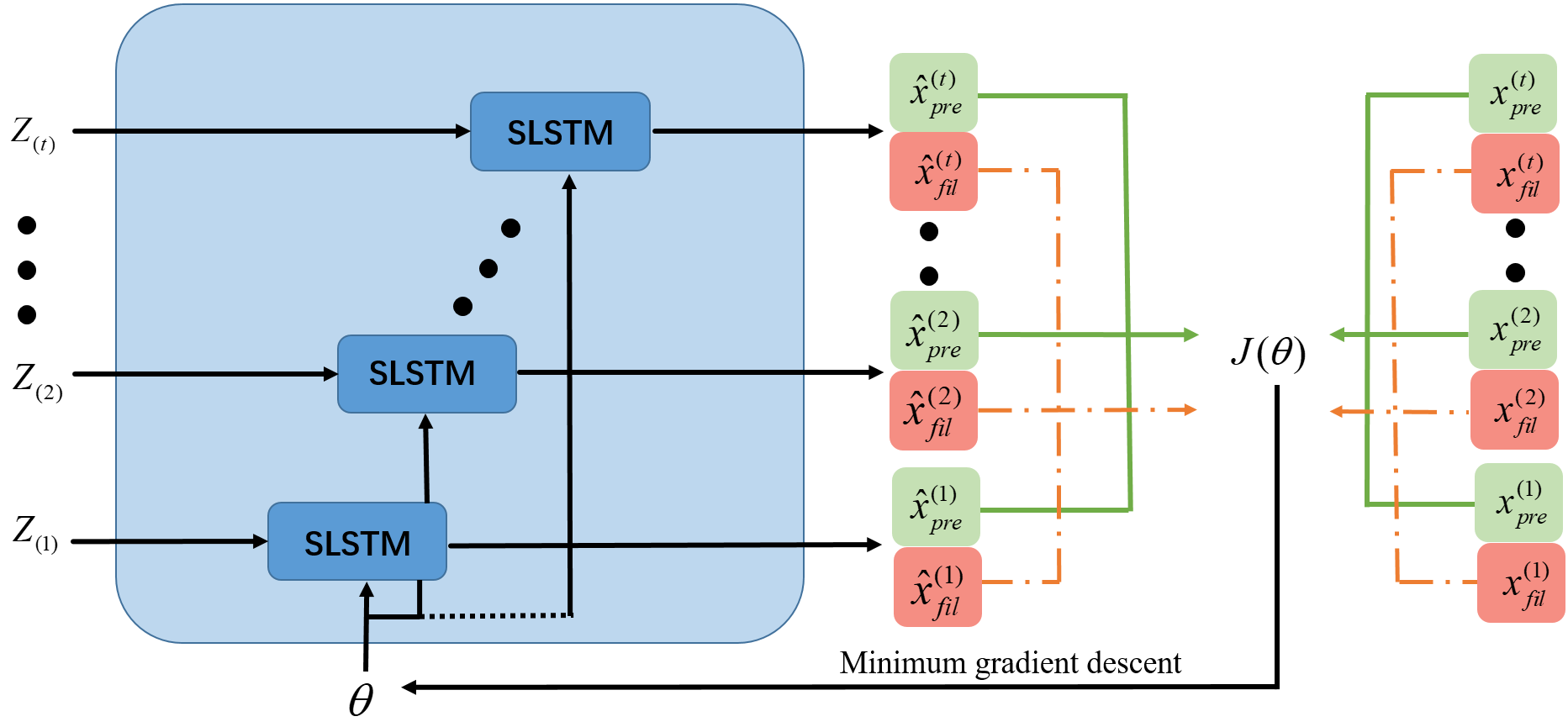
Maneuvering target tracking, as a core task in multi-sensor information fusion, is widely used in unmanned vehicles, missile navigation, and underwater ship localization, where real-time and robust state estimation is critical. Due to the uncertainty of the moving characteristics of maneuvering targets and the low sensor measurement accuracy, trajectory tracking has always been an open research problem and challenging work. This paper proposes a Bayesian-inspired stacked LSTM fusion network (SLSTM) for uncertain motion characteristics. The network consists of two LSTM fusion networks with stacked serial relationships, one of which is used to predict the movement dynamics, and the other is used to update the track's state. Compared with the classical Kalman filter based on the maneuver model, the method proposed here does not need to model the motion characteristics and sensor characteristics. It can achieve high-performance tracking by learning historical data dynamics and sensor characteristics. Experimental results show that this method can effectively improve the trajectory estimation performance when the target motion is unknown and uncertain.
Graphical Abstract
Keywords
Data Availability Statement
Funding
Conflicts of Interest
Ethical Approval and Consent to Participate
References
- Mathiassen, K., Hanssen, L., & Hallingstad, O. (2010, September). A low cost navigation unit for positioning of personnel after loss of GPS position. In 2010 international conference on indoor positioning and indoor navigation (pp. 1-10). IEEE.
[CrossRef] [Google Scholar] - Bar-Shalom, Y., Li, X. R., & Kirubarajan, T. (2004). Estimation with applications to tracking and navigation: theory algorithms and software. John Wiley & Sons.
[Google Scholar] - Julier, S. J., & Uhlmann, J. K. (1997, July). New extension of the Kalman filter to nonlinear systems. In Signal processing, sensor fusion, and target recognition VI (Vol. 3068, pp. 182-193). Spie.
[CrossRef] [Google Scholar] - Julier, S., Uhlmann, J., & Durrant-Whyte, H. F. (2000). A new method for the nonlinear transformation of means and covariances in filters and estimators. IEEE Transactions on automatic control, 45(3), 477-482.
[CrossRef] [Google Scholar] - Julier, S. J., & Uhlmann, J. K. (2004). Unscented filtering and nonlinear estimation. Proceedings of the IEEE, 92(3), 401-422.
[CrossRef] [Google Scholar] - Arasaratnam, I., & Haykin, S. (2009). Cubature kalman filters. IEEE Transactions on automatic control, 54(6), 1254-1269.
[CrossRef] [Google Scholar] - Li, P., Yu, J., Wan, M., Huang, J., & Huang, J. (2009, September). The augmented form of cubature Kalman filter and quadrature Kalman filter for additive noise. In 2009 IEEE Youth Conference on Information, Computing and Telecommunication (pp. 295-298). IEEE.
[CrossRef] [Google Scholar] - Chen, Y., Xie, X., Yu, B., Li, Y., & Lin, K. (2021). Multitarget vehicle tracking and motion state estimation using a novel driving environment perception system of intelligent vehicles. Journal of advanced transportation, 2021(1), 6251399.
[CrossRef] [Google Scholar] - Eltoukhy, M., Ahmad, M. O., & Swamy, M. N. S. (2020). An adaptive turn rate estimation for tracking a maneuvering target. IEEE Access, 8, 94176-94189.
[CrossRef] [Google Scholar] - Wang, L., & Zhou, G. (2021). Pseudo-spectrum based track-before-detect for weak maneuvering targets in range-Doppler plane. IEEE Transactions on Vehicular Technology, 70(4), 3043-3058.
[CrossRef] [Google Scholar] - Jia, S., Zhang, Y., & Wang, G. (2017). Highly maneuvering target tracking using multi-parameter fusion Singer model. Journal of Systems Engineering and Electronics, 28(5), 841-850.
[CrossRef] [Google Scholar] - Zhenkai, X., Fanying, L., & Lei, Z. (2018). Study on Maneuvering Target On-axis Tracking Algorithm of Modified Current Statistical Model. In MATEC Web of Conferences (Vol. 160, p. 02008). EDP Sciences.
[CrossRef] [Google Scholar] - Bar-Shalom, Y., & Blair, W. D. (1992). Multitarget-multisensor tracking: applications and advances. chapter 2.
[Google Scholar] - Lin, H. J., & Atherton, D. P. (1993, May). Investigation of IMM tracking algorithm for the maneuvering target tracking. In Proceedings. The First IEEE Regional Conference on Aerospace Control Systems, (pp. 113-117). IEEE.
[CrossRef] [Google Scholar] - Hochreiter, S., & Schmidhuber, J. (1997). Long short-term memory. Neural computation, 9(8), 1735-1780.
[CrossRef] [Google Scholar] - Chen, C., Zhao, P., Lu, C. X., Wang, W., Markham, A., & Trigoni, N. (2020). Deep-learning-based pedestrian inertial navigation: Methods, data set, and on-device inference. IEEE Internet of Things Journal, 7(5), 4431-4441.
[CrossRef] [Google Scholar] - Wang, B., Chen, C., Lu, C. X., Zhao, P., Trigoni, N., & Markham, A. (2020, April). Atloc: Attention guided camera localization. In Proceedings of the AAAI Conference on Artificial Intelligence (Vol. 34, No. 06, pp. 10393-10401).
[CrossRef] [Google Scholar] - Wang, S., Clark, R., Wen, H., & Trigoni, N. (2017, May). Deepvo: Towards end-to-end visual odometry with deep recurrent convolutional neural networks. In 2017 IEEE international conference on robotics and automation (ICRA) (pp. 2043-2050). IEEE.
[CrossRef] [Google Scholar] - Yang, Z., Tang, R., Bao, J., Lu, J., & Zhang, Z. (2020). A real-time trajectory prediction method of small-scale quadrotors based on GPS data and neural network. Sensors, 20(24), 7061.
[CrossRef] [Google Scholar] - Quan, Y., Lau, L., Roberts, G. W., Meng, X., & Zhang, C. (2018). Convolutional neural network based multipath detection method for static and kinematic GPS high precision positioning. Remote Sensing, 10(12), 2052.
[CrossRef] [Google Scholar] - Markos, C., James, J. Q., & Da Xu, R. Y. (2021, May). Capturing uncertainty in unsupervised GPS trajectory segmentation using Bayesian deep learning. In Proceedings of the AAAI Conference on Artificial Intelligence (Vol. 35, No. 1, pp. 390-398).
[CrossRef] [Google Scholar] - Nagui, N., Attallah, O., Zaghloul, M. S., & Morsi, I. (2021). Improved GPS/IMU loosely coupled integration scheme using two kalman filter-based cascaded stages. Arabian Journal for Science and Engineering, 46, 1345-1367.
[CrossRef] [Google Scholar] - Sun, Y., Xie, J., Guo, J., Wang, H., & Zhao, Y. (2014, December). A modified marginalized Kalman filter for maneuvering target tracking. In Proceedings of 2nd International Conference on Information Technology and Electronic Commerce (pp. 107-111). IEEE.
[CrossRef] [Google Scholar] - Huang, Y., Zhang, Y., Shi, P., & Chambers, J. (2020). Variational adaptive Kalman filter with Gaussian-inverse-Wishart mixture distribution. IEEE Transactions on Automatic Control, 66(4), 1786-1793.
[CrossRef] [Google Scholar] - Chang, Y., Wang, Y., Shen, Y., & Ji, C. (2021). A new fuzzy strong tracking cubature Kalman filter for INS/GNSS. GPS Solutions, 25(3), 120. https://link.springer.com/article/10.1007/s10291-021-01148-5
[Google Scholar] - Xiong, S. S., & Zhou, Z. Y. (2003). Neural filtering of colored noise based on Kalman filter structure. IEEE Transactions on Instrumentation and Measurement, 52(3), 742-747.
[CrossRef] [Google Scholar] - Morales, E. F., Murrieta-Cid, R., Becerra, I., & Esquivel-Basaldua, M. A. (2021). A survey on deep learning and deep reinforcement learning in robotics with a tutorial on deep reinforcement learning. Intelligent Service Robotics, 14(5), 773-805.
[CrossRef] [Google Scholar] - Yeo, K., & Melnyk, I. (2019). Deep learning algorithm for data-driven simulation of noisy dynamical system. Journal of Computational Physics, 376, 1212-1231.
[CrossRef] [Google Scholar] - Liu, J., Wang, Z., & Xu, M. (2020). DeepMTT: A deep learning maneuvering target-tracking algorithm based on bidirectional LSTM network. Information Fusion, 53, 289-304.
[CrossRef] [Google Scholar] - Zhang, J., Wu, Y., & Jiao, S. (2021, November). Research on trajectory tracking algorithm based on LSTM-UKF. In 2021 7th IEEE International Conference on Network Intelligence and Digital Content (IC-NIDC) (pp. 61-65). IEEE.
[CrossRef] [Google Scholar] - Li, S., Hu, C., Wang, R., Zhou, C., & Yang, J. (2019, December). A maneuvering tracking method based on LSTM and CS model. In 2019 IEEE International Conference on Signal, Information and Data Processing (ICSIDP) (pp. 1-4). IEEE.
[CrossRef] [Google Scholar] - Yaqi, C., You, H. E., Tiantian, T. A. N. G., & Yu, L. I. U. (2022). A new target tracking filter based on deep learning. Chinese Journal of Aeronautics, 35(5), 11-24.
[CrossRef] [Google Scholar] - Vedula, K., Weiss, M. L., Paffenroth, R. C., Uzarski, J. R., & Brown, D. R. (2020, November). Maneuvering target tracking using the autoencoder-interacting multiple model filter. In 2020 54th Asilomar Conference on Signals, Systems, and Computers (pp. 1512-1517). IEEE.
[CrossRef] [Google Scholar] - Giuliari, F., Hasan, I., Cristani, M., & Galasso, F. (2021, January). Transformer networks for trajectory forecasting. In 2020 25th international conference on pattern recognition (ICPR) (pp. 10335-10342). IEEE.
[CrossRef] [Google Scholar] - Hui, B., Yan, D., Chen, H., & Ku, W. S. (2021, August). Trajnet: A trajectory-based deep learning model for traffic prediction. In Proceedings of the 27th ACM SIGKDD Conference on Knowledge Discovery & Data Mining (pp. 716-724).
[CrossRef] [Google Scholar] - James, J. Q. (2020). Travel mode identification with GPS trajectories using wavelet transform and deep learning. IEEE Transactions on Intelligent Transportation Systems, 22(2), 1093-1103.
[CrossRef] [Google Scholar] - Liu, J., & Guo, G. (2021). Vehicle localization during GPS outages with extended Kalman filter and deep learning. IEEE Transactions on Instrumentation and Measurement, 70, 1-10.
[CrossRef] [Google Scholar] - Moradi, N., Nezhadshahbodaghi, M., & Mosavi, M. R. (2023). GPS signal acquisition based on deep convolutional neural network and post-correlation methods. GPS Solutions, 27(3), 132.
[CrossRef] [Google Scholar] - Taghizadeh, S., & Safabakhsh, R. (2023). An integrated INS/GNSS system with an attention-based hierarchical LSTM during GNSS outage. GPS Solutions, 27(2), 71.
[CrossRef] [Google Scholar] - He, S., Liu, J., Zhu, X., Dai, Z., & Li, D. (2023). Research on modeling and predicting of BDS-3 satellite clock bias using the LSTM neural network model. GPS Solutions, 27(3), 108.
[CrossRef] [Google Scholar] - Orouji, N., & Mosavi, M. R. (2021). A multi-layer perceptron neural network to mitigate the interference of time synchronization attacks in stationary GPS receivers. GPS solutions, 25, 1-15.
[CrossRef] [Google Scholar] - Venkataraman, V., Fan, G., Havlicek, J. P., Fan, X., Zhai, Y., & Yeary, M. B. (2012). Adaptive kalman filtering for histogram-based appearance learning in infrared imagery. IEEE transactions on image processing, 21(11), 4622-4635.
[CrossRef] [Google Scholar]
Cited By (6)
-
Marzieh Jafari. A spatiotemporal deep learning framework for GNSS displacement forecasting integrating neighboring-station coordinates and meteorological data.
GPS Solutions, 2026 , 30 (3).
[CrossRef] -
K. Yazhini, B. Umarani. Enhanced Intrusion Detection Using PSO Feature Selection with LSTM Gated RNN Based on Inactive Packet Bit Classification in Active Routing Wireless Transmission.
International Journal of Software Engineering and Knowledge Engineering, 2026 , 36 (10).
[CrossRef] -
Yan Li, Lei Feng, Chengpei Tang. A Vehicle Path Planning and Prediction Algorithm Based on Attention Mechanism for Complex Traffic Intersection Collaboration in Intelligent Transportation.
IEEE Transactions on Intelligent Transportation Systems, 2025 , 26 (10).
[CrossRef] -
Mingchao Yan, Yonghua Xiong, Hiroaki Kurokawa, Jinhua She. Multimodal Localization Distillation Method for 3D Single Object Tracking Task in Intelligent Transportation Systems.
IEEE Transactions on Intelligent Transportation Systems, 2025 , 26 (10).
[CrossRef] -
Sujin Cai, Wei Tian, Taizhi Lv, Xiangchen Wang, Xin Li. Safeguarding Privacy in Real-Time Trajectory Releases for AI-Driven Consumer Applications.
IEEE Transactions on Consumer Electronics, 2025 , 71 (2).
[CrossRef] -
Kaiyin Zhu, Mingming Lu, Haifeng Li, Neal N. Xiong, Wenyong He. CMBA-FL: Communication-mitigated and blockchain-assisted federated learning for traffic flow predictions.
Digital Communications and Networks, 2025 , 11 (3).
[CrossRef]
Cite This Article
TY  - JOUR
AU  - Jin, Xuebo
AU  - Liu, Songzheng
AU  - Kong, Jianlei
AU  - Bai, Yuting
AU  - Su, Tingli
AU  - Ma, Huijun
PY  - 2024
DA  - 2024/06/08
TI  - GPS Tracking Based on Stacked-Serial LSTM Network
JO  - Chinese Journal of Information Fusion
T2  - Chinese Journal of Information Fusion
JF  - Chinese Journal of Information Fusion
VL  - 1
IS  - 1
SP  - 50
EP  - 62
DO  - 10.62762/CJIF.2024.361889
UR  - https://www.icck.org/article/abs/CJIF.2024.361889
KW  - trajectory estimation
KW  - recurrent neural network
KW  - GPS
KW  - filtering algorithm
KW  - LSTM fusion networks
KW  - stacked serial structure
AB  - Maneuvering target tracking, as a core task in multi-sensor information fusion, is widely used in unmanned vehicles, missile navigation, and underwater ship localization, where real-time and robust state estimation is critical. Due to the uncertainty of the moving characteristics of maneuvering targets and the low sensor measurement accuracy, trajectory tracking has always been an open research problem and challenging work. This paper proposes a Bayesian-inspired stacked LSTM fusion network (SLSTM) for uncertain motion characteristics. The network consists of two LSTM fusion networks with stacked serial relationships, one of which is used to predict the movement dynamics, and the other is used to update the track's state. Compared with the classical Kalman filter based on the maneuver model, the method proposed here does not need to model the motion characteristics and sensor characteristics. It can achieve high-performance tracking by learning historical data dynamics and sensor characteristics. Experimental results show that this method can effectively improve the trajectory estimation performance when the target motion is unknown and uncertain.
SN  - 2998-3371
PB  - Institute of Central Computation and Knowledge
LA  - English
ER  -
@article{Jin2024GPS,
  author = {Xuebo Jin and Songzheng Liu and Jianlei Kong and Yuting Bai and Tingli Su and Huijun Ma},
  title = {GPS Tracking Based on Stacked-Serial LSTM Network},
  journal = {Chinese Journal of Information Fusion},
  year = {2024},
  volume = {1},
  number = {1},
  pages = {50-62},
  doi = {10.62762/CJIF.2024.361889},
  url = {https://www.icck.org/article/abs/CJIF.2024.361889},
  abstract = {Maneuvering target tracking, as a core task in multi-sensor information fusion, is widely used in unmanned vehicles, missile navigation, and underwater ship localization, where real-time and robust state estimation is critical. Due to the uncertainty of the moving characteristics of maneuvering targets and the low sensor measurement accuracy, trajectory tracking has always been an open research problem and challenging work. This paper proposes a Bayesian-inspired stacked LSTM fusion network (SLSTM) for uncertain motion characteristics. The network consists of two LSTM fusion networks with stacked serial relationships, one of which is used to predict the movement dynamics, and the other is used to update the track's state. Compared with the classical Kalman filter based on the maneuver model, the method proposed here does not need to model the motion characteristics and sensor characteristics. It can achieve high-performance tracking by learning historical data dynamics and sensor characteristics. Experimental results show that this method can effectively improve the trajectory estimation performance when the target motion is unknown and uncertain.},
  keywords = {trajectory estimation, recurrent neural network, GPS, filtering algorithm, LSTM fusion networks, stacked serial structure},
  issn = {2998-3371},
  publisher = {Institute of Central Computation and Knowledge}
}
Publisher's Note
ICCK stays neutral with regard to jurisdictional claims in published maps and institutional affiliations.
Rights and Permissions
 Copyright © 2024 by the Author(s). Published by Institute of Central Computation and Knowledge. This article is an open access article distributed under the terms and conditions of the Creative Commons Attribution (CC BY) license (https://creativecommons.org/licenses/by/4.0/), which permits use, sharing, adaptation, distribution and reproduction in any medium or format, as long as you give appropriate credit to the original author(s) and the source, provide a link to the Creative Commons licence, and indicate if changes were made.


Portico