by
,
,
,
,
,
,


ICCK Journal of Software Engineering | Volume 2, Issue 2: 85-101, 2026 | DOI: 10.62762/JSE.2026.195385
Abstract
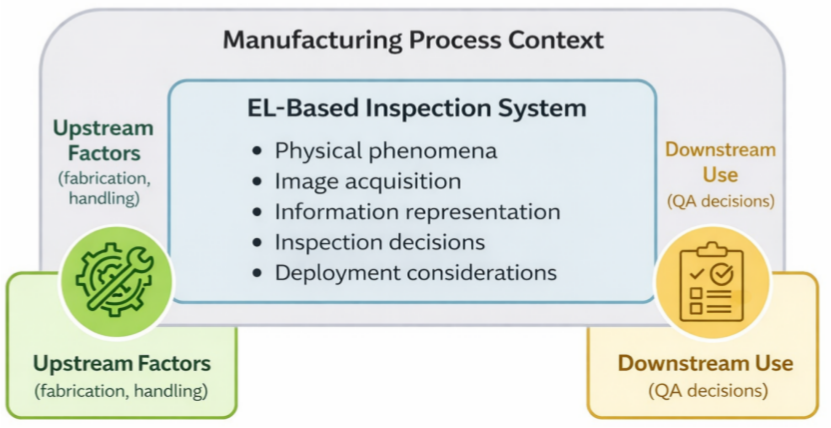
Electroluminescence imaging is widely used for detecting defects in solar cells. It reveals electrically active damage that remains invisible under conventional optical inspection. Most existing studies apply machine learning models to classify electroluminescence images and report performance mainly through accuracy scores. Inspection is often treated as an isolated prediction task, while physical defect mechanisms, sensing variability, representation bias, decision risk, and deployment constraints receive limited attention. As a result, strong benchmark results may not translate into reliable inspection outcomes in manufacturing environments. This paper presents a conceptual, non-systemati... More >
Graphical Abstract