ICCK

Aiza Mukhtar

Department of Computer Science, COMSATS University Islamabad, Sahiwal Campus, Sahiwal 57000, Pakistan

Section 01

Academic Profile

No academic profile information available at the moment.

Section 02

Editorial Roles

This user currently does not serve as an editor for any ICCK journals.

Section 03

ICCK Publications

Open Access | Research Article | 17 August 2026
Decentralized and Explainable Brain Tumor Segmentation: A Blockchain-Secured Federated Learning Approach
ICCK Journal of Image Analysis and Processing | Volume 2, Issue 3: 168-189, 2026 | DOI: 10.62762/JIAP.2026.354772
Abstract
Brain tumor segmentation plays an important role in clinical diagnosis, treatment planning, and neuro-oncology assessment using multimodal Magnetic Resonance Imaging (MRI) data. However, conventional centralized deep learning systems often face limitations associated with patient data privacy, secure inter-institutional collaboration, and limited model interpretability. This study presents a decentralized and privacy-preserving brain tumor segmentation framework that integrates Federated Learning (FL), a blockchain-inspired audit and coordination mechanism, and Explainable Artificial Intelligence (XAI) within a collaborative medical imaging environment. A 3D U-Net architecture was trained on... More >

Graphical Abstract
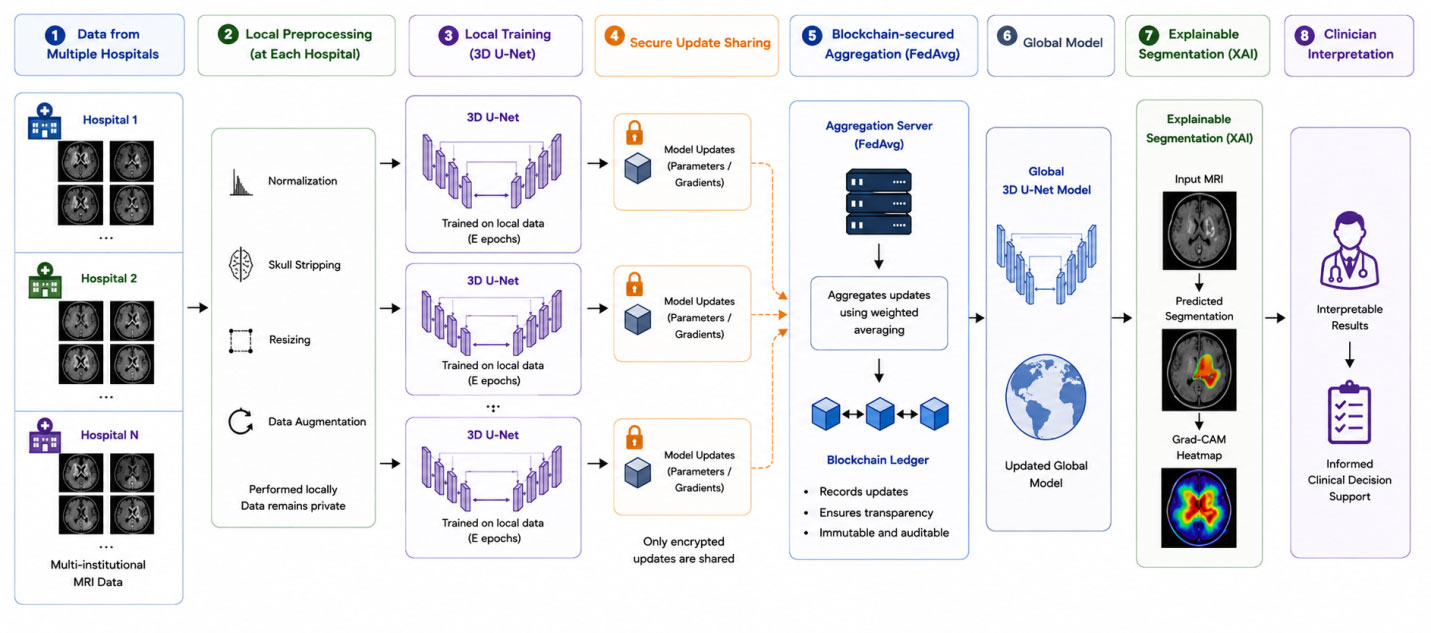
Decentralized and Explainable Brain Tumor Segmentation: A Blockchain-Secured Federated Learning Approach
Open Access | Review Article | 22 April 2026
Electroluminescence Imaging–Driven Software Systems for Solar Cell Defect Detection
ICCK Journal of Software Engineering | Volume 2, Issue 2: 85-101, 2026 | DOI: 10.62762/JSE.2026.195385
Abstract
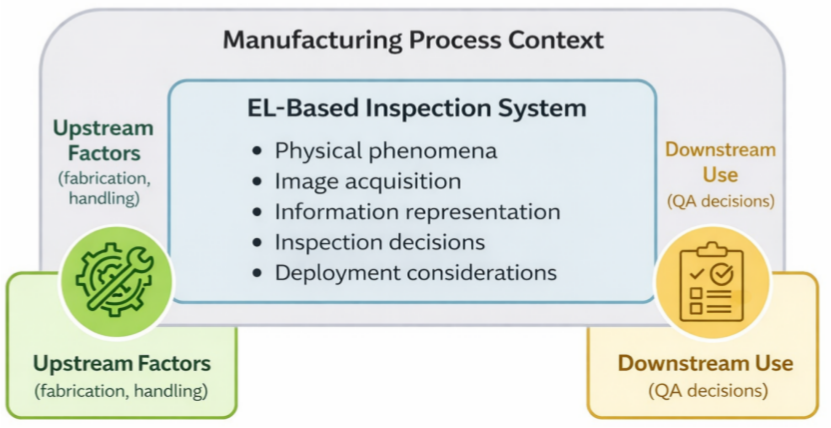
Electroluminescence imaging is widely used for detecting defects in solar cells. It reveals electrically active damage that remains invisible under conventional optical inspection. Most existing studies apply machine learning models to classify electroluminescence images and report performance mainly through accuracy scores. Inspection is often treated as an isolated prediction task, while physical defect mechanisms, sensing variability, representation bias, decision risk, and deployment constraints receive limited attention. As a result, strong benchmark results may not translate into reliable inspection outcomes in manufacturing environments. This paper presents a conceptual, non-systemati... More >

Graphical Abstract
Electroluminescence Imaging–Driven Software Systems for Solar Cell Defect Detection
Open Access | Review Article | 31 October 2025 | Cited: Crossref logo  1 , Scopus 1
A Comprehensive Review on Software Architectures for Facial Emotion Recognition Using Deep Learning Techniques
ICCK Journal of Software Engineering | Volume 1, Issue 2: 75-89, 2025 | DOI: 10.62762/JSE.2025.285106
Abstract
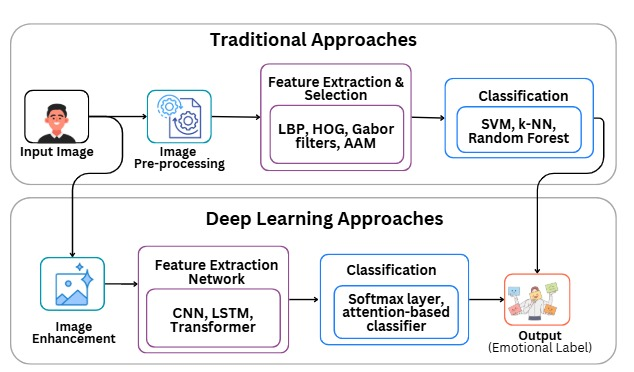
Facial Emotion Recognition (FER) software is an important part of modern software applications. It is used for intelligent user interfaces, diagnostics in psychiatry or psychology, human-computer interaction, and even in surveillance. The recent advancements in the use of deep learning, and the advanced architectures based on them, including Convolutional Neural Networks (CNNs) and transformer models have made the development of FER software much efficient and scalable. This review paper contributes to the existing literature by providing a comprehensive synthesis of Facial Emotion Recognition (FER) systems from a software engineering perspective spanning the period from 2015 to the present.... More >

Graphical Abstract
A Comprehensive Review on Software Architectures for Facial Emotion Recognition Using Deep Learning Techniques