ICCK

Azka Ahsan

Department of Computer Science, COMSATS University Islamabad, Sahiwal Campus, Sahiwal 57040, Pakistan.

Section 01

Academic Profile

No academic profile information available at the moment.

Section 02

Editorial Roles

This user currently does not serve as an editor for any ICCK journals.

Section 03

ICCK Publications

Open Access | Research Article | 17 August 2026
Decentralized and Explainable Brain Tumor Segmentation: A Blockchain-Secured Federated Learning Approach
ICCK Journal of Image Analysis and Processing | Volume 2, Issue 3: 168-189, 2026 | DOI: 10.62762/JIAP.2026.354772
Abstract
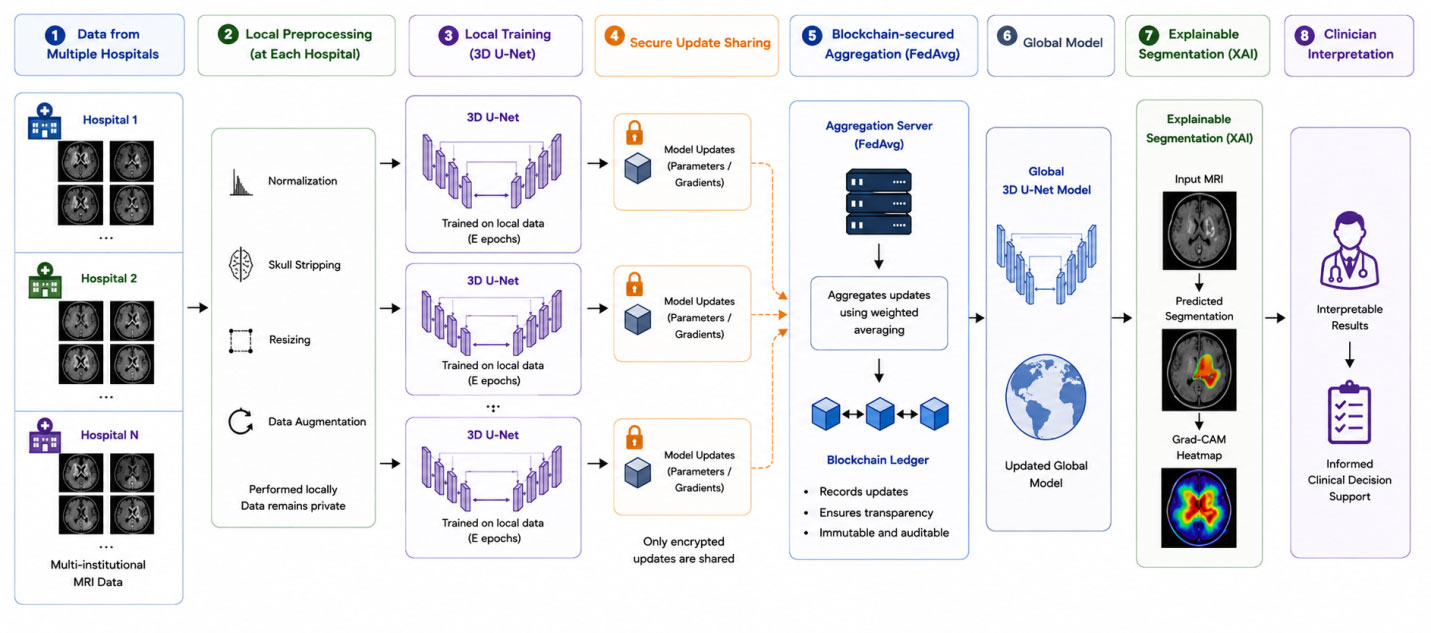
Brain tumor segmentation plays an important role in clinical diagnosis, treatment planning, and neuro-oncology assessment using multimodal Magnetic Resonance Imaging (MRI) data. However, conventional centralized deep learning systems often face limitations associated with patient data privacy, secure inter-institutional collaboration, and limited model interpretability. This study presents a decentralized and privacy-preserving brain tumor segmentation framework that integrates Federated Learning (FL), a blockchain-inspired audit and coordination mechanism, and Explainable Artificial Intelligence (XAI) within a collaborative medical imaging environment. A 3D U-Net architecture was trained on... More >

Graphical Abstract
Decentralized and Explainable Brain Tumor Segmentation: A Blockchain-Secured Federated Learning Approach
Open Access | Review Article | 11 February 2026
Software-Engineering Perspectives on Machine for Skin-Disease Classification
ICCK Journal of Software Engineering | Volume 2, Issue 1: 52-70, 2026 | DOI: 10.62762/JSE.2025.913699
Abstract
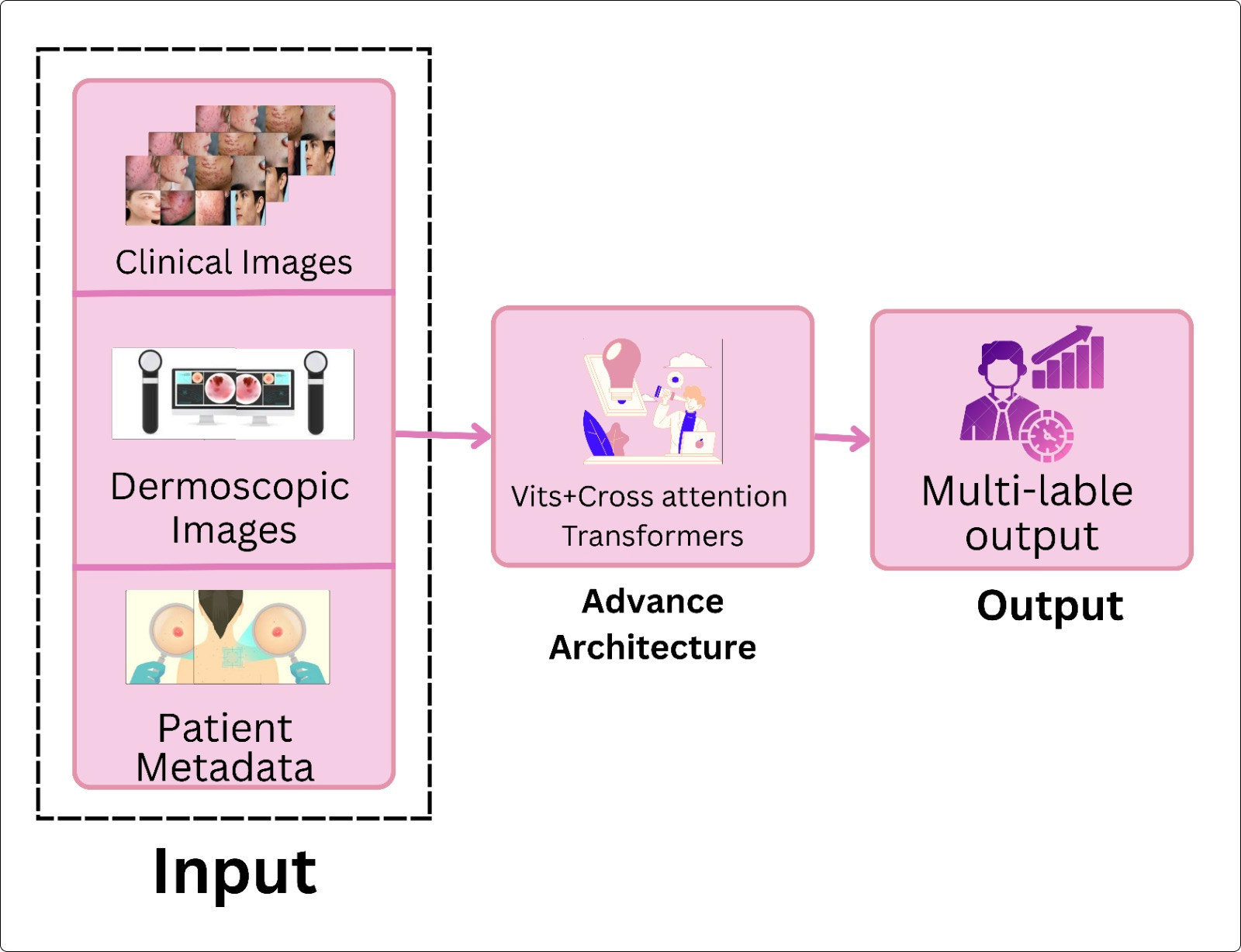
Skin‑disease classification has evolved from simple image recognizers into software‑driven pipelines that demand reliability, reproducibility, and ethical governance. While most AI reviews focus on algorithmic accuracy, few examine these systems through a software‑engineering (SE) lens—essential for assessing pipeline modularity, version control, deployment readiness, and long‑term maintainability, all critical for clinical integration. This review surveys literature from 2015 to early 2025, curating about 180 papers that link skin‑disease classification with SE practices. It traces the shift from handcrafted feature‑based classifiers to end‑to‑end convolutional, ensemble,... More >

Graphical Abstract
Software-Engineering Perspectives on Machine for Skin-Disease Classification