

Decentralized and Explainable Brain Tumor Segmentation: A Blockchain-Secured Federated Learning Approach



Article Information
Abstract
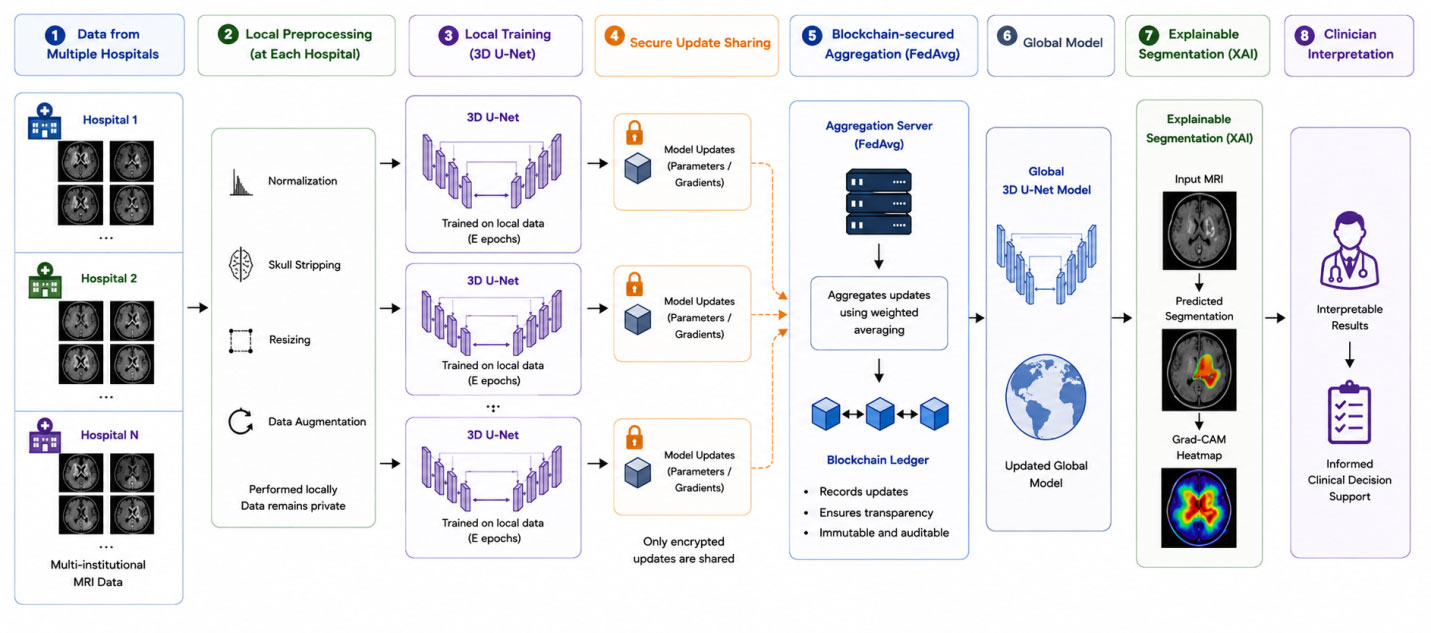
Brain tumor segmentation plays an important role in clinical diagnosis, treatment planning, and neuro-oncology assessment using multimodal Magnetic Resonance Imaging (MRI) data. However, conventional centralized deep learning systems often face limitations associated with patient data privacy, secure inter-institutional collaboration, and limited model interpretability. This study presents a decentralized and privacy-preserving brain tumor segmentation framework that integrates Federated Learning (FL), a blockchain-inspired audit and coordination mechanism, and Explainable Artificial Intelligence (XAI) within a collaborative medical imaging environment. A 3D U-Net architecture was trained on the BraTS 2020 dataset under a simulated multi-institutional federated setting using non-IID MRI data distributions. Federated Averaging (FedAvg) was employed for global model aggregation, while a blockchain-inspired permissioned ledger mechanism was used to record model update hashes and aggregation metadata for auditability across communication rounds. Grad CAM and LIME were incorporated to provide interpretable visualization of tumor related regions contributing to segmentation predictions. Experimental evaluation demonstrated stable convergence behavior with an overall voxel accuracy of 98.52%, a weighted F1 score of 98.3%, and Dice coefficient improvement from 0.752 to 0.830 during federated training. The generated segmentation outputs showed strong agreement with manually annotated tumor regions while preserving decentralized data privacy. The proposed framework contributes a secure, interpretable, and collaborative segmentation pipeline for trustworthy brain tumor analysis across distributed healthcare environments.
Graphical Abstract
Keywords
Data Availability Statement
Funding
Conflicts of Interest
AI Use Statement
Ethical Approval and Consent to Participate
References
- Kumar, K., & Jyoti, K. (2025, January 30). Enhancing transparency and trust in brain tumor diagnosis: An in-depth analysis of deep learning and explainable AI techniques.
[CrossRef] [Google Scholar] - Van der Velden, B. H., Kuijf, H. J., Gilhuijs, K. G., & Viergever, M. A. (2022). Explainable artificial intelligence (XAI) in deep learning-based medical image analysis. Medical image analysis, 79, 102470.
[CrossRef] [Google Scholar] - Dorfner, F. J., Patel, J. B., Kalpathy-Cramer, J., Gerstner, E. R., & Bridge, C. P. (2025). A review of deep learning for brain tumor analysis in MRI. NPJ Precision Oncology, 9(1), 2.
[CrossRef] [Google Scholar] - Kaissis, G. A., Makowski, M. R., Rückert, D., & Braren, R. F. (2020). Secure, privacy-preserving and federated machine learning in medical imaging. Nature machine intelligence, 2(6), 305-311.
[CrossRef] [Google Scholar] - Rieke, N., Hancox, J., Li, W., Milletari, F., Roth, H. R., Albarqouni, S., ... & Cardoso, M. J. (2020). The future of digital health with federated learning. NPJ digital medicine, 3(1), 119.
[CrossRef] [Google Scholar] - Nguyen, D. C., Ding, M., Pham, Q. V., Pathirana, P. N., Le, L. B., Seneviratne, A., ... & Poor, H. V. (2021). Federated learning meets blockchain in edge computing: Opportunities and challenges. IEEE Internet of Things Journal, 8(16), 12806-12825.
[CrossRef] [Google Scholar] - Zhu, L., Zhao, B., & Peng, R. (2026). Blockchain-enabled federated learning: A survey on system design, key challenges, and future directions. Electronics, 15(8), 1572.
[CrossRef] [Google Scholar] - de Aguiar, E. J., Traina Jr, C., & Traina, A. J. (2023). Security and privacy in machine learning for health systems: strategies and challenges. Yearbook of medical informatics, 32(01), 269-281.
[CrossRef] [Google Scholar] - Tjoa, E., & Guan, C. (2020). A survey on explainable artificial intelligence (xai): Toward medical xai. IEEE transactions on neural networks and learning systems, 32(11), 4793-4813.
[CrossRef] [Google Scholar] - Selvaraju, R. R., Cogswell, M., Das, A., Vedantam, R., Parikh, D., & Batra, D. (2017). Grad-CAM: Visual explanations from deep networks via gradient-based localization. In Proceedings of the IEEE International Conference on Computer Vision (ICCV) (pp. 618-626). IEEE.
[CrossRef] [Google Scholar] - Dhade, P., & Shirke, P. (2024). Federated learning for healthcare: a comprehensive review. Engineering Proceedings, 59(1), 230.
[CrossRef] [Google Scholar] - Kumar, R., Bernard, C. M., Ullah, A., Khan, R. U., Kumar, J., Kulevome, D. K., ... & Zeng, S. (2024). Privacy-preserving blockchain-based federated learning for brain tumor segmentation. Computers in Biology and Medicine, 177, 108646.
[CrossRef] [Google Scholar] - Yahiaoui, M. E., Derdour, M., Abdulghafor, R., Turaev, S., Gasmi, M., Bennour, A., ... & Sarem, M. A. (2024). Federated learning with privacy preserving for multi-institutional three-dimensional brain tumor segmentation. Diagnostics, 14(24), 2891.
[CrossRef] [Google Scholar] - Manthe, M., Duffner, S., & Lartizien, C. (2024). Federated brain tumor segmentation: An extensive benchmark. Medical Image Analysis, 97, 103270.
[CrossRef] [Google Scholar] - Bechar, A., Medjoudj, R., Elmir, Y., Himeur, Y., & Amira, A. (2025). Federated and transfer learning for cancer detection based on image analysis. Neural Computing and Applications, 37(4), 2239-2284.
[CrossRef] [Google Scholar] - Srinivasu, P. N., Lakshmi, G. J., Narahari, S. C., Shafi, J., Choi, J., & Ijaz, M. F. (2024). Enhancing medical image classification via federated learning and pre-trained model. Egyptian Informatics Journal, 27, 100530.
[CrossRef] [Google Scholar] - Sami, S. A., & Habib, M. A. (2024). Firefly Algorithm-Based Enhancement of MRI Images for Improved Brain Tumor Detection and Blockchain-Ensured Security. Available at SSRN 4963964.
[CrossRef] [Google Scholar] - Giri, A., Thapa, P., Banu, J. S., Poudyal, S., Rijal, B., & Karki, S. (2024). Harnessing ResUHybridNet with Federated Learning: A New Paradigm in Brain Tumour Segmentation. Revue d'Intelligence Artificielle, 38(3), 765.
[CrossRef] [Google Scholar] - Raheem, A., Yang, Z., Yu, H., Yaqub, M., Sabah, F., Ahmed, S., ... & Chuhan, I. S. (2024). IPC-CNN: A Robust Solution for Precise Brain Tumor Segmentation Using Improved Privacy-Preserving Collaborative Convolutional Neural Network. KSII Transactions on Internet & Information Systems, 18(9), 2589. http://doi.org/10.3837/tiis.2024.09.007
[Google Scholar] - Albalawi, E., TR, M., Thakur, A., Kumar, V. V., Gupta, M., Khan, S. B., & Almusharraf, A. (2024). Integrated approach of federated learning with transfer learning for classification and diagnosis of brain tumor. BMC medical imaging, 24(1), 110.
[CrossRef] [Google Scholar] - Sharma, S., Guleria, K., Dogra, A., & Agrawal, S. K. (2024). A privacy-protected federated learning with cross-silo brain tumour dataset for glioma detection. SN Computer Science, 5(8), 1144.
[CrossRef] [Google Scholar] - Patel, Y., Gupta, R., Kakkar, R., Tanwar, S., & Guizani, M. (2024, May). Blockchain and dl-based brain tumour prediction scheme for telesurgery systems in healthcare 4.0. In 2024 International Wireless Communications and Mobile Computing (IWCMC) (pp. 67-72). IEEE.
[CrossRef] [Google Scholar] - Ngoupayou Limbepe, Z., Gai, K., & Yu, J. (2025). Blockchain-based privacy-enhancing federated learning in smart healthcare: a survey. Blockchains, 3(1), 1.
[CrossRef] [Google Scholar] - Menze, B. H., Jakab, A., Bauer, S., Kalpathy-Cramer, J., Farahani, K., Kirby, J., ... & Van Leemput, K. (2014). The multimodal brain tumor image segmentation benchmark (BRATS). IEEE transactions on medical imaging, 34(10), 1993-2024.
[CrossRef] [Google Scholar] - Nyúl, L. G., Udupa, J. K., & Zhang, X. (2000). New variants of a method of MRI scale standardization. IEEE transactions on medical imaging, 19(2), 143-150.
[CrossRef] [Google Scholar] - Bhardwaj, N., Sood, M., & Gill, S. S. (2023, April). Data Pre-processing Techniques for Brain Tumor Classification. In International Conference on Women Researchers in Electronics and Computing (pp. 195-204). Singapore: Springer Nature Singapore.
[CrossRef] [Google Scholar] - Koc, A. B., & Akgun, D. (2026). A Review of U-Net Based Deep Learning Frameworks for MRI-Based Brain Tumor Segmentation. Diagnostics, 16(4), 506.
[CrossRef] [Google Scholar] - Çiçek, Ö., Abdulkadir, A., Lienkamp, S. S., Brox, T., & Ronneberger, O. (2016, October). 3D U-Net: learning dense volumetric segmentation from sparse annotation. In International conference on medical image computing and computer-assisted intervention (pp. 424-432). Cham: Springer International Publishing.
[CrossRef] [Google Scholar] - Milletari, F., Navab, N., & Ahmadi, S. A. (2016, October). V-net: Fully convolutional neural networks for volumetric medical image segmentation. In 2016 fourth international conference on 3D vision (3DV) (pp. 565-571). IEEE.
[CrossRef] [Google Scholar] - Taha, A. A., & Hanbury, A. (2015). Metrics for evaluating 3D medical image segmentation: analysis, selection, and tool. BMC medical imaging, 15(1), 29.
[CrossRef] [Google Scholar] - McMahan, B., Moore, E., Ramage, D., Hampson, S., & y Arcas, B. A. (2017). Communication-efficient learning of deep networks from decentralized data. In Proceedings of the 20th International Conference on Artificial Intelligence and Statistics (AISTATS), PMLR 54 (pp. 1273-1282).
[Google Scholar] - Ribeiro, M. T., Singh, S., & Guestrin, C. (2016). ``Why should I trust you?'': Explaining the predictions of any classifier. In Proceedings of the 22nd ACM SIGKDD International Conference on Knowledge Discovery and Data Mining (pp. 1135-1144). ACM.
[CrossRef] [Google Scholar]
Cite This Article
TY  - JOUR
AU  - Mukhtar, Aiza
AU  - Ali, Aamir
AU  - Farooq, Wajiha
AU  - Fareed, Muhammad Aqib
AU  - Sohail, Sadia
AU  - Ahsan, Azka
PY  - 2026
DA  - 2026/08/17
TI  - Decentralized and Explainable Brain Tumor Segmentation: A Blockchain-Secured Federated Learning Approach
JO  - ICCK Journal of Image Analysis and Processing
T2  - ICCK Journal of Image Analysis and Processing
JF  - ICCK Journal of Image Analysis and Processing
VL  - 2
IS  - 3
SP  - 168
EP  - 189
DO  - 10.62762/JIAP.2026.354772
UR  - https://www.icck.org/article/abs/JIAP.2026.354772
KW  - brain tumor segmentation
KW  - federated learning
KW  - blockchain-inspired audit logging
KW  - explainable AI
KW  - privacy preserving AI
KW  - medical diagnostics
AB  - Brain tumor segmentation plays an important role in clinical diagnosis, treatment planning, and neuro-oncology assessment using multimodal Magnetic Resonance Imaging (MRI) data. However, conventional centralized deep learning systems often face limitations associated with patient data privacy, secure inter-institutional collaboration, and limited model interpretability. This study presents a decentralized and privacy-preserving brain tumor segmentation framework that integrates Federated Learning (FL), a blockchain-inspired audit and coordination mechanism, and Explainable Artificial Intelligence (XAI) within a collaborative medical imaging environment. A 3D U-Net architecture was trained on the BraTS 2020 dataset under a simulated multi-institutional federated setting using non-IID MRI data distributions. Federated Averaging (FedAvg) was employed for global model aggregation, while a blockchain-inspired permissioned ledger mechanism was used to record model update hashes and aggregation metadata for auditability across communication rounds. Grad CAM and LIME were incorporated to provide interpretable visualization of tumor related regions contributing to segmentation predictions. Experimental evaluation demonstrated stable convergence behavior with an overall voxel accuracy of 98.52%, a weighted F1 score of 98.3%, and Dice coefficient improvement from 0.752 to 0.830 during federated training. The generated segmentation outputs showed strong agreement with manually annotated tumor regions while preserving decentralized data privacy. The proposed framework contributes a secure, interpretable, and collaborative segmentation pipeline for trustworthy brain tumor analysis across distributed healthcare environments.
SN  - 3068-6679
PB  - Institute of Central Computation and Knowledge
LA  - English
ER  -
@article{Mukhtar2026Decentrali,
  author = {Aiza Mukhtar and Aamir Ali and Wajiha Farooq and Muhammad Aqib Fareed and Sadia Sohail and Azka Ahsan},
  title = {Decentralized and Explainable Brain Tumor Segmentation: A Blockchain-Secured Federated Learning Approach},
  journal = {ICCK Journal of Image Analysis and Processing},
  year = {2026},
  volume = {2},
  number = {3},
  pages = {168-189},
  doi = {10.62762/JIAP.2026.354772},
  url = {https://www.icck.org/article/abs/JIAP.2026.354772},
  abstract = {Brain tumor segmentation plays an important role in clinical diagnosis, treatment planning, and neuro-oncology assessment using multimodal Magnetic Resonance Imaging (MRI) data. However, conventional centralized deep learning systems often face limitations associated with patient data privacy, secure inter-institutional collaboration, and limited model interpretability. This study presents a decentralized and privacy-preserving brain tumor segmentation framework that integrates Federated Learning (FL), a blockchain-inspired audit and coordination mechanism, and Explainable Artificial Intelligence (XAI) within a collaborative medical imaging environment. A 3D U-Net architecture was trained on the BraTS 2020 dataset under a simulated multi-institutional federated setting using non-IID MRI data distributions. Federated Averaging (FedAvg) was employed for global model aggregation, while a blockchain-inspired permissioned ledger mechanism was used to record model update hashes and aggregation metadata for auditability across communication rounds. Grad CAM and LIME were incorporated to provide interpretable visualization of tumor related regions contributing to segmentation predictions. Experimental evaluation demonstrated stable convergence behavior with an overall voxel accuracy of 98.52\%, a weighted F1 score of 98.3\%, and Dice coefficient improvement from 0.752 to 0.830 during federated training. The generated segmentation outputs showed strong agreement with manually annotated tumor regions while preserving decentralized data privacy. The proposed framework contributes a secure, interpretable, and collaborative segmentation pipeline for trustworthy brain tumor analysis across distributed healthcare environments.},
  keywords = {brain tumor segmentation, federated learning, blockchain-inspired audit logging, explainable AI, privacy preserving AI, medical diagnostics},
  issn = {3068-6679},
  publisher = {Institute of Central Computation and Knowledge}
}
Article Metrics
Publisher's Note
ICCK stays neutral with regard to jurisdictional claims in published maps and institutional affiliations.
Rights and Permissions
 Copyright © 2026 by the Author(s). Published by Institute of Central Computation and Knowledge. This article is an open access article distributed under the terms and conditions of the Creative Commons Attribution (CC BY) license (https://creativecommons.org/licenses/by/4.0/), which permits use, sharing, adaptation, distribution and reproduction in any medium or format, as long as you give appropriate credit to the original author(s) and the source, provide a link to the Creative Commons licence, and indicate if changes were made.


Portico
