

Lungs Disease Detection Using Deep Learing




Article Information
Abstract
Lung diseases such as COVID-19, pneumonia, and tuberculosis remain major public health challenges worldwide, emphasizing the urgent demand for accurate and efficient diagnostic methods. This research explores the use of a Convolutional Neural Network (CNN)-based framework for binary classification of chest X-ray images to detect abnormalities. The methodology incorporates preprocessing techniques such as image resizing, normalization, data augmentation, and grayscale transformation to improve input data quality. CNN architecture comprising convolutional, pooling, fully connected, and dropout layers were trained and evaluated on publicly available datasets. The model attained a test accuracy of 92%; nevertheless, performance metrics revealed a disparity between the two classified categories. Class 0 (Normal) had precision (83%) and recall (90%), resulting in an F1-score of 0.80, whereas Class 1 (Abnormal) demonstrated higher precision (88%) and recall (90%) with an F1-score of 0.88. This highlights the need for further optimization to enhance the detection of normal cases. The findings underscore the potential of CNNs in automating lung disease detection but also reveal areas for improvement in model robustness and class balance.
Graphical Abstract
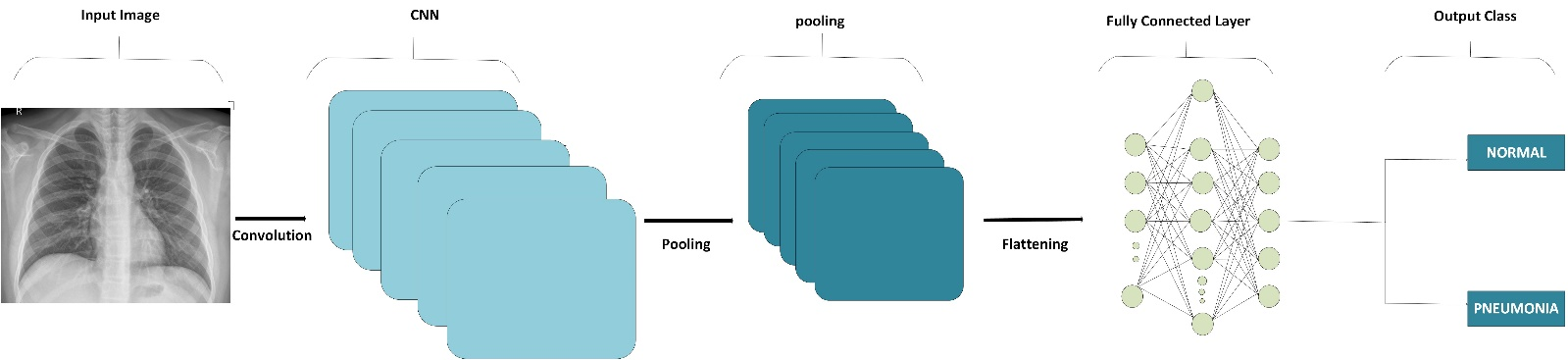
Keywords
Data Availability Statement
Funding
Conflicts of Interest
Ethical Approval and Consent to Participate
References
- Adadi, A., & Berrada, M. (2018). Peeking inside the black-box: a survey on explainable artificial intelligence (XAI). IEEE access, 6, 52138-52160.
[CrossRef] [Google Scholar] - Adithyan, N., Chowdhury, R. R., Padmavathy, L., Peter, R. M., & Anantharaman, V. V. (2024). Perception of the Adoption of Artificial Intelligence in Healthcare Practices Among Healthcare Professionals in a Tertiary Care Hospital: A Cross-Sectional Study. Cureus, 16(9), e69910.
[CrossRef] [Google Scholar] - Amann, J., Blasimme, A., Vayena, E., Frey, D., Madai, V. I., & Precise4Q Consortium. (2020). Explainability for artificial intelligence in healthcare: a multidisciplinary perspective. BMC medical informatics and decision making, 20(1), 310.
[CrossRef] [Google Scholar] - Obermeyer, Z., Powers, B., Vogeli, C., & Mullainathan, S. (2019). Dissecting racial bias in an algorithm used to manage the health of populations. Science, 366(6464), 447-453.
[CrossRef] [Google Scholar] - Lyu, H., Sha, N., Qin, S., Yan, M., Xie, Y., & Wang, R. (2019). Advances in neural information processing systems. Advances in neural information processing systems, 32.
[Google Scholar] - Beets, B., Newman, T. P., Howell, E. L., Bao, L., & Yang, S. (2023). Surveying public perceptions of artificial intelligence in health care in the United States: systematic review. Journal of Medical Internet Research, 25, e40337.
[CrossRef] [Google Scholar] - Goyal, S., & Singh, R. (2023). Detection and classification of lung diseases for pneumonia and Covid-19 using machine and deep learning techniques. Journal of Ambient Intelligence and Humanized Computing, 14(4), 3239-3259.
[CrossRef] [Google Scholar] - Taddeo, M., & Floridi, L. (2018). How AI can be a force for good. Science, 361(6404), 751-752.
[CrossRef] [Google Scholar] - Laï, M. C., Brian, M., & Mamzer, M. F. (2020). Perceptions of artificial intelligence in healthcare: findings from a qualitative survey study among actors in France. Journal of translational medicine, 18, 1-13.
[CrossRef] [Google Scholar] - Chen, I. Y., Joshi, S., & Ghassemi, M. (2020). Treating health disparities with artificial intelligence. Nature medicine, 26(1), 16-17.
[CrossRef] [Google Scholar] - Chen, I. Y., Johansson, F. D., & Sontag, D. (2018, December). Why is my classifier discriminatory?. In Proceedings of the 32nd International Conference on Neural Information Processing Systems (pp. 3543-3554).
[CrossRef] [Google Scholar] - Creswell, J. W., & Creswell, J. D. (2017). Research design: Qualitative, quantitative, and mixed methods approaches. Sage publications.
[Google Scholar] - Davenport, T., & Kalakota, R. (2019). The potential for artificial intelligence in healthcare. Future healthcare journal, 6(2), 94-98.
[CrossRef] [Google Scholar] - Jiang, F., Jiang, Y., Zhi, H., Dong, Y., Li, H., Ma, S., ... & Wang, Y. (2017). Artificial intelligence in healthcare: past, present and future. Stroke and vascular neurology, 2(4).
[CrossRef] [Google Scholar] - NHS England. (2023). Algorithmic transparency standard for health and care. UK Government. Retrieved from https://transform.england.nhs.uk/ai-lab/ai-lab-programmes/algorithmic-transparency/
[Google Scholar] - Topol, E. (2019). Deep medicine: how artificial intelligence can make healthcare human again. Hachette UK.
[Google Scholar] - Dhagarra, D., Goswami, M., & Kumar, G. (2020). Impact of trust and privacy concerns on technology acceptance in healthcare: an Indian perspective. International journal of medical informatics, 141, 104164.
[CrossRef] [Google Scholar] - Floridi, L., Cowls, J., Beltrametti, M., Chatila, R., Chazerand, P., Dignum, V., ... & Vayena, E. (2018). AI4People—an ethical framework for a good AI society: opportunities, risks, principles, and recommendations. Minds and machines, 28, 689-707.
[CrossRef] [Google Scholar] - Gerke, S., Minssen, T., & Cohen, G. (2020). Ethical and legal challenges of artificial intelligence-driven healthcare. In Artificial intelligence in healthcare (pp. 295-336). Academic Press.
[CrossRef] [Google Scholar] - Hassan, M., Kushniruk, A., & Borycki, E. (2024). Barriers to and facilitators of artificial intelligence adoption in health care: scoping review. JMIR Human Factors, 11, e48633.
[CrossRef] [Google Scholar] - McMahan, B., Moore, E., Ramage, D., Hampson, S., & y Arcas, B. A. (2017, April). Communication-efficient learning of deep networks from decentralized data. In Artificial intelligence and statistics (pp. 1273-1282). PMLR.
[Google Scholar] - Mittelstadt, B. D., Allo, P., Taddeo, M., Wachter, S., & Floridi, L. (2016). The ethics of algorithms: Mapping the debate. Big Data & Society, 3(2), 2053951716679679.
[CrossRef] [Google Scholar]
Cite This Article
TY  - JOUR
AU  - Fatima, Itrat
AU  - Mahum, Rabbia
PY  - 2025
DA  - 2025/08/27
TI  - Lungs Disease Detection Using Deep Learing
JO  - ICCK Journal of Image Analysis and Processing
T2  - ICCK Journal of Image Analysis and Processing
JF  - ICCK Journal of Image Analysis and Processing
VL  - 1
IS  - 3
SP  - 96
EP  - 106
DO  - 10.62762/JIAP.2025.406591
UR  - https://www.icck.org/article/abs/JIAP.2025.406591
KW  - convolutional neural network
KW  - coronavirus disease of 2019
KW  - pneumonia
KW  - tuberculosis
KW  - medical imaging
AB  - Lung diseases such as COVID-19, pneumonia, and tuberculosis remain major public health challenges worldwide, emphasizing the urgent demand for accurate and efficient diagnostic methods. This research explores the use of a Convolutional Neural Network (CNN)-based framework for binary classification of chest X-ray images to detect abnormalities. The methodology incorporates preprocessing techniques such as image resizing, normalization, data augmentation, and grayscale transformation to improve input data quality. CNN architecture comprising convolutional, pooling, fully connected, and dropout layers were trained and evaluated on publicly available datasets. The model attained a test accuracy of 92%; nevertheless, performance metrics revealed a disparity between the two classified categories. Class 0 (Normal) had precision (83%) and recall (90%), resulting in an F1-score of 0.80, whereas Class 1 (Abnormal) demonstrated higher precision (88%) and recall (90%) with an F1-score of 0.88. This highlights the need for further optimization to enhance the detection of normal cases. The findings underscore the potential of CNNs in automating lung disease detection but also reveal areas for improvement in model robustness and class balance.
SN  - 3068-6679
PB  - Institute of Central Computation and Knowledge
LA  - English
ER  -
@article{Fatima2025Lungs,
  author = {Itrat Fatima and Rabbia Mahum},
  title = {Lungs Disease Detection Using Deep Learing},
  journal = {ICCK Journal of Image Analysis and Processing},
  year = {2025},
  volume = {1},
  number = {3},
  pages = {96-106},
  doi = {10.62762/JIAP.2025.406591},
  url = {https://www.icck.org/article/abs/JIAP.2025.406591},
  abstract = {Lung diseases such as COVID-19, pneumonia, and tuberculosis remain major public health challenges worldwide, emphasizing the urgent demand for accurate and efficient diagnostic methods. This research explores the use of a Convolutional Neural Network (CNN)-based framework for binary classification of chest X-ray images to detect abnormalities. The methodology incorporates preprocessing techniques such as image resizing, normalization, data augmentation, and grayscale transformation to improve input data quality. CNN architecture comprising convolutional, pooling, fully connected, and dropout layers were trained and evaluated on publicly available datasets. The model attained a test accuracy of 92\%; nevertheless, performance metrics revealed a disparity between the two classified categories. Class 0 (Normal) had precision (83\%) and recall (90\%), resulting in an F1-score of 0.80, whereas Class 1 (Abnormal) demonstrated higher precision (88\%) and recall (90\%) with an F1-score of 0.88. This highlights the need for further optimization to enhance the detection of normal cases. The findings underscore the potential of CNNs in automating lung disease detection but also reveal areas for improvement in model robustness and class balance.},
  keywords = {convolutional neural network, coronavirus disease of 2019, pneumonia, tuberculosis, medical imaging},
  issn = {3068-6679},
  publisher = {Institute of Central Computation and Knowledge}
}
Article Metrics
Publisher's Note
ICCK stays neutral with regard to jurisdictional claims in published maps and institutional affiliations.
Rights and Permissions
 Copyright © 2025 by the Author(s). Published by Institute of Central Computation and Knowledge. This article is an open access article distributed under the terms and conditions of the Creative Commons Attribution (CC BY) license (https://creativecommons.org/licenses/by/4.0/), which permits use, sharing, adaptation, distribution and reproduction in any medium or format, as long as you give appropriate credit to the original author(s) and the source, provide a link to the Creative Commons licence, and indicate if changes were made.


Portico
