Leveraging Machine Learning and Deep Learning for Advanced Malaria Detection Through Blood Cell Images









Article Information
Abstract
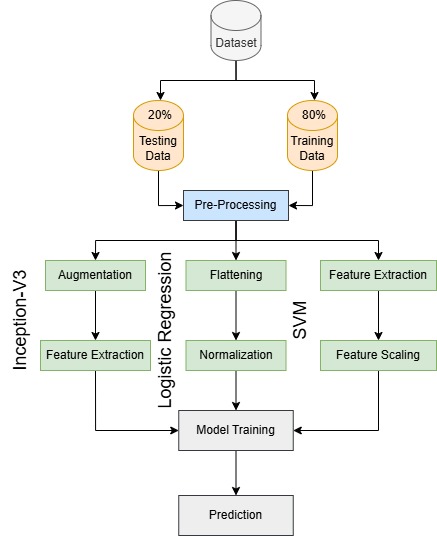
Malaria remains a significant global health challenge, causing hundreds of thousands of deaths annually, particularly in tropical and subtropical regions. This study proposes an advanced automated approach for malaria detection by classifying red blood cell images using machine learning and deep learning techniques. Three distinct models: Logistic Regression (LR), Support Vector Machine (SVM), and Inception-V3 were implemented and rigorously evaluated on a dataset comprising 27,558 cell images. The LR model achieved an accuracy of 65.38%, while SVM demonstrated improved classification performance with an accuracy of 84%. The deep learning-based Inception-V3 model outperformed both, achieving a classification accuracy of 94.52% after five training epochs, demonstrating its superior capability to extract intricate features from medical images. These results highlight the effectiveness of deep learning architectures in malaria diagnosis and pave the way for scalable, automated solutions, particularly in resource-limited settings.
Graphical Abstract
Keywords
Data Availability Statement
Funding
Conflicts of Interest
Ethical Approval and Consent to Participate
References
- Skorokhod, O., Vostokova, E., & Gilardi, G. (2024). The role of P450 enzymes in malaria and other vector-borne infectious diseases. BioFactors, 50(1), 16-32.
[CrossRef] [Google Scholar] - Burke, D. (2021). Health Line Malaria: Causes, Symptoms, and Diagnosis. Healthline. Retrieved from https://www.healthline.com/health/malaria (Accessed: 2024-12-13)
[Google Scholar] - Baptista, V., Costa, M., Calcada, C., Silva, M., Gil, J., Veiga, M., & Catarino, S. (2021). The future in sensing technologies for malaria surveillance: A review of hemozoin-based diagnosis. ACS Sensors, 6(10), 3898-3911.
[CrossRef] [Google Scholar] - World Health Organization. (2021). Malaria. World Health Organization. Retrieved from https://www.who.int/news-room/fact-sheets/detail/malaria (Accessed: 2024-12-16)
[Google Scholar] - Ross, N., Pritchard, C., Rubin, D., & Duse, A. (2006). Automated image processing method for the diagnosis and classification of malaria on thin blood smears. Medical and Biological Engineering and Computing, 44(5), 427-436.
[CrossRef] [Google Scholar] - Moxon, C., Grau, G., & Craig, A. (2011). Malaria: modification of the red blood cell and consequences in the human host. British Journal of Haematology, 154(6), 670-679.
[CrossRef] [Google Scholar] - Poostchi, M., Ersoy, I., Bansal, A., Palaniappan, K., Antani, S., Jaeger, S., & Thoma, G. (2015). Image analysis of blood slides for automatic malaria diagnosis. Proceedings of HI-POCT, 15.
[Google Scholar] - Sawant, S., & Singh, A. (2024). Malaria Cell Detection Using Deep Neural Networks. ArXiv Preprint ArXiv:2406.20005. https://arxiv.org/abs/2406.20005
[Google Scholar] - Dev, A., Fouda, M. M., Kerby, L., & Fadlullah, Z. M. (2024). Advancing Malaria Identification from Microscopic Blood Smears Using Hybrid Deep Learning Frameworks. IEEE Access.
[CrossRef] [Google Scholar] - Mujahid, M., Rustam, F., Shafique, R., Montero, E. C., Alvarado, E. S., de la Torre Diez, I., & Ashraf, I. (2024). Efficient deep learning-based approach for malaria detection using red blood cell smears. Scientific Reports, 14(1), 13249.
[CrossRef] [Google Scholar] - Minarno, A., Aripa, L., Azhar, Y., & Munarko, Y. (2023). Classification of malaria cell image using inception-v3 architecture. JOIV: International Journal on Informatics Visualization, 7(2), 273-278. https://dx.doi.org/10.30630/joiv.7.2.1301
[Google Scholar] - Hoque, M., Islam, M., Khaliluzzaman, M., Al Muntasir, A., & Mohsin, M. (2024). Revolutionizing malaria diagnosis: deep learning-powered detection of parasite-infected red blood cells. International Journal of Electrical and Computer Engineering (IJECE), 14(4), 4518-4530.
[CrossRef] [Google Scholar] - Muhammad, S., Iqbal, M., Majeed, S., Saleem, Y., & Tariq, A. (2024). Malaria Cell Classification through Exercising Deep Learning Algorithms. Journal of Computing & Biomedical Informatics, 7, 53-61.
[Google Scholar] - Delgado-Ortet, M., Molina, A., Alférez, S., Rodellar, J., & Merino, A. (2020). A deep learning approach for segmentation of red blood cell images and malaria detection. Entropy, 22(6), 657.
[CrossRef] [Google Scholar] - Kakkar, B., Goyal, M., Johri, P., & Kumar, Y. (2023). Artificial intelligence-based approaches for detection and classification of different classes of malaria parasites using microscopic images: a systematic review. Archives of Computational Methods in Engineering, 30(7), 4781-4800.
[CrossRef] [Google Scholar] - Irmak, E. (2021). A Novel Implementation of Deep-Learning Approach on Malaria Parasite Detection from Thin Blood Cell Images. Electrica, 21(2).
[CrossRef] [Google Scholar] - Maqsood, A., Farid, M., Khan, M., & Grzegorzek, M. (2021). Deep malaria parasite detection in thin blood smear microscopic images. Applied Sciences, 11(5), 2284.
[CrossRef] [Google Scholar] - Hemachandran, K., Alasiry, A., Marzougui, M., Ganie, S., Pise, A., Alouane, M., & Chola, C. (2023). Performance analysis of deep learning algorithms in diagnosis of malaria disease. Diagnostics, 13(3), 534.
[CrossRef] [Google Scholar] - Pinkaew, A., Limpiti, T., & Trirat, A. (2015). Automated classification of malaria parasite species on thick blood film using support vector machine. 2015 8th Biomedical Engineering International Conference (BMEiCON), 1-5.
[CrossRef] [Google Scholar] - Widodo, S., & Others. (2014). Texture analysis to detect malaria tropica in blood smears image using support vector machine. International Journal of Innovative Research in Advanced Engineering, 1(12), 301-306.
[Google Scholar] - NIH National Institute of Health Sciences. (2024). Malaria Datasets. Retrieved from https://ceb.nlm.nih.gov/repositories/malaria-datasets/ (Accessed: 2024-12-18)
[Google Scholar] - Kaggle. (2024). Cell Images for Detecting Malaria. Retrieved from https://www.kaggle.com/datasets/iarunava/cell-images-for-detecting-malaria (Accessed: 2024-12-09)
[Google Scholar] - GeeksforGeeks. (n.d.). Data Preprocessing in Machine Learning. Retrieved from https://www.geeksforgeeks.org/data-preprocessing-machine-learning/
[Google Scholar] - Scikit-Learn Developers. (2021). Scikit-Learn: Machine Learning in Python. Retrieved from https://scikit-learn.org/stable/ (Version 0.24)
[Google Scholar] - Hastie, T., Tibshirani, R., & Friedman, J. (2009). The Elements of Statistical Learning. Springer.
[CrossRef] [Google Scholar] - Cortes, C., & Vapnik, V. (1995). Support-vector networks. Machine Learning, 20(3), 273-297.
[CrossRef] [Google Scholar] - Scholkopf, B., & Smola, A. (2001). Learning with Kernels: Support Vector Machines, Regularization, Optimization, and Beyond. MIT Press.
[Google Scholar] - Dalal, N., & Triggs, B. (2005). Histograms of Oriented Gradients for Human Detection. Proceedings of the IEEE Conference on Computer Vision and Pattern Recognition (CVPR), 886-893.
[CrossRef] [Google Scholar] - Litjens, G., Kooi, T., Bejnordi, B., Setio, A., Ciompi, F., Ghafoorian, M., & Laak, J. (2017). A survey on deep learning in medical image analysis. Medical Image Analysis, 42, 60-88.
[CrossRef] [Google Scholar] - Rajaraman, S., Antani, S., Poostchi, M., Silamut, K., Hossain, M., Maude, R., & Thoma, G. (2018). Pre-trained convolutional neural networks as feature extractors toward improved malaria parasite detection in thin blood smear images. PeerJ, 6, e4568.
[CrossRef] [Google Scholar] - Szegedy, C., Vanhoucke, V., Ioffe, S., Shlens, J., & Wojna, Z. (2016). Rethinking the Inception Architecture for Computer Vision. Proceedings of the IEEE Conference on Computer Vision and Pattern Recognition (CVPR), 2818-2826.
[CrossRef] [Google Scholar] - Kingma, D., & Ba, J. (2014). Adam: A Method for Stochastic Optimization. ArXiv Preprint ArXiv:1412.6980. https://arxiv.org/abs/1412.6980
[Google Scholar] - Tieleman, T., & Hinton, G. (2012). Lecture 6.5—RMSProp: Divide the Gradient by a Running Average of Its Recent Magnitude. Coursera: Neural Networks for Machine Learning.
[Google Scholar] - Li, W. (2021). Evaluation of left ventricular diastolic function of patients with coronary heart disease by ultrasound images on bilateral filtering image noise reduction algorithm combined with electrocardiogram. Pakistan Journal of Medical Sciences, 37(6), 1699.
[Google Scholar] - Masud, M., Alhumyani, H., Alshamrani, S. S., Cheikhrouhou, O., Ibrahim, S., Muhammad, G., ... & Shorfuzzaman, M. (2020). Leveraging deep learning techniques for malaria parasite detection using mobile application. Wireless Communications and Mobile Computing, 2020(1), 8895429.
[CrossRef] [Google Scholar]
Cited By (5)
-
Khushdeep Kaur, Adamya Chhabra, Harsh Anand, Husanpreet Kaur, Aditi Vasdev, Ayush Rawat. .
2026 International Conference on Computing Theory and Wireless Communications (ICCTWC), 2026 .
[CrossRef] -
Rahul Singh, Srinivas Aluvala, Sonali Gupta, Vartika Aarwal. .
2025 6th International Conference on IoT Based Control Networks and Intelligent Systems (ICICNIS), 2025 .
[CrossRef] -
Dhananjay Pratap Singh Chandel, Sandeep Kumar Sharma. .
2025 2nd Asian Conference on Intelligent Technologies (ACOIT), 2025 .
[CrossRef] -
Emre Bayraktar, Faruk Gökdeli, Emir Ahmet Şişman, Nur Banu Hancı, Oğuzhan Erdem, Nermin Şakru. .
2025 33rd Telecommunications Forum (TELFOR), 2025 .
[CrossRef] -
Sayed Sayem, Sayed Sumsul Islam Sanny, Hadiur Rahman Nabil. Hybrid CNN Model with CBAM for Malaria Disease Classification: Enhanced Feature Extraction.
Biomedical Materials & Devices, 2025 .
[CrossRef]
Cite This Article
TY  - JOUR
AU  - Hamza, Muhammad
AU  - Ali, Ibrar
AU  - Ali, Sikandar
AU  - Khan, Waqas
AU  - Shah, Sayed Mudassir
AU  - Haq, Ijaz Ul
PY  - 2025
DA  - 2025/02/16
TI  - Leveraging Machine Learning and Deep Learning for Advanced Malaria Detection Through Blood Cell Images
JO  - ICCK Journal of Image Analysis and Processing
T2  - ICCK Journal of Image Analysis and Processing
JF  - ICCK Journal of Image Analysis and Processing
VL  - 1
IS  - 1
SP  - 17
EP  - 26
DO  - 10.62762/JIAP.2025.514726
UR  - https://www.icck.org/article/abs/JIAP.2025.514726
KW  - logistic regression
KW  - support vector machine
KW  - Inception-V3
KW  - malaria
KW  - classification
AB  - Malaria remains a significant global health challenge, causing hundreds of thousands of deaths annually, particularly in tropical and subtropical regions. This study proposes an advanced automated approach for malaria detection by classifying red blood cell images using machine learning and deep learning techniques. Three distinct models: Logistic Regression (LR), Support Vector Machine (SVM), and Inception-V3 were implemented and rigorously evaluated on a dataset comprising 27,558 cell images. The LR model achieved an accuracy of 65.38%, while SVM demonstrated improved classification performance with an accuracy of 84%. The deep learning-based Inception-V3 model outperformed both, achieving a classification accuracy of 94.52% after five training epochs, demonstrating its superior capability to extract intricate features from medical images. These results highlight the effectiveness of deep learning architectures in malaria diagnosis and pave the way for scalable, automated solutions, particularly in resource-limited settings.
SN  - 3068-6679
PB  - Institute of Central Computation and Knowledge
LA  - English
ER  -
@article{Hamza2025Leveraging,
  author = {Muhammad Hamza and Ibrar Ali and Sikandar Ali and Waqas Khan and Sayed Mudassir Shah and Ijaz Ul Haq},
  title = {Leveraging Machine Learning and Deep Learning for Advanced Malaria Detection Through Blood Cell Images},
  journal = {ICCK Journal of Image Analysis and Processing},
  year = {2025},
  volume = {1},
  number = {1},
  pages = {17-26},
  doi = {10.62762/JIAP.2025.514726},
  url = {https://www.icck.org/article/abs/JIAP.2025.514726},
  abstract = {Malaria remains a significant global health challenge, causing hundreds of thousands of deaths annually, particularly in tropical and subtropical regions. This study proposes an advanced automated approach for malaria detection by classifying red blood cell images using machine learning and deep learning techniques. Three distinct models: Logistic Regression (LR), Support Vector Machine (SVM), and Inception-V3 were implemented and rigorously evaluated on a dataset comprising 27,558 cell images. The LR model achieved an accuracy of 65.38\%, while SVM demonstrated improved classification performance with an accuracy of 84\%. The deep learning-based Inception-V3 model outperformed both, achieving a classification accuracy of 94.52\% after five training epochs, demonstrating its superior capability to extract intricate features from medical images. These results highlight the effectiveness of deep learning architectures in malaria diagnosis and pave the way for scalable, automated solutions, particularly in resource-limited settings.},
  keywords = {logistic regression, support vector machine, Inception-V3, malaria, classification},
  issn = {3068-6679},
  publisher = {Institute of Central Computation and Knowledge}
}
Publisher's Note
ICCK stays neutral with regard to jurisdictional claims in published maps and institutional affiliations.
Rights and Permissions
 Copyright © 2025 by the Author(s). Published by Institute of Central Computation and Knowledge. This article is an open access article distributed under the terms and conditions of the Creative Commons Attribution (CC BY) license (https://creativecommons.org/licenses/by/4.0/), which permits use, sharing, adaptation, distribution and reproduction in any medium or format, as long as you give appropriate credit to the original author(s) and the source, provide a link to the Creative Commons licence, and indicate if changes were made.


Portico