Volume 2, Issue 4 (In Progress)


In Progress
Citations: Crossref logo 0,   0   |   Viewed: 1288, Download: 348

Table of Contents

Open Access | Research Article | 26 October 2026
How Much Does the Classifier Matter? A Cluster-Aware Comparison of Six Machine Learning Algorithms for Land Use Land Cover Mapping of Taipei, Taiwan, Using Google Earth Engine and Python
ICCK Journal of Image Analysis and Processing | Volume 2, Issue 4: 252-276, 2026 | DOI: 10.62762/JIAP.2026.490298
Abstract
Comparative studies of machine learning classifiers for Land Use Land Cover (LULC) mapping often recommend one algorithm, yet their validation pixels are usually drawn from a few hand-digitised polygons and are far from independent. This study tested whether such differences survive that dependence. Six classifiers, namely Classification and Regression Tree (CART), Random Forest, Extreme Gradient Boosting (XGBoost), Light Gradient Boosting Machine (LightGBM), a multilayer perceptron and a support vector machine (SVM) with a radial basis function kernel, were applied to four top-of-atmosphere bands of a 2020 annual Sentinel-2 median composite of Taipei City, Taiwan, at 10~m. All 110 reference... More >

Graphical Abstract
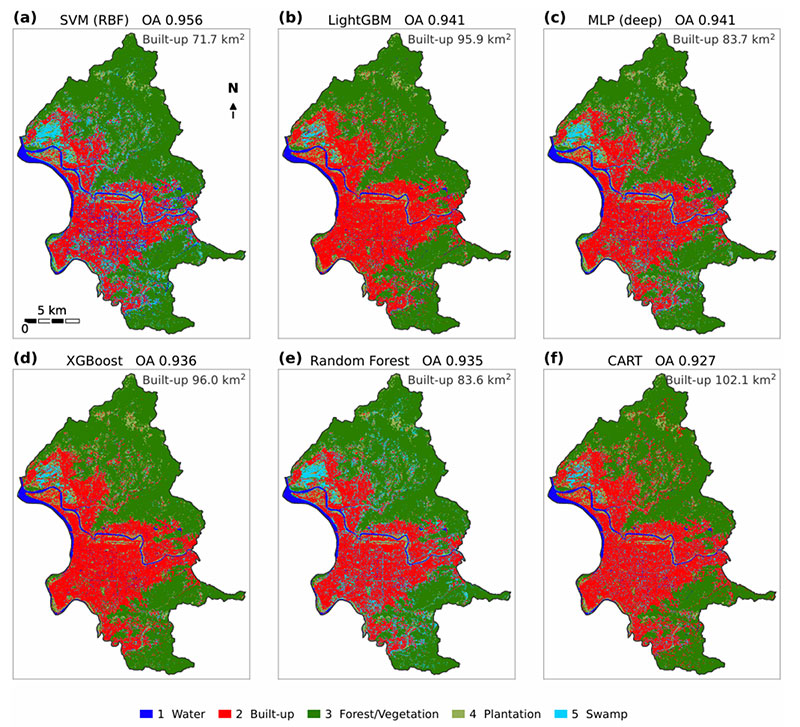
How Much Does the Classifier Matter? A Cluster-Aware Comparison of Six Machine Learning Algorithms for Land Use Land Cover Mapping of Taipei, Taiwan, Using Google Earth Engine and Python
Open Access | Review Article | 11 October 2026
Evaluation Metrics in Digital Image Processing: A Task-Oriented Review and Practical Selection Framework
ICCK Journal of Image Analysis and Processing | Volume 2, Issue 4: 231-251, 2026 | DOI: 10.62762/JIAP.2026.838036
Abstract
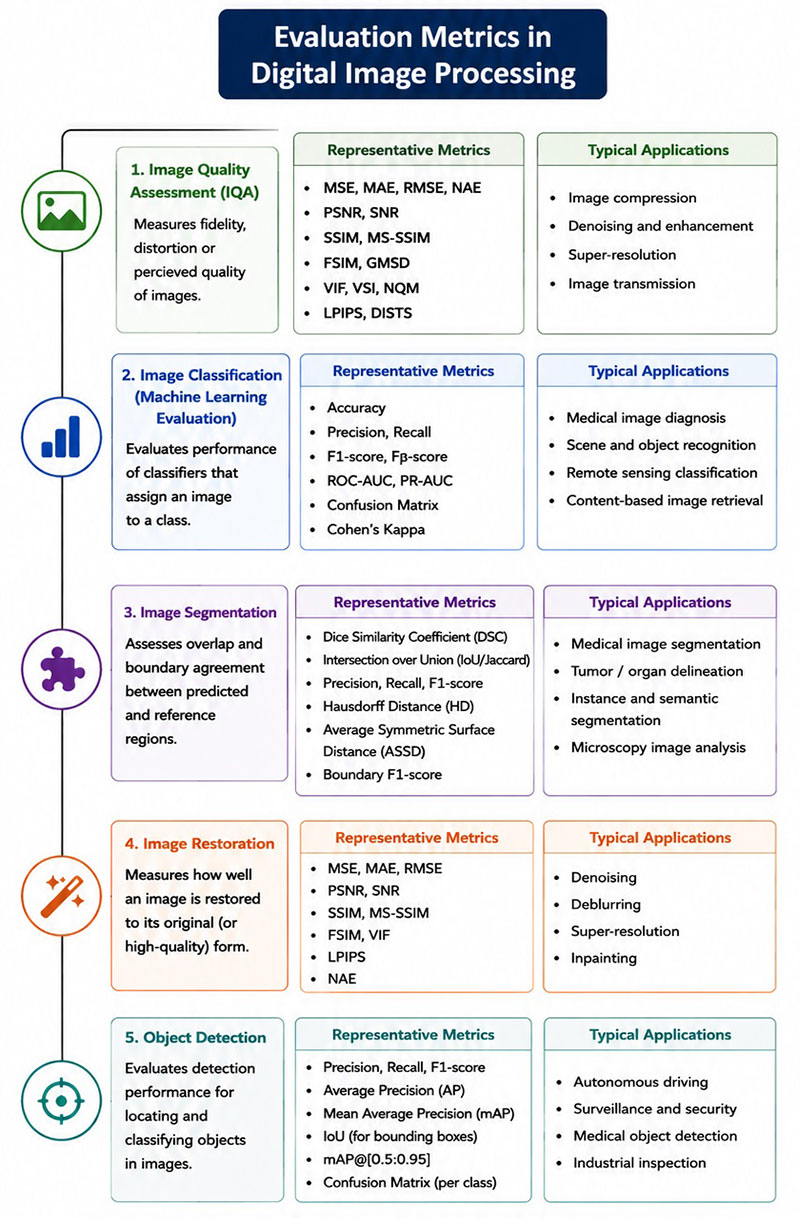
The rapid development of digital image processing and machine learning has increased the need for reliable and task-appropriate evaluation methods. However, the wide range of available metrics, each with different assumptions, strengths, and limitations, makes metric selection challenging across diverse image-processing tasks. This article presents a task-oriented review of commonly used evaluation metrics and proposes a practical framework for selecting appropriate metrics across five major categories: image quality assessment, image classification, image segmentation, image restoration, and object detection. Representative metrics are reviewed based on their mathematical basis, interpretat... More >

Graphical Abstract
Evaluation Metrics in Digital Image Processing: A Task-Oriented Review and Practical Selection Framework
Open Access | Research Article | 09 October 2026
Skin Cancer Detection Using Data Fusion and Deep Transfer Learning Techniques
ICCK Journal of Image Analysis and Processing | Volume 2, Issue 4: 218-230, 2026 | DOI: 10.62762/JIAP.2026.243543
Abstract
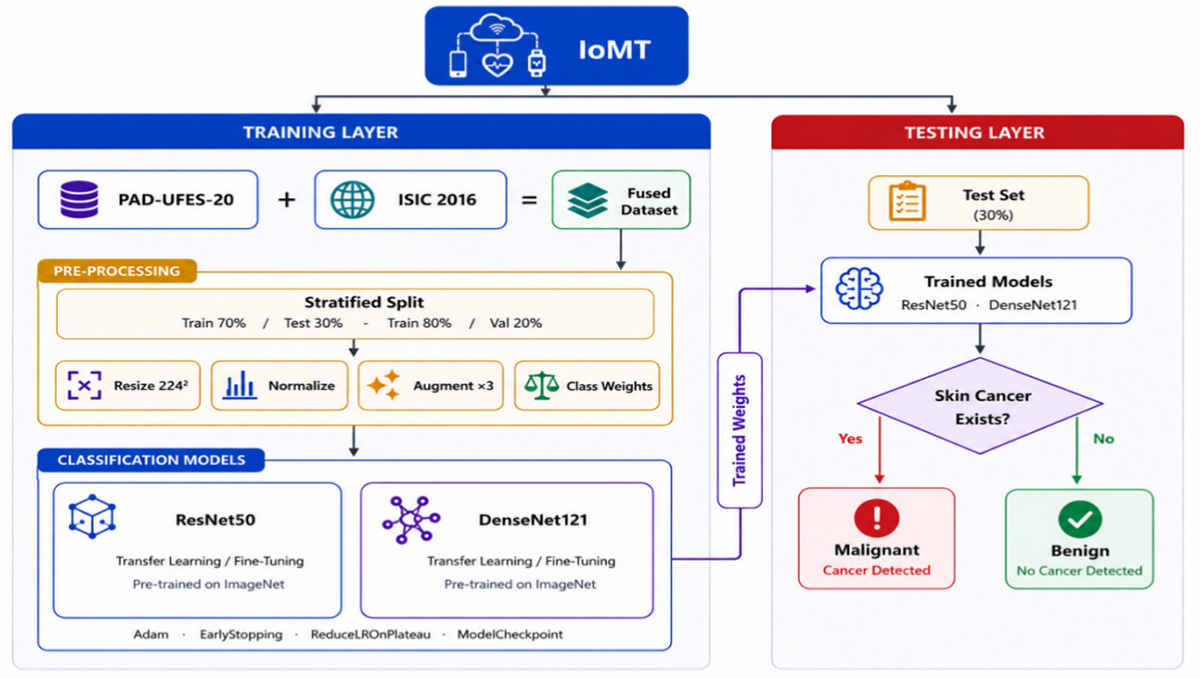
Skin cancer remains a major healthcare challenge. Early detection is important because it increases the chances of successful treatment. Deep learning has become an effective approach for automated skin lesion classification. However, many existing studies rely on a single dataset, which limits the diversity of training images and may reduce model generalization. This study proposes a transfer learning framework for binary skin cancer classification using dataset-level fusion. Two public datasets, PAD-UFES-20 and ISIC~2016, are combined to create a fused dataset that contains both clinical smartphone images and dermoscopic images. The images are resized to 224 × 224 pixels, converted to RGB... More >

Graphical Abstract
Skin Cancer Detection Using Data Fusion and Deep Transfer Learning Techniques
Open Access | Research Article | 10 September 2026
Knee Osteoarthritis Severity Detection Using Multimodal Data
ICCK Journal of Image Analysis and Processing | Volume 2, Issue 4: 206-217, 2026 | DOI: 10.62762/JIAP.2026.275643
Abstract
Osteoarthritis of the knee (KOA) is one of the main causes of disability; hence, it requires precise and early evaluation of the severity level of the disease. In this paper, we propose a multimodal deep learning architecture based on a self-supervised Swin transformer combined with a cross-modal attention mechanism (SWIN-MULTI-ATTEN) for combining radiological images and patients' information (age, sex, and BMI). This framework captures both structural and contextual information to achieve better classification accuracy. Experimental results on the Osteoarthritis Initiative (OAI) dataset show that the proposed model achieves an accuracy of 91.4% and a QWK of 0.903, which outperforms other C... More >

Graphical Abstract
Knee Osteoarthritis Severity Detection Using Multimodal Data