ICCK

Aamir Ali

Department of Computer Science, COMSATS University Islamabad, Sahiwal Campus, Sahiwal 57000, Pakistan

Section 01

Academic Profile

No academic profile information available at the moment.

Section 02

Editorial Roles

This user currently does not serve as an editor for any ICCK journals.

Section 03

ICCK Publications

Open Access | Research Article | 09 August 2026
Automated PCOS Disease Detection Using Clinical and Diagnostic Features
Biomedical Informatics and Smart Healthcare | Volume 2, Issue 3: 108-128, 2026 | DOI: 10.62762/BISH.2026.255887
Abstract
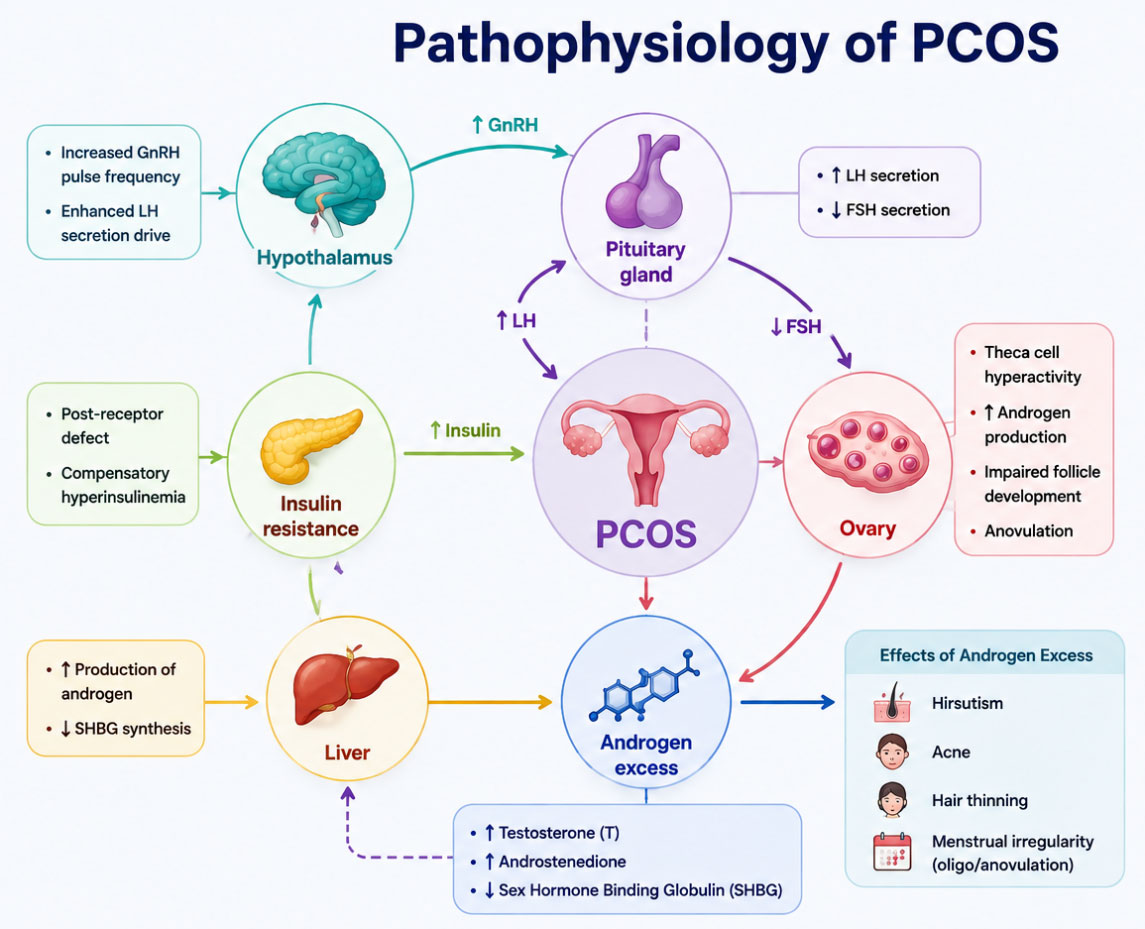
Polycystic Ovary Syndrome (PCOS) is a prevalent endocrine disorder affecting reproductive-age women, leading to infertility, hormonal imbalance, insulin resistance, and cardiovascular complications. Early diagnosis remains challenging due to heterogeneous manifestations, overlapping symptoms, and lack of automated screening tools. To address these issues, this study presents a comprehensive comparative framework for PCOS prediction using machine learning and deep learning on a public dataset of 541 patient records. The framework incorporates missing value imputation, feature standardization, SMOTE class balancing, and correlation-based feature selection. Five machine learning algorithms (Dec... More >

Graphical Abstract
Automated PCOS Disease Detection Using Clinical and Diagnostic Features
Open Access | Research Article | 28 April 2026
Passive Image Forgery Detection Using Multiscale Weber Local Descriptor and SVM Classification
ICCK Journal of Image Analysis and Processing | Volume 2, Issue 2: 69-91, 2026 | DOI: 10.62762/JIAP.2026.490874
Abstract
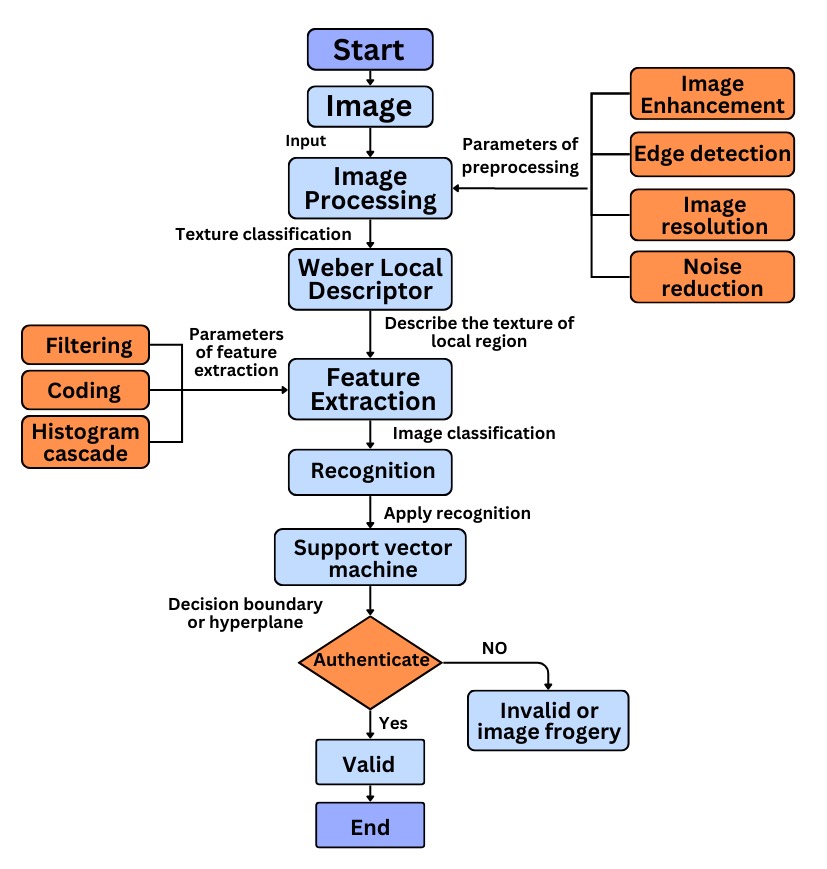
Digital image manipulation has become increasingly prevalent with the widespread availability of editing tools, raising concerns regarding image authenticity in critical applications. This study presents a passive image forgery detection framework based on multiscale Weber Local Descriptor features extracted from chrominance components and classified using a Support Vector Machine. The proposed method operates without embedded authentication information and focuses on detecting both copy-move and splicing forgeries through texture-based analysis. Experiments were conducted on two benchmark datasets, CASIA v2.0 and MICC F2000, using ten-fold cross-validation. On the CASIA v2.0 dataset, the fr... More >

Graphical Abstract
Passive Image Forgery Detection Using Multiscale Weber Local Descriptor and SVM Classification
Open Access | Research Article | 27 March 2026
Automated Brain Tumor Analysis from MRI Using Deep Learning
Biomedical Informatics and Smart Healthcare | Volume 2, Issue 1: 62-78, 2026 | DOI: 10.62762/BISH.2026.687557
Abstract
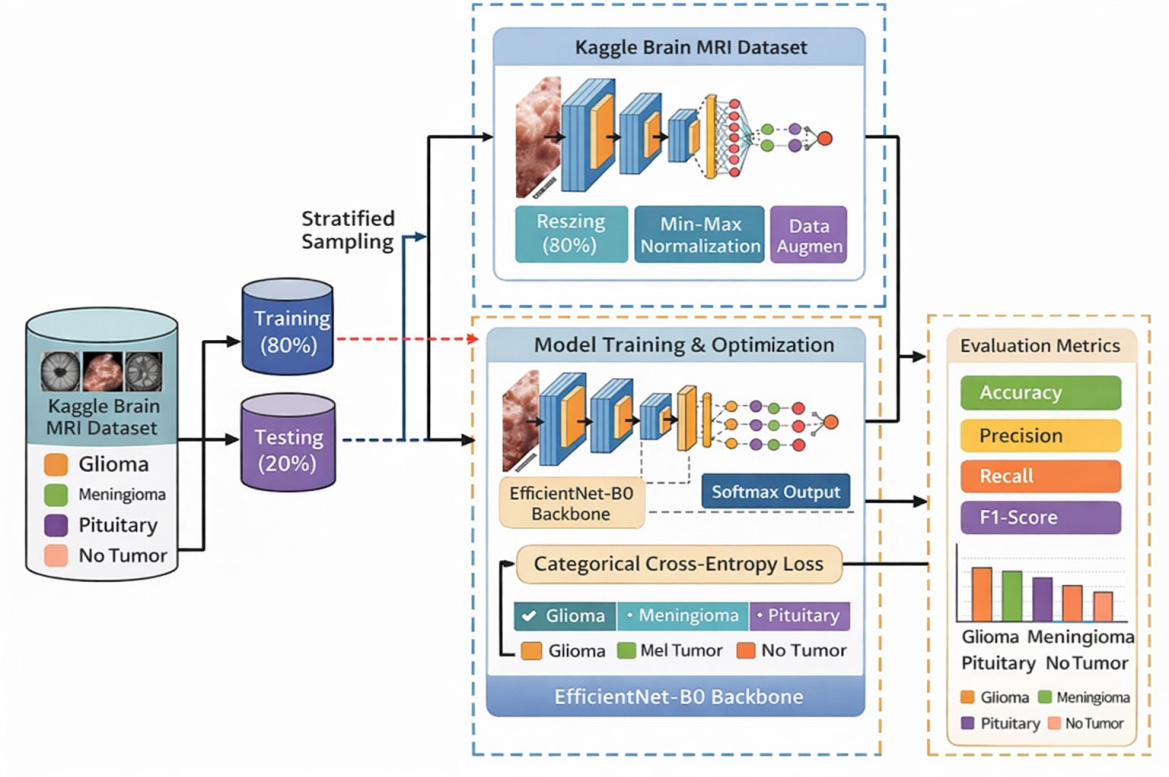
Accurate brain tumor classification from MRI remains essential for computer-assisted diagnosis, yet manual interpretation is time-consuming and variable. This study presents an EfficientNet-B0-based convolutional neural network for multi-class classification of glioma, meningioma, pituitary tumors, and no-tumor cases. The model was trained and evaluated on a public MRI dataset of 7023 images using a strict patient-level split to ensure unbiased assessment. A fixed EfficientNet-B0 backbone with a lightweight classification head reduces overfitting while maintaining stable learning. Performance was assessed via accuracy, precision, recall, F1-score, and specificity. The model achieved class-wi... More >

Graphical Abstract
Automated Brain Tumor Analysis from MRI Using Deep Learning
Open Access | Research Article | 12 March 2026 | Cited: Crossref logo  1
Bridging Predictive Modeling and Clinical Interpretability: An Explainable AI Approach to Parkinson’s Disease Detection
Biomedical Informatics and Smart Healthcare | Volume 2, Issue 1: 20-37, 2026 | DOI: 10.62762/BISH.2026.470997
Abstract
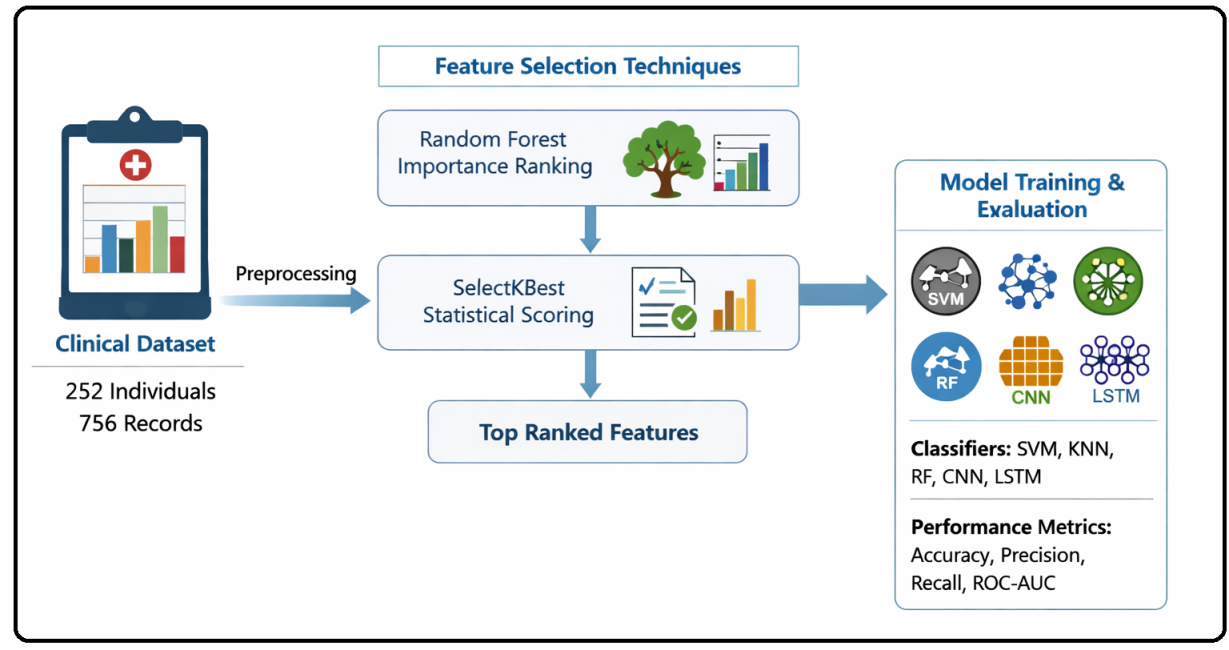
Parkinson’s disease (PD) is the second most common neurodegenerative disorder worldwide, predominantly affecting older adults. Early detection is crucial, as subtle motor and non-motor symptoms frequently overlap with other conditions, often resulting in delayed diagnosis. Many existing models rely on costly and less accessible imaging modalities such as MRI or PET scans, limiting their applicability in resource-constrained settings where only routine clinical data are available. This study develops interpretable AI models for early PD detection using structured clinical variables, incorporating feature selection techniques. Feature selection was conducted via Random Forest (RF) importance... More >

Graphical Abstract
Bridging Predictive Modeling and Clinical Interpretability: An Explainable AI Approach to Parkinson’s Disease Detection
Open Access | Research Article | 30 January 2026 | Cited: Crossref logo  1 , Scopus 1
Fused-CNN-LSTM: A Software-Oriented Multimodal Deep Learning Framework for Intelligent Hypertension Risk Prediction
ICCK Journal of Software Engineering | Volume 2, Issue 1: 11-29, 2026 | DOI: 10.62762/JSE.2025.995217
Abstract
Hypertension, a life-threatening global health challenge, requires early detection to prevent severe cardiovascular complications. Fundus imaging reveals microvascular alterations, yet conventional diagnosis often misses subtle early changes. This study introduces a multimodal deep learning framework that integrates clinical data, fundus images, and demographic features to improve hypertension prediction. Unlike single-modality approaches, our method captures complementary risk factors from both structured and unstructured data. We evaluate machine learning and deep learning models on clinical data, confirming DL's superior accuracy. For fundus images alone, a CNN achieves 74.44% accuracy, h... More >

Graphical Abstract
Fused-CNN-LSTM: A Software-Oriented Multimodal Deep Learning Framework for Intelligent Hypertension Risk Prediction
  • 1
  • 2